Understanding H-1B Sponsorship for OB GYN Residency as an IMG
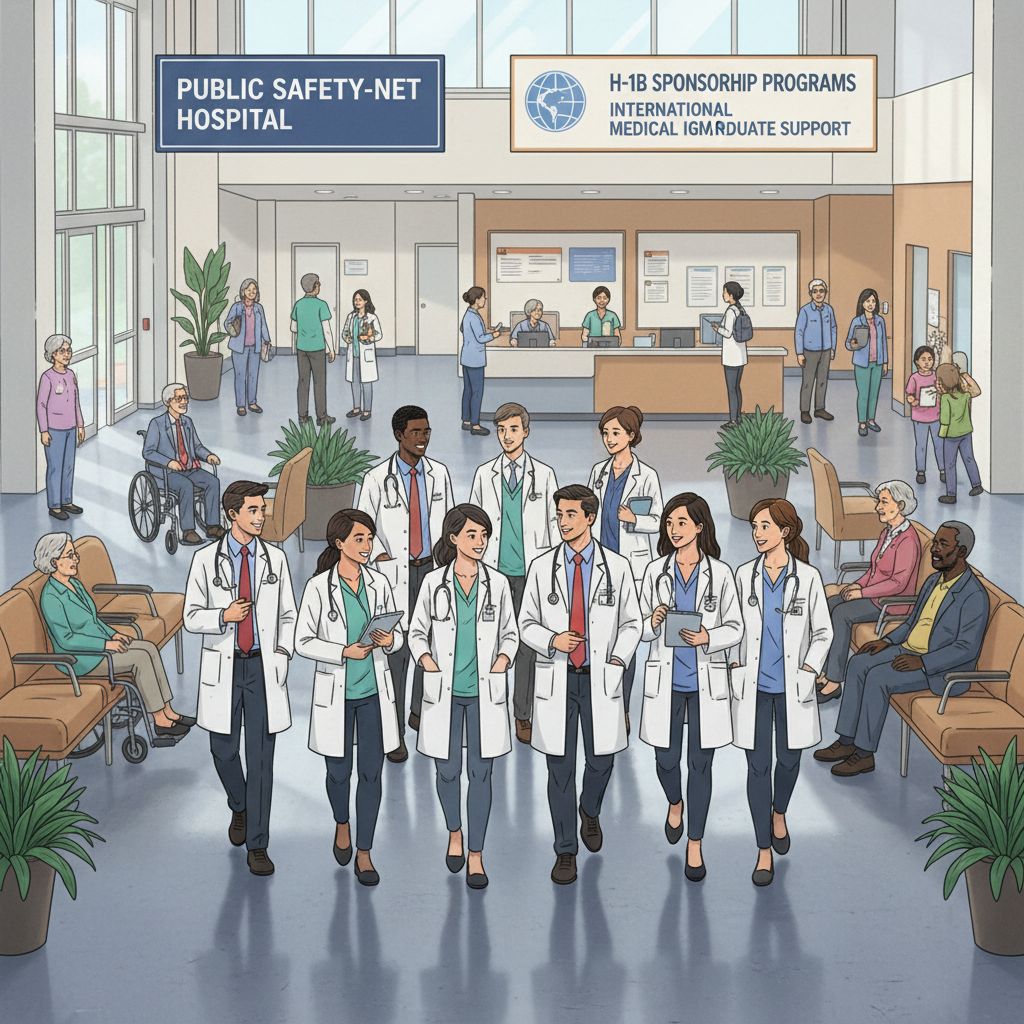
For an international medical graduate interested in OB GYN residency in the United States, understanding H-1B sponsorship is essential. While many programs default to J-1 visas, a strategic focus on H-1B–friendly programs can open doors to long-term U.S. practice without the J-1 home-return requirement.
This IMG residency guide will walk you through how H-1B residency programs work in Obstetrics & Gynecology, how to recognize programs that truly sponsor H-1B visas, and how to position yourself competitively for the obstetrics match as an IMG.
Key Concepts and Definitions
Before diving into strategy, clarify a few core terms:
- H-1B visa: A non‑immigrant visa for “specialty occupations” that allows U.S. employers (e.g., hospitals, universities) to hire foreign professionals. For residents, it is tied to the residency/fellowship position.
- H-1B cap: The annual numerical limit on new H-1B petitions in the private sector (generally 65,000 + 20,000 U.S. master’s cap).
- H-1B cap exempt: Certain employers (universities, non‑profit hospital systems affiliated with universities, research institutions) can sponsor H-1Bs at any time of year without being limited by the cap.
- Cap-exempt teaching hospitals: Many academic OB GYN residency programs fall into this category, which makes H-1B sponsorship logistically easier.
- IMG: International medical graduate, including U.S. citizens and permanent residents who studied abroad, and non‑U.S. citizens trained abroad.
Unlike J‑1 visas (sponsored by ECFMG with a standard structure), H‑1B sponsorship depends entirely on each institution’s immigration policies and their willingness to assume the cost and complexity. That’s why identifying the right H‑1B sponsor list and targeting H-1B friendly OB GYN residency programs is a critical step.
H-1B vs J-1 for OB GYN IMGs: Pros, Cons, and Strategic Implications
Most OB GYN residency programs default to the J‑1 route, but a significant minority will support H‑1B applications. You must understand both to decide what to prioritize.
Advantages of H-1B for OB GYN IMGs
No two-year home residency requirement
J‑1 physicians usually incur a “212(e)” two‑year home-country physical presence requirement after training, unless they obtain a waiver. H‑1B physicians do not have this default obligation.
- If your long‑term goal is to stay in the U.S. without a waiver program commitment, H‑1B can be highly advantageous.
- If your home country has limited opportunities in OB GYN or complicated political/economic conditions, avoiding the return requirement can be critical.
Direct path to permanent residency (green card)
Under H‑1B status, it is legally easier (and more common) for you to begin the employment-based permanent residency process during residency or fellowship:
- Many academic centers may sponsor a green card once you transition to a faculty role.
- Private practices can sponsor green cards after residency or fellowship.
Spouse employment benefits
- J‑2 spouses can apply for work authorization, which is a strong J‑1 advantage.
- H‑4 spouses typically cannot work unless you reach a specific stage in a green card process. However, for those whose primary focus is remaining in the U.S. clinically after training, the direct green card path via H‑1B is often more decisive.
Flexibility for future fellowships or jobs
You can continue in H‑1B status for:
- Another residency or fellowship (e.g., MFM, Gyn Onc, REI, FPMRS)
- Academic or private practice positions
As long as you maintain cap‑exempt employment, you may remain H‑1B cap exempt. Later transitions to private practice often use “concurrent employment” or “portability” strategies aided by immigration attorneys.
Disadvantages and Challenges of H-1B for IMGs
USMLE Step 3 requirement
Almost all OB GYN programs that sponsor H‑1B visas require USMLE Step 3 to be passed before the H‑1B petition is filed. In practice, this often means:
- You must pass Step 3 before ranking programs or at least before March of Match year.
- Taking Step 3 as an IMG outside the U.S. can be logistically challenging due to limited test centers.
Higher cost and administrative burden for programs
H‑1B petitions involve:
- Legal fees (often several thousand dollars)
- USCIS filing fees
- Ongoing compliance and paperwork
Some departments or GME offices are reluctant to take this on, particularly in smaller community OB GYN programs with limited resources.
Limited duration
- Total H‑1B stay is usually capped at 6 years (with some exceptions related to green card processing).
- OB GYN residency is 4 years; fellowship training adds 1–3 years, which can get close to the limit. Advance planning is crucial.
Not all programs are honest or clear online
Some programs may:
- Claim to sponsor “all visa types,” but avoid H‑1B when application time comes.
- Sponsor H‑1B only for fellowship or only after a “trial” J‑1 period.
- Change their policies year‑to‑year based on funding and institutional decisions.
This makes direct confirmation and current-year verification essential.
Where to Find OB GYN H-1B Sponsorship Programs (and How to Verify Them)
There is no single official, always‑accurate H‑1B sponsor list for OB GYN residencies. Instead, use a combination of tools and strategies.
1. Use Official Databases and Program Websites
FREIDA (AMA Residency & Fellowship Database)
- Filter by Specialty: Obstetrics & Gynecology.
- Review each program’s Visa Policy section:
- Look for “H‑1B” or “J‑1 and H‑1B considered”.
- Be cautious with vague language (“We sponsor visas”) and always verify directly.
Program Websites
Under “Eligibility,” “International Medical Graduate,” or “GME Policies” pages, look for:
- Explicit statements such as:
- “We sponsor both J‑1 (ECFMG) and H‑1B visas.”
- “H‑1B sponsorship is considered for exceptional candidates who have passed USMLE Step 3.”
- Notes about:
- Minimum Step scores
- USMLE Step 3 deadlines
- ECFMG certification requirements
2. Focus on H-1B Cap Exempt Academic Centers
Most OB GYN H-1B residency programs are university-affiliated, cap-exempt institutions:
- University hospitals
- Non-profit medical centers closely affiliated with a university
- Major academic centers with large GME offices and subspecialty fellowships
Why these are ideal:
- They are H-1B cap exempt: no worries about the national H‑1B lottery.
- They sponsor H‑1B for residents, fellows, and often faculty.
- They frequently have established immigration attorneys and standard policies.
Examples of H‑1B–friendly settings (illustrative, not exhaustive or guaranteed):
- University‑based OB GYN residencies associated with major schools of medicine.
- Large academic consortia or teaching hospitals that openly list H‑1B sponsorship on their GME pages.
Use these as starting points, but always verify current policy by contacting:
- Program Coordinator
- Program Director (PD)
- GME Office or International Office
3. Analyze Historical H-1B Filings (Optional but Powerful)
USCIS and the U.S. Department of Labor publish data on H‑1B filings. If you search publicly available databases or FOIA‑based H‑1B lists:
- Look for hospital or university names + “Obstetrics & Gynecology” or “Resident Physician.”
- Identify institutions that have filed H‑1Bs for GME positions in the past.
This can help you build your own “H-1B sponsor list” of hospitals that have a track record of sponsoring physicians. Note that:
- Past sponsorship does not guarantee current sponsorship.
- However, programs that never appear in H‑1B filings are less likely to be H-1B friendly.
4. Ask Direct, Specific Questions
Once you identify potential OB GYN programs, write concise, professional emails to clarify H‑1B policies.
Key questions to ask:
- “Do you currently sponsor H‑1B visas for incoming PGY‑1 OB GYN residents?”
- “If yes, is there a requirement for USMLE Step 3 to be completed by a certain date?”
- “Are there any limits on the duration of H‑1B sponsorship for residency and subsequent fellowship?”
- “Have you sponsored H‑1B visas for IMGs in the last 2–3 years?”
This approach has two benefits:
- You get accurate, current‑year information.
- You show professionalism and planning, which can create a positive impression.

Building a Competitive H-1B-Focused OB GYN Application
Because H‑1B sponsorship is harder to obtain, programs that offer it often apply higher selection filters, especially for IMGs. You must be strategic in how you present yourself.
1. USMLE Strategy: Step 1, Step 2 CK, and Step 3
For H-1B residency programs, USMLE Step 3 is not optional; it is usually mandatory.
Timeline suggestions for IMGs targeting H‑1B in OB GYN:
- Step 1: Pass with strong performance (even if pass/fail for some cohorts, underlying score still matters for many IMGs).
- Step 2 CK: Aim for scores well above national mean to stand out.
- Step 3:
- Plan to take Step 3 at least 6–9 months before the Match.
- This allows for score reporting delays and a potential retake if necessary.
- Many programs require the Step 3 pass by:
- The time they submit the H‑1B petition (often spring before July start), or
- NRMP rank list deadline (February–early March).
Practical tip:
If you are unsure whether to prioritize Step 3 or additional OB GYN electives, and your primary goal is H‑1B sponsorship, Step 3 usually takes priority.
2. Clinical Experience and Letters of Recommendation (LoRs)
Academic, H-1B‑friendly OB GYN programs prefer candidates who have:
- U.S. clinical experience (USCE) in OB GYN:
- Sub-internships
- Acting internships
- Observerships with active participation in exams, notes, or deliveries (where allowed)
- Strong letters from U.S. OB GYN faculty that:
- Comment on your surgical skills potential, work ethic, and communication.
- Use comparative language (“among the top 10% of trainees I have worked with”).
Aim for:
- 2–3 LoRs from U.S.-based OB GYN attendings.
- 1 LoR from your home institution or another specialty that highlights professionalism and reliability.
3. Academic and Research Profile
H-1B-friendly OB GYN residency programs are often at academic centers, so research adds weight:
- OB GYN‑related publications, abstracts, or posters (maternal-fetal medicine, reproductive endocrinology, gynecologic oncology, etc.).
- Quality improvement projects in labor and delivery, prenatal care, or surgical outcomes.
- Participation in registries or multicenter research as a sub-investigator.
You do not need dozens of publications, but one or two meaningful, well-described projects can differentiate your application.
4. Personal Statement and CV: Emphasizing Fit and Long-Term Plans
Programs that invest in H‑1B sponsorship want signs you are serious about:
- Completing all 4 years of residency.
- Possibly pursuing fellowship or academic careers.
- Contributing to underserved populations, research, education, or leadership.
In your personal statement:
- Clearly express your commitment to OB GYN, not just to “being in the U.S.”
- Indicate your long‑term vision (e.g., academic MFM, community OB hospitalist with teaching roles, reproductive justice, global women’s health).
- If appropriate, discuss how avoiding the J‑1 home return requirement allows you to serve high‑need U.S. communities long-term while still collaborating internationally.
On your CV:
- Organize experiences under headings like “Clinical Experience,” “Research Experience,” “Teaching,” and “Leadership.”
- Highlight roles that show responsibility (chief intern, research coordinator, lead resident in simulation labs, etc.).
Application Strategies: How to Target and Communicate With H-1B-Friendly OB GYN Programs
Once you understand the landscape, you need a concrete plan to apply efficiently and effectively.
1. Building Your Target List
Create a spreadsheet with the following columns:
- Program name and institution
- City/state
- H‑1B policy (yes/no/unclear)
- Source of information (website, email, FREIDA)
- Minimum requirements (Step scores, number of attempts, Step 3 deadline)
- IMG friendliness (number/percentage of current IMG residents)
- Notes (research strength, subspecialty fellowships, call structure, etc.)
Populate this using:
- FREIDA
- Program websites
- Direct email responses
- Word-of-mouth info from current or former residents
Prioritize:
- University or large academic centers
- Programs that explicitly say “H‑1B sponsorship available”
- OB GYN residency programs where current residents include IMGs with H‑1B status
2. Crafting Targeted Communication
When reaching out to programs or coordinators, keep emails short and specific:
- Introduce yourself with:
- Graduation year
- Current status (e.g., doing USCE, research, observership)
- Exam status (passed Step 1, Step 2 CK, Step 3 if applicable, ECFMG certification timeline)
- Ask 1–2 specific questions about H‑1B sponsorship:
- “Does your OB GYN program sponsor H‑1B visas for qualified IMGs entering PGY‑1?”
- “If yes, by what date would you require evidence of a USMLE Step 3 pass?”
Avoid sending long autobiographical emails; your ERAS application will provide full detail later. The goal here is clarity on visa policy and a professional impression.
3. Application Volume and Balance
Because not all H‑1B-friendly OB GYN programs will invite you, balance your application list:
- Core H‑1B-focused list (programs that clearly sponsor H‑1B)
- “Possible” list (programs with ambiguous or flexible language about visas)
- Backup programs (J‑1 friendly OB GYN residencies if you’re open to J‑1)
For many IMGs targeting OB GYN with a strong profile (good scores, USCE, Step 3 passed), it is typical to apply to 60–100 programs, with 20–40 being strong H‑1B prospects, depending on your competitiveness and budget.
4. Interview Season: How to Discuss H-1B Professionally
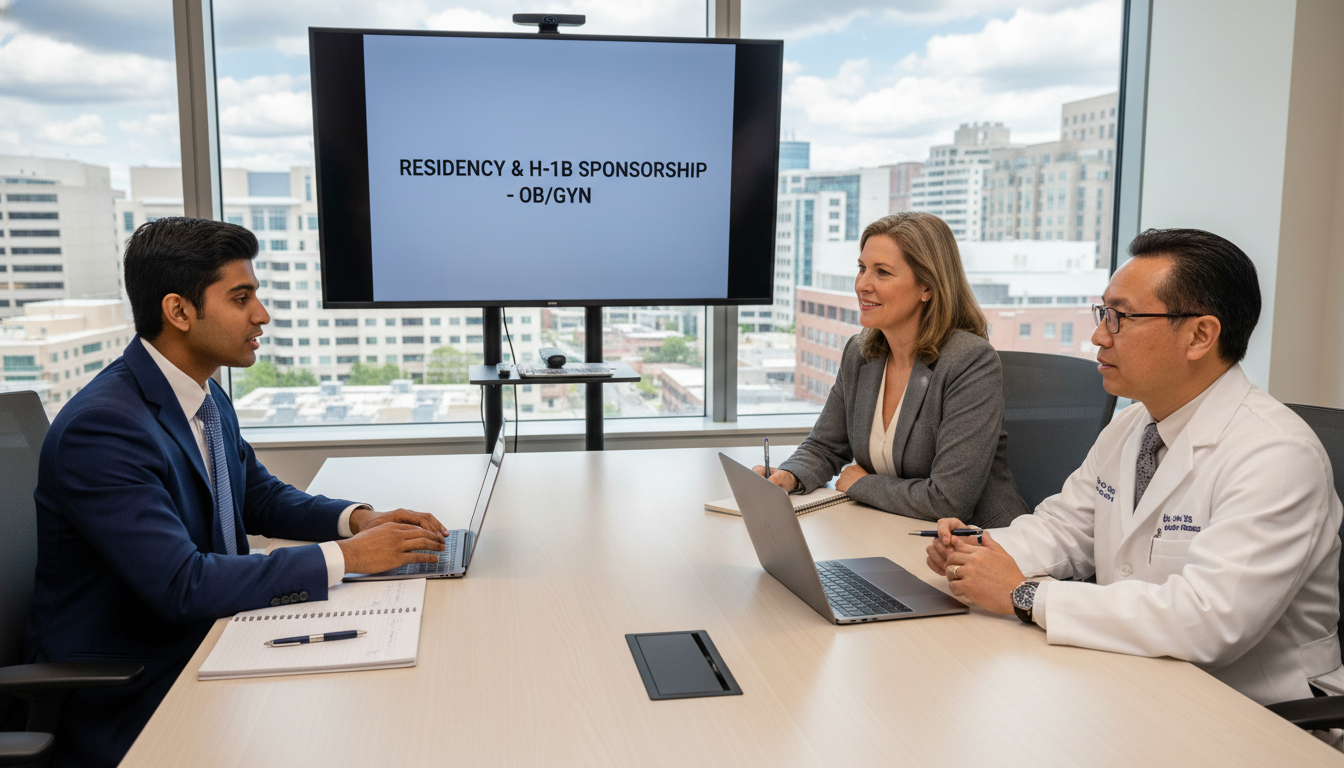
If invited to interviews by a program you believe is H-1B friendly:
- Confirm visa policy politely if it is not explicitly stated:
- “I am very interested in your program and have a strong preference for H‑1B sponsorship. Is this something your department and GME currently support for incoming OB GYN residents who have completed USMLE Step 3?”
- Be prepared to explain:
- Why you prefer H‑1B (long‑term commitment to U.S. practice, desire to avoid uncertainty of waivers, etc.).
- That you understand the program will incur additional costs and you appreciate their investment.
- Reassure them regarding:
- Your USMLE Step 3 status (ideally already passed).
- Your intention to remain in good immigration standing and to work with their international office.
Programs are often more comfortable sponsoring H‑1B when they sense maturity, planning, and stability in the applicant.
Long-Term Planning: From OB GYN Residency to Fellowship and Beyond on H-1B
Your OB GYN residency is what gets you into the U.S. system; long-term success requires thinking past PGY‑4.
1. Fellowships on H-1B
Most OB GYN subspecialty fellowships are offered at academic, cap‑exempt institutions:
- Maternal-Fetal Medicine (MFM)
- Gynecologic Oncology
- Reproductive Endocrinology and Infertility (REI)
- Female Pelvic Medicine and Reconstructive Surgery (FPMRS)
- Complex Family Planning
These are often comfortable with H‑1B because they:
- Already sponsor H‑1B for faculty.
- Are familiar with cap-exempt petitions.
However, confirm early in residency:
- Does your preferred fellowship sponsor H‑1B, or only J‑1?
- How many years of H‑1B will you have already used by the time you start fellowship?
Plan your H‑1B years strategically so that residency + fellowship do not exceed the H‑1B limit before you can transition to a green card or a new visa category.
2. Transition to Practice
After OB GYN training on H‑1B:
- Academic positions at universities or affiliated hospitals:
- These remain H‑1B cap exempt.
- Employers might sponsor your green card.
- Private practice or community hospitals:
- Typically cap-subject H‑1B employers.
- Transition may require:
- Movement from cap‑exempt to cap‑subject if you did not previously hold a cap‑subject H‑1B.
- Use of concurrent employment strategies and careful timing (coordinate with an experienced immigration attorney).
3. Green Card Strategy
Many IMGs on H‑1B in OB GYN aim for an employment‑based green card (EB‑2 or EB‑3). Steps typically involve:
- Labor certification (PERM)
- I‑140 petition
- Adjustment of status (I‑485) when priority date is current
Timelines can vary significantly by country of birth; IMGs from India or China may face longer waits. Starting your green card process early—often in early or mid‑fellowship—can help you remain in status and avoid hitting the 6‑year H‑1B limit without a backup plan.
Frequently Asked Questions (FAQ)
1. Is it realistic for an IMG in OB GYN to match into a residency with H-1B sponsorship?
Yes, it is realistic but competitive. Many OB GYN H‑1B residency programs are academic and expect:
- Strong USMLE scores (especially a passing Step 3 before Match)
- Solid U.S. clinical experience in OB GYN
- Strong letters of recommendation
- Clear, professional communication about visa needs
Your chances improve if you:
- Apply broadly to known H‑1B-friendly programs.
- Confirm policies directly with programs.
- Present a credible, long‑term commitment to U.S. OB GYN practice.
2. Do all OB GYN programs that say “we sponsor visas” offer H-1B?
No. “We sponsor visas” often means only J‑1. You must confirm:
- “Do you sponsor H‑1B visas for incoming residents?”
- “Have you sponsored H‑1B for OB GYN residents in the last few years?”
If a program only writes “ECFMG J‑1,” then H‑1B sponsorship is unlikely. A clear policy stating “H‑1B and J‑1 considered” is a more reliable sign, but again, confirmation via email is wise.
3. Can I apply to OB GYN programs with H-1B preference but still match with J-1 if needed?
Yes, if you are open to J‑1 as a backup, you can:
- Prioritize H‑1B-friendly programs on your rank list.
- Include some strong J‑1 programs.
- If you match at a non‑H‑1B program, you will likely be on J‑1.
If avoiding J‑1 212(e) is absolutely critical (e.g., political circumstances in your home country), you may choose to rank only programs that confirm H‑1B sponsorship—a more risky but principled strategy.
4. How early should I take USMLE Step 3 if I want H-1B sponsorship?
Ideally, you should:
- Take Step 3 at least 6–9 months before Match Day, so by around August–October of the application cycle.
- Have a passing score available before programs submit H‑1B petitions (usually spring before your PGY‑1 start).
Some programs require Step 3 before ranking, so having the result available by January–February is optimal. Check each program’s policy and work backward from their deadlines.
By understanding the H‑1B residency landscape in Obstetrics & Gynecology, targeting cap‑exempt, IMG‑friendly programs, and strategically planning your exams and experiences, you can significantly improve your chances of securing a residency that aligns with both your clinical goals and your long-term immigration plans.