Understanding H-1B Sponsorship in IMG-Friendly Residency Programs
For many international medical graduates (IMGs), securing H-1B sponsorship is a key factor in choosing where to apply for residency. While many U.S. residency programs sponsor only J-1 visas, a smaller but important subset offer H-1B residency programs and are considered particularly IMG friendly. This IMG residency guide will help you understand how H-1B sponsorship works, how to target IMG-friendly residency programs, and how to position yourself as a strong candidate.
This article focuses on residency programs in IMG-friendly environments that are open to international graduate programs and applicants, with special attention to H-1B–related rules, strategy, and timelines.
J-1 vs H-1B: What IMGs Need to Know Before Targeting Programs
Before diving into specific H-1B sponsorship programs, you need a clear understanding of the practical differences between J-1 and H-1B status. This will shape your application strategy.
Key Differences Between J-1 and H-1B for Residents
1. Purpose and Pathway
J-1 (Exchange Visitor Physician)
- Sponsored by ECFMG, not directly by the residency program.
- Intended for graduate medical education and training.
- Typically easier for programs to work with (standard process and known timelines).
H-1B (Temporary Worker in Specialty Occupation)
- Sponsored directly by the residency program (or institution).
- Considered employment-based; resident is effectively a “specialty occupation” worker.
- Involves more institutional legal oversight and cost.
2. Duration and Extensions
J-1
- Usually up to 7 years for residency/fellowship.
- Sufficient for most residency plus fellowship paths.
H-1B
- Typically granted in increments of up to 3 years, maximum 6 years in most cases.
- Can be extended beyond 6 years only in specific situations (e.g., ongoing green card process under certain conditions).
3. Two-Year Home Residency Requirement (J-1)
- Many J-1 physicians are subject to the two-year home country physical presence requirement after training.
- To work in the U.S. after J-1 training, IMGs usually need a waiver, such as:
- Conrad 30 waiver (state-based, often in underserved areas)
- Federal agency waivers (e.g., VA, HHS, etc.)
In contrast, H-1B status has no built-in home country return requirement, making it attractive for IMGs planning longer-term U.S. careers without a waiver.
4. Cap vs Cap-Exempt H-1B
H-1B Cap-Subject
- Most private employers fall into this category.
- Limited number of visas annually; subject to lottery.
- Filing window typically opens in March for an October 1 start date.
H-1B Cap-Exempt
- Universities, university-affiliated hospitals, nonprofit research organizations, and some government research institutions may qualify as H-1B cap exempt.
- Many academic teaching hospitals and large residency programs are cap exempt.
- No annual numerical limit; can file year-round.
Most academic medical centers and university-affiliated residency programs that sponsor H-1B are in the cap-exempt category. This is why identifying H-1B cap-exempt institutions can be an effective strategy.
Which Residency Programs Sponsor H-1B? Understanding IMG-Friendly Patterns
Not all IMG-friendly residency programs sponsor H-1B, and not all H-1B residency programs are equally IMG friendly. Your goal is to find the overlap: programs open to IMGs and willing to sponsor H-1B.
Typical Characteristics of H-1B-Friendly Residency Programs
While there is no official national H-1B sponsor list for residency programs, many H-1B-friendly institutions share common features:
University or Major Teaching Hospital Affiliation
- Affiliation with a medical school or large academic health system
- Established graduate medical education (GME) infrastructure
- Dedicated legal/immigration support services
History of Training IMGs
- Current residents include multiple IMGs
- Program materials or residents’ profiles show diverse international backgrounds
- Websites may explicitly mention “We sponsor J-1 and H-1B visas” or similar
Specialties with High IMG Representation
IMGs are more common in some specialties, especially in IMG-friendly programs:- Internal medicine
- Family medicine
- Pediatrics
- Psychiatry
- Neurology
- Pathology
Certain surgical subspecialties and highly competitive fields are generally more restrictive but still may offer H-1B in select institutions.
Urban and Underserved Locations
- Programs in large urban areas or regions with workforce shortages often rely more heavily on IMGs.
- These institutions may be more experienced with H-1B processes.
Common Institutional Policies You’ll Encounter
Programs often have one of the following policies:
J-1 Only
- Will not sponsor H-1B under any circumstances.
- Often clearly stated on website: “We sponsor J-1 visas only.”
J-1 Preferred, Case-by-Case H-1B
- Default to J-1, but may consider H-1B for strong or special candidates.
- Frequently restrict H-1B to:
- U.S. medical graduates
- IMGs who have already passed USMLE Step 3
- Hard-to-fill positions or shortage specialties
J-1 and H-1B Equally Supported
- Clear statement: “We sponsor J-1 and H-1B visas for eligible candidates.”
- Strong internal legal support; relatively streamlined process.
As an IMG, the last group is the most straightforward, but the middle group can also be viable if you meet their extra conditions.
Eligibility and Requirements for H-1B Residency Sponsorship
H-1B residency programs have stricter eligibility requirements than J-1 programs. If you plan to seek H-1B sponsorship, aligning your profile early is crucial.
Core Requirements for H-1B in Residency
While institutional policies differ, most programs require:
- USMLE Step 3 Passed Before H-1B Filing
Many programs insist that IMGs have USMLE Step 3 passed before they will file an H-1B petition, often by a specific deadline (e.g., before rank list submission or before contract issuance).
- Rationale:
- Step 3 is a USCIS requirement for foreign medical graduates in H-1B clinical positions.
- Programs want to avoid the risk of a resident failing Step 3 and becoming ineligible for H-1B.
Actionable advice:
If you are targeting H-1B residency programs, plan your exam timeline so that Step 3 is completed and passed before the Match (ideally before applications or interviews).
- ECFMG Certification
As with all IMGs:
- Full ECFMG certification is mandatory by the start of residency.
- For H-1B, programs may require certification earlier to facilitate paperwork.
- State Medical License or Training Permit
Some states:
- Require passing Step 3 as part of training license eligibility.
- Require a certain number of postgraduate training years elsewhere (for transfers or fellows).
Programs often process your training license and H-1B in parallel, so all requirements must align.
- No Existing Immigration Barriers
H-1B petitions can be complicated by:
- Prior status violations
- Unresolved immigration issues
- Past J-1 home residency requirements (from other exchange programs)
If you’ve had prior U.S. visas (F-1, B-1/B-2, J-1), ensure you understand any potential consequences and consult an immigration attorney if unsure.
Employer and Institutional Requirements
Programs must also meet conditions to sponsor H-1B:
- Demonstrate that the resident role is a specialty occupation (satisfied by physician role and training context).
- Pay at least the prevailing wage set for the position.
- File a Labor Condition Application (LCA) and H-1B petition with USCIS.
- For cap-exempt status, show affiliation with a qualifying institution (e.g., university).
Some hospitals choose not to sponsor H-1B to avoid these administrative and financial burdens, which is why explicit program policy is so important to check.
Building a Strategic Application Plan for H-1B Residency as an IMG
Because H-1B sponsorship narrows your program pool, you must be targeted, early, and organized in your strategy.
Step 1: Clarify Whether H-1B Is Essential or Preferred
Ask yourself:
- Are you willing to accept a J-1 if necessary, or is H-1B a must-have due to personal, family, or career reasons?
- Are you open to:
- Completing residency on J-1, then seeking a J-1 waiver for service in an underserved area?
- Or is your long-term plan more compatible with H-1B (e.g., spouse’s career, avoidance of waiver obligations)?
This decision affects how broadly or narrowly you apply.
Practical approach:
- If H-1B is preferred but not mandatory:
- Apply broadly to both H-1B and J-1 programs, prioritizing those that can sponsor H-1B.
- If H-1B is essential:
- Focus mainly on confirmed H-1B residency programs, understanding your list may be shorter and more competitive.
Step 2: Build a Personalized H-1B Sponsor List
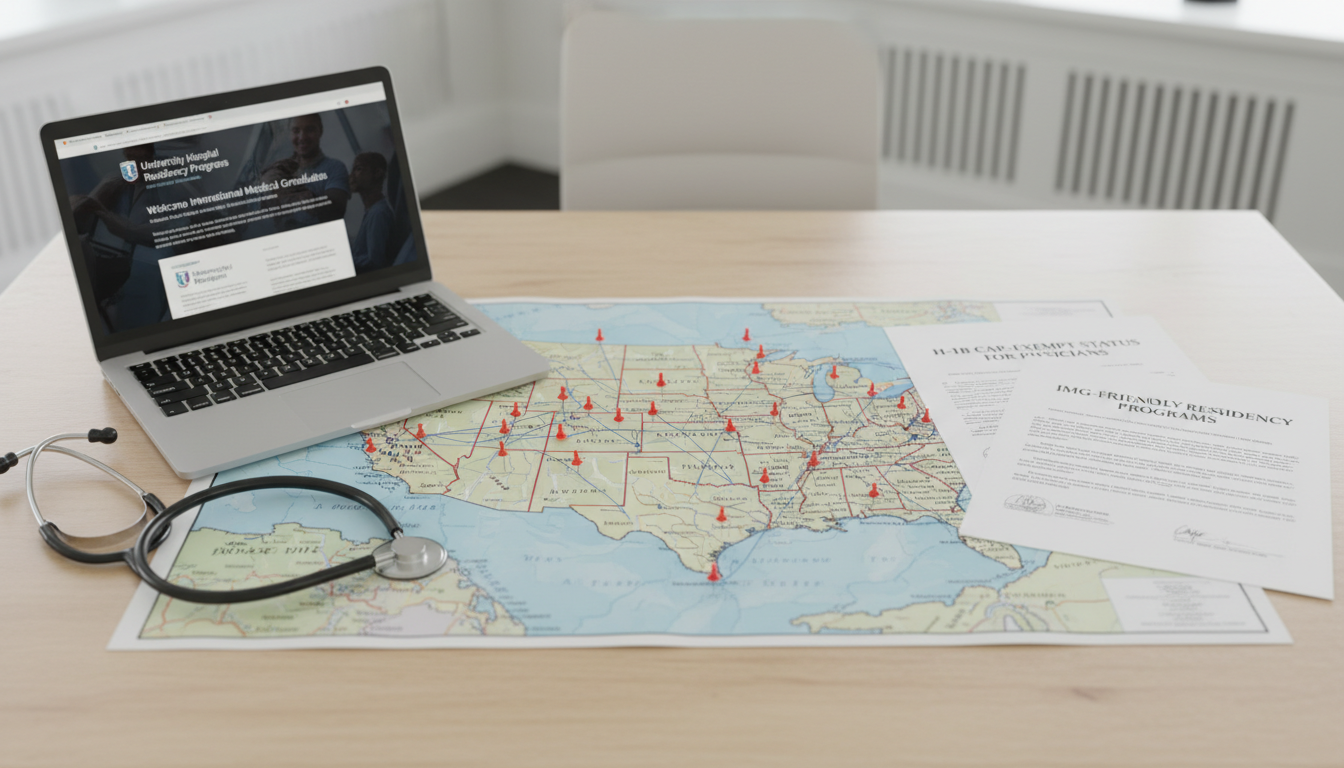
There is no official central database of H-1B-friendly residency programs, but you can build your own H-1B sponsor list:
Start with Known H-1B-Friendly Institutions
- Academic centers with large IMG populations.
- Programs where current residents explicitly mention H-1B in bios.
- Online forums, alumni networks, and IMG communities frequently share updated lists.
Check Program Websites Carefully
- Look for a “Visa Sponsorship” section under:
- Program Overview
- Eligibility & Requirements
- FAQ
- Phrases to look for:
- “We sponsor J-1 and H-1B visas for eligible candidates.”
- “H-1B sponsorship is available for highly qualified candidates who have passed USMLE Step 3.”
- “Visa sponsorship: J-1 only” (mark as not H-1B eligible).
- Look for a “Visa Sponsorship” section under:
Contact Program Coordinators or Administrators
Politely email the program coordinator if the website is unclear.
Example email:
- Brief introduction (name, IMG, graduation year, country).
- Mention your interest in their program.
- Ask directly but respectfully:
“Could you please confirm whether your program sponsors H-1B visas for incoming residents who have completed USMLE Step 3?”
Ask Current or Recent Residents (Especially IMGs)
- Use LinkedIn, alumni networks, and social media (with professionalism).
- Sample question:
- “I’m an IMG who will be applying to your program. Are there current residents on H-1B status, and does the program typically sponsor H-1B for IMGs who have Step 3 completed?”
As you gather information, create a spreadsheet with columns for:
- Program name and specialty
- City and state
- Visa policy (J-1 only, J-1 + H-1B, case-by-case)
- Step 3 requirement and deadline
- Notes from coordinator/residents
This becomes your personalized, evidence-based H-1B sponsor list.

Step 3: Time Your Exams for H-1B Competitiveness
If H-1B is a major goal, your exam scheduling is strategic:
- Step 1 and Step 2 CK
- Aim to take them early enough to maintain competitiveness and allow time for Step 3.
- Step 3
- Ideally taken before ERAS application season (September) or at least before most interviews.
- At the latest, you want results before programs finalize rank lists (February).
- Many H-1B sponsorship policies for IMGs explicitly require Step 3 before Match Day.
Example timeline for a 2027 Match (for illustration):
- Step 2 CK by early 2026
- Step 3 by mid-to-late 2026
- ERAS application September 2026
- Interviews late 2026 to early 2027
- H-1B petition preparation after Match in spring 2027
Step 4: Highlight H-1B Readiness in Your Application
Programs are more open to H-1B sponsorship when they see you as “low risk” and well-prepared.
In your CV / ERAS application:
- Clearly state:
- “USMLE Step 3: Passed [Month, Year]”
- ECFMG certification status and date
- Include U.S. clinical experience and letters from U.S. physicians if possible.
- Emphasize professionalism, communication skills, and adaptability—traits valued in any IMG-friendly residency.
In your personal statement or interviews (when appropriate):
- You may briefly note that you:
- Have completed USMLE Step 3.
- Are eligible for H-1B sponsorship through cap-exempt institutions.
- Avoid making visa needs the main theme—but don’t hide them either.
Step 5: Communicate About Visas Professionally During Interviews
During interviews, programs may ask about your visa needs. Respond:
Clearly and confidently:
- “I am an international medical graduate requiring visa sponsorship. I have already passed USMLE Step 3 and am eligible for either J-1 or H-1B sponsorship, depending on program policy.”
Avoid sounding demanding:
- You can state a preference (e.g., H-1B), but keep the tone flexible and focused on fit and training quality.
If a program seems open to both J-1 and H-1B, you may later clarify:
- “Given that I have Step 3 completed and am planning a long-term career in the U.S., I would prefer H-1B sponsorship if feasible under your institutional policies.”
After the Match: What Happens with H-1B Processing?
Once you match into a residency program that has agreed to sponsor your H-1B, there is a new timeline to manage.
Typical Post-Match H-1B Steps
Confirmation of Visa Type with Program
- Shortly after Match Day, the program or GME office will confirm:
- Whether you will be on J-1 (via ECFMG) or H-1B.
- If H-1B is chosen, they’ll usually connect you with:
- Institutional immigration services
- Or external immigration counsel
- Shortly after Match Day, the program or GME office will confirm:
Document Collection and Petition Preparation You will likely need to provide:
- Passport copies and prior U.S. visa documentation
- USMLE score reports (including Step 3)
- ECFMG certificate
- Medical diploma and transcripts
- CV and sometimes employment history documentation
The employer (program/hospital) will:
- File the Labor Condition Application (LCA).
- Prepare and submit the Form I-129 H-1B petition to USCIS.
- Cap-Exempt Advantage for Academic Residency Programs
Because most residency programs that sponsor H-1B are cap-exempt, you usually avoid:
- The H-1B lottery
- The October 1 start date limitation
This makes it possible to start residency on the standard July 1 date.
- Consular Processing vs Change of Status
Depending on where you are:
If outside the U.S.:
- After the H-1B petition is approved, you schedule a visa interview at a U.S. consulate.
- Bring approval notice, employment letter, and supporting documentation.
If already in the U.S. in another status (e.g., F-1, J-1):
- The H-1B petition may request a change of status without leaving the U.S., if eligible.
- Complex scenarios (e.g., previous J-1 with home-return requirement) may need an attorney.
- Timeline Considerations
- H-1B processing can take several weeks to months.
- Some institutions pay for premium processing (15-calendar-day response time), especially if timelines are tight.
- Stay responsive and organized; delays in providing documents can impact your start date.
Frequently Asked Questions (FAQ)
1. Is it harder to match into residency if I need H-1B instead of J-1?
Needing H-1B does narrow your options, because many programs sponsor only J-1 visas. Among programs that accept both, some prefer J-1 due to lower administrative burden. However, if you:
- Target confirmed H-1B residency programs
- Have passed USMLE Step 3
- Present a strong overall profile (scores, clinical experience, communication skills)
you can remain competitive, especially in traditionally IMG friendly specialties and locations.
2. Do all H-1B-friendly programs require Step 3 before ranking me?
Most H-1B-IMG policies strongly prefer or require Step 3 passed before rank list finalization, but there are occasional exceptions. Some programs may:
- Rank you with a contingency that Step 3 must be passed before a specific date.
- Only offer H-1B to those who already have Step 3, while steering others toward J-1.
Because policies vary, always verify the specific requirement and timing with each program.
3. Can I start on J-1 and later switch to H-1B during residency?
In practice, switching from J-1 to H-1B during residency is uncommon and complicated. Once you begin training under the J-1 physician category, you are usually subject to the two-year home residency requirement after completion, unless you obtain a waiver. Some transitions are possible in limited, legally complex circumstances, but they are not guaranteed and may require specialized legal guidance. If H-1B is important to you, it’s best to start on H-1B from PGY-1 when possible.
4. Are community programs less likely to sponsor H-1B than university hospitals?
Many smaller community programs sponsor only J-1 due to resource constraints. However, some community-based programs affiliated with universities or major health systems may still qualify as H-1B cap-exempt and sponsor H-1B. Don’t assume automatically—check each program’s visa policy. Broad rule of thumb:
- University/university-affiliated teaching hospitals: more likely to be cap-exempt and sponsor H-1B.
- Independent community hospitals: more likely to be J-1 only, but there are exceptions.
By understanding how H-1B sponsorship works, strategically targeting IMG friendly residency programs with cap-exempt status, and aligning your exam timing (especially Step 3), you can significantly improve your chances of securing H-1B sponsorship as an international medical graduate. Thoughtful planning, careful research, and professional, transparent communication with programs will be your strongest tools throughout the residency match and application process.