Understanding H‑1B Residency Sponsorship on the Pacific Coast
For an international medical graduate (IMG), the H‑1B pathway can be the difference between matching at a dream west coast residency and having to change career plans entirely. The Pacific Coast—especially California—has some of the most competitive and desirable training environments in the United States. It is also a region where immigration policies, institutional resources, and state regulations significantly affect how and where IMGs can train.
This IMG residency guide focuses on H‑1B sponsorship programs for IMGs in Pacific Coast states (California, Oregon, Washington), with a practical emphasis on how to find programs, evaluate their policies, and strengthen your application.
We will cover:
- How H‑1B residency sponsorship works for IMGs
- Key differences between H‑1B and J‑1 for residency
- Specific notes on California residency programs and their H‑1B practices
- Building your own H‑1B sponsor list on the west coast
- Strategies to improve your chances of securing an H‑1B spot
1. H‑1B for Residency: Core Concepts IMGs Must Know
Before you start filtering west coast residency programs by “visa: H‑1B,” you need a clear understanding of what the H‑1B actually means in the context of graduate medical education.
1.1 What is the H‑1B for Residency?
For residency, an H‑1B is:
- A temporary work visa for a “specialty occupation”
- Sponsored by the residency program/hospital, not by ECFMG
- Typically valid up to 6 years total (including time spent in fellowship)
- Tied to the specific employer, specific job, and specific location
Unlike the J‑1, where ECFMG is your visa sponsor, your residency program becomes your H‑1B sponsor. This means:
- The institution must handle legal paperwork and filing fees
- They must demonstrate you’re qualified and that the position qualifies as a specialty occupation
- Any major change (e.g., switching programs, moonlighting at outside institutions) may require amended filings
1.2 Core H‑1B Requirements for IMGs
Most Pacific Coast residency programs that sponsor H‑1B for IMGs require:
- USMLE Steps
- Step 1: Passed
- Step 2 CK: Passed
- Step 3: Passed before H‑1B petition filing (in practice, many programs require Step 3 by Rank Order List deadline or before starting)
- ECFMG Certification: Completed before residency start
- State Medical License / Training License Eligibility: Varies by state
- California has specific rules on licensure and postgraduate training that may affect IMG timing
- No major red flags in immigration history (status violations, prior denials, etc.)
Because the H‑1B is a work visa, programs must pay prevailing wage and shoulder significantly higher legal and filing costs than for a J‑1. This is a key reason many programs limit H‑1B sponsorship.
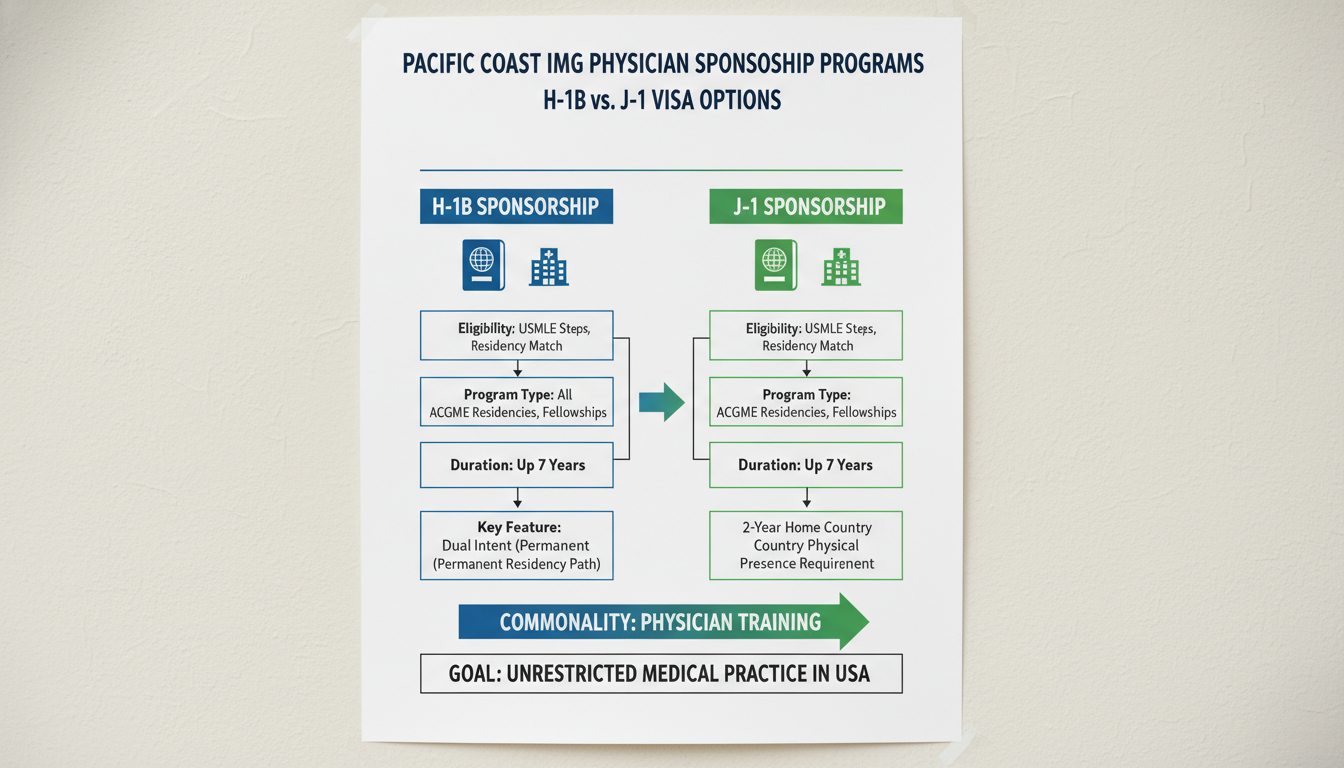
1.3 H‑1B vs J‑1 for IMGs: Why It Matters on the Pacific Coast
J‑1 visa (ECFMG sponsored)
- Most common route for IMGs
- Usually easier for programs to sponsor
- Requires 2‑year home country return (or waiver) after training
- Often preferred by smaller programs or those without strong in‑house immigration teams
H‑1B visa
- No 2‑year home country requirement
- Can transition more smoothly to U.S. job opportunities or fellowship
- Can be H‑1B cap exempt if employed by certain types of institutions
- More complex and expensive for programs → fewer positions offered
On the Pacific Coast, many large academic centers (especially university hospitals) may favor J‑1 but remain open to H‑1B for exceptional IMGs or as institutional policy. However, the number of H‑1B seats is typically much smaller than total IMG seats.
2. Pacific Coast Landscape: Where H‑1B-Friendly Programs Are Found
The term “Pacific Coast” generally includes California, Oregon, and Washington. Each state has different institutional cultures and legal contexts that influence H‑1B sponsorship.
2.1 California Residency Programs and H‑1B
California residency programs are highly competitive and often heavily sought out by IMGs due to:
- Large, diverse patient populations
- Strong academic centers and subspecialty exposure
- Desirable locations (Bay Area, Los Angeles, San Diego, Sacramento, etc.)
However, several factors affect H‑1B sponsorship in California:
Volume of applicants
- Many programs can fill all positions with U.S. graduates (MD and DO).
- Even if they can sponsor H‑1B, they may prioritize U.S. citizens/green card holders and J‑1 IMGs simply due to administrative ease.
Institutional immigration policies
- Some university systems (e.g., UC system) have centralized guidelines about H‑1B sponsorship for residents and fellows.
- Policies can change every few years depending on legal interpretation and budget.
Licensing and training rules
- California Medical Board regulations around postgraduate training and licensing can add complexity, particularly for IMGs with earlier non‑U.S. experience.
Common pattern in California:
- Many big academic programs list: “J‑1 visa supported; H‑1B considered under limited circumstances” or “J‑1 only.”
- A smaller but important subset explicitly states: “J‑1 and H‑1B visas sponsored.”
For an IMG targeting west coast residency with H‑1B, California remains possible but also highly competitive, especially in Internal Medicine and other core specialties.
2.2 Oregon: Smaller Market, Select H‑1B Options
Oregon has fewer residency programs, largely centered around:
- Portland (Oregon Health & Science University, community programs)
- Smaller community hospitals and university affiliates
In Oregon:
- Some large academic centers are open to H‑1B, particularly when IMGs fill critical service needs.
- Many community programs may only accept J‑1 or require U.S. citizenship/permanent residency due to limited administrative resources.
The smaller number of programs means you should research each Oregon program individually if you’re serious about including the state in your H‑1B strategy.
2.3 Washington State: Academic Centers and Cap‑Exempt Advantage
Washington, especially around Seattle, has:
- Major academic centers (e.g., university hospitals, children’s hospitals)
- A mix of community and university‑affiliated programs
Key advantage: many teaching hospitals are institutions of higher education or affiliated non‑profits, allowing them to be H‑1B cap exempt.
This can benefit IMGs because:
- Cap‑exempt employers can petition for H‑1B any time of year, outside the national April lottery cycle.
- There is more flexibility for transitions (e.g., residency → fellowship → faculty) within cap‑exempt settings.
However, as in California, competition is strong, and H‑1B slots may be limited to a small number of residents per year in each program.
3. Cap‑Subject vs H‑1B Cap Exempt: Why Hospital Type Matters
To navigate H‑1B residency programs strategically, you must understand the H‑1B cap and which Pacific Coast employers fall under H‑1B cap exempt status.
3.1 The H‑1B Cap in Brief
- The U.S. grants a limited number of new H‑1B visas each year (the “cap”).
- New cap‑subject H‑1B petitions go through a lottery in March/April.
- Start dates are typically October 1, which does not align well with July 1 residency start dates.
For residency training, this timing conflict is a major problem if the employer is cap‑subject. Many programs avoid this by using institutions/statutes that allow H‑1B cap exempt petitions.
3.2 Who Is H‑1B Cap Exempt?
Employers can be H‑1B cap exempt if they are:
- Institutions of higher education (e.g., universities)
- Non‑profit organizations affiliated with such institutions (e.g., university hospitals)
- Certain non‑profit research organizations or governmental research organizations
Most large academic medical centers on the Pacific Coast fall into one of these categories, meaning:
- They can file H‑1B petitions any time of year
- There is no lottery risk for residents
- Start dates can match July 1
For IMGs, this makes university‑based California residency programs and other Pacific Coast teaching hospitals especially attractive when building an H‑1B sponsor list.
3.3 Practical Implications for Your Strategy
When evaluating a program:
- Check if it’s part of a university system (e.g., UC, UW, OHSU) or clearly a non‑profit teaching hospital.
- Cap‑exempt status doesn’t guarantee they sponsor H‑1B, but it makes it far more logistically feasible.
- Cap‑subject community hospitals (rare for residency, but possible) are far less likely to sponsor H‑1B due to timing constraints.
In your notes, mark programs as:
- “Likely cap‑exempt – university/teaching hospital”
- “Unknown”
- “Likely cap‑subject – small community private hospital”
This will help you prioritize realistic H‑1B options.

4. Building Your West Coast H‑1B Sponsor List
There is no official, up‑to‑date public H‑1B sponsor list for residency programs. Policies change frequently. Instead, you must assemble your own list using reliable signals.
4.1 Step 1: Use Official Program Pages
For each program of interest:
- Go to the program’s official website (not just the FREIDA overview).
- Look for sections like:
- “International Medical Graduates”
- “Visa Sponsorship”
- “FAQ for Applicants”
- Read carefully for phrases such as:
- “We sponsor J‑1 and H‑1B visas”
- “J‑1 only”
- “We are unable to sponsor visas”
- “We typically sponsor J‑1 but may consider H‑1B in specific circumstances”
Create a spreadsheet with columns:
- Program name
- Specialty
- City/state
- Visa policy (J‑1 only / J‑1 + H‑1B / U.S. only / unclear)
- Notes (e.g., “requires Step 3 for H‑1B,” “prefers J‑1 but open to H‑1B”)
4.2 Step 2: Cross‑Check with FREIDA and NRMP Data
Use FREIDA and program descriptions from ERAS/NRMP:
- Filter by region for west coast states (CA, OR, WA).
- Many entries indicate “Accepts J‑1, H‑1B” or specify “J‑1 only.”
Remember: FREIDA entries can be outdated. Always confirm on the program’s own website.
4.3 Step 3: Contact Programs When Policies Are Unclear
If the website is ambiguous, a concise inquiry can help, such as:
“I am an international medical graduate with USMLE Step 3 and ECFMG certification, interested in your Internal Medicine program. Could you please confirm whether your program sponsors H‑1B visas for incoming residents?”
Tips:
- Use a professional email address.
- Keep the message short and specific.
- Avoid sending multiple follow‑up emails if you don’t receive a response.
4.4 Step 4: Learn from Recent Residents
Recent or current residents are often the best source of practical information:
- Check program Instagram/X profiles, where resident spotlights sometimes mention visa type.
- Attend virtual open houses and Q&A sessions; ask politely:
- “Do you currently have any residents on H‑1B?”
- “What is your program’s usual approach to H‑1B sponsorship for IMGs?”
Even one confirmed recent H‑1B resident is a strong signal that the program is at least open to it.
4.5 Red Flags and Green Flags
Green flags for H‑1B‑friendly west coast residency programs:
- Website explicitly states: “We sponsor H‑1B visas”
- Recent residents or alumni known to be on H‑1B
- Large academic center with established GME/immigration office
- Specialty or location with known physician shortages (increasing need for IMGs)
Red flags:
- “We do not sponsor visas”
- “J‑1 only” (some mean this literally, others occasionally make rare exceptions)
- Vague wording with no mention of H‑1B despite many IMGs in the program (could still be J‑1 only)
5. Application Strategy: Maximizing Your H‑1B Chances as an IMG
Knowing which Pacific Coast programs sponsor H‑1B is only half of the equation. You also must be among the few IMGs selected for those coveted H‑1B spots.
5.1 Prioritize Step 3 and Documentation
For H‑1B residency programs, USMLE Step 3 is a gatekeeper:
- Aim to take and pass Step 3 before ERAS application or at least before rank list certification.
- Clearly highlight Step 3 in your CV and ERAS application.
- Some California residency programs will not file an H‑1B petition without Step 3 passed by a strict internal deadline.
Other documentation:
- Keep your ECFMG certificate ready and valid.
- Organize transcripts, diplomas, and past employment documents—programs may need them for credentialing during visa processing.
5.2 Target the Right Mix of Programs
Balance your list among:
- Pacific Coast H‑1B‑friendly programs (your main focus)
- Other J‑1‑friendly programs (elsewhere in the U.S.)
- Possibly a small number of U.S. citizen/green card only programs if you have dual eligibility
Be realistic:
- Even if a California residency program sponsors H‑1B, it may receive thousands of applications.
- Apply broadly, not only to prestigious coastal cities. Inland or smaller cities on the Pacific Coast may offer more opportunities.
5.3 Highlight Fit and Value in Your Application
Programs that sponsor H‑1B invest extra resources in you. Demonstrate that you are worth that investment:
- Emphasize long‑term interest in practicing in the region (e.g., Pacific Northwest, California underserved communities).
- Show clear academic or research productivity, especially at U.S. institutions.
- Highlight any U.S. clinical experience (USCE), especially at academic centers or on the west coast.
For example, in your personal statement for a California Internal Medicine residency:
- Connect your background to the patient population (e.g., bilingual skills, experience with migrant or underserved communities).
- Show that you understand the program’s mission and setting (urban safety-net hospital vs tertiary referral center).
5.4 Prepare for Visa‑Related Interview Questions
During interviews, west coast programs might ask:
- “Do you have a preference between J‑1 and H‑1B?”
- “Have you already passed Step 3?”
- “What is your long‑term plan after residency?”
Be clear but flexible:
- If you strongly prefer H‑1B, state this politely and back it up with reasons (e.g., no home country funding, long‑term plan to work in U.S. academic medicine).
- However, avoid sounding rigid or entitled; many programs prefer J‑1 for structural reasons.
You might say:
“Given my situation and long‑term goal to continue in U.S. academic medicine, an H‑1B would be ideal if available. I understand, however, that many programs primarily support J‑1 and I’m open to discussing what is feasible for your institution.”
5.5 Anticipate Timeline and Processing Issues
For H‑1B cap‑exempt residency programs:
- Petitions are usually filed March–May, aiming for a July 1 start.
- Some institutions use premium processing; others rely on standard processing.
Be responsive:
- Submit requested documents quickly.
- Stay in close contact with the program’s GME office and international services.
If delays occur, options can include:
- Slightly delayed start date
- Transitional status (e.g., extension of prior status if already in U.S.)
However, large delays can risk your spot, so early Step 3 and complete documentation are essential.
6. Common Pitfalls and How to Avoid Them
6.1 Assuming All West Coast Academic Programs Offer H‑1B
Not all university‑affiliated California residency programs automatically sponsor H‑1B:
- Some have institutional decisions to use J‑1 exclusively.
- Policies shift with administrative leadership or legal advice.
Always validate current policy for the specific cycle.
6.2 Waiting Too Long to Take Step 3
Delaying Step 3 is one of the most common errors for IMGs seeking H‑1B:
- Without Step 3, many programs will not even consider H‑1B.
- If you pass Step 3 after interviews/Rank Order deadlines, it may be too late to influence their decision.
If your goal is H‑1B, plan your exam schedule to have Step 3 done before or early in the application season.
6.3 Over‑Restricting Geographic Preferences
Only applying to ultra‑competitive cities (San Francisco, Los Angeles, Seattle) with an H‑1B requirement is risky:
- You are competing with the world’s top candidates for a very small number of H‑1B‑compatible positions.
- Broaden to include smaller cities or less famous but IMG‑friendly programs on the Pacific Coast.
6.4 Ignoring Alternative Paths
If you do not secure H‑1B sponsorship:
- J‑1 residency is still a valid path, especially if you intend to seek a J‑1 waiver later (e.g., underserved area jobs, academic posts).
- Some IMGs later transition to H‑1B during fellowship or early employment.
Your initial visa type does not lock in your entire career, but it does influence short‑term options.
FAQs: H‑1B Sponsorship for IMGs on the Pacific Coast
1. Are there many H‑1B residency programs for IMGs in California?
California has some residency programs that sponsor H‑1B for IMGs, mostly large academic centers and select community programs. However, the absolute number of H‑1B positions is small compared to total IMG positions, and competition is intense. You should identify each program’s policy individually and apply broadly, including outside California, if H‑1B is your priority.
2. Do I need USMLE Step 3 before I apply for H‑1B‑friendly programs?
You can apply to west coast residency programs before passing Step 3, but to actually obtain an H‑1B, most sponsors require Step 3 to be passed by a specific deadline (often before Rank Order List certification or before they file the petition in spring). If H‑1B is crucial for you, taking Step 3 as early as feasible significantly strengthens your application and avoids last‑minute barriers.
3. Are university hospitals on the Pacific Coast always H‑1B cap exempt?
Most university hospitals and their non‑profit affiliates qualify as H‑1B cap exempt, but this is a legal determination made by immigration counsel, not something you can assume. Being cap exempt makes H‑1B residency sponsorship logistically easier but does not guarantee that a program sponsors H‑1B. You still need to verify each program’s visa policy.
4. What if I match to a J‑1 program but wanted H‑1B? Can I change later?
If you match to a J‑1 position, you are generally expected to complete residency on the J‑1. Some IMGs later move to H‑1B for fellowship or post‑residency employment, especially at cap‑exempt hospitals or academic centers. However, you should not count on changing from J‑1 to H‑1B during residency unless there is a compelling and institutionally supported reason; this is uncommon and requires expert legal guidance.
By understanding how H‑1B sponsorship works on the Pacific Coast, particularly within California residency programs and neighboring states, you can make more informed choices, build a targeted H‑1B sponsor list, and present yourself as a strong, prepared candidate. For an international medical graduate aiming for a west coast residency with long‑term U.S. career plans, early planning around visa strategy is just as critical as strong exam scores and clinical performance.