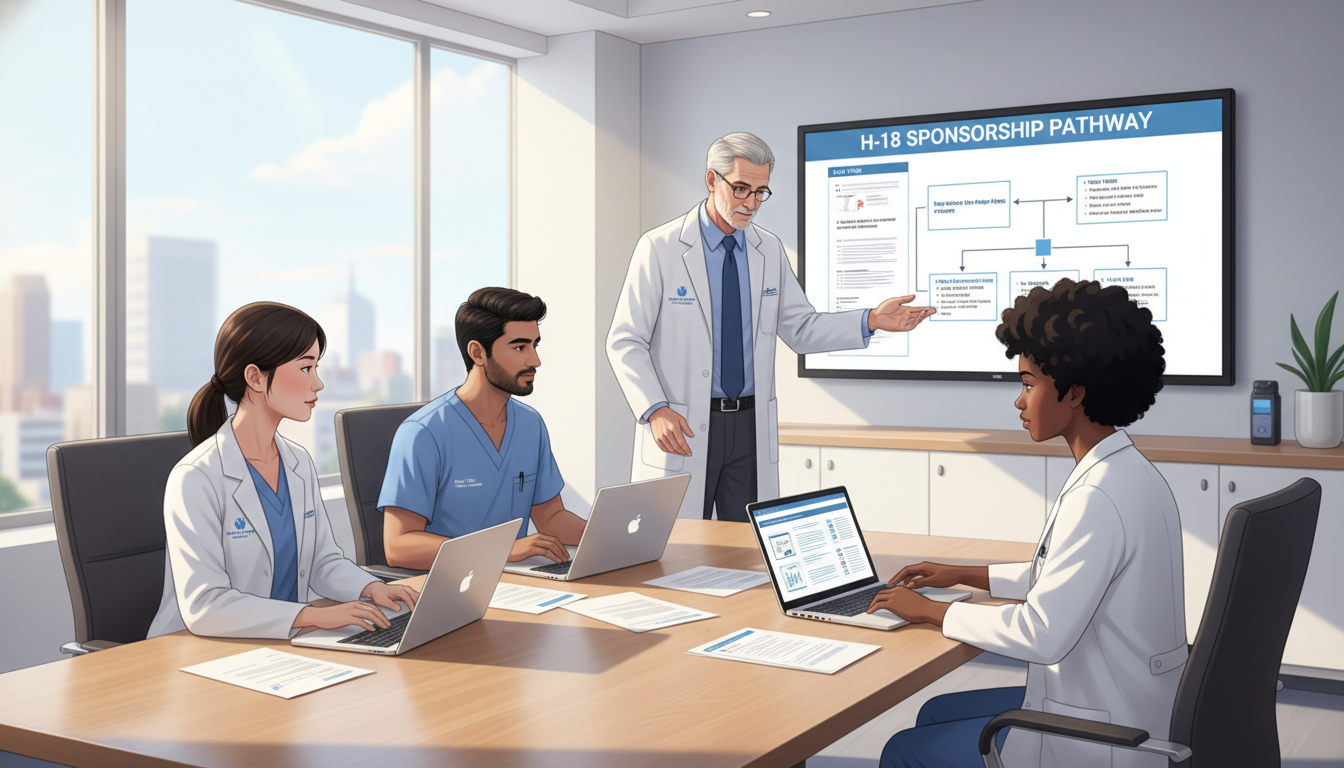
Understanding H-1B Sponsorship in Preliminary Medicine for IMGs
For an international medical graduate (IMG), finding a residency program that sponsors H-1B visas is often the difference between matching into the U.S. system and having to completely rethink your career plans. This is especially true in Preliminary Medicine (prelim IM) positions, where many programs default to J-1 sponsorship or accept only U.S. citizens/green card holders.
This IMG residency guide focuses specifically on H-1B sponsorship programs for Preliminary Medicine—how they work, what you need to qualify, how to build a realistic list, and what strategies maximize your odds of success as an IMG.
We will cover:
- How the H-1B works for residency, and why prelim IM is unique
- Core eligibility requirements (USMLE, ECFMG, timing)
- The landscape of H-1B sponsor programs and “cap exempt” options
- Practical steps to build an H-1B sponsor list for prelim medicine
- Application, communication, and interview strategies tailored to IMGs
Throughout, the focus is on practical, step-by-step advice you can apply this cycle.
H-1B Basics for IMGs in Preliminary Medicine
J-1 vs H-1B: Why does it matter?
Most IMGs train in the U.S. on a J-1 visa sponsored by ECFMG. H-1B is an alternative employment-based visa sponsored directly by the residency program (or affiliated institution).
Key differences for IMGs:
- J-1 visa
- Requires return to home country for 2 years after training (unless you get a waiver)
- More common and easier for many programs to manage
- Tied to ECFMG sponsorship, not a single employer
- H-1B visa
- No automatic 2-year home residency requirement
- Dual intent (you can pursue permanent residency later)
- Requires USMLE Steps and full ECFMG certification before start date
- More legal cost and administrative burden to the program
For some IMGs, especially those who plan to pursue fellowship and then possibly stay in the U.S. long-term, H-1B is very attractive — but also more competitive and less widely available.
Why is Preliminary Medicine more complicated?
Preliminary Medicine (Prelim IM) programs are 1-year positions, typically used for:
- Future anesthesiologists
- Neurologists
- Radiologists
- Dermatologists
- PM&R, ophthalmology, radiation oncology, etc.
From a program’s perspective, sponsoring H-1B for only one year can feel:
- Less cost-effective – same paperwork and legal fees, but only for a 1-year role
- Operationally complex – particularly if the same resident will then move to a different program that must file a transfer petition
As a result, many prelim IM programs:
- Only sponsor J-1, not H-1B
- Restrict H-1B sponsorship to their categorical positions
- Make case-by-case exceptions (more common when the prelim year is linked to an advanced position at the same institution)
Your strategy must reflect this reality: H-1B prelim medicine slots are fewer and more selective than J-1 options.

Eligibility Requirements: What You Must Have for H-1B Prelim IM
H-1B sponsorship for residency is not just about a willing program. You must also meet specific credential, testing, and timing standards. These are stricter than what many programs require for J-1 sponsorship.
1. USMLE Requirements
Most H-1B residency programs (including prelim IM) require:
- USMLE Step 1: Passed (ideally on first attempt)
- USMLE Step 2 CK: Passed (score competitive for IMGs, often ≥ 230–235+ for more selective institutions)
- USMLE Step 3:
- Must be passed BEFORE H-1B petition is filed, which is typically several months before residency start (often by January–March of the match year)
- Many programs will only interview/consider you for H-1B if your Step 3 is already done at the time you apply
If you still lack Step 3, understand that:
- Your H-1B options become very limited
- Most H-1B sponsor programs will filter you out automatically
- A realistic strategy may be to:
- Target J-1 friendly prelim IM programs this cycle, or
- Delay applying until Step 3 is passed
2. ECFMG Certification
You must be ECFMG certified by the time the program files the H-1B petition (and absolutely before residency start).
This means:
- All required USMLE exams passed
- Primary source verification of your medical degree completed
- Any additional ECFMG documentation requirements fulfilled
From a practical standpoint, if your certification is still “in process” during the application season, it can harm your chances at H-1B programs. These programs prefer low-risk applicants whose paperwork will not jeopardize a timely visa approval.
3. Timing Constraints
The H-1B petition process is time-sensitive:
- Match is typically in March
- Residency start is in late June or early July
- H-1B processing can take several months (shorter with premium processing, but not all institutions use it)
Because of this:
- Programs favor IMGs who already have Step 3 and ECFMG certification by the application/interview season
- Late exam results or certification can cause programs to back away from H-1B offers (even if they initially seemed open)
4. Institutional vs Program-Level Rules
Even if a program director personally wants to sponsor H-1B visas, their GME office or hospital system may:
- Prohibit H-1B entirely
- Restrict H-1B to certain specialties or PGY levels
- Allow it only in H-1B cap exempt circumstances (usually academic or non-profit hospitals)
When evaluating a prelim IM program:
- Look for institution-level statements about visas (on GME or HR pages, not just the IM program page)
- Understand that “We sponsor visas” is not the same as “We sponsor H-1B for prelim medicine”
- Ask specifically about prelim IM H-1B — not just the categorical IM track
H-1B Residency Landscape: Cap-Exempt, Sponsors, and Prelim IM Realities
H-1B Cap vs H-1B Cap Exempt: Why IMGs Should Care
H-1B visas are subject to an annual numerical limit (the cap), but certain employers are cap exempt:
Cap-exempt H-1B employers typically include:
- Non-profit hospitals affiliated with a university
- University-based medical centers
- Institutions involved in research or education
For residency, this is critical:
- Most academic medical centers offering residency training are H-1B cap exempt.
- This means:
- No need to compete in the general H-1B lottery
- Petitions can be filed year-round
- Much lower risk of denial due to cap limitations
When you see references to H-1B cap exempt residency programs or an H-1B sponsor list, these are usually university hospitals or large teaching institutions.
Types of Hospitals More Likely to Sponsor H-1B
For a realistic IMG residency guide focused on prelim medicine, you should prioritize:
University-affiliated academic medical centers
- Often cap-exempt
- More likely to have infrastructure and experience with H-1B
- May sponsor H-1B for IM (but prelim vs categorical still varies)
Large teaching hospitals with established IM residency programs
- Especially those known to host many IMGs
- Check if their categorical IM track sponsors H-1B — sometimes prelim follows same policy
Integrated health systems with multiple GME programs
- Some system-level policies allow H-1B under specific conditions
- Look for systems that explicitly state “We are an H-1B sponsor”
Where Prelim IM H-1B Sponsorship Is More Common
Patterns that may favor prelim H-1B sponsorship include:
Linked Advanced Positions at Same Institution
Example: A neurology or anesthesiology residency at a university hospital that requires a prelim IM year at the same institution.- In such cases, the hospital is incentivized to sponsor H-1B for the full 4 years (1 prelim + 3 advanced).
Institutions with high IMG representation and strong GME offices
- They often already sponsor H-1B for categorical IM and may be flexible for prelim IM when it supports an advanced specialty.
Programs explicitly stating H-1B support for prelim positions
- This is the ideal scenario, though relatively rare.
Key Caveat: H-1B Sponsorship Is Not Static
Policies change from year to year:
- Financial or legal policy shifts can lead programs to suddenly stop H-1B sponsorship
- New GME leadership may revise visa rules
- A program that was on a historic H-1B sponsor list may not sponsor now
Therefore:
- Treat any H-1B sponsor list (online or shared by peers) as a starting point only
- Always verify with the current application cycle information, ideally directly with the program

Building a Realistic H-1B Sponsor List for Prelim Medicine
Because there is no official central H-1B sponsor list for residency, you need a structured approach to identifying prelim IM programs that can realistically sponsor you.
Step 1: Clarify Your Constraints and Strategy
Ask yourself:
- Do I absolutely need H-1B this cycle, or am I open to J-1?
- Is my advanced specialty (neurology, anesthesia, etc.) also H-1B dependent?
- Do I already have Step 3 and ECFMG certification?
- Am I willing to limit geographic preferences to increase odds?
If you require H-1B and lack Step 3, your options are extremely limited; you may need to:
- Focus on J-1 prelim medicine
- Or delay application to complete Step 3
If you have Step 3 and strong scores, your effort should be to:
- Identify H-1B cap exempt academic centers with prelim IM tracks
- Cross-match them with known H-1B-friendly institutions
Step 2: Use Public Databases and Program Websites
Tools to start with:
- FREIDA (AMA) and other residency databases
- Filter for Preliminary Internal Medicine
- Check each program’s website for visa info
On each program’s site, look for:
- “We accept J-1 and H-1B visas”
- “We sponsor visas (J-1 and H-1B)”
- “Visa types: J-1 only” (exclude those for H-1B targeting)
- Whether the statement applies to preliminary, categorical, or both
Make a spreadsheet with columns like:
- Program name and institution
- Location and type (university / community / hybrid)
- Visa statement (J-1 only / J-1 + H-1B / not specified)
- Whether H-1B is explicitly allowed for prelim positions
- Contact email for program coordinator
- Notes from any emails or phone calls
Step 3: Identify H-1B Cap Exempt Institutions
Once you have a list of prelim IM programs:
- Mark those affiliated with a university medical school
- Check their GME or HR sites for phrases like:
- “Eligible for H-1B cap exempt petitions”
- “Non-profit, university-affiliated hospital”
These institutions are more likely to support an H-1B-based prelim medicine year.
Step 4: Cross-Reference With Known H-1B-Friendly Programs
Use:
- Alumni networks from your medical school
- Online forums (with caution)
- IMG associations or mentorship groups
- Word-of-mouth from seniors in your specialty
Look for evidence like:
- “This program has multiple residents on H-1B.”
- “They sponsored H-1B for preliminary medicine last year.”
- “They require Step 3 before ranking for H-1B.”
Update your spreadsheet with this informal but helpful information. Whenever possible, verify directly with the program.
Step 5: Directly Contact Programs (Strategically)
Once you’ve narrowed your list to plausible H-1B prelim sponsors:
- Email the program coordinator or listed contact
- Keep your message concise and professional
Example email template:
Subject: Inquiry Regarding H-1B Sponsorship for Preliminary Internal Medicine
Dear [Coordinator/Dr. X],
I am an international medical graduate planning to apply to your Preliminary Internal Medicine program this cycle. I have completed USMLE Step 1, Step 2 CK, and Step 3, and will be ECFMG certified before July [Year].
I am writing to confirm whether your institution is able to sponsor H-1B visas specifically for Preliminary Internal Medicine positions, or if H-1B sponsorship is limited to categorical residents.
Thank you very much for your time and clarification.
Sincerely,
[Your Name], MD
[AAMC ID (optional)]
Key points:
- Mention Step 3 upfront — it signals you are logistically ready for H-1B
- Ask specifically about prelim positions
- Avoid long CV summaries; focus on the visa question
Record all responses in your spreadsheet.
Application, Interview, and Ranking Strategies for H-1B-Seeking IMGs
Once you have your target list of prelim IM programs that can sponsor H-1B, the next step is executing a smart application strategy.
1. Apply Broadly and Early
Because prelim IM H-1B positions are limited and competitive:
- Apply to significantly more programs than a typical applicant would
- Prioritize:
- H-1B cap exempt academic centers
- Programs that explicitly confirmed H-1B eligibility
- Institutions where your advanced program is located (if pursuing an advanced specialty)
Submit your ERAS application as early as possible in the opening window.
2. Tailor Your Application to Internal Medicine
Even if your final goal is another specialty (e.g., radiology), your prelim IM application must show:
- Genuine interest and capability in internal medicine
- Strong clinical evaluations and letters from IM or related specialties
- Comfort managing acutely ill adult patients
Programs are less likely to expend H-1B sponsorship effort on a candidate who appears:
- Disinterested in medicine
- Focused solely on another specialty
Emphasize:
- Your appreciation for internal medicine foundations
- How this year will make you a better physician in your advanced field
- Any IM electives, observerships, or hands-on U.S. experience
3. Highlight H-1B Readiness in Your Application
Without making your entire personal statement about visas, you can:
- Briefly mention U.S. exams completed (including Step 3)
- In the ERAS CV, ensure Step 3 and ECFMG certification status are clearly visible
- Use the “Additional Information” section to state:
- You are eligible for H-1B sponsorship and
- You have no pending licensing or immigration issues
The goal is to present yourself as a low-risk administrative candidate for H-1B.
4. Discussing H-1B During Interviews
Handle visa conversations professionally:
- If asked directly about your visa needs:
- State clearly: “I am an IMG and would require H-1B sponsorship. I have completed Step 3 and will be fully ECFMG certified before the start date.”
- If not asked, but the program’s policy is unclear:
- Toward the end of the interview or with the coordinator, you can say:
- “I’m very interested in your program and wanted to clarify: Do you sponsor H-1B visas for preliminary internal medicine residents?”
- Toward the end of the interview or with the coordinator, you can say:
Avoid appearing as though visa is your only concern. Always pair visa questions with:
- Thoughtful questions about curriculum, teaching, and patient population
- Genuine enthusiasm for the program
5. Ranking Strategy for H-1B-Seeking Prelim Applicants
When creating your rank list:
Rank all H-1B prelim programs you genuinely like, in true preference order.
If you absolutely cannot accept J-1 for personal or legal reasons:
- Consider ranking only H-1B-capable programs
- Understand the increased risk of going unmatched
If you are open to J-1 as a backup:
- Rank H-1B prelim programs higher
- Include J-1 prelim IM programs as additional safety options
- Consider categorical programs as backup if they are H-1B friendly
Discuss your specific situation with:
- A trusted advisor
- IMG mentor
- Or an immigration attorney if you have complex issues (prior U.S. status, gaps, etc.)
Common Pitfalls and How to Avoid Them
Pitfall 1: Relying on Outdated H-1B Sponsor Lists
Many online resources mention an H-1B sponsor list for residency:
- These may be based on old data
- They often don’t distinguish categorical vs preliminary sponsorship
- Program policies change yearly
Solution: Treat any list as a starting hypothesis. Always verify via:
- Program websites
- Direct emails
- GME office visa pages
Pitfall 2: Applying Without Step 3 and Expecting H-1B
Some IMGs assume that passing Step 3 after the Match is sufficient. For most H-1B residency programs, it is not.
Solution:
- Aim to complete Step 3 before ERAS opens, or at least before interviews
- If that’s not feasible, accept that your H-1B prelim options are few, and adjust expectations (e.g., aim for J-1 positions this cycle)
Pitfall 3: Focusing Only on Visa and Ignoring Program Fit
Programs invest heavily in residents. If you send the message that you care only about H-1B and not about training quality, they may avoid committing to you.
Solution:
- Show depth in your interest in internal medicine, even as a prelim
- Ask program-specific questions about education, not just visas
- Demonstrate that you will be a strong, reliable team member on the wards
Pitfall 4: Assuming Categorical H-1B Policy Automatically Applies to Prelim
Many institutions:
- Sponsor H-1B for categorical IM
- But not for prelim IM
Solution:
- Always ask explicitly: “Is H-1B sponsorship available for preliminary internal medicine residents?”
- Don’t assume cross-application of policy
FAQs: H-1B Sponsorship for IMGs in Preliminary Medicine
1. Do many preliminary internal medicine programs sponsor H-1B for IMGs?
No. Compared with categorical IM, fewer prelim programs sponsor H-1B. Many restrict H-1B to categorical positions or to residents in certain advanced specialties. However, some academic and H-1B cap exempt institutions do sponsor H-1B for prelim IM, especially when prelim and advanced years are integrated at the same hospital.
2. Is Step 3 absolutely required for H-1B residency sponsorship?
For almost all H-1B residency programs, yes. U.S. regulations require the USMLE steps needed for unrestricted licensure, which includes Step 3, before an H-1B petition can be approved. Practically, programs expect Step 3 to be completed and passed before they file the petition—often before Match or shortly after. Without Step 3, your realistic options are predominantly J-1 sponsorship.
3. How can I find out if a specific prelim IM program will sponsor H-1B?
Use a combination of:
- Reviewing the program’s website and the GME office visa page
- Checking if the hospital is university-affiliated and non-profit (more likely H-1B cap exempt)
- Emailing the program coordinator with a brief, focused question about H-1B sponsorship specifically for preliminary internal medicine
Always confirm directly; don’t rely solely on older online lists.
4. If my advanced specialty program sponsors H-1B, will my prelim medicine program automatically sponsor H-1B too?
Not automatically. Even within the same institution, visa policies can differ between departments and tracks. However, if your advanced program and prelim IM year are both at the same academic medical center, there is a higher chance that:
- The institution will file a single H-1B covering both prelim and advanced years, or
- They will coordinate sponsorship across departments
You must still confirm explicitly with the prelim IM program and, when possible, the GME office.
By understanding these nuances and approaching the process methodically, an international medical graduate can significantly improve their chances of finding H-1B sponsorship in Preliminary Medicine, even in a challenging and competitive landscape.