Understanding H-1B Sponsorship in Preliminary Surgery for IMGs
For an international medical graduate (IMG), choosing between J-1 and H-1B for residency is one of the most strategic decisions in the entire training pathway. This is especially true for those applying to a preliminary surgery year. Preliminary programs are already complex—limited duration, no guaranteed PGY‑2 spot, and intense clinical workload—so adding immigration strategy can feel overwhelming.
This IMG residency guide focuses specifically on H-1B sponsorship programs for IMGs interested in Preliminary Surgery. You’ll learn how H-1B works in the residency context, what makes prelim surgery different, how to find and evaluate H-1B residency programs, and how to use a prelim year strategically if you need or prefer H-1B over J-1.
1. H-1B vs J-1 for Surgery Residents: What IMGs Must Know
Before you focus on prelim surgery, you need a solid understanding of H-1B residency programs versus J-1 sponsorship.
1.1 How H-1B Works for Residency
H-1B is a temporary employment-based work visa. In residency, that means:
- You are an employee, and your hospital is your H-1B petitioner/sponsor.
- Your visa is tied to that specific institution/position (e.g., PGY‑1 Preliminary Surgery at Hospital X).
- You must meet specific requirements set by USCIS and the state medical board.
Key H-1B eligibility points for IMGs:
- USMLE exams completed:
- Step 1
- Step 2 CK
- Step 3 passed before H-1B petition filing (in most states/programs)
- ECFMG certification at the time of visa filing or prior to start date.
- Valid state limited/graduate medical license eligibility.
- Employer pays most H-1B filing and legal fees (by law, certain fees must come from the employer).
Unlike J-1, H-1B does not impose a 2-year home-country physical presence requirement after training, which is a major reason many IMGs prefer it—particularly those planning a long-term US career without the uncertainty of a J-1 waiver.
1.2 Pros and Cons of H-1B for IMGs in Surgery
Advantages:
- No J-1 2-year home-return requirement.
- Potentially smoother pathway to fellowship and long-term employment in the US.
- Spouses may have options for independent immigration routes (though H-4 EAD for residents is often less straightforward than for attending-level roles).
- More flexible for those planning early US permanent residency (green card) strategies.
Disadvantages:
- Must have USMLE Step 3 passed early (ideally before ranking lists or at least well before the program files the petition).
- More paperwork, coordination, and legal fees for the hospital.
- Not all programs are willing to sponsor H-1B, especially for prelim surgery positions.
- For some IMGs, J-1 is much easier to secure and more widely accepted.
For preliminary surgery, the biggest hurdle is simple: many programs do not want to use an H-1B for a one-year, non-categorical slot.
2. Why H-1B in Preliminary Surgery Is Uncommon (But Not Impossible)
A crucial piece of this IMG residency guide is understanding why H-1B sponsorship is more challenging for prelim than for categorical surgery.
2.1 Categorical vs Preliminary Surgery: Visa Perspective
Categorical General Surgery (5+ years)
Programs often see H-1B as a reasonable long-term investment. They get 5+ years of service from you, and it can align with future fellowships and faculty recruitment.Preliminary Surgery (1 year, sometimes 2)
Designed as a transitional or one-year training position:- For those matching into advanced specialties (e.g., radiology, anesthesia, urology).
- For unmatched or partially matched applicants seeking more US clinical experience.
- For those needing a stepping stone to re-apply in categorical surgery or other fields.
Because preliminary surgery is short-term and often non-renewable, many programs prefer:
- J-1 visas (Easier process via ECFMG sponsorship), or
- US citizens/green card holders, to avoid complex visa logistics for a one-year contract.
2.2 Why Some Programs Still Offer H-1B for Prelim Surgery
A limited number of institutions do consider H-1B for prelim surgery because:
- They are large academic centers with established immigration offices and experience managing H-1B petitions.
- They hope prelim residents might transition into categorical positions if spots open.
- They are H-1B cap exempt academic hospitals (part of universities or affiliated with non-profit research institutions), making cap concerns less of an issue.
If you can identify such programs, a prelim surgery year on H-1B can be powerful:
- It gives you US-based surgical training.
- It may transition into a categorical PGY-2+ at the same institution.
- It can strengthen your profile for other H-1B residency programs or fellowships.

3. Eligibility, Timing, and Strategy: Setting Up for H-1B in a Prelim Surgery Year
To maximize your chances of obtaining an H-1B for a preliminary surgery residency, you must plan aggressively and early.
3.1 USMLE Step 3: Non‑Negotiable for Most H-1B Programs
For H-1B residency sponsorship, USMLE Step 3 is the single most critical factor under your control.
- Most hospitals: will not file an H-1B without a passed Step 3.
- Many programs want Step 3 before ranking you, especially if they regularly sponsor H-1B.
- A few rare exceptions: some states have slightly different licensing rules or allow petition filing with evidence that Step 3 is scheduled; however, this is unreliable and risky to count on.
Actionable advice:
- If your goal is H-1B in prelim surgery, schedule and pass Step 3 before the application season (ideally by September–October of the year you apply).
- Use your internship, research year, or observership period to prepare.
- Highlight Step 3 completion prominently in your CV, ERAS application, and personal statements.
3.2 ECFMG Certification and State Licensing
H-1B petitions are tied to licensure eligibility:
- You need to be ECFMG certified (all required USMLE exams completed and credentials verified).
- You must meet the state’s stipulations for a training license (varies by state: some require Step 3 for a training license, others do not).
Programs and their legal teams will confirm:
- Your degree and ECFMG status.
- Your eligibility for a graduate medical training license in that particular state.
- That your expected start date (usually July 1) is feasible given USCIS processing times.
3.3 Understanding H-1B Cap Exempt Status and Why It Matters
Not all H-1B positions are equal. For IMGs, H-1B cap exempt status is a major advantage.
- Standard private employers are subject to the annual H-1B cap (lottery).
- Most academic hospitals associated with universities or non-profit research institutions are cap-exempt, meaning:
- They can file H-1B petitions any time of year.
- They are not limited by the national numerical cap.
- This is ideal for residency positions with a July 1 start.
Most major teaching hospitals with surgery residencies are H-1B cap exempt, but not all community programs are. When you’re researching, look for:
- “Affiliated with [University Name] School of Medicine”
- Non-profit, university-based, or public/teaching institutions
- Prior use of H-1B for GME (graduate medical education)
3.4 Timing: Matching vs Petition Filing
The timeline typically looks like:
- September–February – Application and interview season.
- February – Rank order list finalization.
- March – Match Day.
- March–April – Program initiates H-1B petition (collect documents, coordinate with lawyers).
- May–June – USCIS adjudication.
- July 1 – Typical residency start date.
Because prelim positions are often decided late, the program must be confident that:
- You already have Step 3 passed.
- You can provide all documentation quickly after the Match.
- There is enough time to secure H-1B approval or at least file before your start date (in some cases, change of status vs consular processing timelines matter).
4. Finding Prelim Surgery Programs That Sponsor H-1B: Practical Search Strategy
Unlike categorical positions, specific public lists for H-1B sponsor list in preliminary surgery are rare. You must use a structured, investigative approach.
4.1 Using Public Databases and Filters
FREIDA (AMA Residency & Fellowship Database)
- Filter by:
- Specialty: Surgery – Preliminary or “General Surgery – Preliminary”
- Visa types accepted: Look for H-1B in addition to J-1.
- Note: Some entries are outdated; always confirm directly.
- Filter by:
Program Websites
- Visit each program’s General Surgery residency and Preliminary Surgery track pages.
- Look for:
- “We sponsor J-1 and H-1B visas for eligible applicants.”
- “Visa: J-1 only” (often excludes H-1B, including prelims).
- Check if the H-1B mention applies to categorical only or also to preliminary positions.
Institutional GME Office pages
- Many GME websites specify:
- “The institution sponsors J-1 and/or H-1B visas for approved training programs.”
- This tells you the institution is capable of H-1B, but you still must confirm if prelim surgery uses it.
- Many GME websites specify:
4.2 Direct Program Outreach: How to Ask About H-1B for Prelim Surgery
You will often need to email directly. A targeted, courteous email can clarify quickly.
Example email template:
Subject: Inquiry Regarding H-1B Sponsorship for Preliminary Surgery Applicants
Dear Dr. [Program Director’s Last Name] / Dear Program Coordinator,
I am an international medical graduate interested in applying to your Preliminary General Surgery program. I have completed USMLE Step 1, Step 2 CK, and Step 3, and I hold (or will hold) ECFMG certification this year.
I wanted to ask whether your program is able to sponsor H-1B visas specifically for preliminary surgery residents, or if H-1B sponsorship is limited to categorical positions only. This information will help me plan my applications and visa strategy appropriately.
Thank you very much for your time and for any clarification you can provide.
Sincerely,
[Your Full Name], MD
[AAMC/ERAS ID if available]
Key tips:
- Mention Step 3 up front – this signals that you are a realistic H-1B candidate.
- Keep it short and professional.
- Expect that some programs may respond:
- “H-1B only for categorical positions”
- “J-1 only”
- “H-1B considered on a case-by-case basis”
Collect responses and build your own personal H-1B sponsor list for prelim surgery.
4.3 Using Alumni and Networks
- Search LinkedIn or Doximity for prelim surgery residents at your target programs.
- Look for IMGs with H-1B status; if visible, you might see “H-1B” or “Work Authorization: H-1B” in their profiles.
- Reach out politely (if appropriate) to ask:
- What visa were they on?
- Did the program sponsor H-1B for prelim year?
- Did anyone convert from prelim on H-1B to categorical?
Even if they can’t share details, patterns will emerge about which institutions are IMG- and H-1B-friendly.
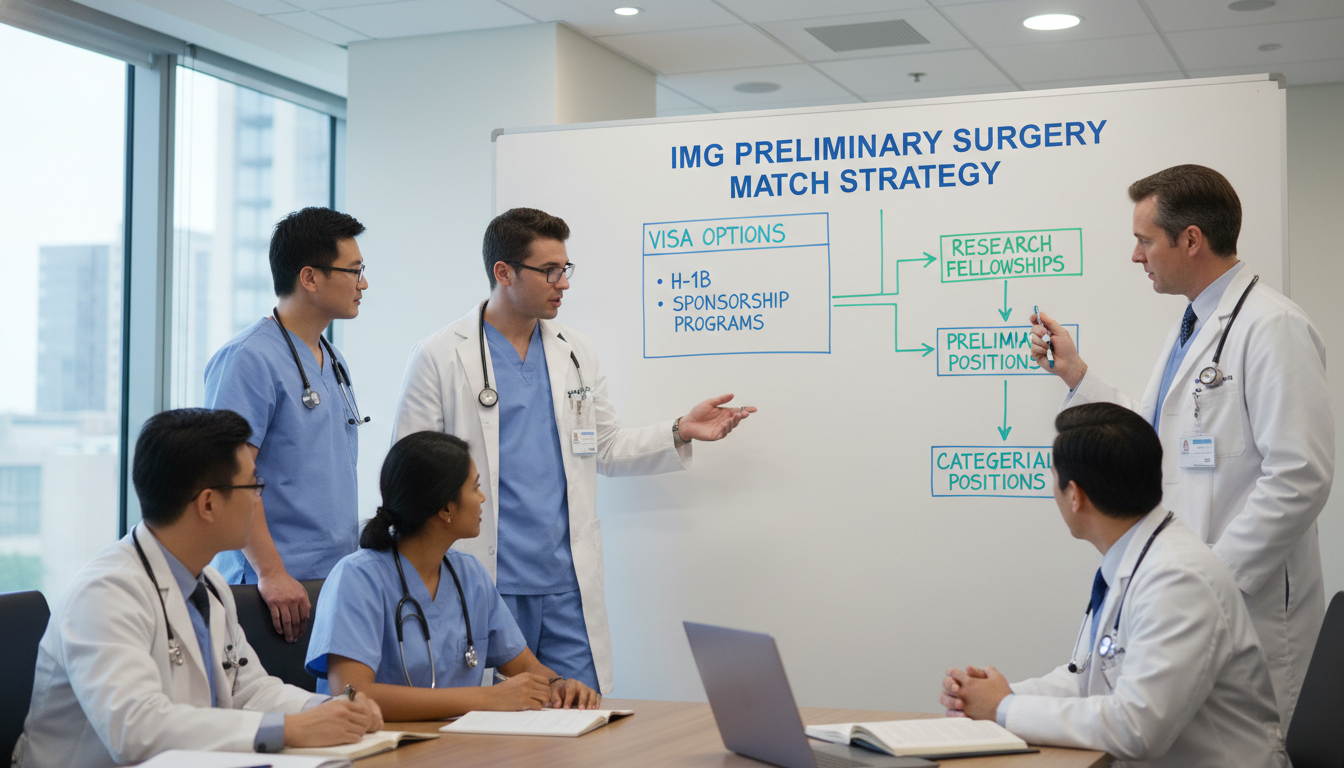
5. Using a Prelim Surgery H-1B Year Strategically for Your Career
Even if a prelim year is “only” one year, it can play a powerful role in your long-term US career plan—especially if you secure H-1B sponsorship.
5.1 Scenarios Where a Prelim H-1B Year Helps
1. Transition to Categorical General Surgery at Same Institution
- You start as a prelim PGY‑1 on H-1B.
- A categorical spot opens in PGY‑2 or PGY‑3 due to attrition or expansion.
- If your performance is strong, the program may internally promote you.
- Your existing H-1B might be amended/extended, not fully re-filed, simplifying continuity.
2. Strengthening Application for Other Surgical Specialties
If you’re targeting fields like:
- Orthopedic surgery
- Neurosurgery
- Plastic surgery
- Urology (advanced positions)
- Integrated vascular or thoracic programs
A prelim surgery H-1B year:
- Provides robust US clinical and operative experience.
- Yields strong US letters of recommendation from surgeons.
- Demonstrates you can perform in a high-pressure, ACGME-accredited environment.
You can then apply for:
- Categorical PGY‑1 or PGY‑2 positions in general surgery or certain specialties.
- Other H-1B residency programs, using your existing track record as leverage.
3. Transition to Non-Surgical Specialties
Some IMGs use a prelim surgery H-1B year to transition into:
- Internal medicine
- Anesthesiology
- Radiology (if advanced positions allow)
- Neurology, PM&R, or others with PGY‑2 advanced tracks
Your ability to handle a rigorous surgical internship can be a strong selling point for these specialties.
5.2 H-1B Portability After a Prelim Year
If your prelim year is on H-1B, you may want to change employers for a categorical spot.
Important notes:
- H-1B is employer-specific – the new program must file a new H-1B petition (a “transfer” or change of employer, still cap-exempt if both institutions qualify).
- If both are H-1B cap exempt institutions, the transition is generally manageable.
- You must maintain continuous lawful status during the process.
Because of this, when choosing a prelim H-1B program, think ahead:
- Are there other H-1B cap exempt programs nearby or within your network?
- Are there categorical surgery or medicine programs that historically accept transfers?
5.3 Financial and Lifestyle Considerations
While the H-1B costs are mostly borne by the employer:
- Some programs may ask you to cover certain legal fees not prohibited by law or premium processing (always clarify; some institutions forbid asking trainees for visa-related payments).
- H-1B preparation may require:
- Extra time gathering documents,
- Coordinating with lawyers, and
- Monitoring USCIS timelines—on top of a very demanding surgical workload.
Be realistic about emotional and logistical strain. Plan back-up pathways (e.g., applying widely to J-1-friendly programs as insurance) unless H-1B is absolutely essential for your long-term plans.
6. Putting It All Together: A Practical Roadmap for IMGs Seeking H-1B in Preliminary Surgery
To make this IMG residency guide directly actionable, here is a step-by-step roadmap.
Step 1: Clarify Your Long-Term Immigration Strategy
Ask yourself:
- Is avoiding the J-1 2-year home requirement critical for personal, family, or political reasons?
- Do you have a viable path to J-1 waiver (e.g., underserved area jobs, spouse with US status, etc.)?
- Are you planning for early green card sponsorship (e.g., physician NIW, EB-1, etc.)?
If J-1 is workable and widely available, it may be less stressful. If you strongly prefer H-1B, be ready to accept a more competitive and narrow program list.
Step 2: Complete USMLE Step 3 as Early as Possible
- Target Step 3 completion before ERAS opens in September.
- Use elective time, research years, or home preparation to ensure a strong performance.
- If you cannot complete Step 3 early, your H-1B options—especially in prelim surgery—will shrink considerably.
Step 3: Build a Focused, Tiered Program List
When applying:
Tier 1: Known or likely H-1B prelim sponsors
- Identified through FREIDA + direct emails + alumni information.
- Programs that explicitly state or confirm H-1B for prelims.
Tier 2: H-1B-capable institutions (categorical-friendly, prelim unclear)
- Academic, university-affiliated centers with known H-1B use in other departments.
- Contact them early to clarify prelim policy.
Tier 3: J-1 friendly or mixed-visa programs for safety
- If you are willing to accept J-1 as backup, include strong preliminary and categorical programs that are IMG-friendly, even if J-1 only.
Step 4: Present Yourself as a Low-Risk, High-Value H-1B Candidate
In your application and interviews:
- Emphasize:
- Completed Step 3 (mention in multiple sections).
- US clinical or research experience, ideally surgery-related.
- Strong communication skills and cultural competence.
- In interviews, when visa questions arise:
- Clearly state that you understand H-1B requirements,
- Have already completed necessary exams, and
- Are prepared to work closely with their GME office and lawyers.
Programs are more likely to sponsor H-1B for prelim surgery if they see you as:
- Well-prepared,
- Informed, and
- Committed to long-term surgical training.
Step 5: Have Backup Plans Ready
Because H-1B options in prelim surgery are limited:
- Consider applying to:
- Categorical programs in surgery and other specialties that sponsor H-1B.
- Prelim internal medicine positions with H-1B (these are sometimes more common than prelim surgery H-1B).
- If you match into a J-1 prelim:
- Use the year to gain US experience and re-apply for H-1B categorical positions later.
- Reassess long-term immigration and waiver strategies.
Flexible strategy is critical; visa pathways often require adaptation.
FAQ: H-1B Sponsorship for IMGs in Preliminary Surgery
1. Do many preliminary surgery programs sponsor H-1B for IMGs?
No. Compared with categorical positions, relatively few prelim surgery programs are willing to sponsor H-1B. Many prefer J-1 or green card/US citizen applicants for one-year positions. However, some large academic and H-1B cap exempt institutions will consider H-1B for prelims, especially for strong candidates with Step 3 completed. You must identify them individually.
2. Can I start a prelim surgery year on J-1 and switch to H-1B later?
In theory, you could move from a J-1 position to an H-1B at a new institution if you end your J-1 training and move into a completely new role. However, once you are on J-1 for GME, the 2-year home-country requirement may apply after you finish that J-1 program, affecting future visa options. This is a complex area; discuss with an immigration attorney before planning such transitions.
3. Is passing USMLE Step 3 absolutely required for H-1B residency sponsorship?
In practice, yes, for almost all H-1B residency programs, including prelim surgery. Step 3 is required for state licensure and strongly preferred or required by hospital legal departments. A handful of exceptions exist, but they are rare and should not be relied upon. For IMGs aiming for H-1B residency, Step 3 is effectively mandatory.
4. How can I find an accurate H-1B sponsor list for prelim surgery programs?
There is no official, comprehensive H-1B sponsor list dedicated to prelim surgery positions. The most reliable approach is:
- Use FREIDA filters for H-1B-friendly programs.
- Review each program’s GME and residency website.
- Email program coordinators/PDs directly to confirm H-1B availability for prelim positions.
- Network with current or former residents to learn which programs are truly IMG- and H-1B-friendly.
Over time, you can build your own tailored list of H-1B residency programs that fit your profile and goals in preliminary surgery.