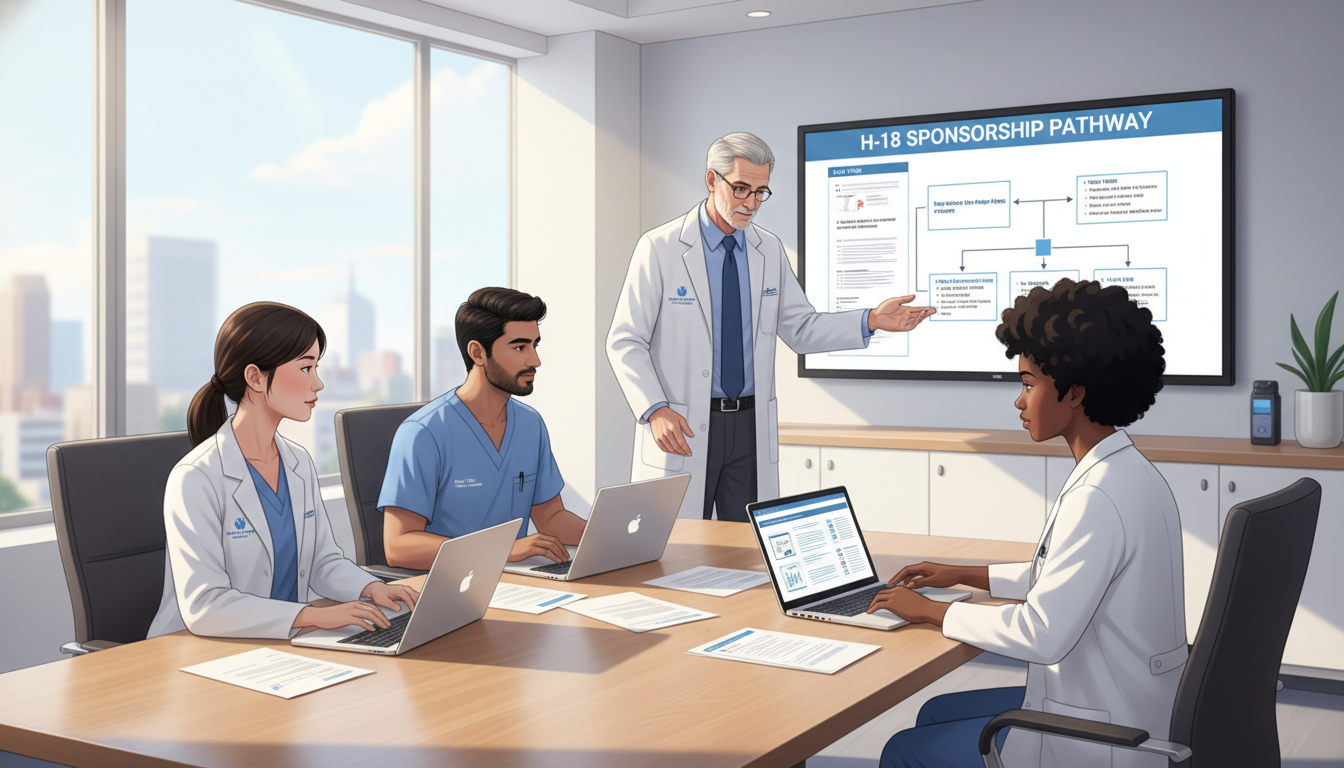
Understanding H‑1B Sponsorship for IMGs in Southern California
For many international medical graduates (IMGs), Southern California represents an ideal combination of rigorous training, diverse pathology, and a vibrant lifestyle. But if you plan to train on an H‑1B visa rather than a J‑1, you need a very specific strategy. This IMG residency guide focuses on H‑1B sponsorship programs in Southern California, how they work, what makes them “H‑1B friendly,” and how to position yourself competitively.
This article is written for IMGs targeting SoCal medical training—from Los Angeles and Orange County to San Diego and the Inland Empire—who are specifically interested in H‑1B residency programs, H‑1B sponsor list considerations, and how H‑1B cap exempt rules apply to residency and fellowship.
H‑1B Basics for International Medical Graduates
Before exploring Southern California residency opportunities, it’s essential to understand the visa framework you’re navigating.
J‑1 vs H‑1B for Residency
Most IMGs use one of two visa types for GME:
- J‑1 (Exchange Visitor Visa)
- Sponsored by ECFMG
- Common, simpler for many programs
- Comes with a 2‑year home residence requirement after training, unless you obtain a waiver
- H‑1B (Temporary Worker Visa, Specialty Occupation)
- Employer-sponsored (your residency program is the sponsor)
- No automatic 2‑year home requirement
- Often preferred for those planning:
- Long-term U.S. practice
- Straight transition to employment without a J‑1 waiver
- Subspecialty fellowship and then U.S. job on H‑1B
However, H‑1B is more complex and not all programs sponsor it.
Key H‑1B Requirements for Residency
Most Southern California residency programs that support H‑1B will expect:
USMLE Step Completion
- Step 1 and Step 2 CK passed before rank list (ideally before interview)
- For H‑1B specifically, USMLE Step 3 is usually required before visa filing
- Practically, many H‑1B‑friendly programs want Step 3 passed before ranking you
ECFMG Certification
- Required for all IMG residency applicants
- Must be completed in time for visa processing
State Medical Board Requirements
- California has its own training license rules
- Your program and hospital office of GME will ensure you meet requirements, but Step 3 timing often needs to align with licensing steps
Program’s Institutional Policy
- Each hospital/health system decides:
- Whether they sponsor H‑1B
- For which specialties
- For what trainee levels (residency and/or fellowship)
- Each hospital/health system decides:
How H‑1B Works in the Residency Context
H‑1B Cap and Cap‑Exempt Status
In the general workforce, the H‑1B visa is subject to an annual cap with a lottery. Graduate medical education is different:
- Most teaching hospitals and universities are H‑1B cap exempt
- That means:
- They can file H‑1B petitions at any time of year
- You do not go through the standard H‑1B lottery
- These positions are not counted against the national cap
For an IMG targeting Southern California residency, this is a major relief: the real challenge is finding a willing sponsor—not winning the lottery.
Cap exempt typically applies if:
- You are employed directly by:
- An institution of higher education (e.g., a university)
- A nonprofit entity affiliated with such an institution (e.g., a teaching hospital)
- Many SoCal academic and large community programs meet these criteria
H‑1B Duration and Extension
- Initial H‑1B approval: up to 3 years
- Total maximum: 6 years (with some exceptions for green card processes)
- Most residencies and fellowships:
- Use one or more H‑1B terms
- May require extension when you move from residency → fellowship → first job
Because residency/fellowship often occur at cap‑exempt institutions, you can change programs within the cap‑exempt environment without the lottery. The main limitation becomes the 6‑year clock.
Why Some Programs Avoid H‑1B
Despite being cap exempt, many Southern California programs are reluctant to sponsor H‑1B due to:
- Administrative overhead and legal fees
- Strict Step 3 timing
- Concerns about:
- Flexibility in extending training
- Trainees switching between programs
- Long‑term institutional policy
For these reasons, your H‑1B sponsor list of potential programs will always be shorter than the overall list of IMG‑friendly residency programs.

Southern California Landscape: Where H‑1B Sponsorship Is More Likely
Southern California’s training landscape spans:
- Major academic medical centers
- Large county and safety‑net hospitals
- Community‑based and university‑affiliated programs
- Private community hospitals
Your odds of finding H‑1B residency programs are usually higher at:
- University and academic centers
- Large county hospitals with academic affiliations
- Well‑resourced community programs with prior IMG sponsorship experience
Below is a conceptual overview to help you understand where to focus. Always verify current policies on each program’s website and contact the program coordinator if the information is unclear, because institutional policies can change from year to year.
1. Los Angeles County and Surrounding Areas
This region includes:
- Major universities and teaching hospitals
- Large county systems with strong IMG representation
- Numerous community and hybrid programs
Potential trends:
- Academic internal medicine, neurology, psychiatry, pathology, and some surgical specialties may have a history of H‑1B sponsorship.
- Some county‑affiliated programs and safety‑net systems are particularly IMG‑friendly but may still prefer J‑1 due to administrative simplicity.
What to look for in program descriptions:
- Mentions of:
- “J‑1 and H‑1B considered”
- “H‑1B sponsorship available for qualified candidates”
- Past residents or fellows with H‑1B noted in alumni or current resident bios
- Explicit wording:
- “We sponsor J‑1 visas only” → not H‑1B friendly
- “We do not sponsor visas” → not IMG‑friendly for non‑green card holders
2. Orange County and Coastal Southern California
This area features:
- University‑affiliated hospitals
- Integrated health systems
- Private community programs with academic ties
For SoCal medical training in this region:
- Core specialties (Internal Medicine, Family Medicine, Pediatrics, Psychiatry) sometimes have more flexible visa policies.
- Smaller programs may sponsor H‑1B selectively for outstanding IMGs with:
- Strong USMLE scores
- U.S. clinical experience
- Solid research or publications
3. San Diego and the Border Region
San Diego offers:
- Large academic medical centers
- Veterans Affairs (VA) hospitals
- Military and civilian training environments
VA facilities themselves do not sponsor H‑1B, but university‑based programs that rotate at VAs often do. Again, the sponsor is the academic institution, not the VA.
Key point: In this region, clarify:
- Who is the legal employer? (University vs. community partner)
- What is their visa policy?
4. Inland Empire (Riverside, San Bernardino) and Smaller Systems
Inland regions have:
- Newer residencies created to serve growing populations
- A strong need for primary care and hospital medicine physicians
- Some systems eager to attract IMGs for long‑term retention
Because many of these programs are newer, visa policies can evolve quickly. Some may be open to H‑1B for strong candidates; others may standardize to J‑1 only.
Building Your Personal H‑1B Sponsor List in Southern California
There is no official, complete, and permanently accurate “H‑1B sponsor list” for residency programs—policies change often. You must construct your own up‑to‑date list using multiple data sources.
Step 1: Use Official Databases Strategically
ERAS / AAMC / FREIDA
- Search programs in:
- California → Southern California cities (Los Angeles, San Diego, Irvine, Riverside, etc.)
- For each program, check:
- “Accepts IMGs” or “Accepts international graduates”
- “Visa types accepted” field or FAQ if available
- Search programs in:
Program Websites
- Most reputable programs have a “Visa Information” or “FAQ” section
- Look for explicit language:
- “We sponsor J‑1 and H‑1B visas”
- “We sponsor only J‑1 visas through ECFMG”
- If unclear, email the program coordinator before applying and ask:
- Whether the program sponsors H‑1B for residency
- Whether H‑1B is limited to certain specialties or PGY levels
- Whether Step 3 must be passed by the time of ranking
Institutional GME Offices
- University GME websites sometimes list:
- Visa policies for all GME programs
- Whether the institution is H‑1B cap exempt
- However, remember: an institution may allow H‑1B, but an individual department might choose not to sponsor it
- University GME websites sometimes list:
Step 2: Use Past Resident Data and Networking
Look up current and former residents
- Program websites often list:
- Country of medical school
- Visa type occasionally shown in alumni bios
- LinkedIn searches of:
- “Program name + MD + H‑1B”
- “Program name + International Medical Graduate”
- Program websites often list:
Ask IMGs currently in the program
- Many IMGs are open to informational emails, especially through:
- Alumni networks
- National medical student/IMG associations
- Ask specifically:
- “Has your program recently sponsored H‑1B for residents?”
- “Is H‑1B limited to certain candidates (e.g., only those with Step 3 and strong scores)?”
- Many IMGs are open to informational emails, especially through:
Conferences and IMG Networks
- Virtual fairs, residency showcases, and IMG‑focused events are prime opportunities to:
- Meet program representatives
- Clarify H‑1B policies directly
- Virtual fairs, residency showcases, and IMG‑focused events are prime opportunities to:

Optimizing Your Application for H‑1B‑Friendly Programs
Once you know where you want to apply, the next challenge is being competitive enough that a program decides you’re worth the effort of H‑1B sponsorship.
1. Step Exams and Timing
For H‑1B residency programs, USMLE Step 3 is your leverage.
Actionable timing strategy:
- Aim to complete:
- Step 1 and Step 2 CK with strong scores before you apply through ERAS
- Step 3:
- Ideally by December–January of the application cycle
- Many H‑1B programs want a passing Step 3 score before the rank list deadline (February/March)
Practical tips:
- If you are serious about H‑1B and Southern California:
- Consider taking Step 3 while you are in a U.S. clinical or observership setting
- Build a dedicated 4–6 week Step 3 study schedule well before interviews
- Communicate Step 3 plans in your application:
- In your personal statement or ERAS experiences section:
- “USMLE Step 3 scheduled for [month/year]; pursuing H‑1B‑sponsoring residency programs.”
- In your personal statement or ERAS experiences section:
Programs see this as a sign you understand the H‑1B process and are proactively planning.
2. Strong IMG Profile Targeted to SoCal
To stand out for SoCal medical training on H‑1B:
US Clinical Experience (USCE)
- Seek rotations or observerships specifically in California or similar health systems
- Prioritize:
- Academic hospitals
- Safety‑net/county systems
- High‑volume community teaching centers
Letters of Recommendation
- At least 2–3 letters from U.S. attending physicians
- Ideally:
- Same specialty you’re applying to
- From institutions with GME programs or academic affiliations
Personal Statement: Regional Fit
- Emphasize:
- Familiarity with diverse, multilingual, socioeconomically varied patient populations
- Experience with underserved communities and safety‑net medicine
- Clearly explain:
- Why Southern California specifically
- Your intention to practice in similar communities long‑term
- Emphasize:
3. Addressing Visa and Long‑Term Plans in Interviews
Programs may hesitate to sponsor H‑1B if they fear short‑term commitment. You can strategically address this.
When and how to discuss H‑1B:
Before interview invitations:
- Clarify by email if they consider H‑1B at all
- If they do not, no need to push further
During interviews (if applicable):
- If asked about visa:
- Be concise and confident:
- “I am ECFMG certified and have already passed Step 3 (or scheduled it). I am seeking programs that either sponsor J‑1 or H‑1B. I understand the requirements for H‑1B and am prepared for the documentation and timelines if your program offers it.”
- Be concise and confident:
- Highlight:
- Your long‑term plan to serve U.S. communities
- Willingness to work in underserved or high‑need areas after training
- If asked about visa:
Avoid:
- Over‑focusing on immigration details at the expense of your clinical strengths
- Appearing inflexible (e.g., “H‑1B only or nothing”) if the program has not clearly committed to H‑1B sponsorship
Strategic Considerations: H‑1B vs J‑1 for SoCal IMGs
Even for IMGs strongly attracted to H‑1B, it is wise to understand the trade‑offs in the Southern California context.
Advantages of H‑1B for IMGs
- No J‑1 home residence requirement
- You can transition to:
- Fellowship on H‑1B
- Employer‑sponsored green card pathways
- Long‑term employment in the U.S. without the two‑year home return obligation
- You can transition to:
- Employer alignment
- Residency program/institution has a direct stake in your success and may support future steps
- Flexibility for spousal careers
- Spouses on H‑4 may gain employment authorization once you reach certain immigration milestones (e.g., I‑140 approval)
Drawbacks or Challenges for H‑1B
- More limited number of programs
- Especially in competitive Southern California markets
- Strict Step 3 timing
- Adds academic pressure
- Higher administrative costs for the program
- Some programs reserve H‑1B only for top candidates or certain specialties
When J‑1 Might Be More Practical
You might lean toward J‑1 if:
- You have not yet passed Step 3 and cannot realistically do so before ranking
- Your main priority is maximizing the number of SoCal interviews and match chances
- You are open to:
- Completing a J‑1 waiver job in a high‑need area
- Possibly outside Southern California (e.g., Central Valley, other U.S. states)
Some IMGs match J‑1 in Southern California, complete residency, secure a waiver in a different region, then return to SoCal later for permanent roles.
Step‑by‑Step Action Plan for a Southern California H‑1B Strategy
To put everything together, here is a concrete roadmap:
18–24 Months Before Match
- Map your exam strategy:
- Finish Step 1 and Step 2 CK early
- Plan Step 3 no later than winter of your application year
- Start U.S. clinical experience, ideally with exposure to Southern California or similar systems
- Map your exam strategy:
12–15 Months Before Match
- Build your preliminary H‑1B sponsor list:
- Use FREIDA, ERAS, program websites, and networking
- Categorize:
- “Confirmed H‑1B”
- “J‑1 only”
- “Unclear—need to contact”
- Reach out to unclear programs with a concise email:
- Introduce yourself briefly
- Ask directly if they sponsor H‑1B for residency
- Build your preliminary H‑1B sponsor list:
9–12 Months Before Match (Application Season)
- Take Step 3 (if ready) or schedule it
- Prepare ERAS with:
- U.S. LORs
- Clear experiences reflecting readiness for U.S. training
- Apply broadly:
- Include a core set of H‑1B‑friendly programs in Southern California
- Add J‑1‑friendly SoCal programs if you’re open to J‑1 as a secondary path
- Consider H‑1B‑friendly programs in other regions as a backup
Interview Season
- Clarify visa policies for each program before interviews
- In interviews:
- Present yourself first as a strong clinician and team member
- Then indicate your visa readiness (ECFMG, Step 3 status, understanding of H‑1B)
- After interviews:
- Send thank‑you notes emphasizing:
- Fit with the program’s patient population
- Long‑term commitment to practice in similar communities
- Send thank‑you notes emphasizing:
Post‑Match
- Once matched to an H‑1B‑sponsoring program:
- Coordinate closely with GME and immigration/legal office
- Provide all documents quickly (medical diploma, ECFMG certificate, exam scores, passport)
- Track timelines:
- H‑1B petition filing
- Start date
- Any contingencies related to Step 3 or state license
- Once matched to an H‑1B‑sponsoring program:
FAQs: H‑1B Sponsorship for IMGs in Southern California
1. Are most Southern California residency programs H‑1B friendly for IMGs?
No. Many SoCal programs accept IMGs but prefer J‑1 due to simpler processing. A smaller subset regularly sponsors H‑1B, typically large academic centers and some well‑resourced community programs. You must research each program individually and build your own up‑to‑date H‑1B sponsor list.
2. Do I absolutely need USMLE Step 3 for H‑1B residency sponsorship?
In practice, yes for almost all programs. Most H‑1B residency programs require Step 3 passed before they can file the visa, and some require it before ranking you. There are occasional exceptions, but relying on them is risky. If you are serious about SoCal H‑1B programs, plan to complete Step 3 early.
3. Are residency H‑1B positions subject to the national H‑1B cap and lottery?
Generally no. Most teaching hospitals and universities in Southern California qualify as H‑1B cap exempt employers. This means your residency H‑1B is not subject to the lottery, and they can file at any time in the year. The real limitation is whether the program is willing to sponsor H‑1B at all.
4. If I train on H‑1B in Southern California, will my first attending job also be cap exempt?
Not necessarily. Your residency may be cap exempt, but a future employer (e.g., private group or non‑teaching hospital) could be cap subject. That means you might need:
- To find another cap‑exempt employer (e.g., academic center)
- Or go through the regular H‑1B lottery if your new job is cap‑subject
Planning your post‑residency visa path should start during residency, especially if you aim to remain in Southern California long term.
By understanding how H‑1B works in the residency context, strategically targeting Southern California residency programs that truly support IMGs, and planning your Step 3 and application timeline carefully, you can significantly improve your chances of securing the right training environment—and building a sustainable U.S. career—on an H‑1B visa.