Understanding H-1B Sponsorship for IMGs
For many international medical graduates, an H-1B visa is the preferred pathway to train and work in the United States. Compared with the J-1, the H-1B can provide more long‑term flexibility and avoid the two‑year home residency requirement that often limits future options. However, navigating H-1B residency programs, US immigration rules, and hospital policies can be challenging without a clear roadmap.
This IMG residency guide focuses specifically on H-1B sponsorship strategies—how the visa works, which programs are likely to sponsor, and how you can position yourself as a competitive candidate.
What is the H-1B Visa in the Residency Context?
The H-1B is a temporary work visa for “specialty occupations” that require at least a bachelor’s degree (medicine qualifies). For residency and fellowship:
- You are an employee of the hospital or university, not an exchange visitor.
- The program is your sponsor and must file the H-1B petition.
- You are tied to that employer and location (and often the specific program) unless you file for a change of employer.
Key features for physicians:
- Dual intent allowed – you can apply for a green card while on H-1B.
- No two-year home requirement – unlike J-1, there is no automatic obligation to return home.
- Duration – generally up to 6 years total (initial 3 years + extensions), often enough for residency and many fellowships, but not always enough for long subspecialty paths.
Core Requirements for Physician H-1B Sponsorship
Most residency programs that sponsor H-1B will expect that you:
- Have passed USMLE Steps 1 and 2 CK (and often Step 3).
- Hold a valid ECFMG certification by the start of PGY-1.
- Have a state medical training license or full license eligibility, depending on the state.
- Meet hospital and HR policies regarding H-1B sponsorship (not all institutions allow it).
In practice, Step 3 is often the key differentiating requirement between J-1 and H-1B for residency.
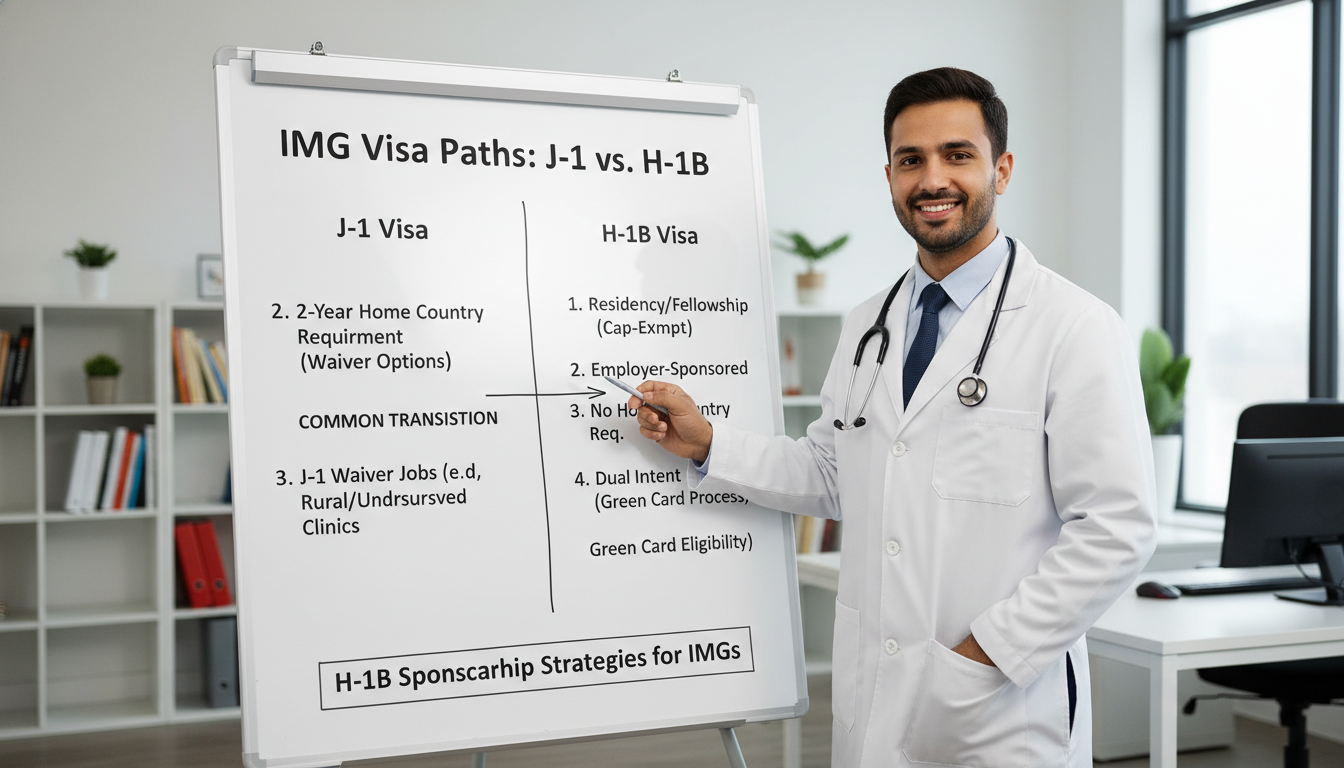
H-1B vs J-1: Strategic Comparison for IMGs
Choosing between J-1 and H-1B is one of the biggest strategic decisions for an IMG. Not every applicant can realistically secure H-1B sponsorship, but understanding the trade‑offs will help you plan your path.
Advantages of H-1B for IMGs
No J-1 2-Year Home Residency Requirement
- J-1 physicians are usually required to return to their home country for 2 years after training, unless they obtain a waiver.
- H-1B physicians do not have this requirement, which gives more flexibility in:
- Applying directly for US fellowships
- Applying for hospitalist or attending jobs immediately after residency
- Starting a green card process during or right after training
Better Alignment with Long-Term US Career Goals
- H-1B allows dual intent, meaning:
- You can pursue permanent residency (green card) without violating your status.
- Employers are often more open to sponsoring a green card for H-1B physicians.
- H-1B allows dual intent, meaning:
Simpler Transition Between Jobs (Compared to J-1 Waiver Routes)
- You can often change employers on H-1B (with proper filings) without going through the complex J-1 waiver process.
- For those who want to practice in competitive urban areas after training, H-1B may be more aligned with career goals than J-1 waiver options that are concentrated in underserved or rural areas.
No Need for a J-1 Waiver Program
- You do not need to compete for limited J-1 waiver spots through Conrad 30 or federal agencies.
- You’re not restricted to specific geographic locations for your first job after training.
Disadvantages and Challenges of the H-1B Path
Higher Threshold: Step 3 Before Residency
- Most H-1B residency programs require USMLE Step 3 passed before ranking or at least before July 1.
- Balancing Step 3 with applying and interviewing can be challenging, especially for recent graduates.
More Limited Sponsorship
- Many programs only sponsor J-1 for IMGs because:
- H-1B is more complex for HR and legal departments.
- Some institutions or states have internal policies against H-1B residents.
- This significantly reduces your pool of programs, especially in some specialties.
- Many programs only sponsor J-1 for IMGs because:
Cost and Administrative Burden for the Program
- Programs bear filing fees, legal costs, and administrative work.
- Some institutions have internal guidelines restricting H-1B to fellowship or faculty level only.
Duration Limits
- The 6‑year maximum duration of H-1B can be tight if you plan:
- 3 years of internal medicine + 3 years of fellowship
- Or long specialty routes like neurosurgery plus fellowship
- You will need forward planning to ensure you remain within H-1B limits or transition to another status (e.g., green card).
- The 6‑year maximum duration of H-1B can be tight if you plan:
When Does an H-1B Strategy Make Sense?
Consider strongly pursuing H-1B residency programs if:
- You have or can realistically obtain USMLE Step 3 early.
- You intend to stay and practice long-term in the US.
- You want freedom to choose your first job without J-1 waiver location constraints.
- You are aiming at academic careers or subspecialty training where flexibility and long-term stability are critical.
On the other hand, a J-1 route may be more realistic if:
- You are late in the application cycle and cannot complete Step 3 in time.
- You have limited interview offers and need to maximize program options.
- Your priority is any US training position first, and visa type is secondary.
Identifying and Targeting H-1B Residency Programs
Finding programs that genuinely support H-1B sponsorship requires a combination of research, networking, and strategic planning.
Understanding “H-1B Friendly” vs “H-1B Possible”
Programs fall into a few broad categories:
Consistently H-1B Friendly
- Publicly state that they sponsor H-1B for IMGs.
- Have current residents or fellows on H-1B.
- Have established HR and legal processes for physician H-1Bs.
Conditionally H-1B Friendly
- Sponsor H-1B only when candidates meet extra criteria:
- USMLE Step 3 completed by Rank List deadline
- Strong US clinical experience
- Priority specialty needs or outstanding qualifications
- May say “H-1B considered on a case-by-case basis.”
- Sponsor H-1B only when candidates meet extra criteria:
Officially J-1 Only
- Program materials and HR policies explicitly state no H-1B sponsorship for residency.
- Sometimes may sponsor H-1B for fellows or faculty only.
Recognizing which category a program belongs to will help you build a realistic H-1B sponsor list and avoid wasted applications.
Step-by-Step: How to Build Your H-1B Sponsor List
Start with Public Databases and Prior Research
- Use publicly available lists and forums that compile:
- H-1B residency programs in internal medicine, pediatrics, psychiatry, etc.
- Past H-1B filings for hospitals (US Department of Labor’s H-1B disclosure data).
- Treat these lists as starting points, not guarantees, because policies change.
- Use publicly available lists and forums that compile:
Review Program and Institution Websites Carefully
Look at:
- FAQ and “For IMGs” sections
- GME office or HR pages for visa policies
- Any mention of:
- “We sponsor J-1 and H-1B visas.”
- “We are unable to sponsor H-1B visas for residency applicants.”
Pay attention to:
- Whether they require USMLE Step 3.
- Whether they differentiate between residency vs fellowship H-1B sponsorship.
Cross-Check with Current Residents
- Go to the Current Residents/Fellows page.
- Look for:
- International graduates with non-US/Canadian medical schools.
- If any list “Visa: H-1B” or show graduation from countries commonly requiring H-1B.
If the site doesn’t show visas, search LinkedIn for “H-1B resident [program name]” or “[program name] H-1B internal medicine resident.”
Contact the Program or GME Office Professionally
When in doubt, send a concise email:
Address:
- Program coordinator
- Program director
- Or GME office (if visa questions are centralized)
Ask specific questions:
- Whether the program sponsors H-1B for residency (not only fellowship).
- Whether Step 3 is required before rank or only before July 1.
- Any restrictions (e.g., H-1B cap exempt only, no transfers, etc.).
Keep it professional and brief; avoid emotional appeals.
Use Historical H-1B Data
- The US Department of Labor publishes data on H-1B petitions by employer.
- Search for the hospital’s name to see if they have filed physician H-1B petitions.
- This doesn’t guarantee residency sponsorship, but it shows institutional familiarity with H-1B.
H-1B Cap-Exempt Status and Why It Matters
Most residency programs are at universities or affiliated teaching hospitals, which are typically H-1B cap exempt. This is a major advantage for IMG physicians.
- H-1B cap usually applies to private employers and is numerically limited each fiscal year.
- H-1B cap exempt employers:
- Can file H-1B at any time of the year.
- Are not subject to the annual quota.
- Include:
- Universities and affiliated nonprofit hospitals.
- Nonprofit research organizations.
- Government research organizations.
For you, this means:
- Residency H-1B petitions are generally cap exempt, avoiding the lottery.
- Future fellowship at an academic center is usually also H-1B cap exempt.
- Later transition to a private practice job may require cap-subject H-1B or another pathway (e.g., green card, O-1).
When building your H-1B sponsor list, favor academic or major teaching hospitals that are clearly H-1B cap exempt whenever possible.
Application Strategy: Maximizing Your Odds for H-1B Sponsorship
Applying strategically is just as important as meeting basic visa requirements. You need your profile and application materials to make H-1B sponsorship feel “worth it” to the program.
Make Step 3 a Core Strategic Priority
For an IMG aiming for H-1B, USMLE Step 3 is not optional—it’s a strategic weapon.
Ideal timeline:
- Take Step 3 before or during the application season.
- Have your Step 3 score reported before rank list deadlines (February).
Why it matters:
- Many programs will not even consider an H-1B petition unless Step 3 is passed.
- Step 3 reassures the program and state medical board that you can progress smoothly.
Actionable advice:
- Plan Step 3 study early, ideally during or immediately after clinical rotations/USCE, while clinical reasoning is fresh.
- If you must take Step 3 later, communicate your timeline clearly to interested programs.
Strengthen Your Overall Competitiveness
Because H-1B sponsorship costs money and time, programs usually reserve it for highly competitive applicants. To stand out:
USMLE Performance
- Aim for strong Step 2 CK scores, especially with Step 1 now pass/fail.
- A solid Step 3 score further provides reassurance.
Robust US Clinical Experience (USCE)
- At least 2–3 months of hands-on or high-quality observerships in the US.
- Strong letters from US attendings who can compare you favorably with US graduates.
Clear Fit with the Program’s Needs
- Tailor your personal statement and experiences to:
- Their patient population (e.g., underserved, immigrant populations).
- Their research or academic focus.
- Your long-term interest in their specialty environment (community vs academic).
- Tailor your personal statement and experiences to:
Professionalism and Reliability
- Visa sponsorship requires institutional trust.
- Demonstrate reliability and communication skills in:
- Email interactions
- Interview behavior
- Responses to requests for documents
Handling the Visa Question During Interviews
You will almost certainly be asked about your visa needs. Prepare a confident, concise response:
- Be honest and direct: “I would require H-1B sponsorship for residency. I have completed USMLE Step 3 and will have ECFMG certification by July.”
- Emphasize preparedness:
- Mention you are familiar with H-1B requirements.
- Offer to work closely with their GME/HR office.
- Avoid sounding demanding. Frame it as:
- “I understand it requires extra effort by the program, and I appreciate any consideration you can give.”
Example script:
“As an international medical graduate, I will require work authorization. My preferred route is H-1B, and I have already passed USMLE Step 3. I’ve reviewed your institution’s general visa policies, and I’m prepared to provide any documentation promptly if matched. I understand this is an additional administrative task, and I truly appreciate any support you can offer.”
Balancing H-1B vs J-1 Programs on Your Rank List
You may face a tough decision: Should you rank a J-1 program higher than an H-1B program if it seems stronger overall?
Consider:
- Your long-term goals:
- If you are committed to staying in the US and wish to minimize immigration hurdles, H-1B may justify ranking slightly lower-tier programs higher.
- The reliability of the program’s H-1B promise:
- Is their sponsorship history consistent?
- Have you confirmed policies in writing?
Many IMGs choose a mixed strategy:
- Apply widely, including J-1 and H-1B residency programs.
- Interview broadly and gather more detailed visa information directly.
- Rank according to the blend of training quality, visa type, and long-term career impact.

Beyond Residency: Fellowships, Jobs, and Long-Term Planning on H-1B
An effective IMG residency guide should not stop at Match Day. Your H-1B strategy needs to anticipate fellowship and first job decisions as well.
Transitioning from Residency to Fellowship on H-1B
Key considerations:
Staying in the Same Institution
- If you match into fellowship at the same hospital/university:
- Your H-1B can typically be extended or amended relatively smoothly.
- Still requires petition filing, but with familiar HR processes.
- If you match into fellowship at the same hospital/university:
Moving to a Different Institution
- You’ll likely need an H-1B transfer (change of employer).
- If both institutions are H-1B cap exempt (most academic centers are), you remain H-1B cap exempt.
- Ensure there is:
- No gap in status.
- Proper coordination between old and new institutions’ HR/legal teams.
H-1B Time Limits
- Keep track of total time spent in H-1B status across residency and fellowship.
- If your combined training exceeds or approaches 6 years, discuss:
- Early green card sponsorship
- Possible O-1 pathway (for exceptional achievements)
First Job After Training: Academic vs Private Practice
Your visa options after training depend heavily on the employer type:
Academic or Teaching Hospital (Cap Exempt)
- Often can continue an H-1B cap exempt position with no lottery issue.
- More likely to sponsor a green card (EB-2 or EB-1) if you have academic achievements.
Private Practice or Non-Affiliated Hospital (Cap Subject)
- H-1B will be cap subject and require:
- Successful selection in the H-1B lottery (if you are not already counted or cannot port your cap).
- Some IMGs transition via:
- J-1 waiver (if they took J-1 paths).
- Green card before or at the time of job start (if possible).
- O-1 visa in some specialty cases.
- H-1B will be cap subject and require:
Your safest long-term approach as an H-1B resident:
- Seek an academic fellowship and job at cap-exempt institutions while starting green card processes early.
- Build a profile that might support national interest waiver (NIW) or EB-1 in the future.
Contingency Planning: If H-1B Is Not Possible
Despite strong planning, some IMGs find that:
- Programs they match into only sponsor J-1.
- H-1B is not approved or delayed due to institutional or regulatory changes.
In such scenarios:
J-1 as a Backup Pathway
- Accept that J-1 is still a valid route to US training.
- Later explore J-1 waiver programs (e.g., Conrad 30, VA, federal waivers).
Alternative Non-Training Paths
- Rarely, some IMGs pivot to:
- Research positions on J-1 research or H-1B research.
- Non-clinical careers (e.g., pharma, consulting) that can sponsor different types of visas.
- Rarely, some IMGs pivot to:
Reapplication Strategically
- If you decide to reapply:
- Use time to strengthen your CV:
- More USCE
- USMLE Step 3
- Research and publications
- Target programs confirmed as H-1B friendly.
- Use time to strengthen your CV:
- If you decide to reapply:
Practical Checklist and Timeline for IMG H-1B Strategy
18–24 Months Before Residency Start
- Take USMLE Step 1 and Step 2 CK; aim for strong performance.
- Start planning US clinical experience (observerships, externships).
- Research specialties and competitiveness relative to your profile.
12–18 Months Before Residency Start
- Schedule USMLE Step 3 (if possible) to be done before or during application season.
- Begin building your H-1B sponsor list:
- Identify H-1B residency programs by specialty.
- Check institutional policies, websites, and IMG forums.
Application Season (ERAS Opening to Rank List Deadline)
- Finalize ERAS application, highlighting:
- USCE
- Step 3 (planned or completed)
- Long-term US career goals
- Apply broadly with a mix of J-1 and H-1B friendly programs, weighted toward realistic options.
- During interviews:
- Clarify visa policy and Step 3 deadlines.
- Communicate your H-1B preference professionally.
After Interviews, Before Rank List Submission
- Update programs when you receive Step 3 results.
- Confirm H-1B feasibility for your top-choice programs.
- Construct a rank list that balances:
- Training quality
- Visa type (H-1B vs J-1)
- Long-term career impact.
FAQs: H-1B Sponsorship Programs for IMGs
1. Do I absolutely need USMLE Step 3 to get H-1B sponsorship for residency?
For almost all H-1B residency programs, yes. State medical boards and institutional policies generally require Step 3 before an H-1B petition can be filed for a trainee physician. Some programs may interview you while Step 3 is pending, but they will expect a passing score before rank list finalization or before July 1. Without Step 3, your H-1B options are extremely limited; J-1 becomes the default route.
2. How can I tell if a program is truly H-1B friendly and not just “case-by-case”?
Look for multiple indicators:
- Clear written statements on their website supporting H-1B sponsorship for residency.
- Current or recent residents who are IMGs on H-1B.
- Consistent responses when you or other applicants email the coordinator or GME office.
- An institutional track record of H-1B petitions (visible in public DOL databases).
Programs that say “case-by-case” are legitimate possibilities, but often reserve H-1B for exceptional candidates or specific departmental needs.
3. Are all residency programs H-1B cap exempt?
No, but most major academic centers and university-affiliated teaching hospitals are H-1B cap exempt. Smaller community hospitals or private institutions may be cap subject, which complicates timing and lottery issues. Always verify:
- Whether the hospital is classified as a nonprofit affiliated with a university or as a cap-exempt employer.
- Whether their HR has experience with cap-exempt physician H-1Bs.
This will typically be clarified by the GME or HR office when you inquire.
4. If I start residency on J-1, can I later switch to H-1B for fellowship or a job?
Yes, many physicians switch from J-1 to H-1B after obtaining a J-1 waiver (for example, through Conrad 30 programs or federal waivers). However:
- You must satisfy or waive the 2-year home residency requirement first.
- Once you obtain a J-1 waiver position, that waiver job will often be on H-1B.
- Directly switching from J-1 to H-1B without dealing with the 2-year requirement is generally not possible.
If you already know you prefer long-term H-1B status, it is better to start with H-1B at the residency level if feasible.
By understanding how H-1B residency programs operate, building a realistic H-1B sponsor list, prioritizing Step 3, and aligning your long-term immigration planning with your training choices, you can significantly improve your chances of creating a stable, sustainable medical career in the United States as an international medical graduate.