
The biggest myth about physician jobs is that urban always means higher pay. The data shows that, once you adjust for hours, call, and cost of living, rural physicians often come out ahead—sometimes far ahead.
If you are coming out of residency and staring at two offers—a big-city academic center versus a small-town hospital—you are not choosing between “high pay and prestige” versus “lower pay and slower pace.” That mental model is outdated and wrong in most specialties.
Let’s walk through the numbers. Not vibes. Not anecdotes from the one cardiologist who “made bank” in Manhattan. Actual compensation, workload, and lifestyle metrics that determine how much your time is worth.
1. Compensation: Headline Salaries vs Real Purchasing Power
Urban vs rural pay comparisons get messy because people stop at the base salary line. That line lies or, at best, only tells half the story.
Across multiple MGMA, AMGA, and state workforce reports over the last few years, four patterns show up repeatedly:
- Rural and non‑metro areas usually offer:
- Higher base salaries
- Larger sign‑on bonuses
- More generous loan repayment
- Major metros usually offer:
- Lower base salaries
- Smaller or no sign‑on
- Minimal loan repayment
- Higher academic-heavy pay structures (RVU + modest base)
So let’s quantify.
Representative starting offers by setting
These are realistic, blended “middle of the road” examples using recent MGMA regional data, state recruitment reports, and market surveys. Think of them as median-ish offers a solid candidate could see—not unicorn jobs, not bottom-of-the-barrel.
| Role / Setting | Urban Academic Center | Urban Private / Large Group | Rural / Small City Hospital |
|---|---|---|---|
| Family Med – Base salary | $210,000 | $230,000 | $260,000 |
| Family Med – Sign‑on bonus | $10,000 | $20,000 | $40,000 |
| Family Med – Loan repayment (first 3 yrs) | $0–$20,000 total | $0–$30,000 total | $60,000–$120,000 total |
| Gen IM – Base salary | $220,000 | $240,000 | $280,000 |
| Gen IM – Sign‑on bonus | $10,000 | $25,000 | $50,000 |
| Gen IM – Loan repayment (first 3 yrs) | $0–$20,000 total | $0–$40,000 total | $80,000–$120,000 total |
Now compare that to typical cost-of-living multipliers. Using Bureau of Economic Analysis regional price parities and common cost-of-living tools, a non‑metro or small-town area is often 20–35% cheaper than a major coastal metro.
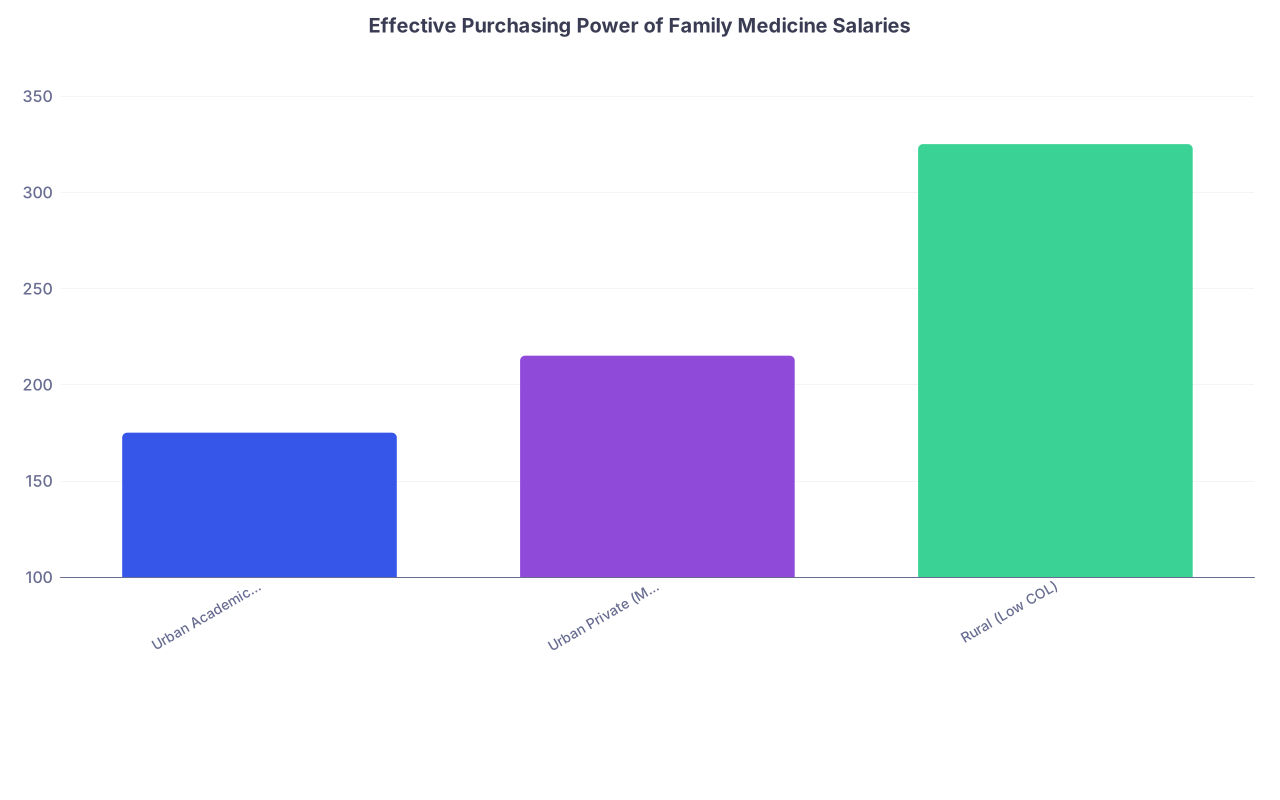
So that $260,000 rural family medicine job in a town with 80% of the cost of living of a big city behaves more like:
- $260,000 ÷ 0.80 ≈ $325,000 “big city equivalent” in purchasing power
Your $210,000 urban academic offer in a city with a cost-of-living index of 120 behaves like:
- $210,000 ÷ 1.20 ≈ $175,000 “real”
You can like the city more and still admit the math is brutal.
| Category | Value |
|---|---|
| Urban Academic (High COL) | 175 |
| Urban Private (Med COL) | 215 |
| Rural (Low COL) | 325 |
Numbers are approximate, but the direction is consistent: on a cost‑adjusted basis, rural and small‑city offers often deliver 40–80% more real purchasing power for primary care and general internal medicine.
Subspecialties show the same pattern, just with bigger dollar signs.
2. Workload: Hours, Call, and “Invisible” Labor
Compensation without workload is meaningless. A $350,000 salary for 70‑hour weeks with q3 call is not a good deal once you actually divide by hours.
Here is how the data generally parses out by setting.
Weekly hours and call burden
Again, these are realistic composite figures using survey data (Medscape Compensation, AMA, specialty societies) plus what I have personally seen in contracts on both sides.
| Metric | Urban Academic | Urban Private / Group | Rural / Small City Hospital |
|---|---|---|---|
| Clinic / ward hours per week | 45–50 | 45–55 | 40–50 |
| Admin / documentation hours | 8–12 | 6–10 | 6–10 |
| Total work hours per week | 55–60+ | 50–60 | 48–55 |
| Nights/week (average) | Variable, q4–q8 | q4–q6 | q4–q7 |
| Weekends/year (inpatient roles) | 14–18 | 12–16 | 10–14 |
Raw hours sometimes look similar. The difference shows up in intensity and “spread.”
Urban academic centers and large groups tend to create:
- Denser templates: 22–26 patients per full clinic day in primary care; 16–22 in subspecialties
- Heavier academic/admin load (meetings, committees, teaching, documentation in multiple systems)
- More fragmented days: split clinics, travel between sites, mid‑day meetings
Rural and small‑city settings more often have:
- Slightly fewer patients per day (18–22 for primary care is common)
- More all‑inclusive work (fewer separate committees, simpler governance)
- Less commute and site hopping
Is rural always “slower”? No. Walk into a two‑physician practice covering a 100‑mile radius and you may see chaos. But on average, the ratio of paid time to actual clinical work is less distorted.
3. Dollars per Hour: The Only Number that Really Matters
Once you normalize for work hours, the compensation gap stops being abstract.
Let us run a simple comparison for a new general internist.
Scenario A: Urban academic general internal medicine
- Base salary: $220,000
- Bonus: $10,000 (assume target met)
- Total cash: $230,000
- Hours: 55 hours/week * 48 working weeks ≈ 2,640 hours/year
Effective hourly rate:
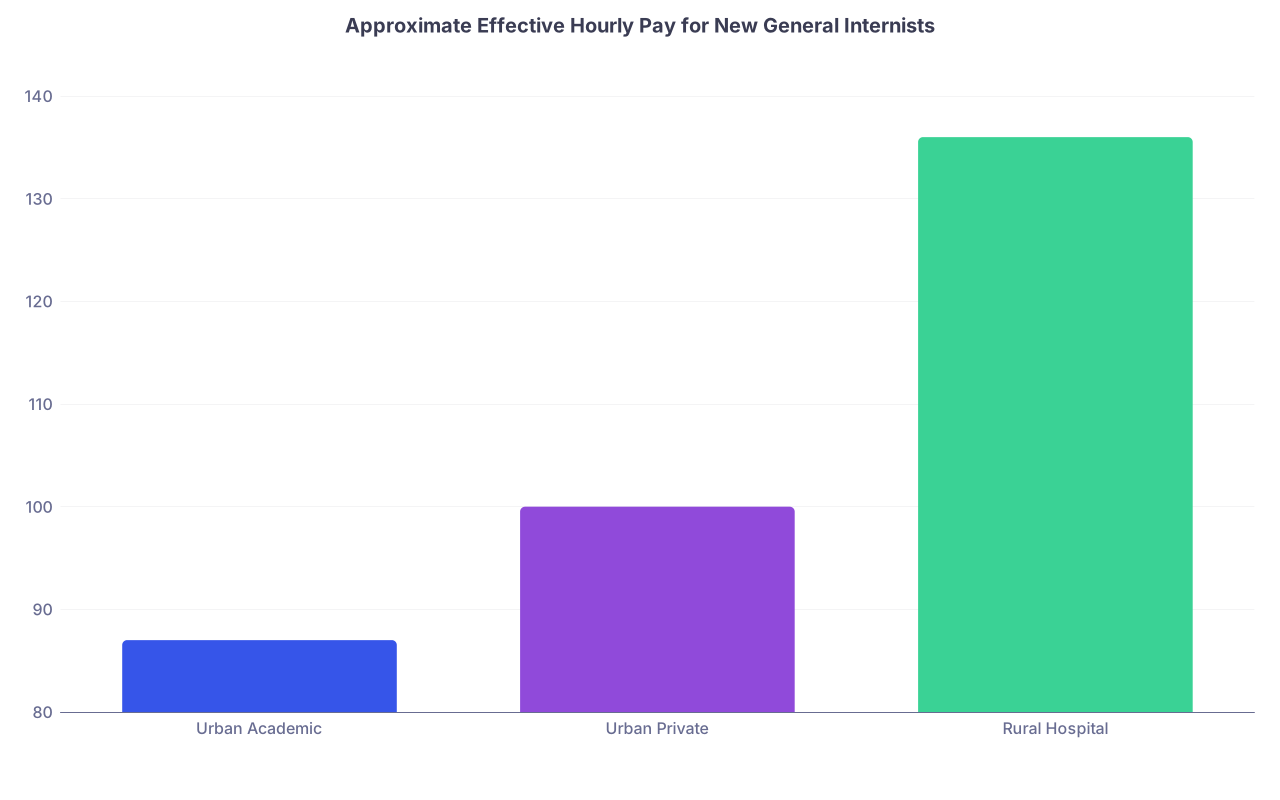
- $230,000 ÷ 2,640 ≈ $87/hour before tax
Scenario B: Urban private group IM (large metro)
- Base salary: $240,000
- Bonus: $20,000 (productivity based)
- Total cash: $260,000
- Hours: 54 hours/week * 48 weeks ≈ 2,592 hours
Hourly:
- $260,000 ÷ 2,592 ≈ $100/hour
Scenario C: Rural hospital‑employed IM
- Base salary: $280,000
- Bonus: $20,000 (quality or RVU)
- Sign‑on spread over 3 years: $50,000 total → ~$17,000/year
- Loan repayment: $90,000 over 3 years → $30,000/year equivalent
- Total economic value per year (salary + prorated sign‑on + loans): $280k + $17k + $30k = $327,000
- Hours: 50 hours/week * 48 weeks ≈ 2,400 hours
Hourly:
- $327,000 ÷ 2,400 ≈ $136/hour
| Category | Value |
|---|---|
| Urban Academic | 87 |
| Urban Private | 100 |
| Rural Hospital | 136 |
That is ~57% higher per hour for the rural job vs the urban academic track. You may still take the academic job—for research, teaching, or family reasons—but do not tell yourself they pay “about the same.”
4. Specialty Differences: Who Gains Most from Rural Jobs?
The rural premium is not uniform. Some specialties barely move. Others jump off the chart.
Pattern from recent MGMA and state recruitment data:
- Primary care (FM, IM, pediatrics): Large rural premium, especially when you factor in sign‑on and loan repayment.
- Outpatient-heavy subspecialties (endocrinology, rheumatology): Noticeable rural premium; demand greatly exceeds supply.
- Procedural subspecialties (GI, cardiology, ortho, general surgery): Mixed. Rural often offers big base salaries, but high‑volume urban private/practice groups can out‑earn them on pure cash, at the cost of more hours and more competitive entry.
- Hospitalist medicine: Rural and small‑city jobs often pay 10–25% more base for similar or slightly higher volumes.
Here is a simplified comparison for starting offers (ballpark medians) by setting:
| Specialty (New Grad) | Urban Academic | Urban Private / Group | Rural / Small City |
|---|---|---|---|
| Family Medicine | $210,000 | $230,000 | $260,000–$280,000 |
| General Internal Medicine | $220,000 | $240,000 | $280,000–$300,000 |
| Hospitalist (7 on / 7 off) | $260,000 | $280,000 | $300,000–$330,000 |
| General Surgery | $380,000 | $420,000 | $450,000–$500,000 |
| Orthopedic Surgery | $500,000 | $550,000–$650,000 | $600,000–$700,000 |
Adjust these by a 20–30% cost-of-living gap and the rural/small‑city advantage widens further, particularly for the cognitive/non‑procedural fields.
5. Cost of Living and Debt: The Silent Multiplier
Two physicians each making $260,000 are not in the same economic universe if one is in San Francisco and the other is in a town with 75% of that cost of living.
Let us run a concrete scenario:
- Two new family physicians, each making $260,000 nominal salary.
- Physician A: Large coastal city, cost‑of‑living index 130 (30% higher than national).
- Physician B: Mid‑size rural/small city, index 80 (20% lower than national).
Normalize their “effective” income:
- A: $260,000 ÷ 1.30 ≈ $200,000 real
- B: $260,000 ÷ 0.80 ≈ $325,000 real
That is a 62.5% real income difference at the same nominal salary.
Now layer in student loans. Assume each has $300,000 at 6.5%.
If Physician B in the rural/small‑city setting gets $30,000/year in loan repayment:
- Effective loan burden is cut from $300,000 to $210,000 over 3 years.
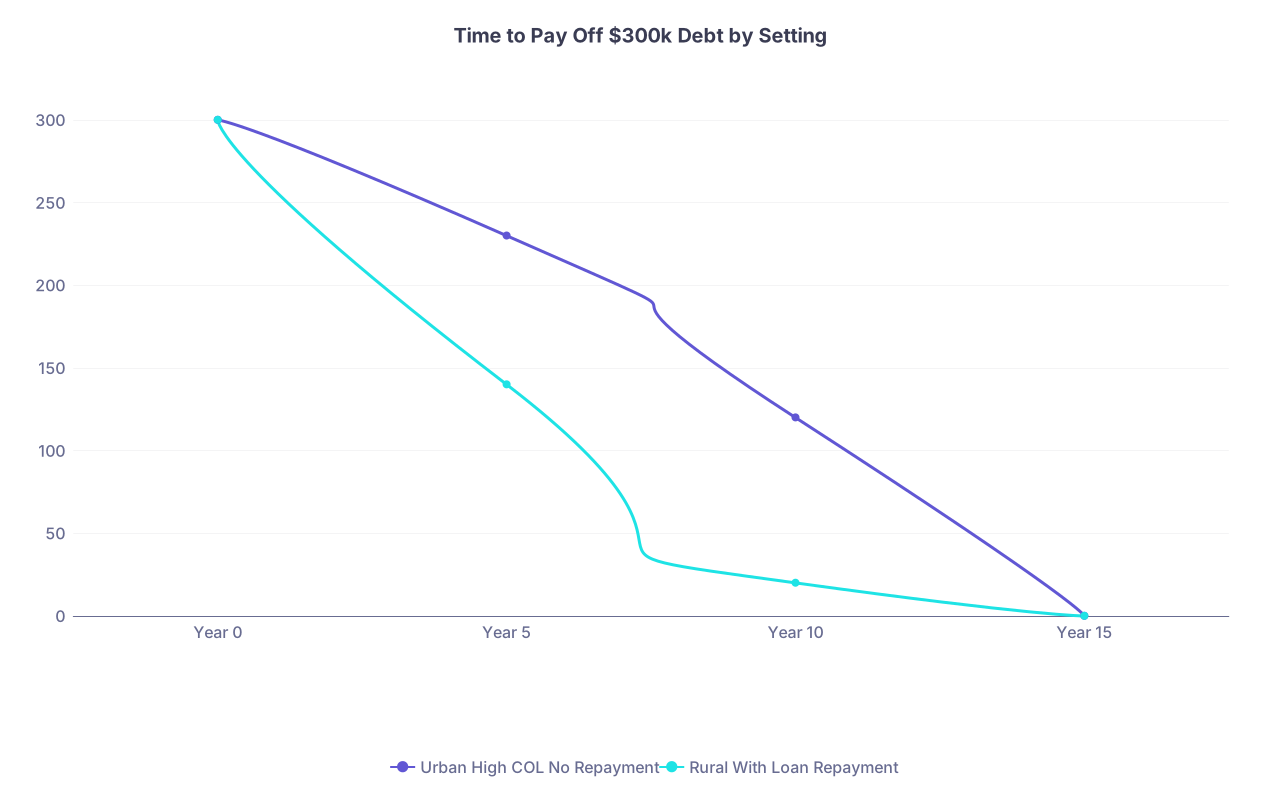
- If they aggressively pay down the rest with their higher real earnings, they can be debt‑free in 5–7 years.
Physician A with no loan repayment and higher living costs has much less surplus to attack the same $300,000. Debt freedom may stretch to 10–15 years unless they squeeze their lifestyle hard.
| Category | Urban High COL No Repayment | Rural With Loan Repayment |
|---|---|---|
| Year 0 | 300 | 300 |
| Year 5 | 230 | 140 |
| Year 10 | 120 | 20 |
| Year 15 | 0 | 0 |
Slightly stylized, but it matches what you see in practice: rural physicians who want to be debt‑free and financially independent early have a powerful set of tools that urban colleagues simply do not.
6. Lifestyle Metrics: Commute, Space, and Non‑Clinical Time
This is where numbers get less precise but still measurable.
Try two more realistic composites:
Urban attending life (large metro)
- Commute: 35–60 minutes each way, 4–5 days per week.
- Rent or mortgage: 30–40% of take‑home for a modest place in a decent neighborhood.
- Childcare: $1,800–$3,000/month per child in many coastal metros.
- On‑call travel time: 20–45 minutes to the hospital if not in‑house.
Rural / small city attending life
- Commute: 5–20 minutes.
- Housing: Often 15–25% of take‑home for a larger house/yard.
- Childcare: $900–$1,500/month per child in many non‑metro areas.
- Call: Often closer to the hospital; sometimes within 5–10 minutes.
That commute difference alone is real time. A 45‑minute each-way commute vs 10 minutes each-way is:
- 70 minutes saved per day
- ~6 hours per week
- ~288 hours per year (48 weeks)
If your rural job also has 3–5 fewer net working hours per week, you can easily gain 400+ hours per year of usable life. That is the equivalent of 10 full workweeks of time, “paid” in lifestyle instead of money.
7. Risks, Trade‑offs, and Non‑Financial Realities
If you stop at the comp tables, you will miss the pitfalls.
Rural and small‑city jobs can come with:
- Professional isolation: Few same‑specialty colleagues, limited backup.
- Scope expansion: You may be pushed to practice more broadly than you are comfortable with if the region has unmet needs.
- Fewer academic/research pathways: If you want a classic academic CV, pure rural is rarely ideal.
- Spouse/partner employment constraints: A serious issue if your partner is also degree‑dependent and job-market sensitive.
Urban jobs bring different drawbacks:
- Saturated markets: For some specialties (e.g., derm, certain IM subspecialties), urban centers are glutted; salaries are capped and partnership tracks longer or more opaque.
- Burnout culture: Middle managers chasing RVUs, unrealistic panel sizes, daily metrics dashboards.
- Higher living cost stress: You can “make” $400,000 and still feel broke in certain metros when you add daycare, housing, and loan payments.
So the rational comparison is not “rural vs urban.” It is:
- How much am I being paid per hour of total work?
- What is the real value after adjusting for cost of living and loan support?
- Does the professional environment fit my risk tolerance and career goals?
Where physicians get burned is ignoring those first two questions and making the decision entirely on the third.
8. A Practical Decision Framework: Quantify Your Two Offers
To make this usable, here is how I would compare an urban and rural job on a spreadsheet before signing anything.

| Step | Description |
|---|---|
| Step 1 | Collect Both Offers |
| Step 2 | Calculate Total Cash Value |
| Step 3 | Estimate Annual Hours |
| Step 4 | Compute Hourly Rate |
| Step 5 | Adjust for Cost of Living |
| Step 6 | Factor Loan Repayment |
| Step 7 | Score Nonfinancial Fit |
| Step 8 | Choose Offer |
Step by step:
Total economic value
Salary + expected bonus + prorated sign‑on + prorated relocation + annualized loan repayment.Hours per year
Clinical + admin + call (yes, estimate call in hours; nights and weekends count).Hourly rate
Total value ÷ hours.Cost-of-living adjustment
Divide that hourly figure by (COL index / 100). Example: Urban index 125 → divide hourly by 1.25.Debt impact
Estimate:- Annual payments you can realistically make in each job.
- Time to pay off all student loans.
Nonfinancial score
Subjective but explicit: rank both jobs 1–10 on:- Career development (teaching, research, subspecialty exposure)
- Family/spouse needs
- Long‑term living preference
- Call stress and backup Then weigh those scores against the financial gap.
Once you do this quantitatively, you will sometimes discover that the glamour urban job is delivering half the real hourly value of the unremarkable small‑city one.
9. Who Should Lean Urban, Who Should Lean Rural?
Based on the numbers and what actually happens to people 5–10 years out:
Leaning URBAN makes sense if:
- You are targeting a clearly academic/research career where prestige signals matter.
- You are in a niche subspecialty that truly depends on tertiary/quaternary centers.
- Your partner’s career essentially locks you to a metro.
- You value cultural/lifestyle amenities enough to accept a 30–50% real income haircut.
Leaning RURAL or SMALL CITY makes sense if:
- You are in primary care, hospitalist medicine, or non‑procedural IM subspecialties.
- Your main goals for the first 5–10 years are debt freedom and financial security.
- You want a higher level of autonomy and community impact.
- You can handle broader scope and somewhat less backup.
Do not romanticize either one. I have seen rural physicians absolutely buried by call and feel trapped; I have also watched urban academic faculty grinding out 60‑hour weeks for $210,000 because they are chasing the next title.
The difference is: the rural attending often has faster paths to financial “exit options” if they choose; the urban attending is more dependent on career ladders they do not control.
10. The Bottom Line
Strip away the noise and the data keeps pointing to the same conclusion:
Rural and small‑city jobs usually deliver significantly higher real compensation per hour—often 40–80% more purchasing power once you include sign‑on, loan repayment, hours, and cost of living.
Urban jobs trade money and time for career branding and amenities. For some physicians, especially those chasing academic careers or specific subspecialty niches, that trade is rational. For many others, it is an expensive reflex, not a data-driven choice.
If you are finishing residency, stop asking “Do I want urban or rural?” and start asking, “What is my real hourly rate and purchasing power in each offer?”
The numbers will usually answer the question faster and more honestly than your gut.