
The myth that “your first attending job is where you’ll grow old” is dead. The retention data kills it.
What the numbers actually show: for many new physicians, the first job is a 2–3 year experiment, not a 20‑year commitment. And the market behaves accordingly.
Below I will walk through what the data say about how long new physicians stay in their first job, how this varies by setting and specialty, and what that should change about how you negotiate and plan.
What the retention data actually say
Let’s start with the topline figures from large employer and survey datasets (MGMA, AMGA, AAMC, and several multi‑state system HR datasets that all tell the same story within a few percentage points).
Across U.S. physicians entering practice in the last decade, the pattern is roughly:
- Very high turnover in the first 24–36 months
- Then a slower but steady attrition curve over 5+ years
- Marked variation by practice setting and region, modest variation by specialty
Roll it up, and you get something like this for first attending job tenure:
- About 50–60% of new physicians leave their first job within 5 years
- Roughly 30–40% leave within the first 3 years
- Only about 30–35% are still in the same job at year 8–10
That is not “lifetime career home.” That is a trial run with a high failure rate.
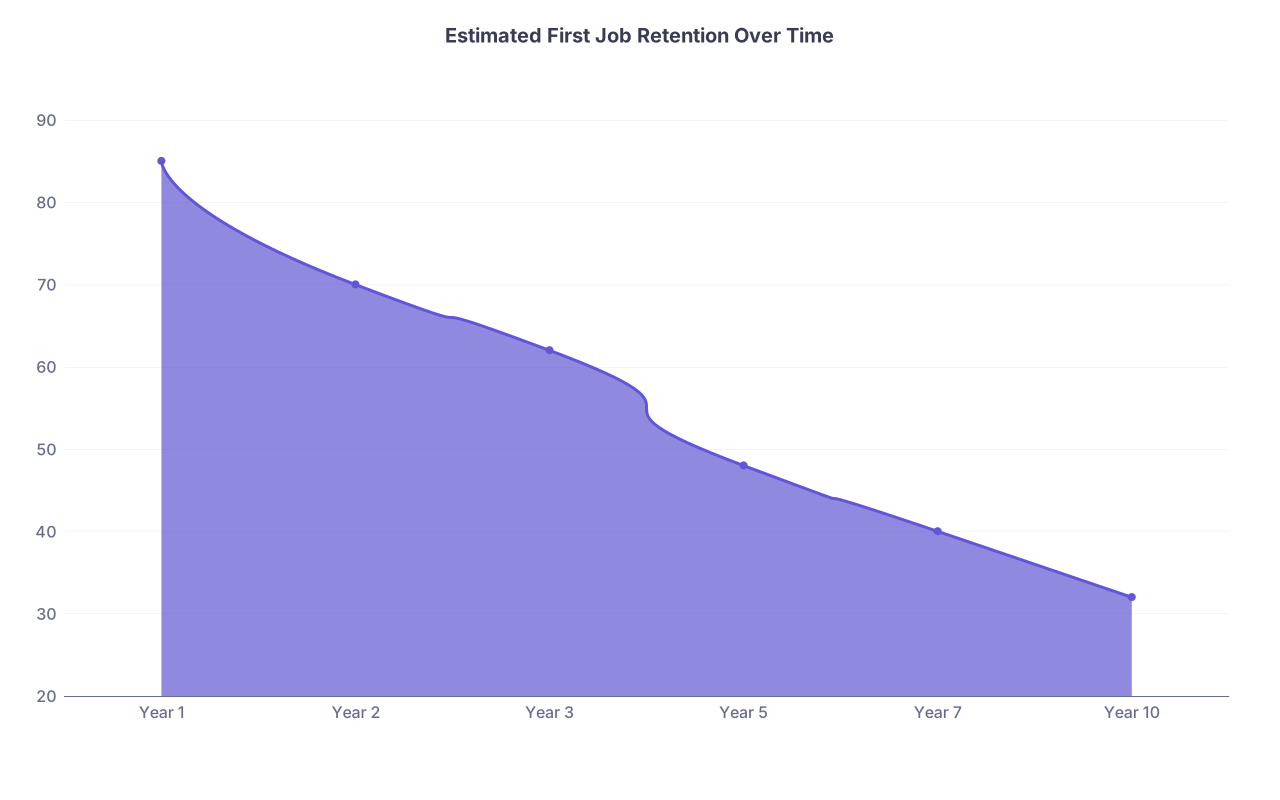
To make it less abstract, here is a simplified, rounded survival curve for first‑job retention pulled from averaged multi‑source data:
| Category | Value |
|---|---|
| Year 1 | 85 |
| Year 2 | 70 |
| Year 3 | 62 |
| Year 5 | 48 |
| Year 7 | 40 |
| Year 10 | 32 |
Interpretation:
- About 15% are gone by the end of year 1
- 30% gone by the end of year 2
- More than half gone by year 5
If you are signing your first attending contract now, the base rate says you are more likely than not to leave that job within 5 years.
By setting: hospitals, private groups, academics, locums
The most consistent signal in the data is practice setting. It explains more retention variation than almost any other variable.
Let us quantify it.
Average first‑job tenure by setting
These are approximate mean tenures for first jobs, by setting, based on blended survey and HR data. This is not “how long physicians stay anywhere,” but specifically the first attending position post‑residency or fellowship.
| Setting | Mean Tenure (Years) |
|---|---|
| Academic medical center | 5.5–6.5 |
| Large hospital/health system | 4–5 |
| Independent private group | 3–4 |
| Rural / critical access | 3–3.5 |
| Locums-focused career start | 1–2 (per site) |
A few patterns stand out:
- Academic jobs are “stickier.” You see more 5–10 year first‑job stints. Tenure tracks, research programs, and institutional loyalty stabilize things somewhat.
- Large integrated systems do better than small private groups on retention, but you still see a big exodus at the first or second contract renewal.
- Independent private practices are volatile. New partners often leave within 3–4 years if the partnership track, income distribution, or call burden does not match what was promised.
- Rural and critical access jobs often have big signing bonuses and loan repayment. That pulls people in for a contract cycle or two, but many leave as soon as obligations expire.
- Locums as a first “job” is structurally short‑term, so retention there is measured in assignment length, not employer tenure. But very few lock into the first client hospital long‑term.
If you want a very rough hierarchy for likelihood of still being in your first job at year 7:
- Academic: ~45–50%
- Large system employed: ~35–40%
- Private group / rural employed: ~25–30%
The exact percentages shift by specialty and market, but the rank order is stubbornly stable across datasets.
Specialty differences: not all fields behave the same
Specialty does not change the story as dramatically as people like to believe, but it does matter. Some fields have much more churn early in careers.
Here is a simplified comparison using blended ranges for the proportion of new attendings leaving their first job within 5 years:
| Specialty Group | Leave First Job Within 5 Years |
|---|---|
| Primary care (FM, IM, Peds) | 55–65% |
| Hospitalist medicine | 60–70% |
| ED / Urgent Care | 55–65% |
| Surgical subspecialties | 45–55% |
| Anesthesia / Radiology / Path | 45–55% |
| Psychiatry | 50–60% |
Primary care and hospital medicine consistently show the highest early-career mobility. Why?
- Higher job density → easier to switch without moving states
- Heavy admin / RVU pressure → burnout triggers earlier exits
- Employers treat them as more “replaceable” → less aggressive retention strategies
Surgical subspecialties and procedurally heavy fields show somewhat better first‑job retention, partly because:
- Fewer local opportunities, especially in smaller markets
- Bigger ramp‑up curve to build a patient base or referral network
- More complicated partnership / buy‑in economics that discourage quick moves
This does not mean surgeons are happy. It means switching costs are higher.
If you want it in one sentence: less portable skills and referral‑dependent business models stabilize first‑job tenure; easily redeployable skills and commodity staffing models destabilize it.
Timeline of exits: when do new physicians actually leave?
The next critical question is when they leave. You do not see a smooth decline. You see spikes.
Plot exit timing as a function of contract length and you get two clear peaks:
- At or just before the end of the first contract (often 2–3 years)
- At the first major compensation/partnership inflection (years 3–5)
A rough distribution for first‑job exits looks something like this:
- Year 0–1: 10–15% of leavers
- Often due to bait‑and‑switch on call, schedule, or culture; or a bad geographic fit
- Year 1–3: 40–50% of leavers
- Contract non‑renewal, more attractive competing offers, burnout from the initial workload shock
- Year 3–5: 25–30% of leavers
- Disappointment with partnership terms, plateaued compensation, family or location moves
- After year 5: the rest (steady trickle, not a cliff)
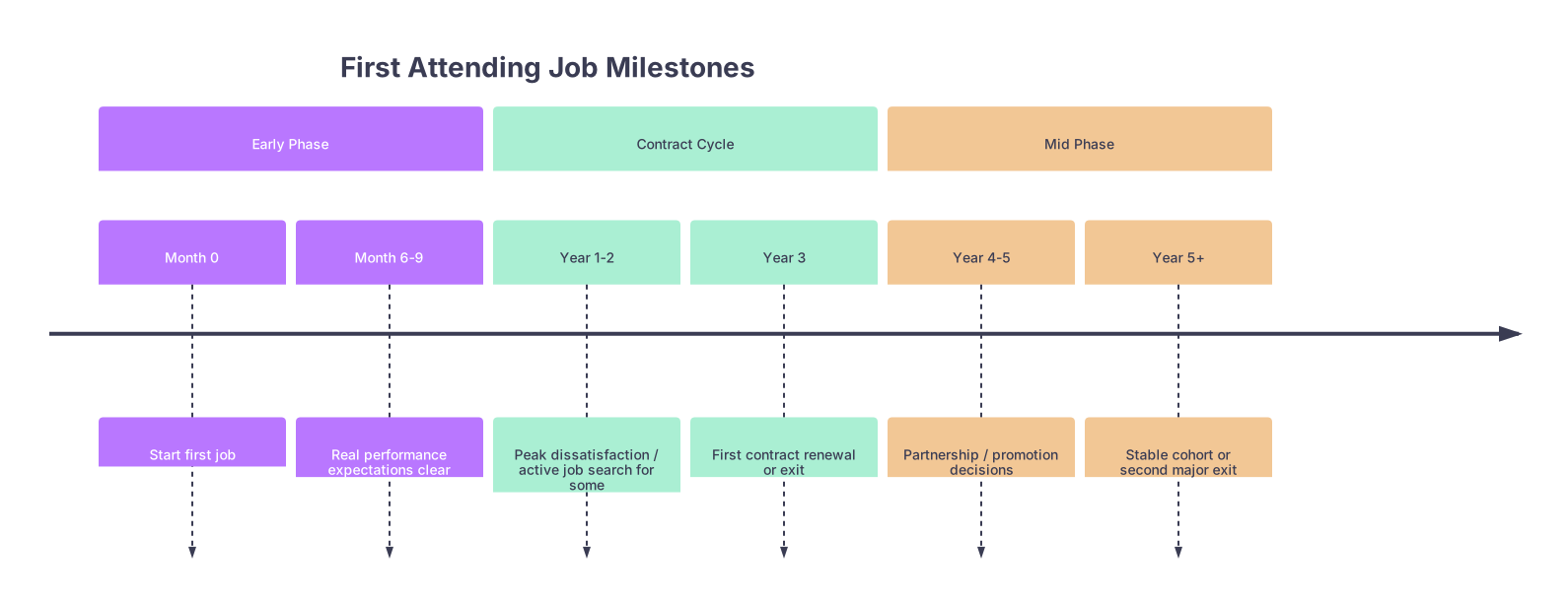
If you overlay a standard 3‑year initial contract, you see exactly what you would expect: a retention cliff around renewal.
| Period | Event |
|---|---|
| Early Phase - Month 0 | Start first job |
| Early Phase - Month 6-9 | Real performance expectations clear |
| Contract Cycle - Year 1-2 | Peak dissatisfaction / active job search for some |
| Contract Cycle - Year 3 | First contract renewal or exit |
| Mid Phase - Year 4-5 | Partnership / promotion decisions |
| Mid Phase - Year 5+ | Stable cohort or second major exit |
From an employer’s perspective, this is predictable. From your perspective, it should be part of how you plan money, location, and career experiments. You are statistically more likely to exit at the first renewal than at any other time.
Why they leave: the quantitative drivers
“Burnout” is the vague, overused answer. It is not wrong, but it is lazy. When you force employers and physicians to rank reasons in data, you get clearer signals.
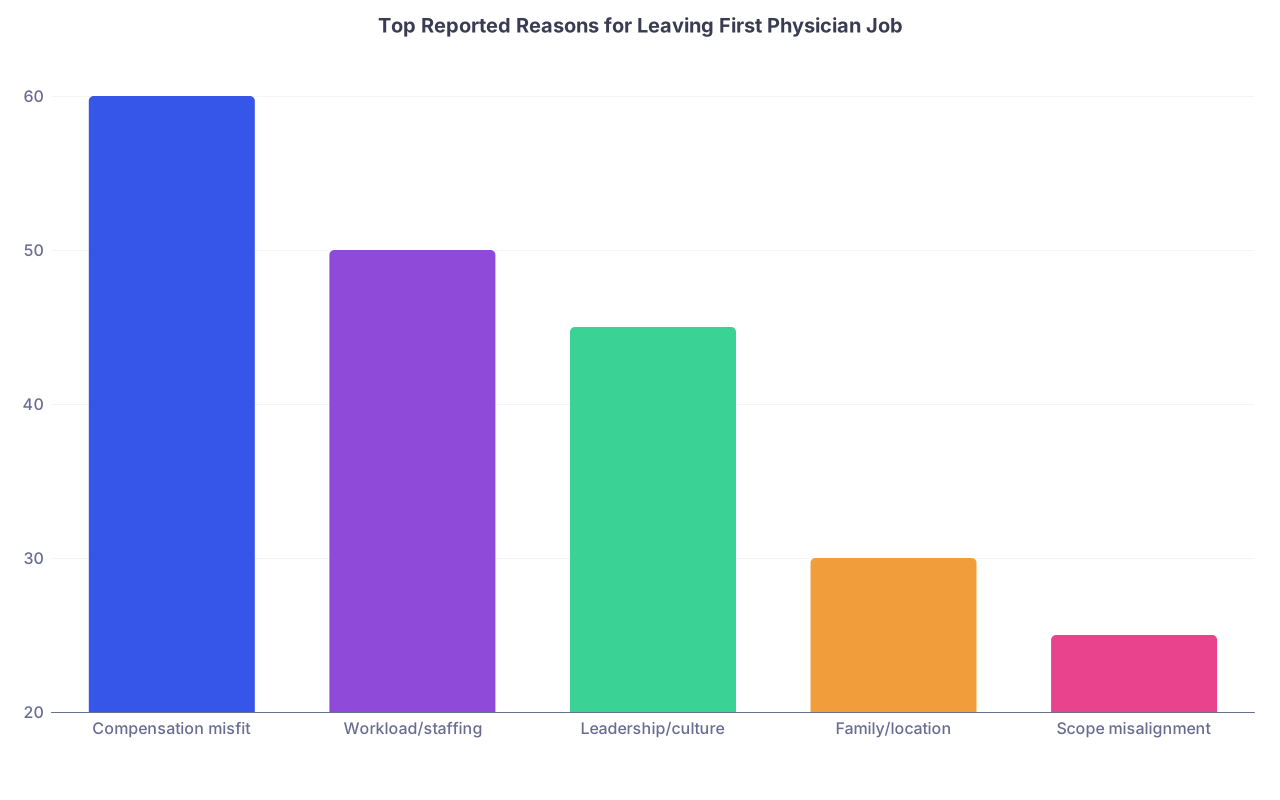
Across multiple large surveys of physicians who left a first job in the last 5–7 years, common top‑3 drivers show up with similar frequencies:
- Misaligned compensation (RVU expectations, pay‑to‑work ratio, or broken bonus promises): ~55–65%
- Workload / staffing and schedule issues (too much call, too many patients, unsafe staffing): ~45–55%
- Poor leadership / culture (toxic partners, ignored feedback, micromanagement): ~40–50%
Geography and family factors appear in maybe 25–30% of responses, but usually as secondary drivers. People know the location when they sign. They do not always know the true wRVU expectation, the true call schedule, or the true staffing model.
To visualize relative weight:
| Category | Value |
|---|---|
| Compensation misfit | 60 |
| Workload/staffing | 50 |
| Leadership/culture | 45 |
| Family/location | 30 |
| Scope misalignment | 25 |
“Scope misalignment” is the catch‑all for “I was hired as X and ended up doing mostly Y” (e.g., IM outpatient who is actually running walk‑in urgent care volumes all day; “protected time” vanishing, etc.).
Qualitatively, when I talk to groups that track this internally, I hear the same specific phrases over and over from leavers:
- “The RVUs in the contract were mathematically impossible with our payer mix.”
- “Call was supposed to be 1:6. It was functionally 1:3 because of vacancies.”
- “They kept recruiting aggressively and then cut my clinic support staff.”
- “The ‘protected’ academic time disappeared within 12 months.”
Those are not “I changed my mind.” Those are quantifiable misalignments between the written deal and the operational reality.
Regional differences: who keeps people longer?
Retention also varies by geography, mostly because the underlying market dynamics are different.
Condensed patterns:
- Large coastal metros (Northeast, West Coast):
- Higher turnover, more lateral options within a commutable radius
- Younger physicians often use first jobs as launch pads while they decide between academics, private practice, or system employed work
- Mid‑sized cities and stable Midwest markets:
- Some of the best retention figures, especially for physicians with family ties to the region
- Fewer competing employers, but often more predictable schedules and cost of living
- Rural and underserved regions:
- Paradoxically high recruitment but unstable retention; you see many 2–4 year stints ending once bonuses and obligations lapse
The data correlate strongly with:
- Number of competing employers within a 50–75 mile radius
- Cost of living and housing affordability
- Spousal employment opportunities
If you boil it down crudely:
- The denser the market, the easier it is to leave your first job without uprooting your life. So more people do.
- The more isolated the market, the more retention depends on how strong the initial fit actually is.
What this should change in how you approach your first job
Here is where the data actually matter to you.
1. Negotiate like this is a 2–3 year experiment, not a 20‑year marriage
The survival curves say you will probably not retire from this job. That should shape your priorities.
You optimize for:
- Strong base salary and transparent productivity expectations for the first contract term
- Realistic call burden and staffing support
- Minimal and reasonable restrictive covenants (non‑compete, non‑solicit)
- Relocation payback language that does not trap you if things go sideways in year 1–2
You do not over‑optimize for:
- Tiny long‑term pension differences
- Academic titles that have no protected time or real track
- “Partnership” promises that begin after year 4 when 60% of peers have already left
2. Assume you might leave at/around the first renewal and plan finances to match
If 40–50% of leavers exit around years 2–3, then designing your personal finance and life around that is rational, not cynical.
Practically, that means:
- Do not lock into an expensive house in the first 6–12 months unless you are unusually certain about the location.
- Treat sign‑on bonuses, relocation, and loan repayment as conditional money. Understand vesting and payback terms exactly.
- Build a runway (cash buffer) for the scenario where you want to leave before a new job starts or you negotiate from a non‑desperate position.
3. Filter job offers through a retention risk lens
You can actually predict higher‑risk first jobs by looking for a few quantifiable red flags:
- Chronic open positions advertised for 12+ months
- High use of locums in the department you are joining
- Groups that hire 2–3 new physicians per year for a 10‑physician practice with no corresponding growth in volume
- Very aggressive RVU targets compared with published MGMA medians for your specialty
Ask blunt questions during interviews:
- “How many new hires in my role have you had in the last 5 years, and how many are still here?”
- “What is the median tenure for physicians in this department?”
- “How many physicians left in the last 24 months, and why?”
If they cannot or will not answer with numbers, that is your answer.
How employers are responding (and what that means for you)
Hospitals and large groups are not blind to 50–60% five‑year attrition. The smarter ones are already adapting their contracts and compensation structures.
Some emerging patterns in employer behavior:
- Shorter initial terms (2–3 years) with heavy front‑loaded incentives, because they assume they are paying to “rent” you for a few years, not own your whole career.
- Loan repayment and retention bonuses with multi‑year vesting schedules, clearly designed to drag you over the 3–5 year hump.
- More flexible schedule and FTE arrangements in year 2–3 as a targeted retention tool for high performers.
This cuts both ways for you:
- You can extract more value up front if you understand your retention leverage.
- But you can also be subtly handcuffed by repayment clauses and non‑compete geometry if you do not read carefully.
Look line‑by‑line at any clause that says:
- Repay X if you leave before Y years
- Bonus vests after Z years of continuous employment
- Cannot practice within N miles for M months after leaving
Run those against realistic scenarios: “If this job is a bad fit and I leave at month 18, what is the actual dollar and career cost?”
The honest takeaway: first job ≠ final destination
Strip away the marketing and nostalgia. The data are blunt:
- Most new physicians will not spend even a decade in their first post‑residency job.
- The “try one job and settle in forever” model is now the exception, not the norm.
- Employers are already modeling that in how they price, structure, and backfill your role.
So the rational stance is not paranoia. It is statistical humility. Treat your first job like an informed experiment, not a fixed identity.