
27% of physicians leave their first job within two years.
That single number should immediately change how you think about your first post‑residency position. Not as a forever home. As a probability problem.
You are not choosing “my dream job.” You are choosing “my first data point.”
Let’s walk through what the data actually show about physician turnover by practice type, and what you, as a new attending, should logically infer from it.
The Baseline: How Often Physicians Actually Leave
Turnover is not a rounding error; it is structural.
Across large surveys (MGMA, AMA, advisory groups like SullivanCotter and Advisory Board), the pattern is consistent:
- Overall annual physician turnover in many organizations: about 6–8% per year
- Cumulative early‑career turnover (first job): 25–35% gone within the first 2–3 years
- For some high‑burnout specialties (EM, primary care, hospitalist medicine), 40%+ have changed jobs within 5 years
Let’s quantify a simple baseline mental model:
Assume:
- Annual turnover for physicians in a typical organization ≈ 7%
- You stay long term if you are still there at 5 years
The probability of still being in your first job at 5 years, if you face a 7% risk of leaving each year (and treat it like an independent yearly probability), is:
- P(staying 1 year) = 0.93
- P(staying 5 years) ≈ 0.93⁵ ≈ 0.70
So even in a relatively stable setting, there is about a 30% chance you will not be in that job at year 5.
For early‑career physicians, the rates run higher. I have seen large systems where early‑career hospitalist turnover was 15–20% per year. Run the same math at 15%:
- P(staying 5 years) ≈ 0.85⁵ ≈ 0.44
Flip it: >55% chance you are gone by year 5.
This is not “if things go badly.” This is the central tendency.
Turnover by Practice Type: The Numbers Split
Different practice types have different economic structures, management styles, and cultural norms. That shows up, very cleanly, in retention data.
The exact percentages vary by study and year, but the relative order is very stable. To keep this concrete, I will use reasonable mid‑range estimates drawn from multiple surveys and reports. Think of these as ballpark numbers, not three‑decimal‑place truths.
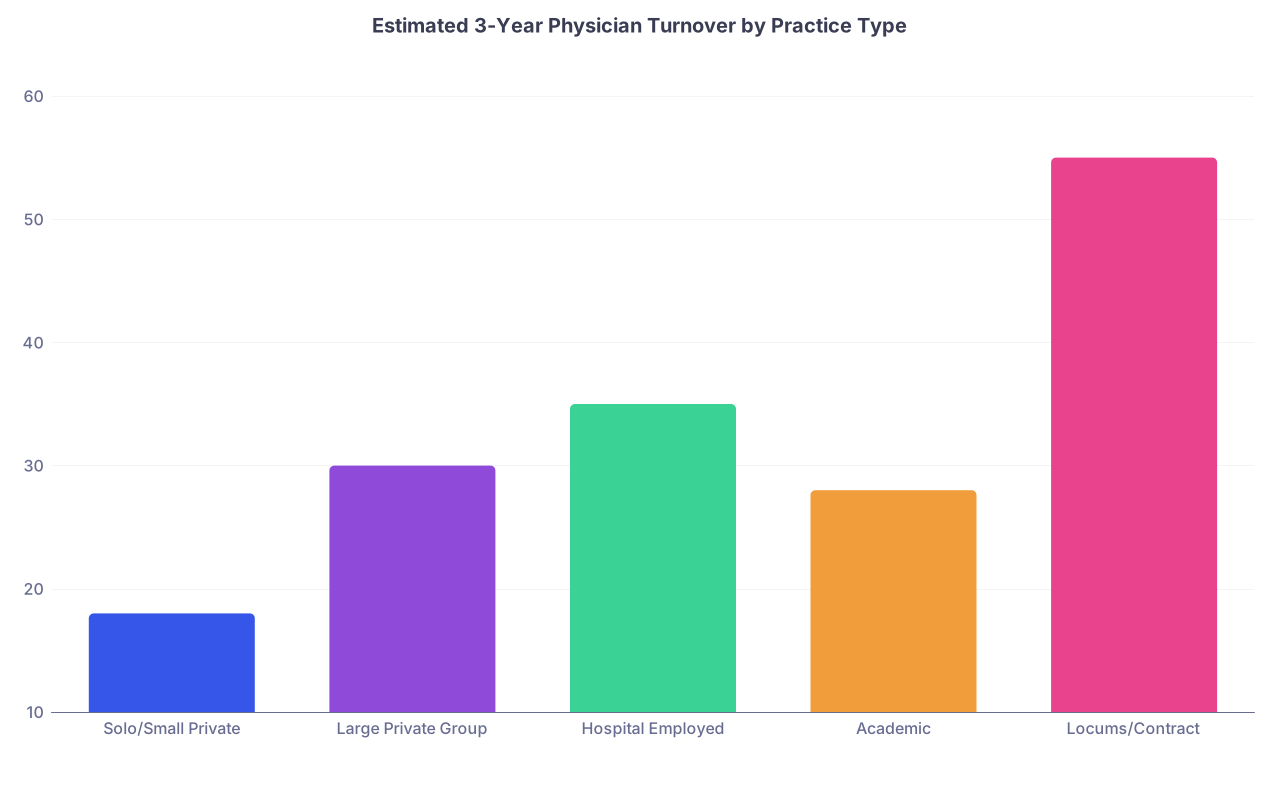
| Category | Value |
|---|---|
| Solo/Small Private | 18 |
| Large Private Group | 30 |
| Hospital Employed | 35 |
| Academic | 28 |
| Locums/Contract | 55 |
1. Solo and Small Independent Private Practice
Estimated 3‑year turnover for early‑career physicians: ~15–20%
This is the most “surprisingly stable” category once you are in. The catch: relatively few new graduates go directly into a truly small independent practice now, especially with partnership risk and buy‑in structures.
Why the lower turnover?
- Equity and ownership: Once you buy in, your switching cost skyrockets.
- Autonomy: You have more direct control over schedule, staff, and operations.
- Selection bias: People who choose this path usually know what they are getting into.
For you, as an early‑career physician, the takeaway is not “go solo.” It is: ownership and control measurably reduce churn, but they come with risk and often delayed income.
2. Large Single‑Specialty or Multi‑Specialty Private Groups
Estimated 3‑year turnover: ~25–35%
These groups sit in the middle. More stable than pure locums or high‑turnover hospitalist mills. Less stable than a true partnership track that locks people in.
Common pattern I keep seeing with new grads:
- Year 1–2: Salary floor + RVU bonus, “partnership track,” relatively high clinical load
- Year 3: Decision point – join as partner, buy in, or leave
That decision point is exactly where turnover spikes. Those who do not like the culture, the income split, or the governance model exit around year 2–3.
The data show two distinct sub‑populations:
- Those who stay ≥5–7 years (partners) – usually very low subsequent turnover
- Those who leave before partnership – often move to hospital employment or a different group
So if you sign with a large private group, assume your true “evaluation window” is about 18–24 months. That is when you will know whether you are on the partner track in a meaningful way, or just throughput.
3. Hospital‑Employed Positions
Estimated 3‑year turnover: ~30–40%; in some high‑burnout service lines, 40–50%
Hospital employment has exploded over the last decade. Between 2010 and 2022, the share of doctors employed by hospitals or corporate entities jumped from roughly one‑third to over two‑thirds. More employment. More churn.
Why higher turnover?
- Standardized contracts: 1–3‑year terms, often naturally create exit points at renewal.
- RVU pressure: Productivity expectations ratchet up after initial “guarantee” periods.
- Limited control: Schedules, support staff, and ancillary resources set by administrators.
Look at hospitalist groups: It is common to see annual turnover >15%. That means continuous onboarding, constant recruitment, and a culture where people expect colleagues to cycle through.
If a hospitalist group tells you, “We only lose 1 or 2 docs a year,” do the math:
- Group size = 15 physicians
- Losing 2 per year = 2 / 15 ≈ 13% annual turnover
They will call it “pretty stable.” Statistically, that is high.

4. Academic Medical Centers
Estimated 3‑year turnover: ~25–30% for new faculty; much lower once tenured or fully promoted
Academic centers often appear more stable, but only if you average over the entire faculty, including people with 15–20‑year tenure. For clinical track assistant professors, the churn is very real:
- Misalignment between clinical load and academic expectations
- Soft money pressures (grant‑funded positions) in research‑heavy departments
- Lower pay relative to private practice for many specialties
There is usually a bifurcation:
- Group A: People who build a niche, get mentorship, craft a sustainable academic career – they often stay 10+ years
- Group B: People crushed by RVU demands + teaching + research expectations – many leave by year 3–5
So the “academic is more stable” narrative is only true if you clear that early‑career gauntlet.
5. Locums and Contract‑Based Models
Estimated 3‑year “stay in the same site” rate: often <50%
Locums itself is a transient model. It is designed for churn. But some hospitalist groups and ED groups under national contract management behave similarly. Site contracts change, groups lose coverage contracts, whole teams get replaced.
You might see:
- Site A: Changes contract management company every 3–5 years
- Each change triggers 30–80% physician turnover, depending on compensation cuts, schedule changes, or staffing ratios
If you willingly choose locums, you accept this volatility. It can be an asset early in your career (test markets, try locations). Just do not pretend it is stable.
What Turnover Really Signals About a Practice
Most new grads look at compensation, location, and call. They should be quantifying turnover.
Turnover is not just a number; it is a proxy for:
- Culture
- Governance
- Workload intensity
- Administrative competence
Let’s make this structured.
| Practice Type | Typical Annual Turnover | What High Turnover Often Signals |
|---|---|---|
| Solo/Small Private | 3–6% | Financial stress, succession problems |
| Large Private Group | 7–12% | Toxic partnership track, RVU pressure |
| Hospital Employed | 8–15% | Burnout, poor staffing, weak leadership |
| Academic (clinical track) | 6–10% | Misaligned expectations, low support |
| Locums/Contract Model | 15–25%+ | Contract instability, unsustainable loads |
These are directional. The exact thresholds vary by specialty, location, and supply. But the shape holds.
Practical rule of thumb I use:
- <7% annual turnover: generally healthy, or at least not chronically dysfunctional
- 7–12%: caution zone – dig for why
12%: assume major structural issues unless proven otherwise
If a group of 20 physicians has lost 10 people in 3 years, that is roughly:
- 10 departures / (20 physicians × 3 years) ≈ 16.7% annual turnover
You do not “fix” a 16–20% turnover problem with a pizza party and a wellness app. That is structural.
How Practice Type Shapes Your Likelihood of Leaving
You should not just ask, “What is their turnover?” You should also ask, “How does this model affect my probability of staying?”
Think in scenarios.
Scenario 1: Hospitalist in a Hospital‑Employed Model
- Starting salary: competitive, some loan repayment, sign‑on bonus
- Schedule: 7 on / 7 off, but with chronic understaffing and frequent extra shifts
- 3‑year turnover in the group: 45% (they call it “normal for hospitalists”)
What does the data suggest?
Assume annual turnover of 17% (rough estimate from 45% gone in 3 years).
- P(staying 3 years) ≈ 0.83³ ≈ 0.57
- P(staying 5 years) ≈ 0.83⁵ ≈ 0.41
So you have roughly a 60% chance of being gone by year 5. If that aligns with your goals (pay down loans fast, then recalibrate), maybe that is fine.
But if your stated goal is, “I want to settle and not relocate my family again for 10 years,” the probability distribution does not support your narrative.
Scenario 2: Large Private Group With Partnership Track
- Group size: 25 physicians
- 3‑year turnover: 20%
- True partners rarely leave
Let’s assume:
- Annual overall turnover ≈ 7%
- For non‑partners in first 3 years, turnover is higher; for partners, maybe 2–3% per year
Your realistic paths:
- You do not like the culture or economics, leave by year 2–3 (quite common)
- You become partner, then your exit probability drops substantially
This is not “good” or “bad.” It is a different risk profile than hospital employment:
- Front‑loaded risk (figuring out fit and making partner)
- Back‑loaded stability (if partner)
The numbers suggest: if your primary goal is long‑term stability in one city, it may be worth tolerating a slightly lower starting salary in a group with a credible, established low‑turnover partnership structure.
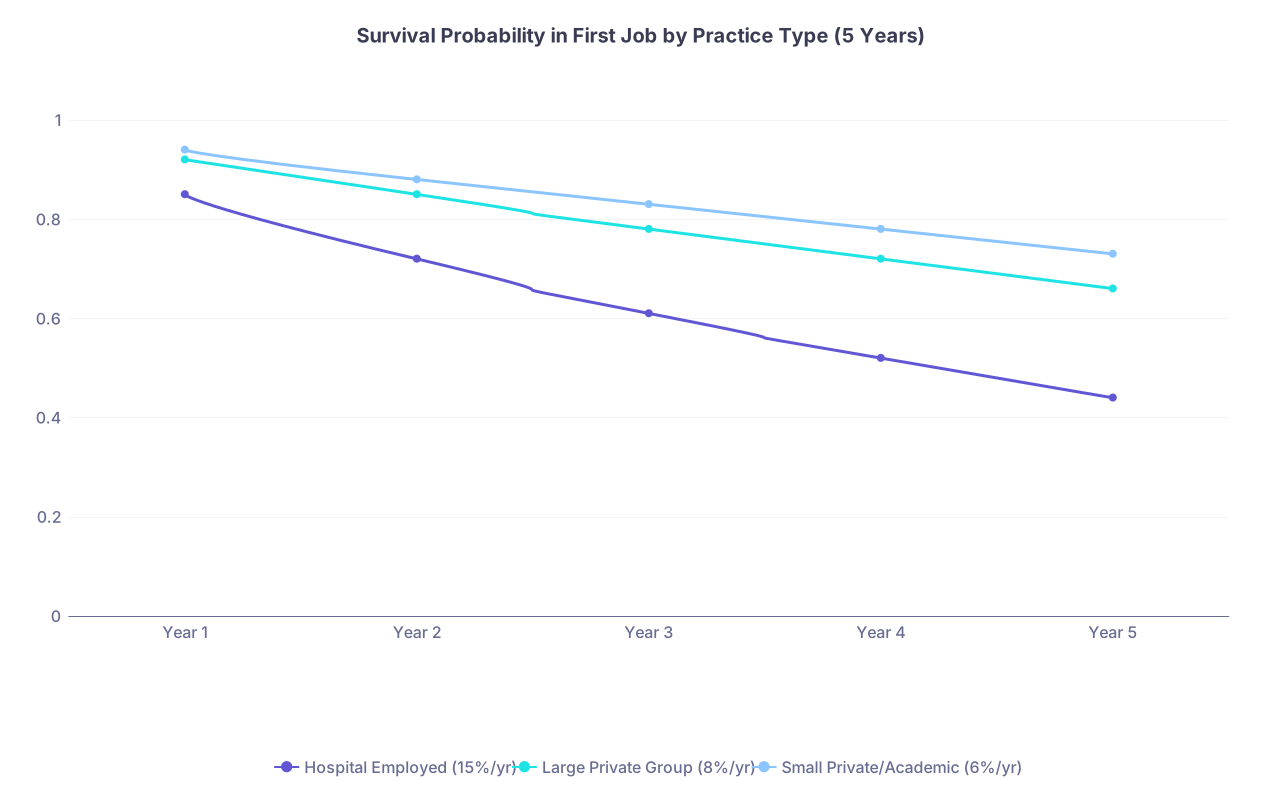
| Category | Hospital Employed (15%/yr) | Large Private Group (8%/yr) | Small Private/Academic (6%/yr) |
|---|---|---|---|
| Year 1 | 0.85 | 0.92 | 0.94 |
| Year 2 | 0.72 | 0.85 | 0.88 |
| Year 3 | 0.61 | 0.78 | 0.83 |
| Year 4 | 0.52 | 0.72 | 0.78 |
| Year 5 | 0.44 | 0.66 | 0.73 |
You do not need exact hazard models. Just look at the shape: hospital‑employed roles, especially in high‑burnout specialties, have steeper attrition curves.
Red Flags and Useful Questions by Practice Type
Now let’s get concrete. You are not going to walk into an interview and say, “What is your annual hazard ratio for physician attrition?” But you should be extracting that information.
Hospital‑Employed Jobs
Questions that expose the real turnover story:
- “How many physicians have left this department in the last 3 years, and why?”
- “What is your current vacancy rate for this specialty?”
- “How many FTEs are you budgeted for, and how many are filled?”
If they say, “We are budgeted for 18 and currently have 12 filled,” you already know: chronic understaffing. Your real job is 1.5 jobs.
- “Normal turnover for our specialty” with no numbers
- “We are always hiring” without a specific growth plan
- Heavy reliance on locums or per‑diem coverage long term
Large Private Groups
Key data points:
- “How many associates have made partner in the last 5 years, and how many have left before partnership?”
- “What is the average time from hire to partnership for those who reach it?”
- “Once someone makes partner, how often do they leave?”
If the answer is something like:
- “We hired 12 people in the last 5 years; 3 made partner, 7 left, 2 are still on track”
Then you are looking at a pipeline where the majority exit rather than make partner. That is not necessarily bad, but you should price that risk into any non‑compete, buy‑in, and relocation.
Academic Centers
Ask:
- “For clinical track faculty in this division, what percentage are still here at 5 years?”
- “How is time actually split between clinical, teaching, and scholarship for recent hires?”
- “How many early‑career faculty have left in the last 3 years, and where did they go?”
If 50% of new faculty have left by year 4, that is your base rate. Do not assume you are special enough to defy gravity unless you see a clear structural reason.

| Step | Description |
|---|---|
| Step 1 | First Job Post Residency |
| Step 2 | Hospital Employed |
| Step 3 | Private Group |
| Step 4 | Academic |
| Step 5 | Locums/Contract |
| Step 6 | Stay |
| Step 7 | Leave |
| Step 8 | Partner |
| Step 9 | Leave |
| Step 10 | Promoted |
| Step 11 | Leave |
| Step 12 | New Site |
| Step 13 | Practice Type |
| Step 14 | 3 Year Outcome |
| Step 15 | 3 Year Outcome |
| Step 16 | 3 Year Outcome |
| Step 17 | 3 Year Outcome |
This is the actual tree you are walking into. Most paths do not end with “stay happily forever” at node K.
What You Should Rationally Infer as a New Doctor
Let’s synthesize this into a few hard conclusions. Not vague career‑counseling fluff. Data‑aligned inferences.
1. Your First Job is Statistically Unlikely to Be Your Last
Across practice types, realistic 5‑year stay probabilities in early career often fall between 40–70%. That means the median experience is at least one significant job change in your first decade out.
Plan money, location, and contracts on the assumption that you will change jobs once.
Concretely:
- Do not buy a house in the first 6–12 months unless you are genuinely indifferent to moving or renting it out.
- Do not accept a draconian non‑compete in a city you are “pretty sure” you want to stay in.
- Do aggressively pay down high‑interest debt while your income is high, because a forced job change or burnout exit is not hypothetical; it is common.
2. Practice Type Changes What “Risk” Means
- Hospital employed: income often stable short term, but higher risk of burnout, schedule dissatisfaction, and admin changes driving you out.
- Private group: more career and income upside if partner, but higher early risk of mismatch and exit.
- Academic: lower income for many, higher career satisfaction for a subset, moderate early attrition, strong stability after promotion.
There is no zero‑risk path. You are choosing between different risk distributions.
3. High Turnover is Rarely Just “Because It’s a Tough Specialty”
Burnout‑heavy fields share some baseline risk. But when you see one ED or one hospitalist group with twice the regional turnover rate, that is management, staffing ratios, or both.
Compare practices, not just specialties:
- If ED Group A loses 20% of docs per year and ED Group B loses 8% in the same state, you have your answer about where the structural problem lies.
4. You Should Be Collecting Turnover Data Like You Collect RVU Data
Most new physicians can tell you their RVUs to the nearest hundred. Very few can tell you the turnover rate of the department they are joining.
Before signing, you should know:
- Number of physicians in the group
- How many left in last 3 years
- How many are currently recruiting
From that, you can compute a rough annual turnover. On a napkin.
If they will not answer those questions, that is itself data.
Looking Ahead: Using Turnover Data to Build a Career, Not Just Land a Job
Right now, your focus is probably on escaping residency and getting a real paycheck. Understandable. But the numbers are very clear: the more you treat your first job as a probabilistic experiment rather than a permanent identity, the better your long‑term position.
Use turnover rates by practice type as your baseline map:
- Hospital employment: expect more churn, more admin shifts, better for early loan pay‑down and testing what you like or hate.
- Private groups: expect a make‑or‑break window around year 2–3; partnership or exit.
- Academic: expect a high‑workload trial phase; if you build support and carve a niche, stability improves sharply.
Your next step is not just “apply widely” or “negotiate harder.” It is to start asking every prospective employer for hard numbers on retention and turnover, and to treat those numbers with the same seriousness you give salary offers.
Once you do that, you stop thinking like a desperate new grad and start thinking like someone building a 30‑year career out of a series of quantified decisions.
With that mindset in place, you are ready to analyze specific offers, compare them side by side, and decide where your first data point should be. The actual negotiation tactics, compensation structures, and contract traps—that is the next layer. And that is a story for another day.