
The mythology around “attending money” is wildly distorted. The data show a fragmented market where starting salaries vary by 2–3x depending on practice setting, region, and specialty—and new attendings who do not understand that data routinely leave six figures on the table in their first contract.
This is not a monolithic number. It is a distribution. And the shape of that distribution changes dramatically between academic centers, hospital-employed groups, private practice, and locums.
Below I will walk through the most recent numbers (2023–2024 era data) for starting salary ranges by practice setting, how those compare to “average” compensation, and what actually drives the outliers you hear about on Reddit and in the workroom.
1. The Big Picture: How Much Are New Attendings Really Making?
Start with the macro view. Across all specialties, all regions, all practice types, the central tendency for new attending base salaries in 2023–2024 typically lands in the $260,000–$340,000 range.
That median hides a brutal spread.
On one side you have academic general internists starting at $190,000–$220,000 base. On the other, rural private practice orthopedists or anesthesiologists signing deals with guaranteed packages north of $700,000. Same degree. Same “MD” after the name. Different market.
The most reliable large-scale datasets come from:
- MGMA (Medical Group Management Association) compensation surveys
- Doximity Physician Compensation Reports
- AMGA and specialty-specific society surveys
- Contract review firms aggregating offer data (e.g., for new grads)
While they slice the data differently, they converge on one key point: practice setting systematically shifts starting salaries by six figures.
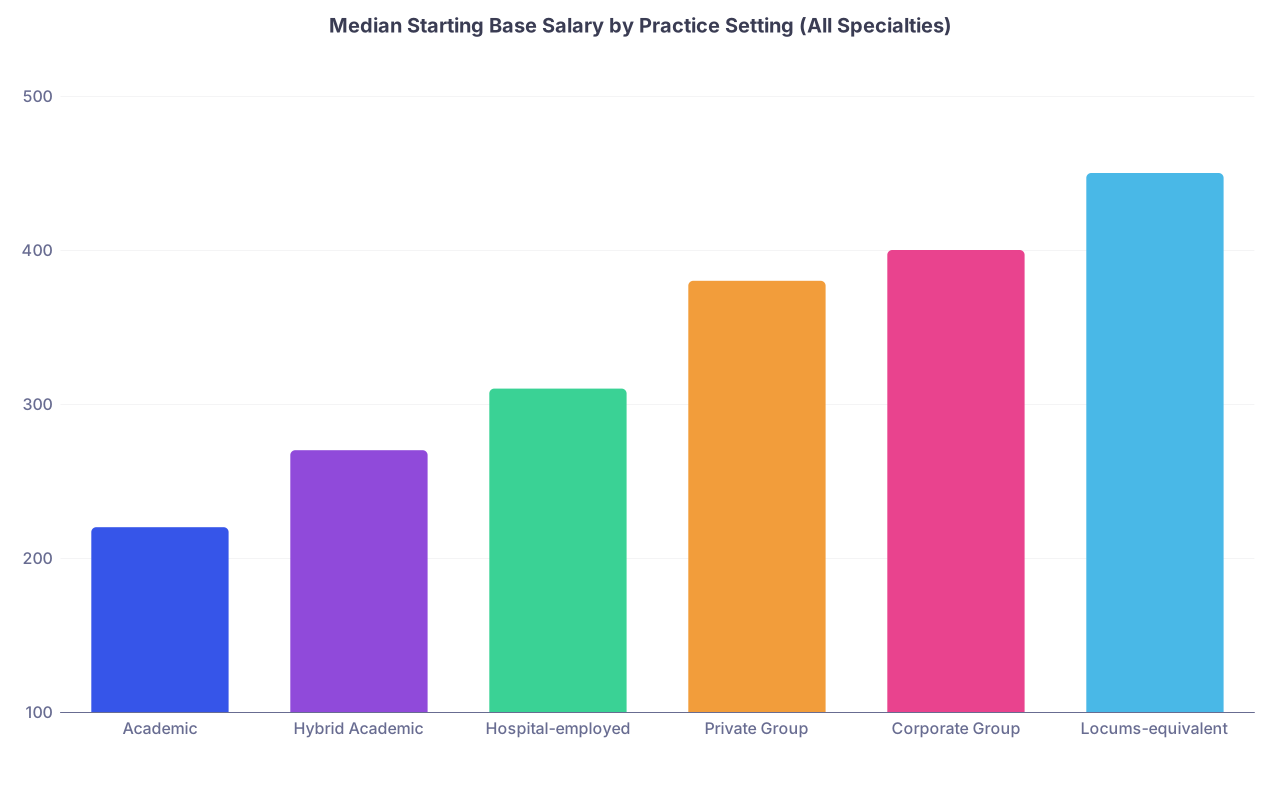
To make that concrete, look at a simplified, all-specialty snapshot for new attendings only:
| Practice Setting | Typical Starting Base Range | Common Median |
|---|---|---|
| Academic (university) | $190k–$260k | ~$220k |
| Academic-affiliated (hybrid) | $230k–$320k | ~$270k |
| Hospital-employed (non-academic) | $260k–$380k | ~$310k |
| Private practice – single/multi-specialty group | $300k–$500k | ~$380k |
| Large corporate/PE-backed groups | $320k–$520k | ~$400k |
| Locums-heavy / traveling model | Equivalent $350k–$650k | ~$450k+ |
The range inside each bucket is driven by specialty and geography. But the stepwise pattern across settings is very consistent: each move away from pure academic centers tends to add $40,000–$80,000 to base salary for the same specialty and region.
To visualize the distribution by setting:
| Category | Value |
|---|---|
| Academic | 220 |
| Hybrid Academic | 270 |
| Hospital-employed | 310 |
| Private Group | 380 |
| Corporate Group | 400 |
| Locums-equivalent | 450 |
Those are base numbers only. Total compensation—including productivity bonuses, call stipends, and sign-on—pushes the real first-year earnings substantially higher, especially outside academics.
2. Academic vs Nonacademic: The Pay–Prestige Tradeoff
The data make this blunt: starting in academic medicine is often a 20–40% pay cut compared with nonacademic roles in the same specialty and region.
Academic Medical Centers (AMCs)
For new attendings in AMCs (university hospitals, major teaching centers), recent survey data typically show:
- Primary care (IM, FM, outpatient pediatrics):
- Starting base: $185,000–$230,000
- Cognitive adult specialties (endocrinology, rheumatology, ID, geriatrics):
- Starting base: $190,000–$240,000
- Hospital-based fields (hospitalist, academic EM, academic anesthesiology):
- Starting base: $230,000–$320,000
- Surgical subspecialties:
- Starting base: $300,000–$450,000 (with large later upside if RVU-based and high-volume)
Several factors drag academic salaries down:
- High density of trainees and faculty → supply is robust
- Non-monetary value: research time, teaching, prestige, niche expertise
- Large institutional salary scales and “equity” constraints
- Geography: many AMCs are in high-cost, high-demand urban markets
The gap is not subtle. If you compare typical academic vs nonacademic starting offers for the same specialty and same city, 30–35% differences are normal, and 40% is not rare.
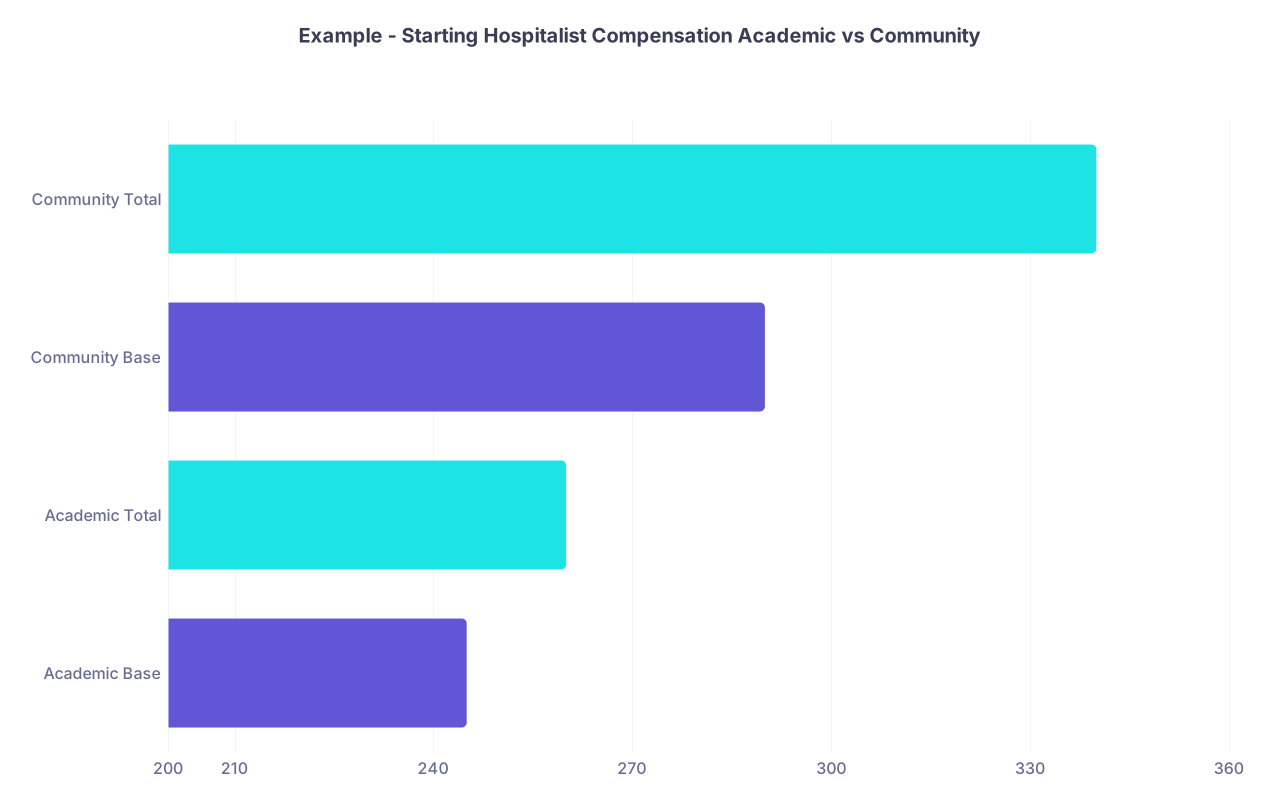
Take internal medicine hospitalist roles:
- Academic hospitalist at a large university center:
- Base: $220,000–$260,000
- Modest quality bonus: $5,000–$10,000
- Nonacademic community hospitalist, same metro area:
- Base: $260,000–$320,000
- Sign-on: $20,000–$50,000
- Productivity or shift differential: another $10,000–$30,000 first year
You can model that:
- Academic: $235,000–$270,000 total first year
- Nonacademic: $290,000–$380,000 total first year
You are looking at a delta of $60,000–$100,000 per year right out of residency, solely based on setting.
| Category | Value |
|---|---|
| Academic Base | 245 |
| Academic Total | 260 |
| Community Base | 290 |
| Community Total | 340 |
Academic life has upsides—research time, niche cases, fellowships, branding. Financially, though, the starting salary is simply lower in exchange for those non-cash benefits. The data are unambiguous.
3. Hospital-Employed vs Private Practice vs Corporate Groups
Once you leave the university campus, the real spread starts to show.
Hospital-Employed (Nonacademic)
This is the most common landing spot for many new attendings now—especially hospitalists, EM physicians, anesthesiologists, and outpatient PCPs.
For nonacademic hospital-employed roles in 2023–2024, typical starting base ranges:
- Outpatient primary care: $240,000–$300,000 base, with:
- Sign-on bonus: $15,000–$50,000
- Loan repayment sometimes $20,000–$100,000 over several years
- Hospitalist: $260,000–$340,000 base (depending on schedule intensity)
- EM: $250,000–$380,000 equivalent (often paid hourly, but converts to that band)
- Anesthesiology: $350,000–$500,000 base starting, region-dependent
Hospital-employed contracts usually trade slightly lower ceilings for stability:
- Guaranteed base for 1–3 years
- RVU or quality bonuses with moderate upside
- Minimal ownership opportunity
Traditional Private Practice Groups
Independent single- or multi-specialty groups tend to pay higher starting salaries or guarantees for the same work, but with more variability and often more call.
For new joiners:
- Base/guaranteed compensation: commonly $300,000–$500,000 depending on specialty
- Shorter guarantee period (1–2 years) followed by pure productivity / partnership track
- Potential for significant jumps (e.g., cardiology, GI, ortho, anesthesia, radiology) after buy-in
This is where you see extreme anecdotes:
- New radiology attending guaranteed $450,000 in a midwestern group with partnership at years 2–3 leading to $700,000–$800,000+
- New GI doc in a high-volume private group starting at $500,000 guaranteed, then jumping to $900,000+ as partner
- New anesthesiologist in a rural group starting $450,000 guaranteed plus large call stipends
Those are not universal, but they are also not unicorns. They cluster in specific specialties and geographies.
Large Corporate / PE-Backed Groups
Think national EM, anesthesia, radiology, and hospitalist companies. Also some large primary care platforms.
For new attendings, their starting salary offers often sit between hospital-employed and high-performing private groups:
- EM: $250,000–$400,000 equivalent, depending on shift load and location
- Anesthesia: $350,000–$520,000 equivalent
- Hospitalist: $260,000–$360,000 total comp
- Radiology (telerad, for instance): $350,000–$550,000+ based on RVUs
The pattern:
- Up-front guarantees are usually decent
- Benefits and malpractice typically fully handled
- Productivity upside exists but the “partnership multiple” is often absent or muted compared with truly independent groups
4. Locums and Travel Models: High Rate, High Variability
Locums is where the headline numbers get loud.
Hourly rates for locums new attendings in 2023–2024 commonly fall in these bands:
- Hospitalist: $150–$250/hour
- EM: $200–$350/hour or more for high-need sites
- Anesthesia: $230–$400/hour
- Psychiatry: $160–$250/hour
- Surgical specialties: highly variable but frequently $250–$400/hour+
Even at the low end of those ranges, a 40–42 hour workweek equivalent pushes annualized income well above many employed roles.
Basic math for hospitalist locums at $180/hour, 180 shifts per year, 12 hours each:
- 180 shifts × 12 hours = 2,160 hours
- 2,160 × $180 = $388,800 gross
At $220/hour, same load:
- 2,160 × $220 = $475,200 gross
Of course, you trade:
- No guaranteed PTO (unpaid days off)
- Variable benefits; sometimes you self-fund
- Travel and housing logistics
- Income volatility between assignments
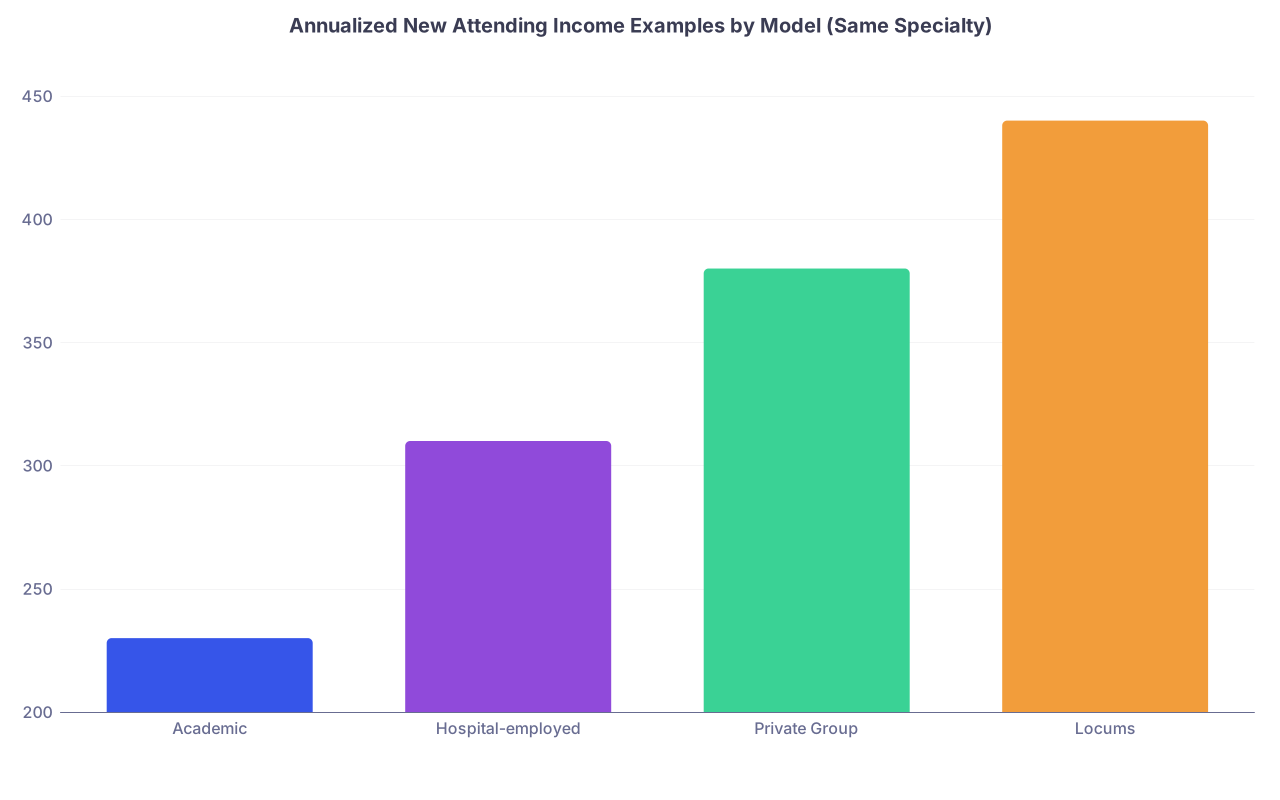
Still, the data show that for certain specialties, locums-heavy practice can generate first-year earnings 30–60% above a standard employed salary, at least initially.
| Category | Value |
|---|---|
| Academic | 230 |
| Hospital-employed | 310 |
| Private Group | 380 |
| Locums | 440 |
Those values are midpoints from realistic scenarios in hospital-based fields. Actual ranges are broader, but the ordering holds in most markets.
5. How Specialty and Geography Distort “Starting Salary”
You cannot talk about practice setting without controlling for specialty and region. If you do, the signal gets buried in noise.
Specialty Competitiveness vs Compensation
The classic data pattern still holds:
- Primary care and cognitive subspecialties:
- Median starting compensation: roughly $220,000–$290,000 in academic, $250,000–$340,000 in nonacademic
- Procedural/surgical specialties:
- Median starting compensation: $350,000–$600,000, with extreme outliers above $700,000
- Radiology, anesthesiology, EM:
- Median starting compensation: $350,000–$500,000, sometimes higher in rural/high-need areas
Here is a simplified cross-section for nonacademic, mid-cost-of-living regions:
| Specialty (New Attending) | Typical Starting Base/Guarantee |
|---|---|
| Outpatient IM/FM | $250k–$310k |
| Hospitalist | $260k–$340k |
| EM | $280k–$400k (equiv) |
| General Surgery | $350k–$450k |
| Cardiology (non-invasive) | $400k–$550k |
| GI | $450k–$600k+ |
| Anesthesiology | $375k–$500k |
| Radiology | $380k–$550k |
You cannot “average” those into a meaningful single number. A new dermatologist’s offer and a new ID specialist’s offer might differ by $150,000+ in the same city.
Geography: Rural vs Urban vs Coasts
Location behaves like a multiplier on top of specialty and setting.
Empirically, across broad data:
- Rural / high-need regions: often 10–30% higher starting compensation than major metro in same specialty and setting
- Midwest / South: generally higher base pay and lower COL than coastal big metros
- West Coast / Northeast big cities: lower relative pay, higher COL, but often academic prestige or lifestyle draws
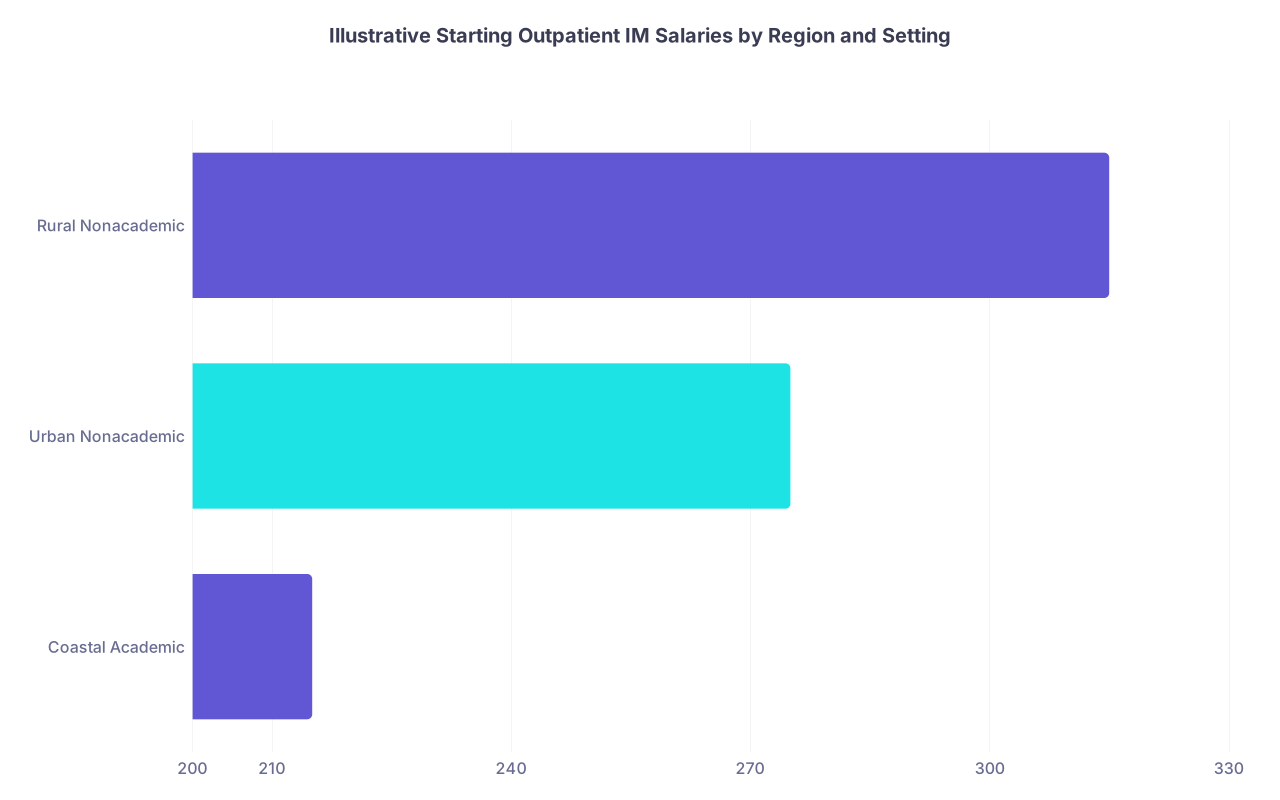
For example, a new outpatient IM attending:
- Urban coastal academic center:
- $200,000–$230,000 base
- Same specialty, nonacademic hospital-employed in large Midwestern city:
- $250,000–$300,000 base
- Rural community hospital in the Plains/South:
- $280,000–$340,000 base
- Plus $25,000–$75,000 sign-on, often loan repayment
| Category | Value |
|---|---|
| Coastal Academic | 215 |
| Urban Nonacademic | 275 |
| Rural Nonacademic | 315 |
The result: a rural nonacademic job can easily pay 40–50% more in real purchasing power once you adjust for housing, taxes, and general living costs.
6. Components of Compensation: Base vs Bonus vs “Funny Money”
When residents talk about salary, they usually mean “base.” Employers and recruiters, on the other hand, love quoting “total potential compensation” with optimistic assumptions.
You need to deconstruct the package.
Typical Components in a New Attending Contract
- Base salary or guaranteed income
- Productivity incentives (RVUs, collections, encounters)
- Quality/value bonuses
- Call pay or shift differentials
- Sign-on bonus
- Loan repayment
- Relocation stipend
- Benefits (health, retirement, CME, disability)
The first four drive your real year-to-year earnings. The last four are one-time or slow-burn add-ons.
A realistic first-year breakdown for a nonacademic hospitalist in a mid-cost region:
- Base salary: $290,000
- RVU / productivity bonus target: $30,000 “at median productivity”
- Quality bonus: $5,000–$10,000
- Sign-on: $25,000 (paid over 1–2 years, often with clawbacks if you leave)
- Loan repayment: $20,000 per year for 3–5 years
- Call/extra shifts: maybe $10,000–$30,000 if you pick up more
Conservatively:
- Guaranteed-ish (base + modest bonus): $300,000–$320,000
- “Realistic” total first year including sign-on, some extra shifts: $340,000–$370,000
Now compare that to a sticker “salary” thrown around in conversation. Someone says, “I am making $350,000 as a new hospitalist.” When you unpack it, base may be $285,000, and the rest is bonuses and extra work.
So if you see two offers:
- Offer A: $260,000 base, “up to $350,000” with bonuses
- Offer B: $300,000 base, “up to $360,000” with bonuses
Run the math assuming only 50–70% of the maximum bonus actually materializes. The larger guaranteed base often wins, especially first year when you are still ramping up efficiency.
7. Where New Attendings Commonly Misread the Market
Here is where the data consistently show new grads leaving money on the table.
1. Anchoring on Residency City Salaries
Residents in HCOL coastal cities see lowball academic or hospital-employed offers and assume that is “normal” for their specialty.
Then you pull the numbers across regions and realize:
- That $220,000 academic IM offer in Boston or SF
- Is competing with $280,000–$320,000 community IM offers in mid-sized cities
- And $320,000–$360,000 rural offers plus loan repayment
Adjust for rent and taxes, and the real gap is huge.
2. Underestimating Private Practice and Partnership Upside
Many residents now never see a thriving independent group during training. They hear “private practice” and imagine chaos.
On paper, though, income trajectories are striking:
| Year | Hospital-Employed (Stable) | Private Practice (Partnership Track) |
|---|---|---|
| 1 | $310k | $360k (guarantee) |
| 2 | $320k | $380k |
| 3 | $330k | $500k (early partner) |
| 4 | $340k | $650k |
| 5 | $350k | $700k |
Even with conservative assumptions, cumulative 5-year income can differ by $500,000–$800,000+. That is not pocket change.
3. Failing to Treat Locums as a Benchmark
Even if you do not want a locums career, locums rates are data. They tell you what the market will pay for your time.
If EM locums is paying $250/hour in your region and an employed offer essentially pays you $150/hour when you divide total comp by actual work hours (including call/admin), that is a 40% haircut. You may be fine with that for stability—but you should be aware of the haircut.
8. How to Use This Data When You Negotiate
You do not need a PhD in econometrics. You just need a structured approach.
Here is a simple decision process:

| Step | Description |
|---|---|
| Step 1 | Receive Job Offer |
| Step 2 | Identify Setting and Specialty |
| Step 3 | Pull Compensation Benchmarks |
| Step 4 | Negotiate or Decline |
| Step 5 | Negotiate Better Base or Bonus |
| Step 6 | Evaluate Nonfinancial Fit |
| Step 7 | Accept Offer |
| Step 8 | Offer Below 25th Percentile? |
| Step 9 | Below Median for Region? |
| Step 10 | Career Goals Met? |
You want at least three anchor data points for your exact scenario:
- Same specialty
- Similar region / COL tier
- Same practice setting
Then classify the offer:
- Below 25th percentile: often unacceptable unless offset by very strong nonfinancial upside (dream location, research, visa, etc.)
- Around median: reasonable baseline, you can still push
- Above 75th percentile: strong, but verify work hours, call, and RVU expectations
If a nonacademic offer is close to academic pay in the same city, the data strongly suggest you can do better. The market usually pays a clear premium for nonacademic work; if it does not, that is a signal.
9. Key Takeaways by Practice Setting
To compress the entire landscape:
- Pure academic: lowest starting salaries, typically 20–40% below nonacademic equivalents. Main “compensation” is research, teaching, prestige, and subspecialty depth.
- Nonacademic hospital-employed: stable, moderate-to-good starting salaries; typical range for new grads ~ $260,000–$380,000 base depending on field; ceiling may be limited.
- Private practice groups: higher starting guarantees (often $300,000–$500,000) and massive upside with partnership in many procedural specialties; more variability, more risk.
- Large corporate groups: good starting pay, standardized structures, less upside than true independent partnership but more than some hospital-employed.
- Locums/travel: often highest per-hour rates; total comp easily 30–60% above conventional roles if you work full-time equivalents; offset by volatility and weaker benefits.
The data do not say one path is universally “best.” They say that pretending all settings pay roughly the same is financially naïve, and that a new attending who treats starting salary as a fixed number rather than a negotiable, market-driven variable is simply donating income back to the system.
FAQ (5 Questions)
1. What is a realistic national “average” starting salary for new attendings across all specialties?
If you force a single number, recent composite data put the national starting base for new attendings roughly in the $260,000–$340,000 range. But that number is almost worthless without specifying specialty and setting. A new outpatient pediatrician in an academic center might start near $190,000–$210,000, while a new anesthesiologist in a nonacademic group might start at $400,000–$500,000. Use that “average” only as a very rough sanity check, not a target.
2. How much more does nonacademic practice usually pay compared with academics for the same specialty?
In most large datasets, the gap for early-career physicians in the same specialty and region runs around 25–35% higher total compensation outside academics, sometimes more. For example, an academic general internist in a coastal city might start at $210,000 while a community IM role in the same metro is offering $270,000–$300,000. In procedural specialties and hospital-based fields, it is not unusual for nonacademic offers to exceed academic ones by $100,000+ per year.
3. Are sign-on bonuses and loan repayment actually meaningful, or are they just recruiting tricks?
They are meaningful, but you must discount them correctly. A $50,000 sign-on bonus paid over three years with a clawback is essentially $16,000–$17,000 per year before taxes—not life-changing next to a $40,000 difference in base salary every year. Loan repayment of $20,000–$40,000 per year is more substantial, especially if you are aggressively paying down debt. Still, you should not let a large-looking bonus distract you from a chronically lower base.
4. Does starting in a lower-paying academic job permanently cap my earning potential?
Not inherently. Many physicians move from academic to nonacademic roles after a few years and see substantial income jumps. However, the opportunity cost is real: three to five years earning $70,000–$120,000 less per year than market alternatives adds up. If your long-term goal is research-heavy or fellowship-director-type work, the tradeoff can be rational. If your only reason for staying academic is inertia or fear of private practice, the data argue you are paying a steep premium for that comfort.
5. How much can I realistically negotiate as a new attending?
For most nonacademic roles, moving base salary by 5–15% via negotiation is very common if you have competing offers or strong local demand. Academic centers are more rigid; you might only get small bumps, extra protected time, or better non-cash terms. The biggest gains often come from stepping back and changing some dimension of the job—region, practice setting, rural vs urban—rather than squeezing an existing offer. From a data perspective, switching from academic to nonacademic, or from urban coastal to midwestern community, has a much larger financial effect than pushing an offer up by $10,000–$20,000.