
The fetishization of “loan repayment” in job offers is misleading a lot of new attendings. The data shows: in many cases, you are trading six figures of lifetime income for a shiny but suboptimal sign-on gimmick.
Let me quantify that.
You are coming out of residency with something like $250k–$400k in educational debt, looking at base offers that might differ by $40k–$80k a year, and HR throws in a “$50,000 loan repayment!” and expects you to stop asking hard questions. Too many people do.
This is a numbers-only comparison. Higher salary vs. loan repayment, stripped of marketing language. I am going to assume you are a rational actor who cares about after-tax cash flows, not just emotional relief when someone says “we’ll help with your loans.”
1. Baseline: What your debt actually costs you
Most new docs I talk to underestimate both the size and the time horizon of their loans. They focus on balance, not cash flows.
Let’s define a clean baseline:
- Total student loan balance at the end of residency: $300,000
- Interest rate (weighted average): 6.5%
- Standard 10-year amortization, no weird forgiveness programs
On a standard repayment schedule, your monthly payment is roughly:
- Payment factor for 6.5% over 10 years ≈ 1.135% of principal per month
- Monthly payment: 0.01135 × 300,000 ≈ $3,405
- Annual payment: ≈ $40,860
- Total paid over 10 years: ≈ $408,600
- Total interest: ≈ $108,600
If you stretch to 20 years (common when people “just want the lowest payment”):
- Monthly factor for 6.5% over 20 years ≈ 0.00746
- Monthly payment: 0.00746 × 300,000 ≈ $2,238
- Annual payment: ≈ $26,856
- Total paid over 20 years: ≈ $537,120
- Total interest: ≈ $237,120
The data point almost nobody internalizes: increasing your annual income by $50k–$80k and dedicating a slice of that to loans is usually more powerful than a one-time $50k–$100k repayment carveout.
To keep comparisons clean, I will treat “loan repayment” as employer-paid lump sums that reduce principal directly. That is the usual marketing language.
2. How loan repayment benefits are actually structured
Here is where the details are quietly stacked against you.
Most common employer repayment structures I see:
- $20,000 per year for 3 years (total $60,000)
- $25,000 per year for 4 years (total $100,000)
- One-time $50,000 sign-on applied to loans
- Eligibility usually contingent on staying employed
And then the kicker: almost all of this is taxable.
Unless you are in a very specific federal or state program using Section 127 rules (capped at $5,250/year tax-free in 2024), employer “loan repayment” is just additional W-2 income with a label. That means:
- You are likely losing 35–45% of headline “loan repayment” to federal + state + payroll taxes.
- A “$100,000 loan repayment package” might only reduce your balance by $55k–$65k net.
Let’s quantify three typical structures, assuming a 40% combined tax hit.
| Package Type | Nominal Total | After-Tax (40% hit) | Real Principal Reduction |
|---|---|---|---|
| $20k/year × 3 years | $60,000 | $36,000 | ≈ $36,000 |
| $25k/year × 4 years | $100,000 | $60,000 | ≈ $60,000 |
| One-time $50k sign-on | $50,000 | $30,000 | ≈ $30,000 |
So that “$100k program” is actually about $60k off a $300k balance. Useful. Not magic.
Now compare that to permanent salary differences.
3. Salary vs loan repayment: clean side-by-side scenarios
I am going to set up a few direct comparisons. Assume:
- You are considering two jobs in the same city, same specialty, similar call burden.
- Marginal tax rate (federal + state + payroll) ≈ 40%.
- You plan to stay in any job at least 5 years unless it is a disaster.
Scenario A: Higher salary vs. “good” loan repayment
Job 1: Higher salary, no repayment
- Base salary: $350,000
- No employer loan repayment
Job 2: Lower salary, loan repayment
- Base salary: $300,000
- Loan repayment: $25,000/year for 4 years (headline $100,000)
Let’s compare after-tax cash per year.
Job 1:
- Salary after 40% tax: 0.60 × 350,000 = $210,000
Job 2:
- Salary after tax: 0.60 × 300,000 = $180,000
- Loan repayment after tax (real principal reduction): 0.60 × 25,000 = $15,000
- Economic benefit (cash-to-you + debt reduction): 180,000 + 15,000 = $195,000
Annual difference:
- Job 1 advantage: 210,000 − 195,000 = $15,000 per year
Over 4 years (the period when repayment applies):
4 × $15,000 = $60,000 in favor of the higher salary.
And once the repayment ends (year 5 onward), the spread widens:
- Annual after-tax advantage becomes 0.60 × (350k − 300k) = $30,000 per year
If you stay 10 years:
- Years 1–4: +$60k
- Years 5–10: 6 × $30k = +$180k
- Total lifetime advantage (10-year horizon): $240,000 to higher salary.
And we have not yet compounded investment returns on that extra cash. If you invest the extra after‑tax income at a conservative 5% real return, the gap gets bigger.
So in this scenario, taking the “lower salary + $100k loan repayment” costs you roughly a quarter million over a decade, in today’s dollars, even before considering compounding.
Scenario B: Smaller salary gap, same repayment
Now more subtle. People find this one harder to intuit.
Job 1:
- Salary: $330,000
- No repayment
Job 2:
- Salary: $300,000
- $25k/year × 4 years loan repayment
After-tax:
Job 1:
- 0.60 × 330,000 = $198,000
Job 2:
- Salary after tax: $180,000
- Repayment after tax: $15,000
- Combined: $195,000
Annual difference: $3,000 in favor of Job 1.
Four-year total: $12,000 in favor of higher salary.
Years 5–10: salary only, 0.60 × (330k − 300k) = $18,000 per year. Six years → $108,000.
Total over 10 years: $120,000 advantage for the higher salary.
The break-even here, simplified:
You could accept about a $5,000–$8,000 lower annual salary for Job 2 and be economically neutral over 10 years vs a $100k gross loan repayment package. Any larger salary discount, you are losing money long term.
Most offers I see demand a lot more than an $8k haircut to “earn” that repayment perk.
4. Time value of money: early cash beats slow repayment
Early dollars are more powerful than later ones. Especially for new physicians who have pent-up consumption (houses, cars, kids) plus investment opportunities.
Let’s drag compounding into this.
Assumptions:
- You invest any extra after-tax salary in a broadly diversified portfolio.
- Real (after-inflation) return: 5% annually. Conservative for a 30-year horizon.
Revisit Scenario A:
- Job 1 gives you +$15,000 extra cash equivalent per year for 4 years, then +$30,000 per year thereafter.
Value of extra savings after 10 years if invested at 5%:
Years 1–4: each $15k contribution grows:
- Year 1 contribution: 15,000 × (1.05^9) ≈ 15,000 × 1.551 ≈ $23,265
- Year 2: 15,000 × (1.05^8) ≈ 15,000 × 1.477 ≈ $22,155
- Year 3: 15,000 × (1.05^7) ≈ 15,000 × 1.407 ≈ $21,105
- Year 4: 15,000 × (1.05^6) ≈ 15,000 × 1.340 ≈ $20,100
Total from first 4 years: ≈ $86,625
Years 5–10: $30k each for 6 years:
Treat as an annuity:
Future value ≈ 30,000 × [((1.05^6 − 1) / 0.05)]
1.05^6 ≈ 1.3401
Factor ≈ (1.3401 − 1) / 0.05 ≈ 0.3401 / 0.05 ≈ 6.80230,000 × 6.802 ≈ $204,060
Total extra portfolio value after 10 years: 86,625 + 204,060 ≈ $290,685.
That is the opportunity cost of chasing a $100k headline loan repayment (really $60k post-tax) instead of the higher salary. You might reduce your loan balance a bit faster with the repayment job, but your net worth is likely lower by close to $300k.
The time value of money is brutal if you ignore it.
5. Specialty-specific context: where this bites hardest
Loan repayment offers cluster in certain markets:
- Rural primary care and hospitalist roles
- Lower-paying specialties used to staff underserved areas
- Safety-net hospitals, FQHCs, and some academic centers
Higher salary deltas show up elsewhere:
- Busy community procedural specialties (ortho, GI, cards, anesthesia)
- Private groups with productivity-based comp
- High-volume hospitalist and ED jobs in non-glamour locations
The trade-off pattern: you will often see something like:
- Underserved-area job: $250k + “$50k loan repayment”
- Busy community job: $325k, no loan repayment
Let’s run a quick comparison with realistic numbers.
Job A (rural hospitalist):
- Base: $250k
- Loan repayment: $20k/year × 3 = $60k gross
Job B (community hospitalist):
- Base: $325k
- No repayment
After-tax annual:
Job A:
- Salary: 0.60 × 250k = 150k
- Repayment: 0.60 × 20k = 12k
- Combined: $162k
Job B:
- Salary only: 0.60 × 325k = $195k
Annual advantage: $33,000 for Job B.
3-year total (repayment period): $99,000.
If you stay 7 years:
- First 3 years: +$99k
- Next 4 years: each year 0.60 × (325k − 250k) = $45k; 4 × 45k = $180k
- 7-year total difference: $279,000 in favor of higher salary.
I have seen people pick Job A because “they are helping pay my loans.” On a pure numbers basis, that decision is indefensible unless there are non-financial priorities (family location, lifestyle, training opportunities) that outweigh a quarter million dollars.
Which is legitimate. Just do not pretend it is the better financial move.
6. Visualizing the trade-offs
Here is a clean summary with simple sample data to mirror what I just walked through.
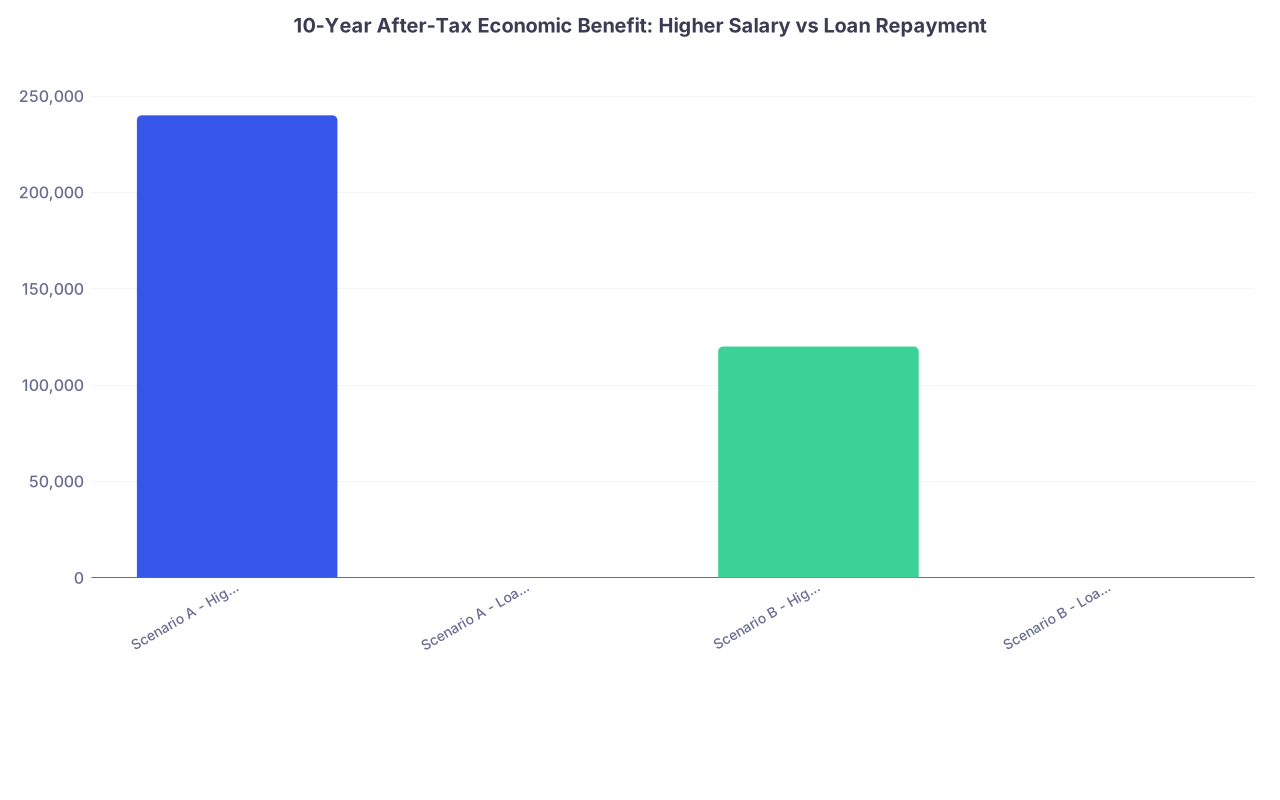
| Category | Value |
|---|---|
| Scenario A - High Salary | 240000 |
| Scenario A - Loan Repay | 0 |
| Scenario B - High Salary | 120000 |
| Scenario B - Loan Repay | 0 |
Interpretation: those bars represent the excess economic benefit of choosing the higher-salary option compared with the “lower salary + loan repayment” job over a 10‑year horizon, in the scenarios we modeled. The loan repayment option is the reference (0); the higher salary is the amount ahead.
The specific numbers will change with your situation. The directional result almost never does: permanent income > temporary loan support.
7. When loan repayment does win on the numbers
There are edge cases.
Loan repayment becomes mathematically attractive when:
- The loan repayment is large relative to the salary difference,
- The tax treatment is genuinely favorable (e.g., some PSLF-aligned positions or Section 127 optimized programs), and
- You expect to leave the job shortly after the vesting period, limiting the advantage of the higher salary.
Let’s construct a more favorable scenario for loan repayment.
Job X:
- Base: $300k
- No repayment
Job Y:
- Base: $295k (only $5k difference)
- Loan repayment: $30k/year × 4 = $120k gross
- And assume they structure up to $5,250/year tax-free; suppose effective tax on repayment is 25% instead of 40%.
After-tax:
Job X:
- Salary: 0.60 × 300k = $180k
Job Y:
- Salary: 0.60 × 295k = 177k
- Repayment: 0.75 × 30k = 22.5k
- Combined: $199.5k
Now Job Y wins by 19.5k per year for four years. 4 × 19.5k = $78k advantage over that period.
After year 4 (no more repayment):
- Annual salary after tax: Job X 180k, Job Y 177k.
- Difference: $3k per year in favor of X.
If you plan to stay exactly 6 years:
- First 4 years: Y ahead by 78k.
- Years 5–6: X ahead by 2 × 3k = 6k.
- Net: Y still ahead by $72k.
Here the “loan repayment” job wins, because:
- Salary discount is minimal ($5k/year),
- Repayment duration is decent (4 years),
- Tax treatment is better than usual,
- Time in job is not long enough for the higher salary to catch up.
The problem: this structure is not what most people are offered. The salary trade-off is usually much larger than $5k.
8. A practical triage framework for your offers
Let me give you a simple mental algorithm. You do not need Monte Carlo simulations. Back-of-the-envelope works.
Use this 5-step check whenever you see “loan repayment” in a job ad:
Translate repayment into after-tax principal reduction.
Multiply the headline total by 0.55–0.65 unless you have written proof of special tax treatment.- $100k package → roughly $60k real.
Convert that into an annualized equivalent over your expected stay.
If you think you will stay 5 years but repayment only runs 3 years, spread the real value over your entire 5-year horizon.- $60k real over 5 years ≈ $12k/year effective benefit.
Compare that to the after-tax salary difference.
Salary delta × 0.60 is the yearly take-home difference.- Salary gap of $40k → 0.60 × 40k = $24k/year.
If the annual after-tax salary advantage > annualized effective repayment benefit, the higher salary wins, even on a short horizon.
Adjust for time horizon.
If you think you will bail after the repayment vests (e.g., 3 years), use 3 years in your math.
Higher salary’s advantage compounds over time, but if you only stay 2–3 years, the loan repayment might temporarily dominate. You need to be very honest with yourself here.Layer in lifestyle and non-financial factors last.
Commute, call burden, support staff, EMR, partner compatibility. These matter. Just do the math first, so you know how many dollars you are trading for that nicer schedule or better city.
9. Visual check: loan repayment vs salary by horizon
Here is a compact visual: imagine a $60k real loan repayment benefit versus an annual $20k gross salary difference ($12k after tax). At what horizon does salary surpass repayment?
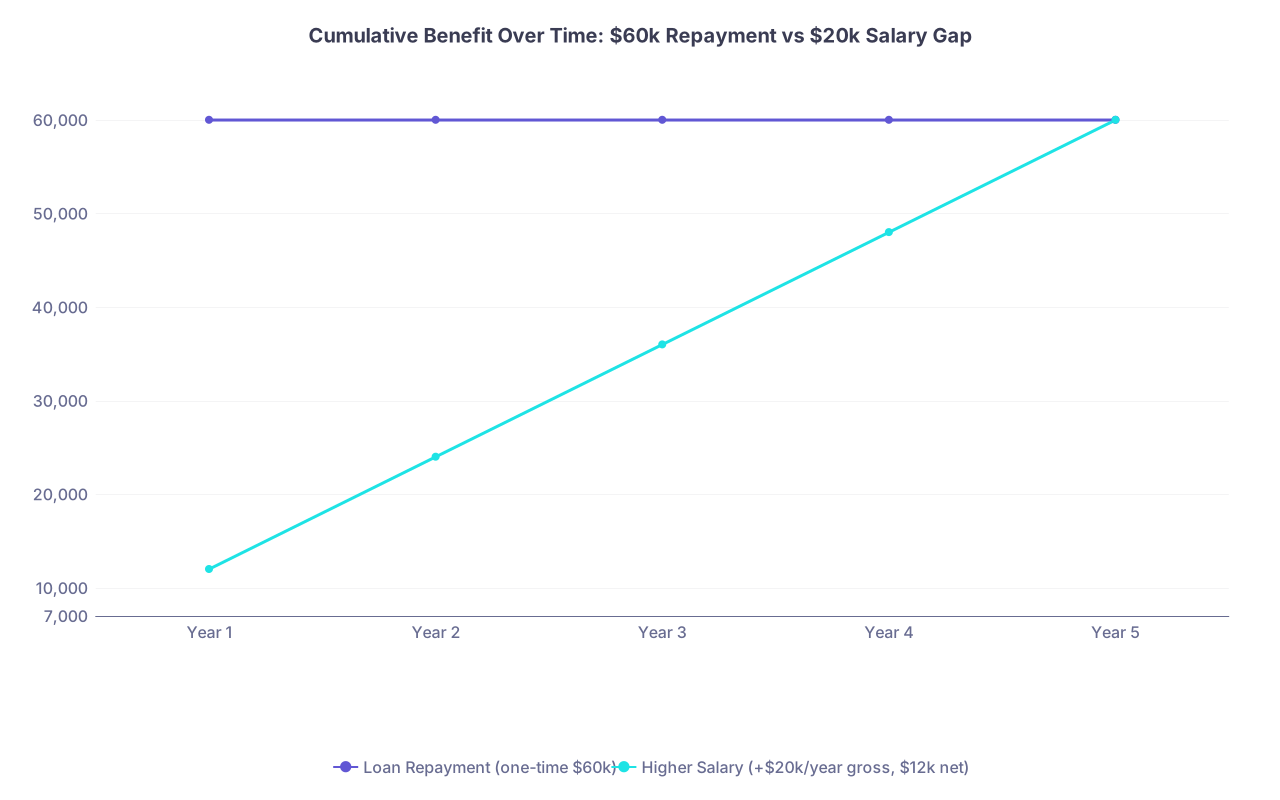
| Category | Loan Repayment (one-time $60k) | Higher Salary (+$20k/year gross, $12k net) |
|---|---|---|
| Year 1 | 60000 | 12000 |
| Year 2 | 60000 | 24000 |
| Year 3 | 60000 | 36000 |
| Year 4 | 60000 | 48000 |
| Year 5 | 60000 | 60000 |
Interpretation:
- Around Year 5, the cumulative after-tax salary advantage catches up with a one-time $60k repayment.
- Add investment growth on the extra salary, and the break-even moves even earlier.
That is why every additional year you stay in the higher-salary job makes the initial repayment perk look smaller and smaller.
10. A few landmines buried in the fine print
I keep seeing the same traps:
Clawbacks and vesting
Many contracts require you to repay prorated amounts of the loan benefit if you leave early. A $100k package might vest over 4 years, and if you leave after 2 you owe $50k back. That turns the “benefit” into golden handcuffs.Repayment paid to you, not your lender
Some employers dump the “repayment” into your paycheck and then you are expected to pay the lender. Behaviorally, lots of people do not. The money goes to cars, houses, lifestyle creep. Loans linger. Debt math loses.Income-driven repayment/PSLF interaction
If you are legitimately pursuing PSLF at a qualifying nonprofit job, employer repayments and your own aggressive prepayments might be economically dumb. Under PSLF, you want to minimize qualifying payments, not rush to zero. Loan repayment in that context is often more about marketing than math.Psychological relief vs. real net worth
I have heard, verbatim: “It just feels better seeing a smaller loan number.” I get it. But feelings do not compound like invested dollars. If you are trading a lot of income for that relief, at least be aware of the cost.
11. What I would do if I were you
If I were a new attending with $300k of debt and two offers on the table, I would:
Build a simple spreadsheet or even a notebook table: 10-year projection, after-tax salary, after-tax loan repayment, loan balances. Nothing fancy. Just year-by-year rows.
Assume I will behave rationally with extra salary: dedicate a fixed slice (say $2,000/month) to rapid loan payoff and invest the rest.
Ignore “loan repayment” as a separate category and just think in total after-tax economic benefit from each job.
Ask myself one question: “What is the minimum additional lifetime cash I require to justify worse call, worse location, or worse culture?” Then see if the job actually clears that bar.
The data overwhelmingly supports this: for most non-PSLF, non-special tax program situations, a materially higher recurring salary beats a finite employer loan repayment package, often by six figures.
Loan repayment is not evil. It is just usually overpriced. Employers use it because it sounds generous while often being cheaper than simply paying you what you are worth.
12. Key takeaways
Most “$100k loan repayment” packages are really $50k–$65k after tax, spread over several years. Run that math before you get excited.
Permanent salary differences compound. Over a 5–10 year horizon, even modestly higher pay usually beats loan repayment by six figures, especially if you invest the surplus.
Use a simple framework: convert everything to after-tax annual benefit, compare over your realistic time-in-job, and only then layer in lifestyle and personal factors. Emotion last, spreadsheet first.