
The idea that one low Step score permanently kills your chances at a competitive fellowship is a lie that terrified residents tell each other on call.
It feels true. But it’s not.
You and I both know the thought loop: “My Step 1/2 score is garbage. I’m in a mid-tier residency. The derm / GI / cards / heme-onc dream is over. I’ll be the person still explaining this score at 45.”
Let’s walk straight into that fear instead of dancing around it.
The Hard Truth: Yes, Your Score Matters. No, It’s Not the Whole Story.
I’m not going to sugarcoat it: a low Step score does matter, especially for competitive fellowships coming out of competitive residencies.
Program directors are lazy in a very predictable way. When they have 400 applications for 4 spots, they sort by easy filters: where you trained, letters, research, and yes—board scores. They want to know you’re likely to pass specialty boards. They want low risk.
So the anxious part of your brain jumps in:
“Low score = risky applicant = auto-reject = I’m screwed.”
Here’s what actually happens in the real world:
- Some programs do use hard filters (e.g., never interview below X score).
- Some programs care more about where you did residency than your Step score.
- Some programs care a ton about research and letters and barely look at USMLE once you’re in residency.
And it’s not the same across specialties.
| Fellowship Type | Step Score Weight | Research Weight | Home/Residency Program Weight |
|---|---|---|---|
| Cardiology | Medium | High | Very High |
| GI | Medium-High | Very High | Very High |
| Heme/Onc | Medium | Very High | High |
| Pulm/Crit | Medium | Medium | High |
| Derm (via IM/Path) | High | Very High | Very High |
| Nephro/Endo/Rheum | Low-Medium | Medium | Medium |
Is this exact data? No. It’s the reality I’ve seen play out again and again watching residents match (and not match) into these fellowships.
Bottom line: your low Step score is a handicap, not a death sentence. But you no longer get to be “average and still match.” You have to be strong elsewhere on purpose.
How Much Does Your Step Score Still Matter in Residency?
Here’s the question you’re probably obsessing over:
“Do fellowship directors care about my Step 1 from M2? Or is it all about ITEs and boards now?”
The annoying answer: it depends what was low and when.
If Step 1 was low (now pass/fail, but many still have numeric)
Older cohorts: if your Step 1 is low but Step 2/3 are stronger, some PDs quietly think: “Maybe they were a slow starter. They improved. Good.”
You don’t erase Step 1, but you reframe it.
If both Step 1 and Step 2 are low? Then you need more proof that you’re not going to fail fellowship boards. That proof comes from:
- In-training exam (ITE) scores
- ABIM or specialty board pass on first attempt
- Strong clinical evals and letters that explicitly mention fund of knowledge
If Step 2 is low
This one hurts more for some fields. Step 2 is closer to actual clinical reasoning. If it’s weak, PDs get nervous. But again, I’ve seen people with 220–230 ranges match into GI, cards, heme/onc from solid IM programs because everything else screamed: “This person is a beast clinically and academically.”
Do fellowships still ask about USMLE?
Some applications will still request Step scores. Some PDs barely glance. Others will quietly flag extremes (very low, or very high).
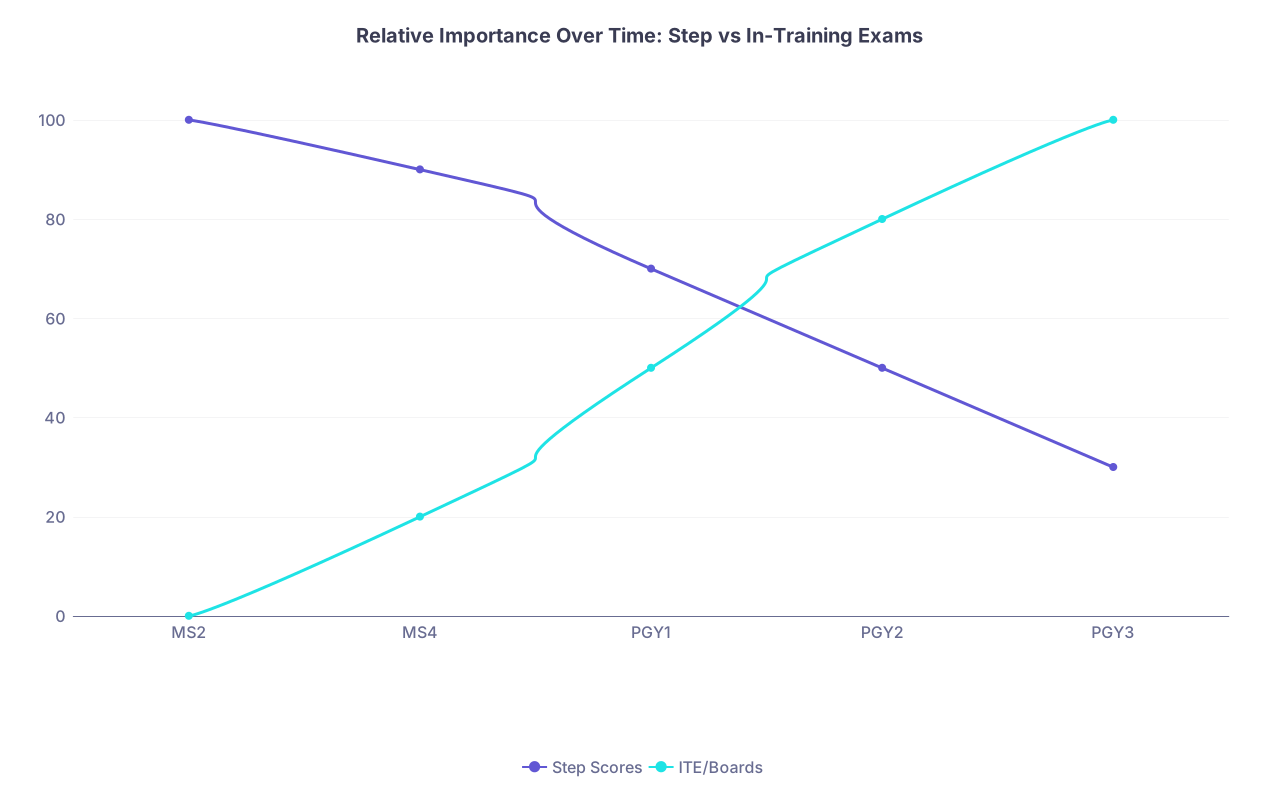
What they care about even more in residency: can you pass specialty boards and not make them look bad?
So they look at patterns.
| Category | Step Scores | ITE/Boards |
|---|---|---|
| MS2 | 100 | 0 |
| MS4 | 90 | 20 |
| PGY1 | 70 | 50 |
| PGY2 | 50 | 80 |
| PGY3 | 30 | 100 |
Your job now is to make your later performance scream, “That score was an outlier, not who I am.”
What Competitive Fellowships Actually Care About (Beyond Step)
Let’s be blunt: they care who will make their program look good. That’s it.
Here’s what moves the needle more than you think, especially if your Step score is dragging you down.
1. Your Residency Program’s Reputation
This is ugly but true: a mediocre Step score coming from Mass General or UCSF IM is treated very differently than the same score from a tiny community program nobody’s heard of.
You can’t change where you matched. But you can do this:
- If you’re at a big-name place: use that brand hard. Network. Do research with big names. Their name on your letter softens your Step score a lot.
- If you’re at a mid-tier or community program: your letters and research need to be so strong that PDs think, “This person is the star of their program.”
2. Research In The Right Places
Not just research. Strategic research.
If you want GI, and your CV is a bunch of random QI posters about “improving discharge summaries” from intern year, that doesn’t help much.
You need:
- Projects in your target field
- Preferably multi-author with your fellowship’s big names or well-known attendings
- Something that leads to an abstract, poster, or (ideally) a publication before you apply
I’ve watched residents with average Step scores match into insanely competitive fellowships because their name popped up over and over at national meetings (e.g., ACC for cards, DDW for GI, ASH / ASCO for heme-onc).

3. Letters That Don’t Sound Like Everyone Else’s
Most letters are garbage. “Hardworking, pleasant to work with, good knowledge base.” Nobody cares.
With a low Step score, your letters need to explicitly counter that doubt. Things like:
- “One of the strongest fund-of-knowledge residents I’ve supervised in the last 5 years”
- “If you looked only at USMLE scores, you’d underestimate this resident. In real clinical work, they are in the top 10%.”
- “Handled complex patients at a level I usually expect from a fellow.”
Those kinds of lines rewrite the committee’s story about you.
How do you get letters like that? You:
- Crush your specialty rotations
- Ask directly for a strong letter from people who know you well
- Give them a short summary of your story: “I’m concerned about my Step score; I’m working hard to show that’s not who I am. If you genuinely feel comfortable commenting on my growth and clinical ability, that would mean a lot.”
Yeah, it’s awkward. Do it anyway.
4. Your In-Training Exams and Board Pass
This is huge if your Step was low.
If your ITEs climb each year, that’s a concrete narrative: “I figured out how to learn. I improved.”
If you crush your specialty boards on the first try? That’s another brick in that story.
If you bomb ITEs and then fail boards on top of a low Step? That’s when doors really slam shut. That’s the reality your brain is scared of—and it’s valid. So don’t let that happen. Treat ITEs and boards like your redemption arc.
Tactical Damage Control: What You Can Actually Do Now
Ok, you’re in residency. You can’t go back in time and retake Step 1. So what now?
Here’s the unromantic checklist I’ve seen actually work for people with low scores who still matched competitive fellowships.
1. Build a “Redemption” Academic Story
Your story needs to be: “Early misstep. Then relentless upward trajectory.”
That means:
- Strong ITE improvement year to year
- Solid or strong ABIM / specialty board score
- A couple of well-chosen publications or high-yield abstracts in your field
- At least one letter that directly or indirectly redeems your “fund of knowledge”
You’re not trying to be perfect. You’re trying to be obviously not risky.
2. Get Known By the Right People
If you’re at a place with the fellowship you want:
- Rotate with them early
- Offer to help with projects, even the boring chart-review stuff
- Show up, be reliable, be the intern/resident who quietly gets stuff done
If your program doesn’t have that fellowship:
- Look for away electives as a senior resident
- Reach out (yes, cold email) to attendings at nearby academic centers for research
- Show up to conferences and literally introduce yourself: “I’m X, IM resident at Y, really interested in Z fellowship.”
People match because of “Oh yeah, I remember them, they worked with Dr. So-and-so and did good work.” Not because they had one perfect number years ago.
3. Be Honest But Controlled About Your Score
You don’t need to lead your personal statement with, “I know my Step score is bad.” Don’t center your entire identity around this one thing.
If it comes up in interviews, you can say something like:
“I was disappointed in that score. Looking back, I didn’t yet know how to study efficiently. Since then, I’ve really focused on building a stronger foundation. You can see the difference in my in-training exams and clinical performance. I’m grateful it pushed me to grow up academically.”
Short. Direct. Ownership without groveling.

| Step | Description |
|---|---|
| Step 1 | Low Step Score |
| Step 2 | Focus on ITE and Boards |
| Step 3 | Improve Next Exam Performance |
| Step 4 | Targeted Research in Desired Field |
| Step 5 | Strong Relationships with Faculty |
| Step 6 | Powerful Letters of Recommendation |
| Step 7 | Apply Strategically to Fellowships |
| Step 8 | Start Fellowship |
| Step 9 | Reassess and Strengthen CV |
| Step 10 | In Residency Now? |
| Step 11 | Match? |
4. Apply Strategically, Not Just Aspirationally
This is where people with low Step scores sabotage themselves. They only apply “up” and then are shocked when they don’t match.
You need a tiered list:
- A few reach programs (where your Step is clearly below their usual, but everything else is strong)
- A solid chunk of realistic programs (good places where your profile is competitive)
- Some safety programs (less prestigious, but solid training where you’d still be okay training)
Don’t let your ego force you into an all-or-nothing application strategy. You’re not a spreadsheet. Your life doesn’t need to collapse if you don’t match at the shiniest place.
Worst-Case Scenarios Your Brain Is Torturing You With
Let’s drag the nightmare thoughts into the light.
“What if I don’t match fellowship at all?”
It happens. Every year. To people with good scores and to people with bad scores.
If it happens to you, it doesn’t mean “you’ll never get a competitive fellowship.” It means:
You reapply stronger. Maybe:
- Do a chief year
- Do a research year in your desired field
- Work as a hospitalist while building your CV and connections
I’ve seen people match GI, cards, and heme-onc on second attempts from exactly this route. Their Step scores didn’t change. Their story did.
“What if every PD sees my score and rejects me without looking at anything else?”
Some will. Not all.
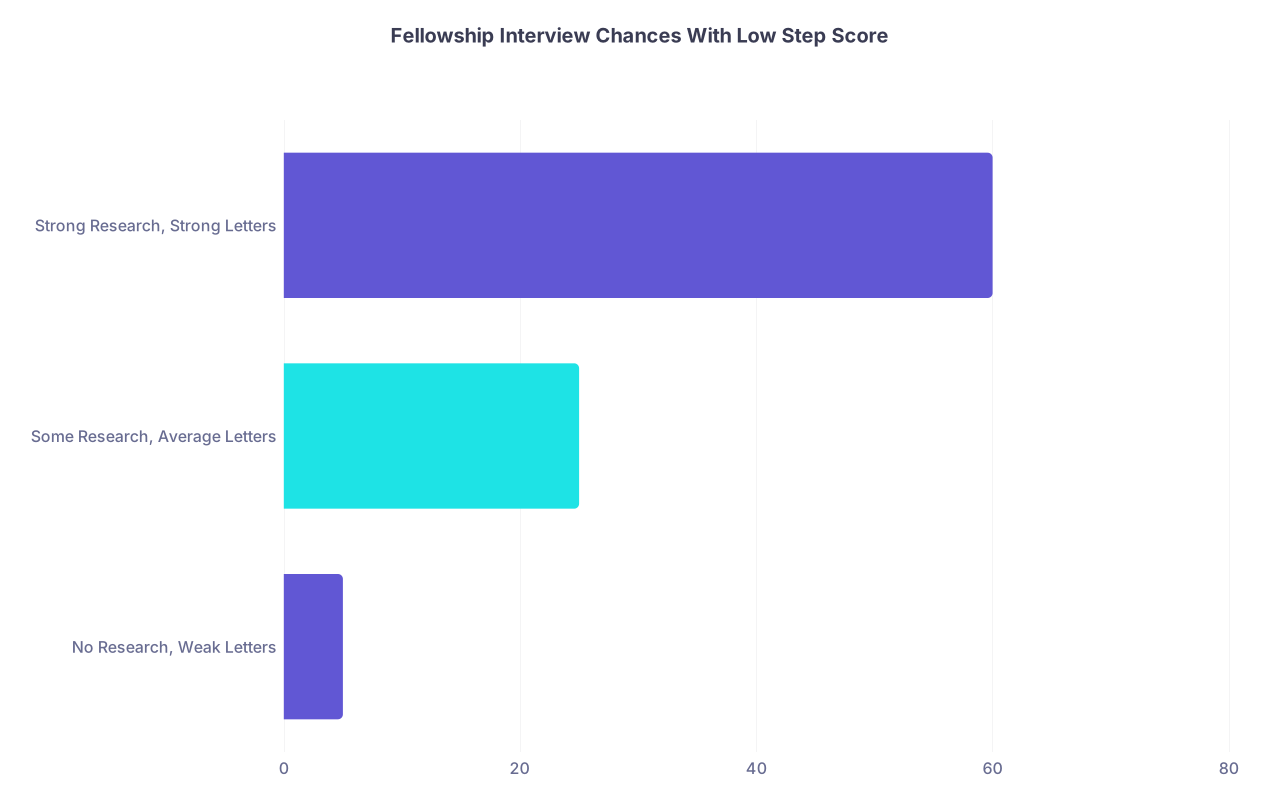
You don’t need 100 programs to believe in you. You need a handful who can see beyond a number. Your job is to make the rest of your file so compelling they pause before hitting delete.
| Category | Value |
|---|---|
| No Research, Weak Letters | 5 |
| Some Research, Average Letters | 25 |
| Strong Research, Strong Letters | 60 |
“What if I settle for a less competitive fellowship and hate my life forever?”
This is the anxiety monster speaking in absolutes.
Reality: plenty of people end up in a “less competitive” fellowship or a different niche than they imagined and build really good lives. They shape their career through jobs, additional training, niche expertise, and sheer persistence.
You’re not choosing your entire existence at age 28 because of a bad day at Prometric.
FAQ (Exactly 6 Questions)
1. Is there a Step score below which competitive fellowships basically won’t touch me?
There isn’t a universal cutoff, but if you’re in the very low 200s or below (for numeric eras) and your later exams aren’t stronger, you’re in a high-risk category. It doesn’t mean impossible; it means you need a big counterweight: strong ITEs, boards, serious research, and letters that go out of their way to vouch for your knowledge. If your later exams are solid, that low number becomes more of a yellow flag than a red one.
2. Does a strong Step 3 help redeem a low Step 1 or 2 for fellowship?
It helps, but it’s not magic. Step 3 is nice to have, and a strong score supports the “I got my act together” narrative. But fellowships care more about your ITE trend and board pass than Step 3 alone. Use Step 3 as one piece of a consistent improvement arc—not your whole redemption plan.
3. I’m at a community residency with a low Step score. Am I basically done for competitive fellowships?
No, but you don’t have margin for sloppiness. You’ll need to be one of the top residents in your program, have standout letters, and intentionally seek research or rotations at academic centers in your field. People do match from community programs into competitive fellowships, but they are almost never “average” in their class. They are the clear star.
4. Should I address my low Step score directly in my personal statement?
Only if you can do it briefly and tie it to a growth story. One or two sentences is fine: acknowledge, own it, and pivot to how you improved. Don’t write an essay about it. Your personal statement is not your Step score apology tour; it’s your “this is who I am now” pitch.
5. Is it better to apply one year later with more research, or apply on time with a weaker CV?
If your CV is truly thin—no meaningful research, average letters, nothing that counters your low Step—waiting a year to strengthen your file can be smarter. That could mean a chief year, research year, or a year as a hospitalist with active scholarly work. A stronger second try is better than a half-baked first try that burns bridges and demoralizes you.
6. What if I fix everything else and still don’t match into the ultra-competitive fellowship I want?
Then you have a hard, adult decision to make: try again, pivot to a related (or less competitive) fellowship, or shape your career through jobs and niche expertise instead. None of those paths means “failure.” It just means your career didn’t follow the prestige-script your anxious brain wrote in M3. I’ve seen “plan B” careers that look a lot better—and feel a lot happier—than the supposedly perfect, hyper-competitive path.
Key things to remember:
Your low Step score is a hurdle, not a life sentence. Your trajectory during residency—ITE scores, boards, research, letters, and relationships—matters more than that one number. And no matter how loudly your brain screams “it’s over,” there are always more ways to build a good career than whatever narrow, prestige-obsessed path you’re picturing right now.