
The default advice residents give each other about low Step scores is wrong.
Most people either over-explain and sink themselves… or stay totally silent when they should be proactive.
You’re asking the right question: should you email programs about your low Step score or just keep your head down and hope they do not care?
Here’s the blunt answer:
Most of you should stay silent in the initial application.
Some of you absolutely should reach out strategically.
Very few should send apology novels by email.
Let’s break down who belongs in which group and exactly what to do.
Quick Framework: Do You Email or Stay Silent?
Use this as your fast decision filter.
| Situation | Recommended Approach |
|---|---|
| Single low Step (e.g., 214) but passed on first try | Stay silent in initial outreach |
| Failed Step once, now passed with clear improvement | Consider targeted, concise outreach to select programs |
| Big mismatch vs specialty norms (e.g., 205 for Derm) | Consider a combination: email some, refocus list |
| Already have connections at the program | Ask mentor to signal, not you to explain |
| Program explicitly lists score cutoff you do not meet | Email only if you have a strong, specific hook |
Now, zoom in on the nuance.
What Programs Actually Think About Low Step Scores
You cannot decide what to say until you understand how PDs and coordinators think.
They’re usually asking three questions:
- Can this applicant pass board exams on time?
- Will they struggle with in-training exams and jeopardize accreditation metrics?
- Does the score reflect work ethic/discipline issues or just a bad day/context?
A low Step score is a risk signal. Not a death sentence. But a flag.
Here’s what I’ve seen:
- Many programs do a hard screen at a certain Step 2 or combined threshold. Your email will not override an automated filter.
- Once you’re above their floor, the exact number matters less than you think unless you’re in very competitive specialties.
- Programs care far more about pattern and trajectory than a single low score.
So the question becomes:
Does emailing help reframe you as “low-risk, high-upside”…
Or does it highlight you as “anxious applicant trying to explain away a problem”?
Most people fall into the second bucket because they write the wrong type of email.
When You Should NOT Email About a Low Step Score
If any of these are you, you likely should not send a Step-focused email.
You passed on the first attempt with a modest but not disastrous score
Example: Step 2 CK 220, applying IM/FM/Peds/Path/Neurology. That’s not a strong score, but it’s absolutely workable for many programs, especially community and mid-tier.You have nothing new to add
“I studied hard but the exam was difficult” is not new information. It is every bad email I have ever seen from anxious applicants.Your only goal is to make them “feel better” about your score
Programs don’t adjust decisions based on emotional appeals or generic “I know I can do better.”Your email would be a repeat of what is already in your personal statement
If you already mentioned a brief, controlled explanation in your PS, you don’t need a second version by email.The program receives 3000+ applications and is hyper-competitive
You’re not losing because you failed to email. You’re losing because the numbers and filters are brutal. Your energy is better spent on realistic targets.
In all these scenarios, silence about the number is usually better.
You focus your application on strengths: letters, clerkship comments, continuity, fit.
When You SHOULD Consider Emailing Programs
There are situations where proactive communication can help – if done right.
1. You had a failure, then a clear rebound
Example: Step 1 fail, Step 2 CK 238 with strong clerkship comments.
Here, programs see a red flag (failure) and a green flag (recovery).
A brief, controlled explanation shows maturity and context.
Email makes sense especially if:
- You’re applying to community or mid-tier academic programs.
- You have a geographic tie, rotation, or faculty connection there.
- The program historically considers applicants with previous failures.
2. You are below their typical range but have a strong hook
Hooks that actually matter:
- You rotated there and received strong informal feedback.
- A faculty member with real influence knows you and is willing to advocate.
- You bring something the program reliably values (e.g., fluent Spanish in a heavily Spanish-speaking patient population, strong prior career in research for research-heavy programs, etc.).
Email is not “I love your program because of X.” Everyone says that.
Email is: “Here’s why I’m still worth a look despite my score, in one or two sentences.”
3. Your score was pulled down by a specific, concrete, non-chronic event
Examples:
- Acute personal crisis during the exam window (family death, health issue) that is now fully resolved.
- Major logistical disruption (test center issues) documented at the time.
Caution: You’re not trying to sound like you’re making excuses. You’re giving context and showing the issue is not ongoing.
The Right Medium: Email vs ERAS vs Faculty Signal
Do not default to email when other channels work better.
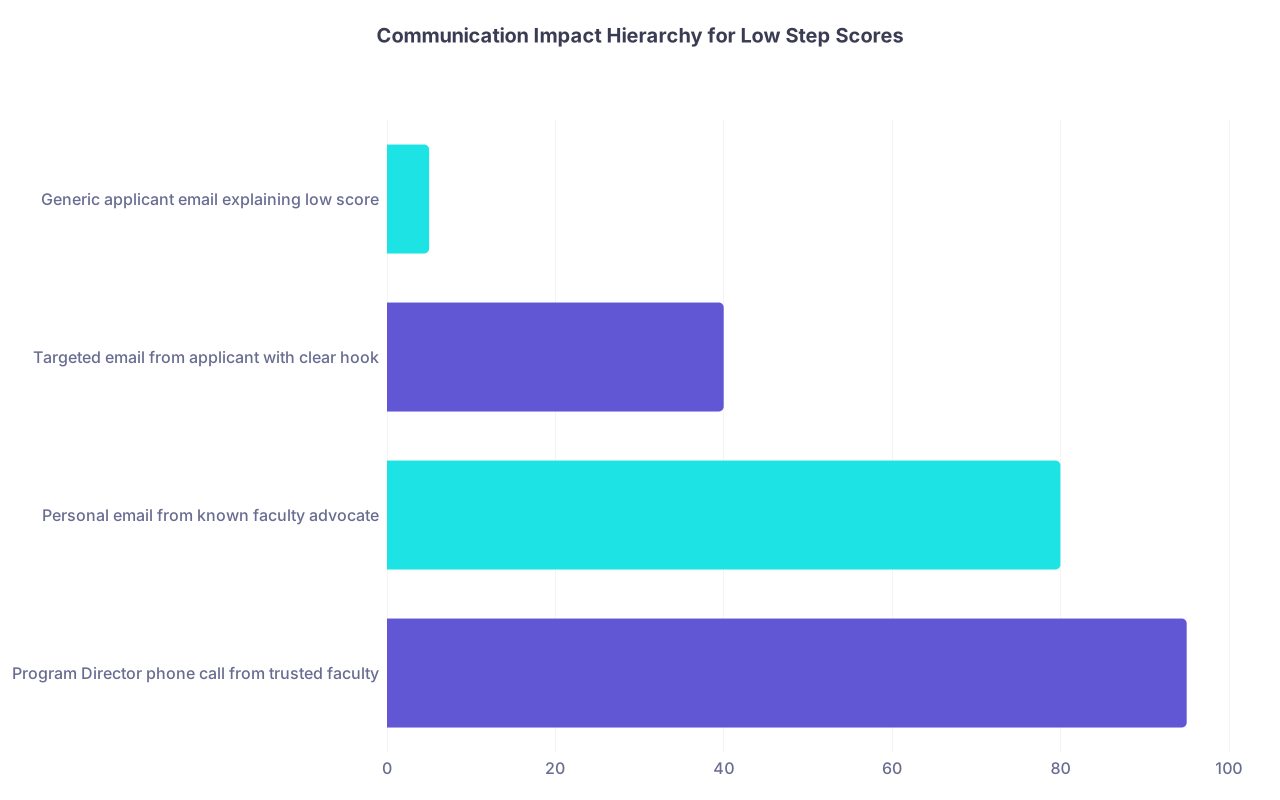
Here’s the hierarchy that actually gets attention:
| Category | Value |
|---|---|
| Program Director phone call from trusted faculty | 95 |
| Personal email from known faculty advocate | 80 |
| Targeted email from applicant with clear hook | 40 |
| Generic applicant email explaining low score | 5 |
If a faculty member who knows you can call or email on your behalf, that’s almost always better than you sending a long explanation yourself.
Your options, in rough order of power:
- Trusted faculty → PD direct call or email
- Trusted faculty → APD / program contact
- Your own concise, targeted email (to a limited number of programs)
- ERAS content only (short explanation in PS or experiences)
- Generic mass emails (this usually just annoys people)
If you have a mentor who’s willing to go to bat for you, use that.
Your job then is to give them a sharp, honest 2–3 sentence summary of the Step story so they can frame it for you.
What a Good Email Actually Looks Like
If you’re in the “yes, I should email” group, here’s the structure that works.
Goal of the email
Not to apologize.
Not to relitigate the exam.
Your goal:
- Express genuine interest.
- Acknowledge the score briefly, without drama.
- Point to evidence that contradicts the concern the score raises.
Example for a prior failure with improvement
Subject: Application to [Program Name] – [Your Name, US MD]
Body:
Dr [PD Last Name],
I’m a fourth-year at [Your School] applying in Internal Medicine and very interested in [Program Name], especially your focus on [brief specific program feature – e.g., primary care for underserved patients in X region].
You’ll see on my application that I failed Step 1 on my first attempt. I subsequently passed and improved to a 238 on Step 2 CK while consistently honoring my core clerkships, including Medicine and Surgery. I’ve worked closely with our school’s learning specialist and built a much more effective approach that I’ve sustained over the past year.
I realize my early test performance may raise concern, but I wanted to emphasize that my more recent exam results and clinical evaluations better reflect the physician I’m becoming. I would be grateful for any consideration of my application.
Sincerely,
[Name, AAMC ID]
Short. Controlled. No oversharing.
Example when you’re slightly below typical range but have a hook
Dr [Last Name],
I’m a [US-IMG/FM resident/etc.] applying to Psychiatry with strong interest in [Program Name]. I completed an elective at [Your Hospital] in [Month/Year] with Dr [Faculty Name] and greatly valued the team’s approach to [specific type of patient or clinic].
My Step 2 CK score is below your program’s usual average, but my recent performance – including honors in Psychiatry and consistent strong clinical evaluations – is much more in line with my everyday work. Dr [Faculty] has kindly offered to speak on my behalf regarding my rotation.
I know your program receives many applications, but I wanted to briefly express my interest and highlight context that may not be fully apparent from scores alone.
Thank you for your time,
[Name]
What you avoid:
- Paragraphs about anxiety, family drama, or test-day catastrophes.
- “I know I can do better if given a chance.” Everyone says this.
- Sounding desperate.
Where to Address Step in the Application (If Not Email)
Sometimes the best move is zero direct email, but a smart explanation inside ERAS or your personal statement.
Best places to put it:
Personal statement – one tight paragraph
That means 3–5 sentences max, middle of the statement, not the headline.Institutional action / explanation field (if applicable)
If your school suggests you clarify there, keep it factual and brief.Dean’s letter/MSPE
Some schools will already contextualize this. If they do, you may not need to repeat everything.
What you’re aiming for:
- Brief acknowledgment: “I struggled with Step 1 and failed my first attempt.”
- Concrete response: “I met weekly with a learning specialist, changed my study approach, and improved to a 239 on Step 2 CK.”
- Evidence of stability: “Since then, I’ve passed all shelf exams and honored key clerkships.”
That’s it. Then you pivot back to strengths.
Specialty Reality Check: How Much Does Email Even Matter?
Some specialties care so much about score cutoffs that no email will fix that. Others are much more forgiving if the rest of the file is strong.
| Specialty | Sensitivity to Low Step Scores |
|---|---|
| Dermatology, Plastics, Ortho | Extremely high |
| Radiology, Anesthesia, EM | High but flexible at some programs |
| IM, Gen Surg, Neuro | Moderate, context matters |
| FM, Peds, Psych, Path | More flexible, especially community programs |
If you’re applying:
- Derm/Plastics/Ortho with a low score → you don’t need clever emails; you need a brutally realistic backup plan.
- FM/Peds/Psych with a low score and strong clinicals → silence about Step is often fine; just apply broadly and smartly.
- IM/Gen Surg → it depends heavily on region and program tier.
A Simple Flowchart: Should You Email?
Use this mental decision tree before you type a single word.

| Step | Description |
|---|---|
| Step 1 | Low Step or Failure |
| Step 2 | Do not email about score - focus on strengths |
| Step 3 | Do not email - work on overall strategy |
| Step 4 | Ask faculty to contact PD |
| Step 5 | Send brief, targeted email to select programs |
| Step 6 | Consider short, targeted email |
| Step 7 | Silence about score - apply broadly |
| Step 8 | Did you fail any Step? |
| Step 9 | Score above many program cutoffs? |
| Step 10 | Clear improvement on later exam? |
| Step 11 | Any strong hook to program? |
| Step 12 | Faculty advocate available? |
If you land in “do not email,” believe it. The urge to “do something” often just leads to awkward over-explanation.
Common Mistakes That Hurt You More Than Your Score
I’ve watched applicants with mediocre scores match well and others with better scores crash. Often because of these unforced errors:
- Mass, copy-paste emails to 80+ programs with obvious template language.
- Subject lines like “Explanation of my Step 1 score” – do not make your weakness your headline.
- Over-sharing personal health and mental health details by email. That’s sensitive information; do not casually distribute it.
- Writing more about your score than about your clinical performance or fit.
- Treating PDs like therapists instead of employers.
Your low score is one line on your application.
Do not turn it into your entire story.
FAQs
1. Should I ever mention my low Step score during an interview?
Yes, if they ask directly or allude to it. You do not volunteer it unprompted if they do not. When it comes up, keep it tight: acknowledge, explain your response (new strategies, support, improved results), and pivot to how you’re performing now. One minute, max.
2. Is it better to explain a low Step score in my personal statement or in an email?
Personal statement is safer and more controlled. You know they’ll at least see it when reviewing your file. Email is higher-risk and should be reserved for specific cases: prior failure with improvement, strong program hook, or faculty advocate referencing your message. If you’re unsure, default to personal statement, not email.
3. How many programs should I email about my low Step score?
Very few. Think 5–15 maximum, not 50. Target places where you have geographic ties, prior rotations, realistic competitiveness, or genuine program-specific reasons. The more emails you blast out, the more generic and desperate you sound, and the less any one PD will care.
4. Do programs really care about Step 1 now that it’s pass/fail?
They still care in context. A failure is a red flag. A pass with subsequent strong Step 2 CK and shelves is fine. More weight has shifted to Step 2 CK, clerkship grades, and narrative comments. So yes, the game shifted, but it did not eliminate concern about board performance. If your issue is Step 1 pass-only, and Step 2 is solid, you generally do not need an email explanation.
5. I am an IMG with a low Step score. Should I email more aggressively?
No. If anything, you must be more disciplined. Most IMG-unfriendly programs will not change their filters based on your email. Your biggest levers are: applying smartly to IMG-friendly programs, strong US clinical experience, excellent letters, and, if available, faculty advocates. Targeted emails to a small number of programs where you have a real connection can help; mass emailing usually just wastes your time.
6. What should I do today if I already sent a bad “low Step explanation” email?
Do not send a follow-up apology email. That just draws more attention to it. Instead, focus on what you can still control: tighten your personal statement, strengthen your letters (ask faculty to be specific), finalize a realistic and broad program list, and prepare to shine on any interview you do get. If you have a mentor who knows a PD where you already emailed, they can still reach out with a positive framing that shifts focus away from your awkward message.
Open a blank document right now and draft a single, 6–8 sentence email based on the frameworks above to one realistic program you’re truly interested in. Then cut any sentence that sounds like an excuse and make sure at least half of it talks about your strengths, not your score.