
Your subinternships and subspecialty electives can do more for your application than ten extra points on Step 1 ever could—if you use them correctly.
Low Step scores or mediocre core clerkship exams are not automatic death sentences. What kills applications is when those numbers are the only clear signal a program sees. Subspecialty electives are how you overwrite that signal with something louder, more specific, and coming from the right mouths.
Let me break this down specifically.
1. What Subspecialty Electives Can (and Cannot) Fix
First, boundaries. You cannot “elective” your way out of a 205 on Step 1 and 220 on Step 2 and match Derm at UCSF. Fantasy. But you can:
- Change how programs interpret your low/average scores
- Create powerful, credible counter‑evidence from people the specialty trusts
- Open doors at programs that would otherwise screen you out on numbers
Think of your scores as your default narrative:
- Step 1: 205
- Step 2: 222
- Shelf exams: mostly passes, one or two lows
Default interpretation from a PD who does not know you: “Borderline test taker, possible knowledge gaps, maybe not sharp under pressure.”
Your job with subspecialty electives is to generate competing data:
- Honors on specialty electives
- Concrete, detailed letters from respected subspecialists
- Clear evidence of growth between earlier and later rotations
- Proof you perform at or above co‑resident level in that niche
Good electives do not erase the scores. They bury them in context.
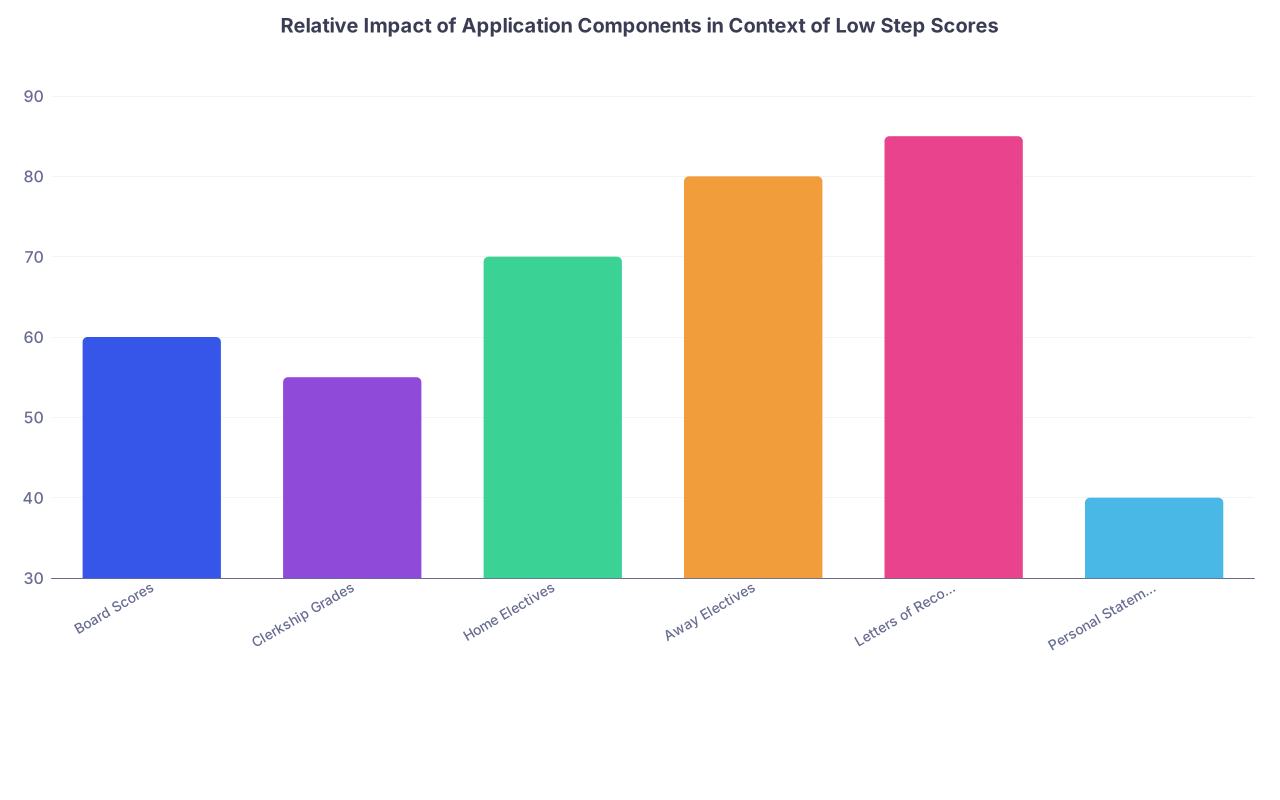
| Category | Value |
|---|---|
| Board Scores | 60 |
| Clerkship Grades | 55 |
| Home Electives | 70 |
| Away Electives | 80 |
| Letters of Recommendation | 85 |
| Personal Statement | 40 |
Interpretation: when your scores are weak, away electives and letters disproportionately move the needle. That is where you fight.
2. Choosing Electives Strategically for Low Scores
Most students pick electives based on interest and schedule convenience. You do not have that luxury. You are using electives as active countermeasures to a liability.
Step 1: Be brutally honest about your risk profile
There are three broad scenarios I see over and over.
- Low boards, solid clinical evaluations
- Low boards and spotty clinical performance
- Mid‑range boards, but weak in a single core (e.g., failed Surgery shelf)
Each scenario requires a different elective strategy.
Scenario A: Low boards, good on the wards
This is the “I test poorly but I am good with patients and teams” group.
Your leverage points:
- Subspecialty electives that are clinically intense and evaluation‑heavy
- Services with high resident/attending interaction (not scattered consult‑only fluff)
- Programs known for detailed narrative evaluations, not checkbox nonsense
You want letters that explicitly say things like:
“Despite lower numeric scores, this student functioned at or above the level of an early intern on our busy pulmonary consult service…”
Those phrases are policy‑level dynamite. PDs know exactly what “early intern level” means.
Good elective choices here:
- For IM: Cardiology consults, Pulmonary/ICU, Nephrology, GI inpatient
- For Surgery: Surgical Oncology, Trauma, Vascular, Transplant
- For Neuro: Stroke service, Epilepsy monitoring, Neuro ICU
- For EM: Toxicology, ICU, Ultrasound, EMS (if EM‑run and evaluation‑heavy)
Avoid: ultra‑narrow electives with little patient volume or minimal observation (e.g., a half‑day per week outpatient niche where no one really sees you work).
Scenario B: Low boards and inconsistent clinical performance
Harder. Not impossible.
Here your elective goals shift:
- Show recent, sustained improvement under higher expectations
- Pick environments where you can get intense feedback and fix things
- Find attendings who actually teach and write thoughtful letters
You may need a mix:
- One home subspecialty elective with a supportive faculty mentor who knows your trajectory
- One away elective where you perform solidly and prove your “floor” has risen
The key phrase you want in letters:
“Recent performance on our service showed substantial improvement compared with earlier clerkships; I have no concerns about this student handling residency responsibilities.”
That “no concerns” clause is gold.
Scenario C: Mid scores overall but one big red flag
Example: you want Internal Medicine, but you barely passed your Medicine core and got a below‑average IM shelf.
Targeted repair strategy:
- Do at least one rigorous general IM or ICU‑type elective before dedicated subspecialty elective
- Then a subspecialty in the field you want (Cardiology, Heme/Onc, etc.) with someone who can specifically comment on your internal medicine skills
You want letters that directly tackle the red flag:
“I am aware that this student had a weaker performance on the core Medicine clerkship earlier in training. That is not the student I saw. On my service…”
Leaving that gap unexplained is how files slide to the rejection pile.
3. Home vs Away: Where Subspecialty Electives Do the Most Work
You are not just picking topics. You are picking locations and audiences.
When a home subspecialty elective is your primary weapon
Your home program matters most when:
- You are applying to that specialty at your own institution
- Your school’s faculty are respected nationally or regionally
- You need advocates who know your whole story and can contextualize low scores
Classic example: low Step 1 (207), Step 2 (225), but you are at a strong state school IM program. You do:
- Pulmonary/ICU elective with the program director or an associate PD
- Another inpatient subspecialty with a senior, well‑known attending
They see you crush it. They write:
“I have reviewed this student’s board scores, which are below our usual interview cutoff. I recommended we review this application in detail based on my experience with them on our ICU service…”
That kind of internal advocacy is the difference between no interview and a shot.
When away subspecialty electives become critical
Away electives are not just “auditions.” They are pathway modifications.
You should strongly consider an away if:
- You are targeting a more competitive specialty with low‑ish scores (e.g., EM, Ortho, ENT, Anesthesia, some IM fellowship‑heavy programs)
- Your home department is weak, disorganized, or uninterested in teaching
- You come from a lower‑tier or lesser‑known school and want to break into an academic program
Where electives matter most for low scorers:
| Target Specialty | Impact of Strong Away Elective | Notes |
|---|---|---|
| Emergency Medicine | Very High | SLOEs often override Step screens |
| Orthopedic Surgery | Very High | Performance on away often decisive |
| General Surgery | High | Especially at target programs |
| Internal Medicine | Moderate–High | More for top academic programs |
| Neurology | Moderate | Strong letters help significantly |
| Family Medicine | Moderate | Less board‑obsessed overall |
If your scores are below typical cutoffs, away electives are your main way to:
- Get your file seen despite filters
- Get SLOE‑type letters (in EM) or very specific subspecialty letters (Surg, Ortho, Neuro)
- Demonstrate “fit” and work ethic in person
But you must choose sites carefully.
Do not:
- Go to the absolute hyper‑elite program in the country where Step filters are brutal and they take 1 MD student per year from outside their usual pipelines
- Choose a place that is infamous for chewing through rotators and writing useless, generic letters
You want a program that:
- Historically takes people from a range of schools
- Has a reputation as “fair but busy”
- Actually interviews rotators if they perform well (talk to your seniors; they know)
4. Timing: When to Schedule These Electives for Maximum Impact
If you have low scores, timing is not an afterthought. It is a weapon.
The core principles
- You want your best, most intense electives completed before ERAS submission so those letters can be in early.
- You do not want your first elective in the specialty to be an away. You need reps at home first.
- You must balance Step 2 CK prep and testing, especially if Step 1 is low and you are using Step 2 as a “comeback.”
For a traditional 4th‑year timeline targeting, say, Internal Medicine or Surgery, with lowish steps:
Late MS3 / early MS4
- Do a solid home elective in the target specialty (subspecialty or ICU) after your core is done.
- This gives you familiarity with workflow and expectations.
Early MS4 (May–August)
- Do at least one “letter‑generating” elective at home and/or away.
- Ensure at least 2 strong letters from subspecialists in your target field can be ready by September.
ERAS submission (Sep)
- Your subspecialty letters should already be uploaded or imminent.
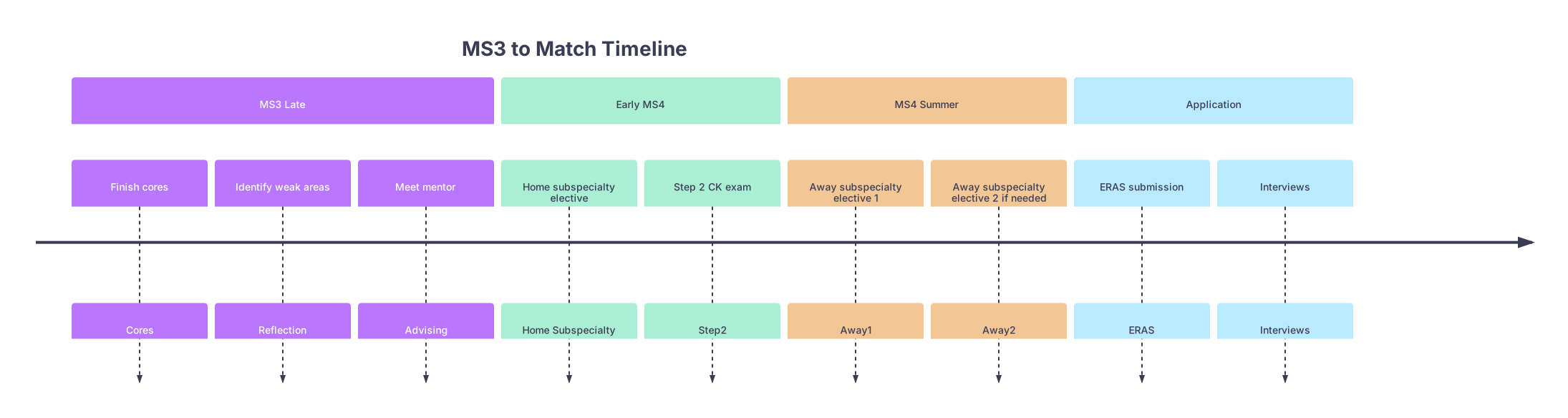
| Period | Event |
|---|---|
| MS3 Late - Finish cores | Cores |
| MS3 Late - Identify weak areas | Reflection |
| MS3 Late - Meet mentor | Advising |
| Early MS4 - Home subspecialty elective | Home Subspecialty |
| Early MS4 - Step 2 CK exam | Step2 |
| MS4 Summer - Away subspecialty elective 1 | Away1 |
| MS4 Summer - Away subspecialty elective 2 if needed | Away2 |
| Application - ERAS submission | ERAS |
| Application - Interviews | Interviews |
If Step 2 is your comeback exam, do it before your key away elective if possible. Programs will be less anxious about a low Step 1 when they see an upward trend (e.g., 205 → 235).
5. How to Behave on a Subspecialty Elective When Your Scores Are Weak
This is where people sabotage themselves. They finally get the high‑impact elective, then act like passive observers because “it’s just an elective.”
If your numbers are already a liability, you are playing on hard mode. You must outwork the curve without being obnoxious.
Here is what that looks like in reality.
Before the rotation starts
- Email the attending or clerkship coordinator a brief, focused introduction:
- Your level (MS4, etc.)
- Your interest in the specialty
- One line acknowledging you want formative feedback and are eager to improve
- Quietly review:
- Top 10 common consult questions / problems in that subspecialty
- Relevant guidelines (at least skim): e.g., ACC/AHA for Cardiology, GOLD for COPD, etc.
- How to write a consult note in that field (ask seniors; get templates)
You are not trying to be an expert. You are trying not to be dead weight on day 1.
On service: non‑negotiable behaviors
You must consistently:
- Show up early enough that your resident is never waiting on you
- Pre‑read your patients and anticipate at least one reasonable next step per case
- Volunteer for unglamorous tasks—calling families, following up labs, tracking down prior records
- Present succinctly and logically; verbal chaos kills trust quicker than low Step scores
You should explicitly ask for feedback early:
Day 2 or 3, to your senior or attending:
“I know my board scores are not where I wanted them, and I am really focused on showing I can function well clinically. Is there one thing I can change this week that would make the biggest difference in how I’m contributing?”
That level of self‑awareness disarms a lot of quiet skepticism.
What attendings are actually watching in low‑score applicants
No one is secretly re‑grading your board performance. They are subconsciously asking:
- Do you recognize your limits and ask for help appropriately?
- Can you integrate feedback quickly? (Do not make the same mistake 3 days in a row.)
- How do residents feel about working with you after 2 weeks?
I have seen PDs throw out initial doubts when a subspecialist they trust says:
“The residents were disappointed to see this student leave service.”
You do not get that kind of comment by being brilliant. You get it by being reliable, engaged, and not annoying.
6. Letters of Recommendation: Turning Electives into Defenses
Subspecialty electives offset low scores only when they produce the right kind of letters. “Strong letter” is not enough. You need strategic letters.
Who should write your letters
Prioritize:
- Faculty clearly within the specialty you are applying to (or closely allied subspecialty)
- People who directly observed you clinically—not just saw you give a talk
- Attendings who are:
- Senior enough to be recognized by PDs, or
- Known as excellent teachers whose letters PDs trust
A mediocre letter from a big‑name chair is worse than a detailed, enthusiastic letter from a clinically respected associate professor.
What those letters must explicitly address
With low or mediocre scores, you want your letter writers to hit several specific points:
- Comparison language: “top 10% of students I’ve worked with this year” or at least “above average”
- Concrete examples of clinical reasoning, not vague “hard worker” fluff
- Explicit reassurance phrases:
- “I have no concerns about this student’s ability to handle the cognitive demands of residency.”
- “Their test scores under‑represent their actual clinical acumen and work ethic.”
You have to tee this up. End of week 2 or 3, have an honest, brief conversation:
“Dr. X, I am applying to [specialty]. My Step scores are lower than I would have liked, and I am working hard to show that clinically I can perform at the level expected of residents. If you feel you know my work well enough, I would be very grateful for an honest letter that speaks to my performance here, especially in the context of those scores.”
Good attendings understand that signal is critical. Some will even say, “Send me your CV and personal statement draft so I can comment specifically.”
For EM, this is formalized in SLOEs. For other specialties, you want SLOE‑like content: comparative, concrete, and clearly addressing fit for the field.
7. Matching Specialty Ambition to Reality
There is a painful truth here: sometimes the smartest strategic move with low scores is specialty recalibration, then elective optimization.
Let me be specific.
Extremely competitive specialties
Dermatology, plastic surgery, neurosurgery, ENT, orthopedic surgery at top‑tier programs—if your Step 1 is in the low 200s and Step 2 is sub‑230, you are starting so far behind that even incredible electives may not be enough for most programs.
You can still:
- Target mid‑tier or less competitive programs in those fields
- Use electives to prove you belong in that niche to a carefully selected set of institutions
But you must scale expectations. One great away elective at a high‑volume, non‑elite program where you click with the team is more valuable than four electives at brand‑name places that never take you seriously because of your board numbers.
Moderately competitive specialties
Emergency Medicine, Anesthesia, General Surgery, Neurology, academic Internal Medicine—this is where subspecialty electives can meaningfully swing your outcome.
A realistic pattern I have watched:
- EM applicant, Step 1: 208, Step 2: 224
- Solid third‑year evals, but 1 failed shelf (retaken and passed)
- Two strong EM away electives, SLOEs both in top tier of their rotation cohorts
- Home EM elective with clear upward trajectory and advocacy
Result: Not matched at absolute “big four” academic programs, but matched at a solid university‑affiliated EM program with fellowship options.
The SLOEs—and the reputation of being the hardest‑working student on shift—carried more weight than his Step numbers.
Less competitive specialties
Family Medicine, Psychiatry (in many programs), some Community IM, Pediatrics.
Here, low scores matter less, but subspecialty electives can still determine where you land:
- Strong Child Psych elective → better shot at academic Psych with child fellowship access
- FM elective at a community program → direct path to matching there with a PD who already trusts you
- Peds ICU or Heme/Onc elective → gives you leverage for fellowship‑oriented Peds programs, even with average boards
Do not waste this by doing only low‑intensity “lifestyle” electives because “fourth year is for relaxing.” Not if you are trying to compensate for earlier weaknesses.
8. Packaging the Story in Your Application
Numbers, electives, and letters are raw material. Your application is the narrative.
You need everything pointing in the same direction:
- Personal statement
- MSPE language (to the extent you can influence context)
- Interview answers
Core story you are building:
- Yes, my scores are lower than the median for your typical applicant.
- Those scores reflect [brief, honest explanation if there is one: test anxiety, late adjustment to med school, life event], not a lack of work ethic or ceiling on my capability.
- Since that time, my performance has been consistently strong on clinically demanding subspecialty electives and in environments similar to your residency.
- The subspecialists who have seen me most recently—on high‑acuity services—are willing to stake their names on my readiness.
Do not whine about the exams. Do not spend three paragraphs dissecting your Step 1 trauma.
One sentence suffices, followed by evidence of growth and resilience:
“Early in medical school, I struggled with standardized exams, which is reflected in my Step 1 score. Since then, I have sought out feedback‑heavy, clinically demanding rotations to build a stronger foundation. On my pulmonary ICU and cardiology electives, I functioned at the level of an early intern and received strong evaluations, which reassured me that I can meet the cognitive and emotional demands of residency.”
Then you let your letters back that up.
9. Common Mistakes I See Low‑Score Applicants Make With Electives
Let me be blunt about what not to do.
Stacking easy electives
Four outpatient lifestyle clinics in a row, all graded Pass, with vague letters. That tells a PD you want a vacation, not a demanding training environment.Doing your away electives too late
An October or November away in a key specialty will not help much for interview offers that mostly go out September–early October.Failing to ask for letters until months later
Attendings forget you. Their letters become generic and cautious. Ask at the end of the rotation while your performance is fresh.Hiding your low scores from letter writers
Many will assume you are a standard applicant and write lukewarm language. If you are direct about your scores and what you are trying to prove, good faculty will aim their letters accordingly.Acting like a tourist on elective
Showing up late, skipping didactics because “it’s just an elective,” disappearing after rounds. If your scores are weak, that pattern confirms every negative bias.
Do the opposite. Make your electives feel like interviews with a long runway, not like vacation blocks.
10. Quick Reality Check: What Success Actually Looks Like
Success here is not magical transformation. It is reframing.
Reasonable expectations if you execute well:
- You will not erase your low Step scores, but you can soften their impact enough to get past screens at a subset of programs.
- You may still get screened out at very competitive places. That is normal, not a failure of your strategy.
- Your interview list will likely skew toward programs where you rotated or where your letter writers are known. That is exactly what you want.
You are trying to convert your application from:
“Numbers say no”
to
“Numbers are marginal, but faculty X and Y—whom we trust—say yes.”
That is how people with mediocre or low boards end up as completely competent residents in good programs every single year.
Key Points
- Subspecialty electives will not delete low Step or core exam scores, but they can generate powerful, specialty‑specific evidence that those numbers underestimate your clinical ability and readiness.
- For low or borderline scores, you must choose electives and sites deliberately: high‑intensity, evaluation‑heavy services at home and/or away, with attendings who will actually watch you work and write targeted letters.
- The real value of these electives is in the letters and the narrative: attendings explicitly stating that your recent performance, on demanding subspecialty services, reassures them—and should reassure PDs—that you will function at or above intern level despite earlier exam weaknesses.