
The biggest lie you’ve been told about low Step scores is that “after you pass, everything else is holistic.” It is not. When two low-Step candidates land on a PD’s screen, there are very specific unwritten rules that decide who lives and who dies in the pile.
Let me walk you through what really happens behind closed doors.
How PDs Actually Look at “Low Step” Candidates
Here’s the first uncomfortable truth: once you’re in the “borderline” bucket, the comparison between you and the other low-Step candidate is more ruthless, not more forgiving.
They are not saying, “Both have low Step, let’s see who has a kind heart.”
They are saying, “If I have to take a risk on one of these, which one is less likely to embarrass me, fail boards, or be a headache on rotations?”
Low Step candidates get sorted into three mental categories:
- Clearly unsafe – won’t touch unless desperate.
- Risky but maybe workable – only if they have strong counters.
- Low but explained, compensated, and clearly trending up – these are the ones who can actually win a spot.
When a PD has two low Step candidates side by side, they are not treating you as identical. They’re using a whole set of unwritten filters. And they’re faster and harsher than you think.
Rule #1: The Direction of Your Academic Trend Matters More Than the Absolute Step
This is the first thing experienced PDs do with low scores: they look at the story around the number.
Imagine two candidates:
- Candidate A: Step 1 barely passed, Step 2 CK is a modest but clear jump.
- Candidate B: Slightly higher Step 1, but Step 2 CK plateaued or dipped.
Every PD I’ve ever sat with makes the same comment:
“I’m more worried about the flat or falling line than the one who started low and improved.”
Why? Because of what they’re really thinking:
“Will this person pass their in-training exams and boards on the first try, or are they going to be a problem I have to defend to the chair?”
If your Step is low, they start digging:
- Did Step 2 CK improve, even modestly?
- Are your clerkship grades stronger than preclinical?
- Are there failed courses or remediation early on that later stabilize?
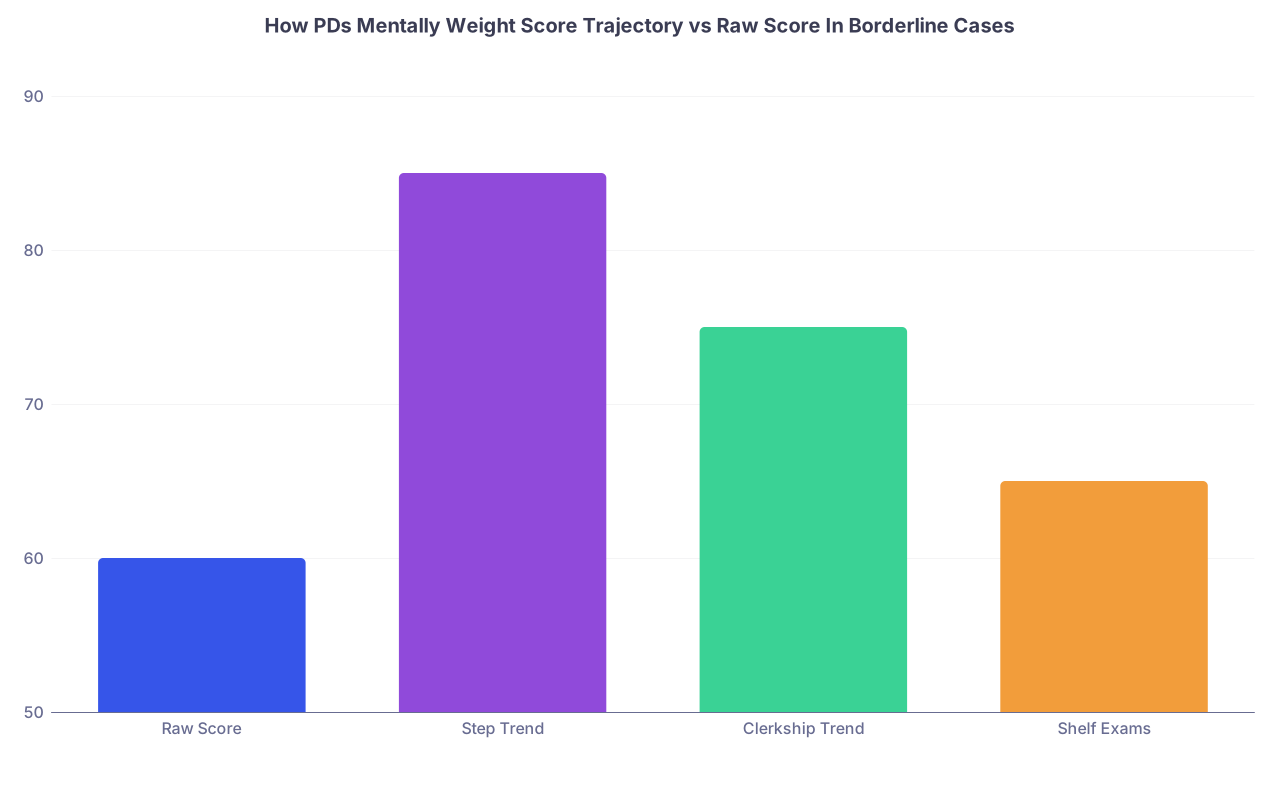
| Category | Value |
|---|---|
| Raw Score | 60 |
| Step Trend | 85 |
| Clerkship Trend | 75 |
| Shelf Exams | 65 |
The candidate with a clear upward trajectory usually wins when both have low Step scores. I’ve heard variations of:
“Yeah, the number sucks, but at least they’re moving in the right direction. This one… flattened out. That worries me.”
If you’re the one with the stronger upward trend, you’ve got leverage. If you’re not, you need compensation elsewhere—heavier, louder, and very intentional.
Rule #2: Failures Are Not All Equal – PDs Rank the Type of Damage
Low but passing is one level of concern. Actual failures are another. But even within “red flags,” there’s a hierarchy nobody explains to you.
When comparing two low Step candidates, PDs quietly use a risk scale:
| Issue Type | Perceived Risk Tier |
|---|---|
| Single preclinical course remediated, early | Low–Moderate |
| Step 1 barely passed, no failures | Moderate |
| Step 2 CK barely passed, no failures | High |
| Shelf exam failures needing retake | High |
| Multiple Step attempts (especially CK) | Very High |
I’ve literally heard:
“I can work with someone who needed the first two years to figure it out. I cannot have someone failing licensing exams during residency.”
So between two similarly low scores:
- The one with clean pass records (no repeats, no exam failures) almost always wins.
- The one with a failure on Step 2 or multiple attempts gets pushed down unless there’s a very compelling narrative and unbelievable support from faculty.
And here’s the dirty little secret:
If your school transcript quietly hints “repeat” or “remediation” and your personal statement never mentions any struggle, PDs read it as avoidance, not resilience.
The candidate who owns the stumble and shows a controlled comeback usually looks safer than the one pretending nothing happened.
Rule #3: They Look for Evidence You Can Survive the Grind, Not Just Pass One More Exam
Once you’re flagged as “low Step,” PDs start searching for a different kind of proof:
“Can this person handle 80-hour weeks, emotional stress, night float, and still function?”
So when two low-score candidates are being compared, they don’t just see stats. They scan for stamina and reliability signals:
- Long-term commitments (multi-year research, leadership, teaching).
- Consistent work – tutoring, scribing, EMS, CNA, military service.
- No pattern of “start big, then bail.”
The resident who blows up at 2 a.m. on call or melts when they’re behind on notes is the PD’s nightmare. Low Step candidates have to convince them: “I’ll grind. I won’t quit. I will not make your life harder.”
This is why sustained, unglamorous work actually helps you more than a shiny but shallow project.
Between:
- Candidate A: 1.5 years of longitudinal clinic or research with the same attending, strong letter backing their reliability.
- Candidate B: Three short summer things that look scattered.
A goes on the interview list. B gets the “maybe if we need to fill spots” pile.
Rule #4: Letters of Recommendation Become the Tie-Breaker Weapon
When the numbers are weak, PDs weaponize your letters.
Not the quantity. The content and the voice behind them.
Compare these two:
- “X is a hard worker and pleasant to work with. They will do well in residency.”
- “I would actively advocate for X to join our program. We’d be lucky to have them as a resident.”
Both are technically positive. Only one moves the needle.
When two low Step candidates are on the screen, PDs look for:
- Does any letter writer stake their reputation on this person?
- Are the comments specific, or are they generic pre-printed fluff?
- Does anyone address, even indirectly, the concern about performance or resilience?
A line like:
“Despite early academic struggles, X has consistently been among the most prepared students on my service, and I have no doubt they will succeed in a rigorous academic program”
is gold for you if your scores are soft.
The other hidden rule: WHO wrote the letter.
A strong letter from a known, respected clinician in that specialty at a mid-tier program will outrank a lukewarm one from a department chair nobody knows. PDs are very human. They trust certain voices more.
If you’re a low-Step candidate, your smartest move is to secure fewer but very strong letters from people who truly know you and will go to bat for you, rather than “big name” signatures who barely remember you.
Rule #5: Clinical Performance and Narrative Comments > Grade Labels
You know how everyone panics about Honors vs High Pass? PDs don’t obsess over that nearly as much as students think. Especially once your score is already low and you’re being compared against another low Step candidate.
What they actually zoom in on:
- How did you perform on core clerkships relevant to the specialty?
- What do narrative comments say about your work ethic, judgment, and team function?
I’ve sat with attendings reading an evaluation and saying things like:
- “Look at this: ‘Never needed to be asked twice, always stayed late to help.’ That matters.”
- “This is concerning: ‘Needed frequent redirection.’ I don’t care if they got Honors; this is a problem.”
Between two low Step candidates applying to Internal Medicine:
- Candidate A: Mostly Pass/High Pass, with narratives full of phrases like “prepared,” “great with patients,” “team player,” “reads about her patients.”
- Candidate B: A couple of Honors, but vague comments or hints of difficulty with feedback.
A will usually get the call. Because once your test metrics are compromised, you get judged heavily on how safe and functional you look on the wards.
Rule #6: “Fit” Is Not Vibes – It’s Risk Management Disguised as Culture
You’ll hear PDs say things like, “We’re a tight-knit, hardworking program; we want people who fit our culture.” That sounds fluffy.
Translation behind closed doors:
“I don’t want someone who is going to crumble, complain, or stir drama when they realize how hard we work.”
With two low Step candidates, programs start asking:
- Does this person understand what our program is actually like?
- Have they had contact with us? Rotations, emails, faculty interactions?
- Do their experiences suggest they’ll tolerate our intensity?
If you rotated at the program, were humble, on time, and dependable, you can absolutely beat another low-Step applicant who has better paper stats but no relationship with the program.
This is where “home program” or “away rotation” advantage becomes very real. The PD remembers:
“That was the student who never left early, even when the intern told them to. Score’s low, but they’ll survive here.”
You’re not chasing warm fuzzy “fit.” You’re trying to look like a low-risk, high-grit, low-drama addition.
Rule #7: Personal Statement and MSPE – Do You Own Your Weakness or Hide From It?
Let me be very blunt: most personal statements from low Step candidates are either delusional or defensive. PDs see right through it.
Here’s what they hate:
- Completely ignoring an obvious academic issue when the transcript clearly shows trouble.
- Making excuses that blame the school, the pandemic, the system, everyone but you.
- Overcompensating with “I am so passionate about [specialty]” paragraphs that read like AI wrote them.
When two low Step candidates are otherwise similar, the one who takes controlled ownership of their weakness usually looks safer.
Example of what works (paraphrased from one that actually impressed a PD I know):
“I struggled during my preclinical years, and my Step 1 score reflects that. I did not yet have an effective system for mastering large amounts of material. After that wake-up call, I worked closely with our academic support team to restructure how I study and how I use practice questions. The result has been consistent improvement in my clerkships, shelf exams, and Step 2 CK performance. More importantly, I now have a sustainable system that I’ve proven under pressure.”
Short, accountable, with evidence of change. No tearful drama. No excuses.
Now compare that to the candidate who writes 750 glowing words about “ever since I was a child I loved science and people” and pretends the 205 never happened. PDs aren’t fooled. They just don’t invite that person.
The same goes for the MSPE (“Dean’s letter”). If your school includes a note about academic struggles, and nowhere in your application do you claim that and show growth, you look like a walking red flag.
Rule #8: Rotations and Away Electives – The Silent Tiebreaker
This part is rarely spelled out to students: for low Step candidates, your behavior on rotations is sometimes more deciding than your application.
When two low Step applicants cross the radar:
- One did an away at the program and quietly crushed it.
- The other has never been seen in person.
Guess who wins.
I’ve been in rank meetings where someone says, “Look, their Step is awful. But everyone on wards loved them. They show up, they read, they own their patients. I’d rather take a chance on them than a mystery applicant with a slightly better score.”
Your job on an away rotation as a low-score applicant is not to “be impressive.” It’s to look like a resident already:
- Show up early, leave when the work is done.
- Be the person the team trusts.
- Ask for feedback once or twice, then apply it visibly.
One bad comment like “seemed disengaged” on an away can absolutely kill your chances at that program—and, quietly, at others if word spreads. The hallway conversations between PDs are very real.
Rule #9: PDs Notice Application Strategy – It Signals Self-Awareness
Programs can see what kind of applicant you think you are by how you apply.
They notice if:
- You’re a low Step applicant shooting only for ultra-competitive university programs and ignoring community or mid-tier places.
- You haven’t applied broadly enough within your realistic range.
- You’re chasing a hyper-competitive specialty where your Step alone is an automatic filter at many places.
This reads as poor judgment.
Between two low Step candidates, both applying to Internal Medicine:
- Candidate A: Applied to a smart mix of community, university-affiliated, and a few reaches. Personal statement shows realistic understanding of training needs.
- Candidate B: Applied only to top-heavy, brand-name university programs.
Even before they meet you, PDs already have a feeling: A is grounded. B is out of touch with their own profile.
I’ve heard explicit comments like: “Their Step’s low and they only applied to places that routinely filter out at that cutoff. I worry about their judgment and expectations.”
You signal maturity by showing you understand where you fit in the ecosystem—and then building a narrative around being a strong contributor there.
Putting It All Together: When Two Low Step Candidates Go Head-to-Head
Let’s make this concrete.
Two IM applicants. Both Step 1: 205. Step 2 CK: 217 vs 220. Neither score is good. Both are technically “pass.”
Candidate A:
- Step trend: 205 → 217 (modest uptick).
- Clinical grades: Mostly High Pass, strong comments on IM and FM.
- One early preclinical remediation, addressed in PS.
- Longitudinal clinic work 2 years, letter from supervising physician who wrote: “We would be thrilled to have them as a resident.”
- Did an away at a mid-tier university, evaluation: “Feels like an intern already.”
Candidate B:
- Step trend: 205 → 220 (slightly better number).
- Clinical grades: Mixed, some Pass, some High Pass, vague comments.
- No failures, but no explanation of any academic issues.
- Several short-term research and service projects, none >6 months.
- Generic letters: “hardworking,” “pleasant,” no one really sticks their neck out.
- No connection to the program.
On ERAS, some students would bet on Candidate B because of the slightly higher Step 2 CK. Most PDs would lean Candidate A without hesitation.
Because the unwritten rules aren’t about a three-point difference. They’re about:
Who looks less likely to create problems and more likely to grind, grow, and pass boards?
How You Can Tilt These Rules in Your Favor Now
You can’t edit your Step score. But you can absolutely shape how PDs read you when they place your application next to another low-score file.
If you’re still in training or preparing to apply:
- Protect Step 2 CK. A meaningful upward trend buys you trust.
- Build at least one deep, multi-year commitment that screams reliability.
- Identify one or two attendings who truly know you and can write specific, advocacy-level letters.
- On rotations, especially aways, behave like an intern, not a visiting student tourist.
- Use your personal statement to briefly own your weak spots and show the system you built to fix them.
If you’re already applying:
- Audit your letters. If someone barely knows you, do not use them because of their title.
- Consider a short addendum or strategic statement if there’s a clear story behind your low scores.
- Apply smartly: balance your list with realistic programs that actually interview applicants with your profile.
- Prioritize programs where you have any existing relationship or where your school has sent past grads with similar stats.
Your goal is simple:
When a PD compares your file to another “low Step” candidate, you want them thinking,
“Score is not great, but everything else tells me this person will show up, work hard, and pass boards. I can live with that.”
Because for borderline applicants, that’s the decision.
Not “who’s the superstar?” but “who can I trust not to blow up in my face?”
You do not need perfection. You need to look like the safest bet among the imperfect.
With that mindset, you’re not powerless. You’re just playing a different game than the 260 crowd. And if you understand these unwritten rules, you can absolutely win your match.
The next step after this? Learning how to turn interviews—when you finally get them—into undeniable proof that the PD was right to take a chance on you. But that’s a conversation for another day.
FAQs
1. My Step 1 is low but Step 2 CK is better. Should I explicitly mention this improvement in my personal statement?
Yes, briefly. One short, honest paragraph is enough: acknowledge that Step 1 was below your expectations, describe one or two concrete changes you made, and point to your Step 2 CK and clerkship performance as evidence that those changes worked. Do not turn it into a tragedy essay, and do not over-explain. PDs want ownership and proof of growth, not a multi-page justification.
2. If I had to remediate a course or failed a shelf, should I address it directly?
If it’s visible in your transcript or MSPE, you’re better off giving a controlled explanation somewhere—personal statement, secondary, or a short addendum if allowed. Own it, frame it as a specific problem you identified and fixed, and show the forward trajectory. Silence is interpreted as lack of insight or avoidance.
3. Are away rotations worth it for low Step candidates, even if they’re expensive and logistically hard?
For many low Step candidates, a well-chosen away can matter more than the next five application “tweaks.” A strong in-person month where you’re remembered as reliable, eager, and coachable can override a weak score at that specific program—and sometimes at others in the same region if word spreads. One excellent away > three lukewarm ones.
4. How many programs should I apply to if my Step scores are low but passing?
More than your classmates with average or high scores—and more strategically. For something like Internal Medicine or Family Medicine, 40–60 well-chosen programs is usually more useful than 90 random ones. You want a broad mix of community, university-affiliated, and a few stretch schools that are known to look holistically. Talk to recent grads from your school with similar stats; see where they got interviews and start from that data.
5. Can strong research make up for low Step scores?
Pure research rarely “erases” a low score, but it can tip the scale if it comes with powerful, specific letters and shows long-term commitment and discipline. For research-heavy specialties (like heme/onc–leaning IM programs), a co-authored paper plus a letter from a respected PI who says, “This student outworked my other trainees” helps. But if PDs doubt your ability to pass boards, no amount of PubMed citations fully compensates. Research is a bonus, not a shield, for low Step candidates.