What if the programs I love basically fill all their interview slots with my genius classmates before they even look at my application?
Because that’s the fear, right?
Not just “my score is lower than I wanted,” but this: I know people in my class with 250+ (or whatever your benchmark is)… are they going to eat up every single interview invite while I just sit here refreshing my inbox like an idiot?
Let me say this bluntly before your brain spirals any further:
No, your classmates with higher scores are not going to “take” all the interview spots.
But.
Can their higher scores matter? Definitely.
Can it feel like they’re getting everything while you get scraps? Also yes.
The trick is understanding how programs actually hand out interviews, and then playing the game strategically instead of just… panicking and doom-scrolling Reddit.
Let’s break this down like someone who’s actually sat in the group chat watching everyone post their “got another invite!!” screenshots while your phone is quiet.
How Programs Really Think About Step Scores (Not the Fantasy Version in Your Head)
Your brain:
“If the program gets 1000 apps and interviews 100 people, they’ll just rank everyone by Step and invite the top 100. I’m dead.”
Reality:
Most programs don’t run some ultra-clean “sort by score” list and call it a day. They’d end up with a weird, unbalanced class: 10 clones from the same med school, 80 gunners with 260+, and zero diversity in background, personality, or interests. That’s not how PDs build classes.
Here’s what actually happens, roughly:
They filter. Then they curate.
Filtering is where your anxiety lives:
- They might set a soft floor (e.g., Step 2 > 220 or “no fails” or “above national mean”).
- Below that → auto-reject or “unlikely to review unless special circumstance.”
- Above that → considered.
So yes, your score can keep you from being in the conversation if it’s very low for that specialty/program.
But if you’re above their general floor, then you’re in the noise with hundreds of others. After that, things get much more chaotic and subjective.
Programs start slicing applicants into buckets: home med school, region, IMG vs AMG, research-heavy, “mission fit,” “has connection to our city,” underrepresented in medicine, prior career, etc.
Within each bucket, they absolutely notice scores. But they don’t just fill the whole interview day with the top scores and go home. They balance. They build a cohort.
Your 235 isn’t going head-to-head with someone’s 260 in a single death match. You’re more likely being compared within a subgroup: “Students from X region with strong letters, decent scores, interest in primary care,” for example.
So no, your classmates aren’t literally “taking your” interview. They’re playing in overlapping but not identical lanes.
Are High-Scoring Classmates Competition? Yes. Are They Your Main Problem? No.
Here’s the ugly truth: you’re not mainly competing with your classmates.
You’re competing with:
- Thousands of applicants you’ve never met
- Their narratives, their research, their connections, their letters
- Whatever obsession the program director has this year (“we really want people interested in QI,” “we’re focusing on physician-scientists,” “we need more Spanish speakers,” etc.)
Your classmates with 250s being at your school doesn’t suddenly drop your value. Programs don’t say, “We already interviewed one person from StateMed, we can’t interview another.”
I’ve literally seen:
- 5+ people from the same med school interview at the same mid-tier IM program.
- A 260+ student from School A get rejected from a program where their classmate with a 230 got an invite. Why? Because the lower-scoring student had a killer home rotation and letter there.
- A PD say out loud: “We liked this person more on paper—they fit our culture better.” That person did not have the highest score.
So yes, scores matter. But they are one lever. Not the whole machine.
You know what actually tanks people with high scores?
Letters that are lukewarm.
Weird vibes on their personal statement.
Acting too arrogant on interview day.
Zero alignment with the program’s strengths.
Your score is a filter. Your application is the story. Programs remember the story.
The Real Scarcity: Not Interviews. Strategy.
Here’s the part that hurts to admit: a lot of lower-scoring applicants don’t “lose” because of their score. They lose because they played the game badly.
They applied like their classmates with 250s. They assumed the same target list, the same mix of reaches, and the same casual attitude about “safety” programs would work for them.
It doesn’t.
If your score is on the lower side (for your specialty), you can’t afford to be delusional about where you stand. You also don’t have the luxury of a sloppy strategy. Programs aren’t out to get you, but they’re not going to come find you either.
This is where strategy beats raw horsepower.
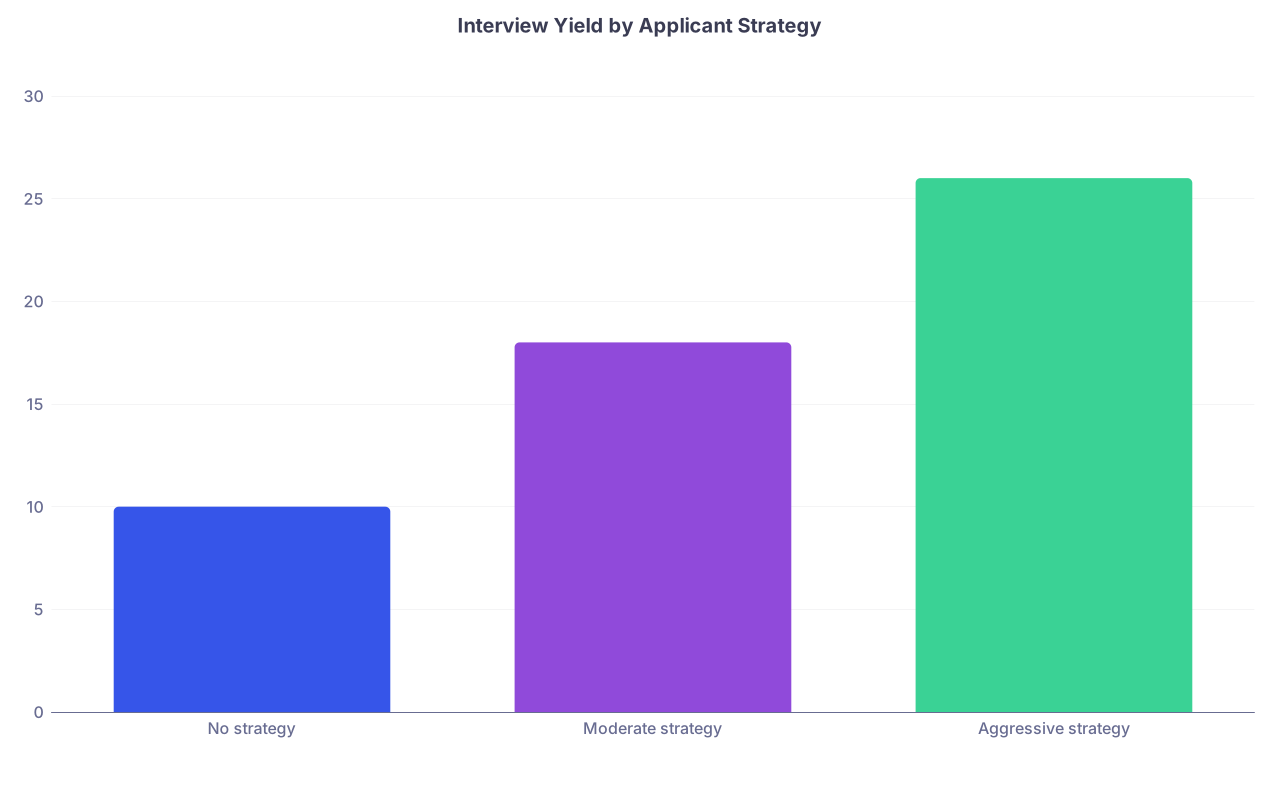
| Category | Value |
|---|---|
| No strategy | 10 |
| Moderate strategy | 18 |
| Aggressive strategy | 26 |
Interpret this however you want, but I’ve watched versions of this play out: same score range, wildly different outcomes because of how targeted and aggressive the application strategy was.
An “aggressive strategy” for a lower Step score isn’t just “apply to more programs randomly.” It’s:
- Choosing specialties and programs where your score is actually viable
- Hitting a lot of those programs (not 15, more like 40–80 for some specialties, even 100+ for very competitive situations)
- Leveraging every “in” you have—home program, away rotations, mentors with contacts
- Writing application materials that sound like a real human, not a bland robot
The person with a 240 who does all that can out-interview the 250+ person who just sprays apps and vibes.
Is it fair? No.
Is it reality? Yeah.
What About Programs That Are “Score-Obsessed”?
Some are. Let’s not pretend.
You can usually spot them:
- They brag about their average Step scores for residents
- Their residents’ bios all scream “AOA, 260+, 10+ pubs”
- The specialty is one of the usual hyper-competitive suspects (derm, plastics, ortho, neurosurg, ENT, rad onc, etc.)
In those places, a lower score isn’t a small problem. It’s a wall.
That doesn’t mean you have zero options. It means:
- Those programs become long-shot reaches, not your core list
- Your main safety net is more medium-competitive or less score-obsessed places
- You have to ask the brutal question: Do I want the specialty more, or the location/brand name more?
Sometimes the answer is: switch your target programs, not your dream specialty.
Sometimes the answer is: pivot specialty entirely if your floor is truly below viability.
Here’s a rough (not perfect, but honest) sense:
| Program Type | Weight of Step Score | Hope with Lower Score? |
|---|---|---|
| Hyper-elite academic | Very high | Only with big hooks |
| Strong academic | High | Possible but uphill |
| Mid-tier academic/community | Moderate | Yes, with good app |
| Community / newer programs | Lower-moderate | Often yes |
| Preliminary only | Variable | Often score-flexible |
So no, your classmates with higher scores aren’t “taking” your interviews at Mass General or UCSF. Those programs were probably always going to be long shots if your score is far below their resident averages. That’s a harsh pill, but an important one.
Your real power move is building a big enough list of programs where your score isn’t an automatic disqualifier.
What Actually Gets You an Interview with a Lower Score
Let’s strip the fake optimism and talk about what really moves the needle when your Step score isn’t shiny.
1. A convincing, specific narrative
Not “I like internal medicine because I enjoy continuity of care.” That’s filler.
I’m talking about:
- “I grew up in a rural area and want to work in underserved settings.”
- “I’m obsessed with medical education and invested years tutoring, creating resources, etc.”
- “I want to do academic IM with a focus on quality improvement and have 3 QI projects that show that.”
Programs remember clear through-lines. It makes them overlook imperfect metrics because they see what they’re “buying.”
2. Strong, personal letters that actually say something
If your letters say, “Hardworking, pleasant to work with,” you’re toast next to someone whose letters say:
“Top 5% of students I’ve worked with in the last 10 years. I would be thrilled to have them as a resident.”
A powerful letter from someone at that program or in that specialty can blunt the impact of a not-stellar score. I’ve seen it rescue people.
3. Rotations where someone stakes their reputation on you
Audition rotations can be dangerous, but with a lower score they can be a massive asset—if you show up and are consistently:
- Prepared
- Reliable
- Pleasant to work with
- Not a know-it-all
- Not lazy
Then a PD/attending can say, “Look, their score isn’t amazing, but I’ve seen them. They’re solid. I’d trust them with my patients.”
That counts more than a 5-point difference in Step.
4. Thoughtful program selection
The unsexy multiplier.
If your list is:
- 5 dream academic programs everyone wants
- 10 medium ones
- 5 you consider “safeties” but are actually not soft at all
…then yeah, you’re going to feel like your classmates are taking all your interviews.
If instead your list is:
- A handful of true reaches
- A large core of realistic programs where your stats are near or slightly below their averages
- A buffer of true safety programs and prelims, on purpose
You’ve just made it way, way harder to get completely shut out.
How Interview Spots Actually Get Distributed (Not in Your Head, In Real Life)
Let’s zoom out and look at it like a process, not a horror story.

| Step | Description |
|---|---|
| Step 1 | Applications Received |
| Step 2 | Score and Filter Screen |
| Step 3 | Reject |
| Step 4 | Holistic Review |
| Step 5 | Shortlist by Fit and Needs |
| Step 6 | Send Initial Invites |
| Step 7 | Some Decline or Do Not Respond |
| Step 8 | Offer Spots to Next Group |
| Step 9 | Final Interview Roster |
Here’s the key part:
Some people decline interviews. Some double-book then cancel. Some never respond.
Programs almost always over-invite a bit, then keep a waiting pool. You can be in that second or third wave, especially if you’re a solid “maybe” with a lower score but good story.
You won’t see that on Reddit. Reddit doesn’t post: “Got a random late invite from XYZ program because their first wave didn’t all accept.”
But it happens. Constantly.
Your higher-scoring classmates might get early invites. They might get more invites. But they can’t physically go to all of them. Their overabundance can actually open up later spots.
You still need to be someone the program wants. But you’re not locked out just because you weren’t shiny enough for the first pass.
Mental Game: Handling the “Everyone but Me Is Getting Interviews” Spiral
Let’s talk about that group chat.
You know:
The one where someone drops “5 invites so far!” and everyone reacts with 🎉 and “where???” and you type “omg congrats!” while your throat closes.
Two things can be true:
- Your feelings are valid. It sucks watching people get what you want while you wait.
- Their numbers don’t actually tell you your odds.
Some people:
- Inflated their target list
- Have a different specialty
- Have home programs you don’t
- Have very specific hooks (research, connections, niche interests) that line up perfectly with certain programs
If you stare at their stats and use them to predict your own doom, you will absolutely wreck your mental health.
What actually helps:
- Tracking your own data: how many programs, what types, how your numbers compare to historical match data
- Adjusting early: if invites are sluggish by mid-season, expanding your list, emailing programs, telling your home advisors, “I’m worried. What else can I do?”
You’re not powerless. You just can’t copy-paste someone else’s match path.
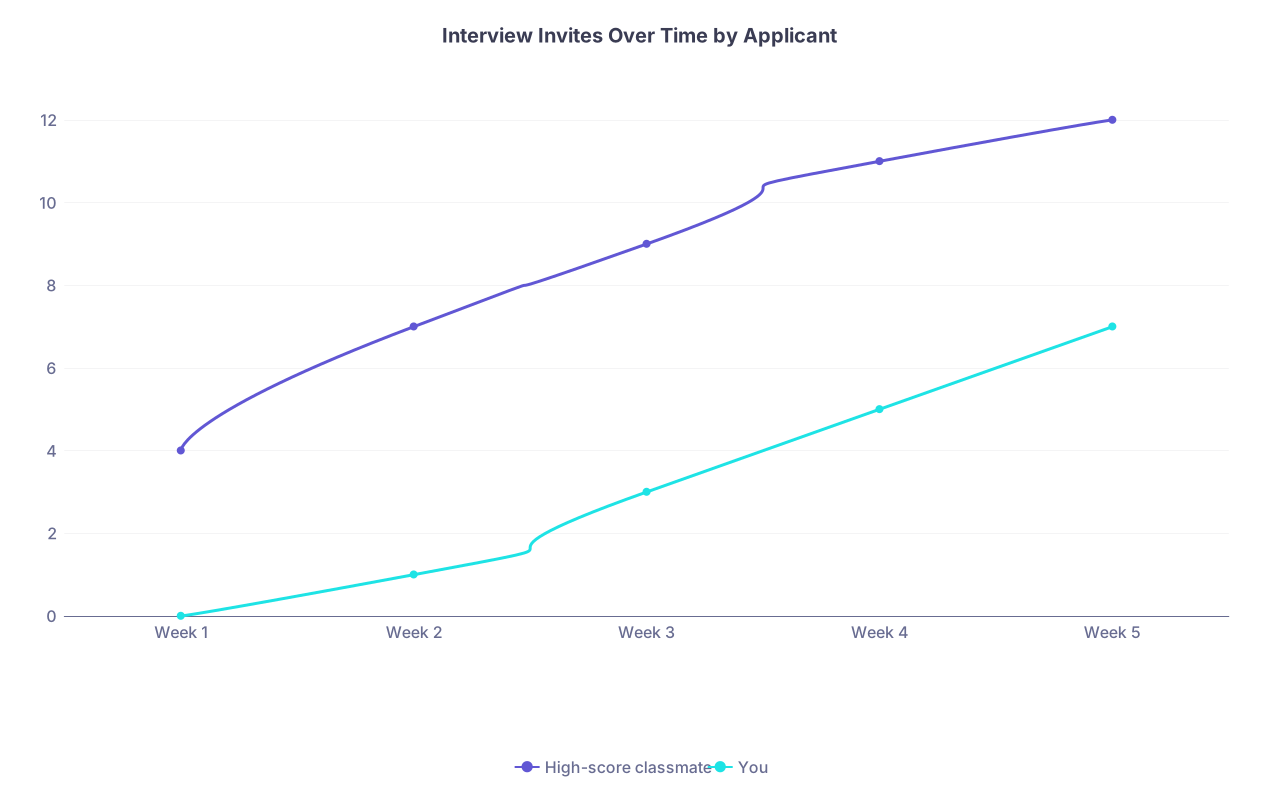
| Category | High-score classmate | You |
|---|---|---|
| Week 1 | 4 | 0 |
| Week 2 | 7 | 1 |
| Week 3 | 9 | 3 |
| Week 4 | 11 | 5 |
| Week 5 | 12 | 7 |
Same endpoint: both match. First one looks better on Instagram. Second one feels awful in real time but is still completely viable.
Okay, But What Should You Actually Do If Your Score Is Lower?
Here’s the move, not the fantasy.
Get brutally honest data
Talk to an advisor who will not sugarcoat. Ask:- “With this Step score, and my CV, what specialties are actually realistic?”
- “Within that specialty, what tier of program should be my core focus?”
Build a list that matches reality, not ego
Reach, realistic, true backup.
If your score is low for your specialty, your number of applications needs to be on the higher side.Lean into your differentiators
Anything true about you that 80% of applicants can’t say? Emphasize the hell out of it in your personal statement and experiences.Tell your story in a way that explains (not excuses)
If there’s a reason your score is low (illness, caregiving, late diagnosis of ADHD, etc.), frame it concisely, then pivot to what you did after and who you are now. Don’t just drop a sad sentence and run.Use people
Mentors, attendings, PDs who like you. Ask them to email programs. Ask them where they think you have a shot. This feels gross, but it works.
You’re not trying to be the “best” on paper. You’re trying to be a clear, believable bet for the programs that make sense for you.
FAQ (Exactly 5 Questions)
1. If my score is below the program’s average, is it pointless to apply?
Not necessarily. There’s a big difference between “below average” and “below their unofficial floor.” If residents there average, say, 240 and you have a 225, that’s not an auto-no if everything else is strong and you fit what they care about. If you’re at 205 and they’ve never had a resident under 230, that’s closer to pointless unless you have a major connection or are coming from a pipeline/home program.
2. Can my classmates with higher scores from the same school really not hurt my chances at the same program?
They can change the context, but they’re not literally knocking you off a fixed list. In fact, programs often like getting multiple strong applicants from the same school—it confirms that the school sends good trainees. The main thing that matters is whether you independently hit their bar and bring something they want. You’re compared, yes, but not in a “only one per school” way at most places.
3. I failed Step once but passed on retake—am I automatically done for competitive programs?
For some hyper-competitive or extremely score-sensitive places, yes, that can be a de facto disqualifier. For many others, it’s a serious red flag but not an automatic death sentence if your retake is solid, your clinical performance is strong, and your narrative around the failure is honest and growth-oriented. You’ll just have to be much more intentional with your program list and lean on strong letters and performance.
4. Should I delay graduation or take a research year to “fix” a low Step score?
A research year doesn’t erase a low score; it just adds more positives to your file. It helps most if:
- You’re going for a research-heavy specialty or academic programs
- You get real output (posters, pubs, strong letters)
If you’re going into a less cutthroat specialty or are already borderline older in training, delaying may not be worth it. Sometimes it’s smarter to target different tiers of programs now rather than trying to brute-force your way into a top program a year later.
5. What if interview season starts and I’m getting almost nothing—am I just doomed?
Not automatically, but you’re in the danger zone. This is when you:
- Tell your dean’s office/advisors immediately and ask for help expanding your list
- Consider applying to more programs (including prelims or adjacent specialties if appropriate)
- Ask mentors to send “reach-out” emails to programs where you might be a good fit
Some people get most of their interviews later in the season from these moves. Others still struggle. But doing nothing and just hoping is the one strategy that basically never works.
Open your program list right now and ask yourself, line by line: “With my score and my story, is this a reach, a realistic shot, or a true safety?”
If more than half are reaches, your problem isn’t your classmates’ scores. It’s your list. Fix that today.