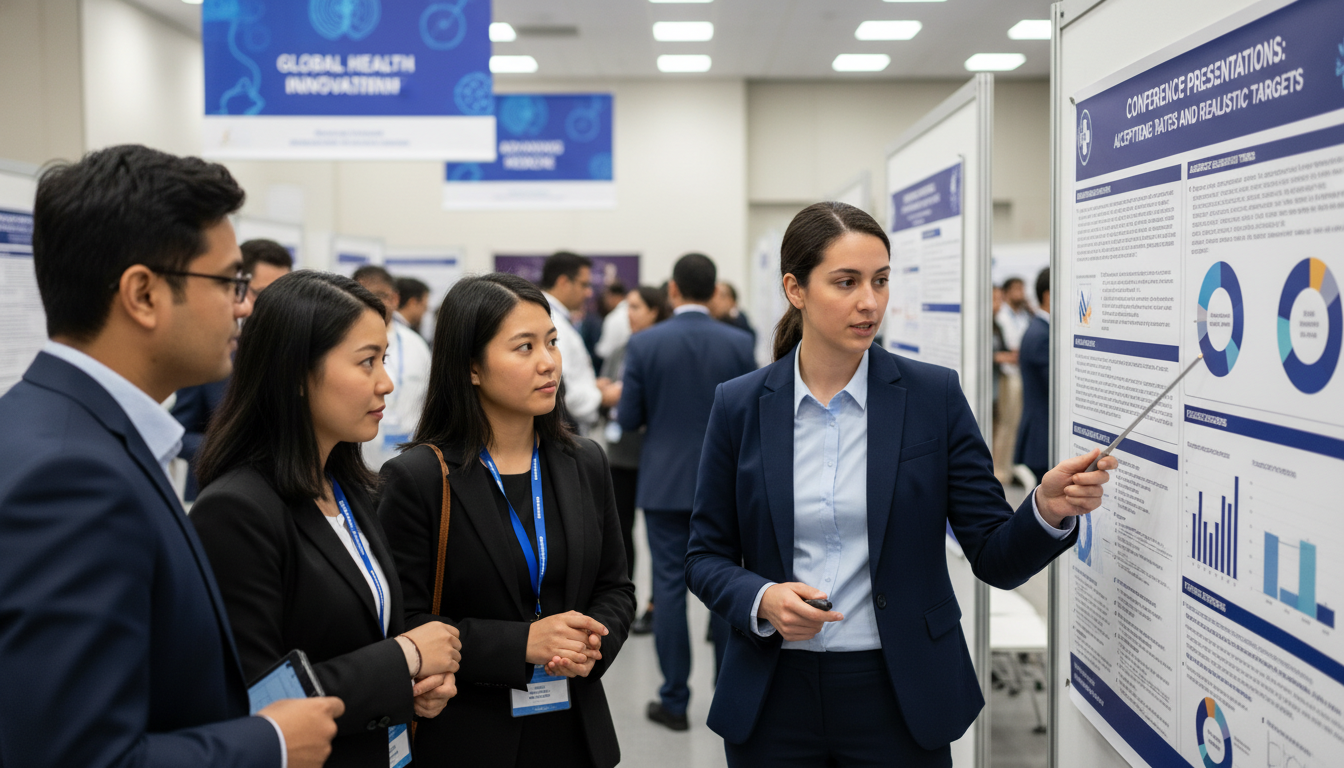
The biggest misconception premeds and early medical students have about conference presentations is that acceptance is a binary judgment of their worth. The data show something very different: acceptance rates track conference type, project maturity, and submission strategy far more than individual brilliance.
If you treat conference presentations like an admissions lottery, you will behave irrationally. If you treat them like a probability problem with controllable inputs, your odds improve dramatically.
This article translates the messy world of “will my abstract get accepted?” into numbers, ranges, and realistic targets, specifically for premeds and medical students preparing for research in medicine.
1. What the Data Actually Say about Conference Acceptance Rates
(See also: Funding vs Unfunded Projects: Does Grant Support Help Students? for insights on research funding.)
No single global acceptance rate exists. You are operating in multiple overlapping markets, each with its own probability distribution.
Based on published reports from societies, conference FAQs, program chairs’ statements, and institutional guidance from 2015–2024, the following approximate abstract acceptance ranges emerge:
1.1 By Conference Tier and Scope
1. Top-tier, high-visibility national/international medical conferences
Examples:
- American Heart Association (AHA) Scientific Sessions
- American Society of Clinical Oncology (ASCO) Annual Meeting
- American Association for Cancer Research (AACR) Annual Meeting
- Radiological Society of North America (RSNA) Annual Meeting
Reported / inferred ranges:
- Overall abstract acceptance: 25–45%
- Oral (platform) presentations: 5–12% of submitted abstracts
- Late-breaking / plenary slots: often <3% of submissions, sometimes by invitation
ASCO, for example, has historically cited abstract acceptance rates in the 35–45% range for posters, with <10% of accepted abstracts selected for oral sessions. Similar patterns show up in cardiology and oncology meetings.
2. Mid-tier national specialty conferences and strong regional meetings
Examples:
- American College of Physicians (ACP) internal medicine meetings
- American Academy of Pediatrics (AAP) section meetings
- Regional chapters of specialty societies (e.g., AHA regional, state-level ACC chapters)
Typical reported / observed ranges:
- Overall acceptance: 50–75%, often higher for student or trainee categories
- Oral presentations (trainee competitions): 10–25% of trainee submissions
Many regional chapters explicitly structure abstract programs to encourage trainee participation. Some publish trainee abstract acceptance rates at 70–85%, especially for posters.
3. Institutional, student, and local research days
Examples:
- Medical school research day
- Hospital-wide quality improvement symposium
- Undergraduate institution research symposia
Observed patterns:
- Acceptance rates often >80–90%, sometimes near 100% if submissions meet minimal formatting and ethical standards.
- Selection pressure is usually on format (oral vs poster) rather than acceptance vs rejection.
From a probability standpoint, these are your highest-yield venues early on.
2. Poster vs Oral: Two Different Probability Games
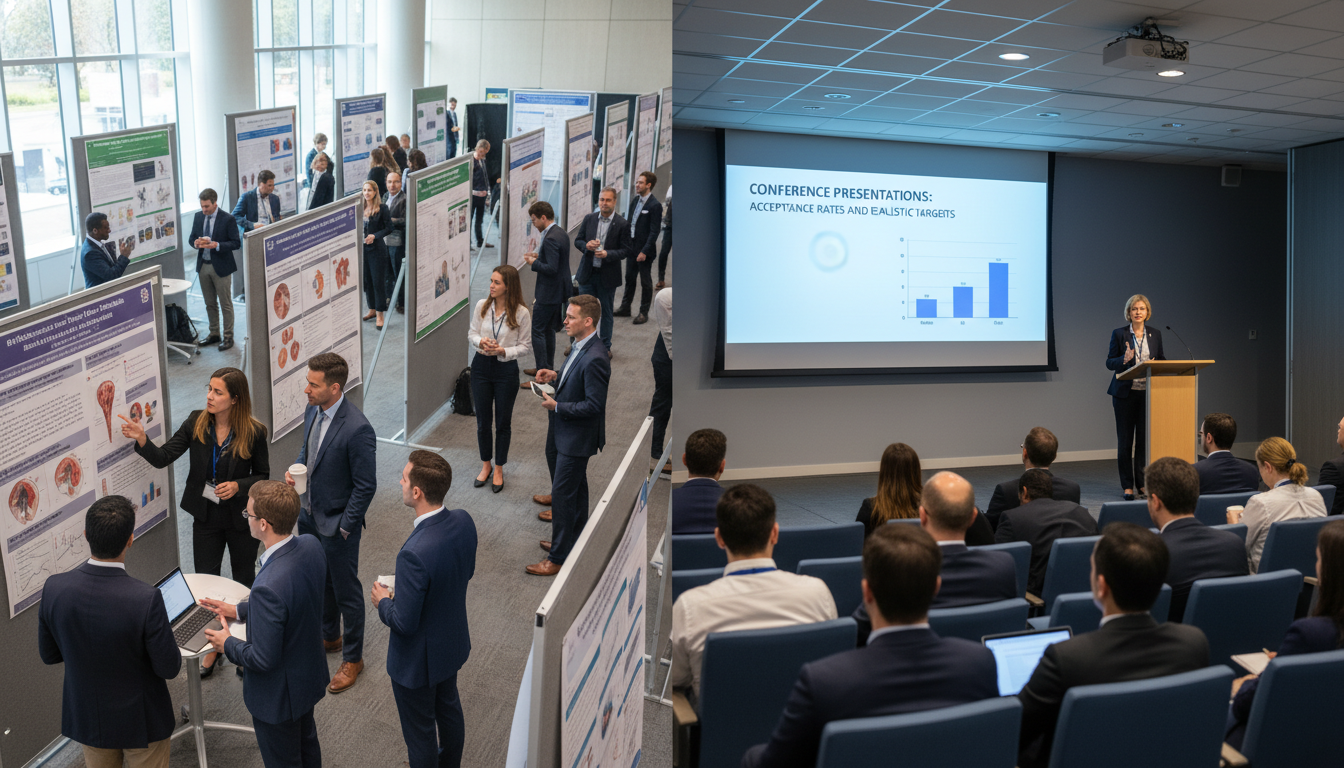
A common error is equating “conference presentation” with “oral plenary talk.” Statistically, those are different outcomes with different baselines.
2.1 Poster Presentations
Across large medical conferences:
- Poster acceptance rates: 35–70%, depending on:
- Conference tier
- Topic popularity
- Abstract category (original research vs case report vs QI)
For trainee-specific tracks:
- Acceptance rates often 60–85%, especially for:
- Student/resident categories
- Case reports
- Educational innovations or QI initiatives
Many large societies intentionally inflate poster capacity to be inclusive. Room size and session design allow hundreds to thousands of posters; the constraint is not time at a podium, but pavilion size and reviewer workload.
2.2 Oral Presentations
For the same conferences:
- Oral acceptance rate relative to all abstracts: typically 5–12%
- Oral acceptance rate relative to accepted abstracts: 10–25%
Meaning: if a general national meeting has a 40% overall acceptance rate, and 10% of accepted abstracts become oral presentations:
- Probability of oral presentation ≈ 0.40 × 0.10 = 4% of total submissions
Or, stated differently, about 1 in 25 submitted abstracts gets an oral slot.
For trainee or student competitions, this can look better:
- Trainee oral slots sometimes allocated by region or institution
- Acceptance to “oral finalist” status may approach 15–25% of submissions in small competitions
But at high-prestige meetings, the podium remains a low-probability outcome unless your data are strong, novel, and well-presented.
3. How Your Training Level Shifts Acceptance Probabilities
Data from program descriptions, trainee-focused calls for abstracts, and published acceptance breakdowns show a clear pattern:
Being a premed or early medical student is not a disadvantage if you match the right conference tier and abstract type.
3.1 Premed Students
Realistic acceptance ranges for well-prepared premed submissions:
- Institutional / undergraduate research days: 80–100%
- Regional undergraduate research conferences: 60–90%
- Specialty society student sections (e.g., APSA, AMSA events): 50–80%
- Major national specialty meetings (as coauthors, occasionally first author):
- Poster acceptance: 30–60%, depending on project quality and mentor
- Oral: <5%, often only for robust, well-analyzed projects
The data show that the main determinant is not your status as “premed” but:
- Whether the abstract has solid methods and results
- Whether a senior mentor helps tune the framing and statistics
- Whether the target conference has a dedicated student category
3.2 Medical Students (Preclinical)
Typical patterns based on institutional tracking data from multiple U.S. schools:
- Medical school research day: near-universal acceptance for genuine projects
- Regional specialty or state society meetings:
- Posters: 65–90% acceptance for student tracks
- Oral spots: often 10–20% of accepted student posters
- National or international specialty meetings:
- Posters: 30–55% for standard categories, higher for trainee-focused sections
- Oral: 3–10% of total student submissions
Many schools report 60–80% of their students who submit at least one abstract during preclinical years obtain at least one acceptance, usually at local or regional level.
3.3 Clinical Medical Students (MS3–MS4)
By MS3–MS4, the quantity and level of projects often increase:
- Multi-institutional clinical projects / QI initiatives
- Subspecialty work aligned with residency interests
- Case series instead of single case reports
Institutional reporting frequently shows:
- Students targeting 2–4 abstract submissions during clinical years
- 50–70% of those students achieving ≥1 acceptance
- Higher match into research-heavy specialties among those with multiple presentations
Again, the limiting factor is usually project pipeline, not abstract “talent”.
4. The Abstract Type Effect: Different Categories, Different Odds
Not all abstracts face equal competition. Looking at calls for abstracts and acceptance breakdowns from large conferences shows a clear hierarchy.
4.1 Original Research vs Case Reports
Estimated acceptance tendencies:
Original research (with data)
- Higher priority at top-tier meetings
- Acceptance rates similar to or slightly above overall conference average
- Strong methods and real statistics drastically improve odds
Case reports / case series
- Often separated into trainee or educational tracks
- At major meetings, competition is intense; acceptance rates can be <20–30% if submissions are numerous and slots limited
- At student/resident meetings or institutional days, acceptance can be 70–90%
Key point: A polished case report that is truly rare, changes management, or ties to new guidelines stands a better chance than a generic, non-impactful case.
4.2 Quality Improvement (QI) and Educational Projects
These have become a major entry point for students:
Many hospitals and medical schools hold QI symposiums where:
- Poster acceptance approaches 90–100% for legitimate QI cycles
- Oral sessions focus on the best few projects
National QI and medical education conferences often:
- Report overall acceptance 50–70%
- Favor structured QI frameworks (PDSA cycles, run charts, process measures)
The data show that QI/education routes are often the statistically easiest pathway for early-stage trainees to accumulate multiple presentations.
5. Setting Realistic Targets by Stage and Specialty Interest
Rather than chasing arbitrary numbers, you can set data-driven targets based on actual distribution patterns among successful applicants.
5.1 For Premeds Interested in Medical School
Based on surveys and published profiles of accepted applicants to research-oriented medical schools:
- A sizeable fraction of competitive applicants list 0–2 conference presentations
- Among those with stronger research profiles (especially MD/PhD-leaning):
- 1–3 presentations is common
- Often a mix of institutional posters and one regional or national meeting
Realistic target as a premed:
- Submissions: 1–3 abstracts over 2–3 years
- Expected acceptances (if mentored and targeted well):
- 1–2 institutional or local presentations
- ±1 regional/national poster
Statistically, pushing for an oral presentation at a top national meeting is low-yield. A better optimization is: multiple high-probability local/regional venues plus 1–2 carefully chosen national submissions when data are strong.
5.2 For Medical Students (Non–Research-Heavy Specialty)
Students targeting fields like internal medicine, pediatrics, family medicine, psychiatry without strong academic focus often match successfully with 0–3 presentations.
However, data from NRMP and specialty-specific surveys show that even in these fields, applicants with multiple scholarly activities have a slight edge for more competitive programs.
Reasonable target for most students:
- Aim for 2–4 total conference presentations across medical school:
- 1–2 at institutional research days
- 1–2 at regional or national meetings, often as posters
- Abstract acceptance probability per submission can sit around 50–75% if:
- Projects are real and mentored
- Venues are chosen realistically
From a numbers perspective, this might translate to 3–6 total submissions to end up with 2–4 acceptances.
5.3 For Research-Intensive or Competitive Specialties
Examples: dermatology, plastic surgery, neurosurgery, radiation oncology, ophthalmology, orthopedics, ENT.
Surveys of matched applicants in these fields show:
- Median number of scholarly products (publications + presentations) in double digits for top programs
- Conference presentations commonly in the 5–10+ range for research-heavy applicants
However, much of this comes from:
- Working in productive labs producing multiple related abstracts
- Being coauthor on multi-project lines
- Submitting multiple abstracts to the same or related conferences
Data-driven planning for these specialties:
- Plan 8–12 abstract submissions across M1–M4, weighted towards:
- Specialty-specific meetings (regional and national)
- Institutional days
- Resident/student research competitions
- With a ~60% expected acceptance rate (assuming good mentorship and realistic targeting), this yields:
- 5–8 actual conference presentations, likely sufficient for even research-heavy paths
The key is not chasing a magic number but creating a sustained pipeline that systematically generates multiple probabilistic opportunities.

6. Maximizing Acceptance Probability: What Moves the Needle
Acceptance rates are not random; they respond to specific levers. From a data analyst’s perspective, four variables matter most for you as a premed or medical student.
6.1 Conference Selection
Empirically, students who “overshoot” (only submit to top-tier national meetings) report much lower acceptance rates than those who stratify venues.
A more optimized mix:
High-yield (safety) venues:
- Institutional research days
- Hospital QI/education days
- Student/resident-specific meetings
- Expected acceptance: 80–100%
Moderate-yield (target) venues:
- Regional chapters of national societies
- Mid-tier specialty meetings
- Trainee-specific tracks in larger societies
- Expected acceptance: 50–75%
Stretch venues:
- Top-tier national or international conferences
- Late-breaking abstract calls
- Expected acceptance: 25–45% overall; lower for oral
A simple strategy: for each strong project, submit at least one high-yield and one moderate/ stretch venue. You diversify risk.
6.2 Abstract Quality and Structure
From reviewer guidelines and sample scoring rubrics, the most heavily weighted elements are:
- Clarity of hypothesis or objective
- Appropriateness of methods for the question
- Presence of real results (not “data will be collected” unless explicitly allowed)
- Impact and originality for the audience
Anecdotally, faculty who review 100+ abstracts per cycle report that:
- Sloppy structure or missing data is responsible for a large fraction of rejections
- Well-organized, concise abstracts with clear outcomes stand out immediately
In probability terms, polishing the abstract structure can easily shift your odds from “borderline” to “likely accept,” which might mean moving from ~40% to ~70% for the same underlying project at a trainee-friendly venue.
6.3 Timing and Late-Breaking Calls
Another underused lever: many conferences have multiple submission windows:
- Regular call for abstracts
- Late-breaking abstracts
- Separate trainee competitions with later deadlines
Data from some societies show that late-breaking tracks can be more competitive:
- Smaller number of slots
- High-density, high-impact submissions
For a student project that is still maturing, sometimes a later regional meeting rather than a “late-breaking” national slot gives better odds of acceptance and a more realistic timeline for data analysis.
6.4 Mentor and Institutional Support
Comparing outcomes of mentored versus unmentored student submissions shows a consistent pattern:
- Projects with a committed faculty mentor:
- More likely to choose an appropriate venue
- More likely to have polished methods and statistics
- More likely to hit the right keywords and framing for the conference’s audience
Informally, mentors can shift the acceptance probability by a large margin—easily from <30%** to **>60–70% when abstract quality and venue selection are corrected.
7. Converting Probabilities into a Personal Plan
Instead of asking, “Will my abstract get accepted?”, reframe as:
“If I submit N reasonably strong abstracts to thoughtfully chosen venues, what is the expected number of acceptances, and how does that compare with my career goals?”
A simple model:
- Assume p = 0.65 acceptance probability for well-mentored abstracts at realistic venues (mix of local, regional, and appropriate national meetings)
- Let N = number of submissions
Expected value of acceptances: E = N × p
Examples:
Premed with N = 3 submissions
- E ≈ 3 × 0.65 = 1.95 acceptances
- Realistically, 1–3 acceptances; meeting the typical range for strong applicants.
Medical student (general field) with N = 5 submissions
- E ≈ 5 × 0.65 = 3.25 acceptances
- Likely landing 3–4 presentations across medical school.
Competitive-specialty student with N = 10 submissions
- E ≈ 10 × 0.65 = 6.5 acceptances
- Likely yield: 5–8 presentations, which aligns well with data from research-heavy applicants.
You can refine p if your environment differs:
- Strong research institution, heavy mentoring, and targeted venues: p may approach 0.7–0.8
- Minimal mentoring, only top-tier conferences: p may drop to 0.3–0.4
The point is not the exact number. It is realizing that the system is probabilistic and under your partial control.
8. Rejection Rates and Why They Are Not a Red Flag
Given acceptance ranges, rejections are mathematically inevitable.
At a conference with a 40% acceptance rate:
- Even strong projects see 60% rejection at that venue
- This does not imply the project lacks merit; it often reflects:
- Topic prioritization
- Space limitations
- Reviewer variability
Students who ultimately accumulate multiple presentations often report:
- 30–60% of their initial submissions being rejected somewhere
- Successful re-submission to:
- More focused conferences
- Regional or institutional meetings
- Educational or QI-specific symposia
From a data standpoint, if you never receive rejections, you are probably undershooting and not challenging yourself with any stretch submissions.
9. Key Takeaways in Plain Numbers
Three points matter most:
Acceptance is not binary; it is probabilistic and tiered.
- Top-tier national meetings: 25–45% acceptance overall
- Regional and trainee-focused meetings: often 50–85%
- Institutional days: commonly 80–100%
Reasonable targets are modest in absolute number but strategic in composition.
- Premeds: 1–3 acceptances is common for strong applicants
- Medical students: 2–4 for general specialties, 5–8+ for research-heavy fields
- These typically come from 3–12 total submissions, not from perfect hit rates.
You can move your acceptance odds with deliberate choices.
- Match project type to venue tier
- Prioritize poster opportunities and trainee tracks
- Use mentors to raise your effective acceptance probability toward the 60–70% range
Treat conference presentations like a numbers problem, not a personal verdict. The data show that with realistic targets, structured submissions, and the right mix of venues, strong presentation records are statistically attainable for motivated premeds and medical students.