The idea that you must do a Special Master’s Program (SMP) instead of a post-bacc to get into MD school is wrong. Not just slightly wrong—dangerously, expensively wrong for a lot of applicants.
The SMP-or-bust narrative has become one of the most persistent myths in premed advising circles. It gets repeated in Reddit threads, by anxious classmates, and sometimes even by well-meaning advisors: “If your GPA isn’t great, you have to do an SMP. Post-bacc is for lightweights.”
The actual data and admissions logic tell a very different story.
Let’s break this myth where it lives: in misunderstanding what SMPs are for, how med schools interpret them, and when a traditional undergraduate post-bacc is actually a better—and safer—path.
What SMPs Really Do (And What They Don’t)
Special Master’s Programs sound incredibly attractive at first glance.
You see phrases like “med-school-like curriculum,” “take classes with M1s,” “direct linkage,” “known to adcoms.” You see classmates say, “My advisor told me SMPs prove I can handle med school rigor, and that’s what med schools care about.”
Here’s the reality.
An SMP is designed for a very specific kind of applicant:
- Someone with significant undergraduate academic damage (usually a low overall and science GPA)
- Who is already done with the standard premed prerequisites
- Who needs evidence, at the graduate level, that they can survive something close to M1 coursework
That’s the niche. Not “everyone with a less-than-perfect GPA should do an SMP.”
SMPs:
- Provide a chance to show you can handle rigorous coursework
- Sometimes offer structured linkage or guaranteed interview agreements
- Often charge $40,000–$70,000+ for one year, excluding living expenses
- Are high-risk: a mediocre SMP performance can literally worsen your chances compared with not doing it at all
What they don’t do:
- They don’t erase your undergraduate GPA from your AMCAS calculation
- They don’t make you competitive if you were never competitive in undergrad science courses
- They don’t automatically trump strong undergraduate repair via post-bacc coursework
Graduate GPA is secondary to undergrad GPA in most MD admissions decisions. A blazing-hot 3.9 SMP with a 2.8 undergrad BCPM does not “fix” the 2.8. It mitigates it. Sometimes enough. Sometimes not.
And that’s the nuance missing from “you must do an SMP.”
How Admissions Actually View Undergrad vs Graduate Work
Medical schools don’t weigh all GPAs the same way. And they don’t interpret SMPs and post-baccs as interchangeable “fix everything” tools.
Here’s what the data and consistent adcom commentary show:
Undergraduate GPA is still the foundation.
The AMCAS GPA breakdown gives separate lines for:- BCPM (biology, chemistry, physics, math)
- AO (all other)
- Undergraduate vs post-bacc vs graduate
Schools care deeply about sustained undergraduate-level science performance. Because that’s the longest, most representative sample of your academic behavior.
A graduate GPA (including SMP) is a supplement, not a replacement.
A 3.7+ SMP says, “I can handle a heavy, advanced load now.”
What it doesn’t say is, “My 2.6 science GPA no longer matters.”When adcoms review borderline applicants, they often say versions of:
- “Strong SMP helps, but undergrad performance is still concerning.”
- “Good graduate work, but undergrad trends are flat or declining.” That’s not hypothetical. That’s straight from committees.
Undergraduate post-bacc work plugs a gap SMPs often ignore.
Post-baccs (formal or informal) allow you to:- Retake key courses you originally bombed
- Build a sustained trend of A-level performance in core sciences
- Boost your undergraduate BCPM GPA—the metric most schools scrutinize first
If your undergrad GPA and/or science GPA are salvageable with more high-quality undergrad work, many MD programs will value that more than a single intense year of graduate coursework stacked on a weak base.
It’s like building a house. If your foundation is cracked, adding a fancy second floor doesn’t fix the structure. You reinforce the foundation first.
When a Post-Bacc Is Actually the Better Move
The SMP-only crowd skips over the most basic question: What problem are you actually trying to solve?
Because not all GPA problems are the same.
Scenario 1: The “Late Bloomer” with a Recoverable GPA
Applicant A:
- Cumulative undergrad GPA: 3.1
- Science GPA: 2.9
- Last 45 credit hours (mostly upper-level bio/chem): 3.5
- MCAT: not yet taken
This is a classic “borderline but recoverable” profile.
What this applicant thinks they need (because of the myth):
“I must do an SMP to show I can handle med school work. Post-bacc isn’t strong enough.”
What they actually need:
- More high-quality undergraduate science credits to pull the BCPM from 2.9 closer to 3.2–3.4
- Time to build a steep upward trend (multiple semesters of A-level work)
- MCAT preparation during or after that trend to align a new strong score (e.g., 510+) with a visible academic turnaround
For Applicant A, an SMP is overkill and risky. If they get a 3.3 in an SMP—respectable, but not eye-popping—while still holding a 2.9 science GPA, they’ve spent $50k+ for a marginal bump and no real foundation repair.
A targeted undergrad post-bacc—even informal through a local state university—can:
- Convert that 2.9 science GPA into something more competitive
- Give adcoms a clean narrative: “Rocky start, strong finish, now consistently excellent”
Post-bacc isn’t the weak option here. It’s the correct option.
Scenario 2: The “Disaster GPA” Applicant
Applicant B:
- Cumulative undergrad GPA: 2.4
- Science GPA: 2.2
- Degree already completed
- Significant non-academic life events during undergrad (e.g., serious illness, family crisis)
This applicant’s situation is fundamentally different. No amount of extra undergrad coursework will elevate a 2.2 science GPA into standard MD territory (3.4+ at many schools) without years of full-time classes.
For Applicant B, an SMP—or another rigorous, medically-aligned master’s with strong performance—may actually make sense. Because they are not just “repairing” a GPA; they’re demonstrating that the person they are now bears almost no resemblance to the person who earned that 2.2.
But even here, the SMP shouldn’t be step one. A few semesters of high-level undergrad or certificate coursework with straight As may be necessary to prove they’re ready before committing to the high stakes of an SMP.
SMPs are like final exams. You shouldn’t use them as practice tests.
The Hidden Risks of the “SMP-Or-Nothing” Mindset
There are three major risks baked into the “you must do an SMP” mantra that rarely get discussed honestly.
1. Financial Risk
A typical SMP:
- Tuition: $30,000–$60,000
- Living expenses: $15,000–$25,000+ for the year
- Lost earning potential: another $20,000+ if you could have been working
You can easily cross $70,000–$90,000 in total cost for a single year.
If that SMP doesn’t move the needle because:
- Your undergrad GPA is still too low
- Your SMP grades are good but not stellar
- Your MCAT is average or weak
You’ve just burned nearly six figures and a year of your life for a line on your CV that might mildly help with DO or Caribbean schools but not dramatically change your MD odds.
A smartly planned post-bacc, especially at a public university, might cost a fraction of that and do more to fix the metrics med schools actually care about.
2. Performance Risk
In an SMP, getting a 3.0 is not “good enough.”
Many programs and adcoms expect:
- 3.5+ to really see it as compelling evidence
- Often top-third performance relative to your cohort
Remember, you’re in a room full of highly motivated premeds, some of whom already had decent GPAs and are just trying to polish an already strong application.
If your study habits, time management, and test-taking skills weren’t fully rehabbed during some preliminary post-bacc classes, you’re jumping straight into the deep end with concrete shoes.
A weak SMP record is worse than no SMP at all.
3. Psychological Risk
The “SMP-or-fail” narrative ramps up anxiety and leads people to believe that if they don’t choose the most intense, expensive option, they’re not serious about medicine.
That mindset:
- Pushes students into commitments they’re not ready to handle
- Leads to shame and burnout when performance doesn’t match the hype
- Ignores the fact that many successful MDs took slower, less flashy, but more strategically sound paths
You are not competing to have the most impressive-sounding repair program. You’re competing to present the most coherent, upward-trending academic record that matches your MCAT and fits a school’s risk tolerance.
When an SMP Actually Makes Sense
Let’s be clear: SMPs are not useless. They are just misused.
They tend to make sense when:
- Your undergrad GPA is severely damaged (low 2s) and mathematically unrecoverable into a competitive range with more undergraduate hours
- You have already demonstrated, through more recent undergrad or certificate-level coursework, that you can earn As in upper-level science classes
- You’re targeting schools that explicitly value or recognize that specific SMP (e.g., Georgetown SMP, Cincinnati, EVMS, USF Morsani, Loyola MAMS) and you understand their linkage/interview conditions
- You are prepared to earn excellent grades—think 3.6+—not just survive
In those situations, yes, the right SMP can be a powerful signal. It can say, “Look at the trajectory, not just the old numbers.” Some MD schools will listen.
But treating SMPs as the default “serious” choice and post-baccs as training wheels completely misunderstands the hierarchy admissions actually use.
Why Post-Baccs Are Underestimated—and Often Better
The traditional or DIY post-bacc is often dismissed as “just more undergrad.” Which is precisely why it’s so valuable.
A well-executed post-bacc:
- Directly raises your undergraduate BCPM GPA
- Shows sustained improvement over multiple semesters
- Gives you time to develop real study systems before you face med-school-level workloads
- Allows for flexible scheduling around MCAT prep, work, or clinical experiences
- Costs far less than an SMP, especially at in-state public schools or community colleges (for selective content, though some MD schools are less excited about too much CC science)
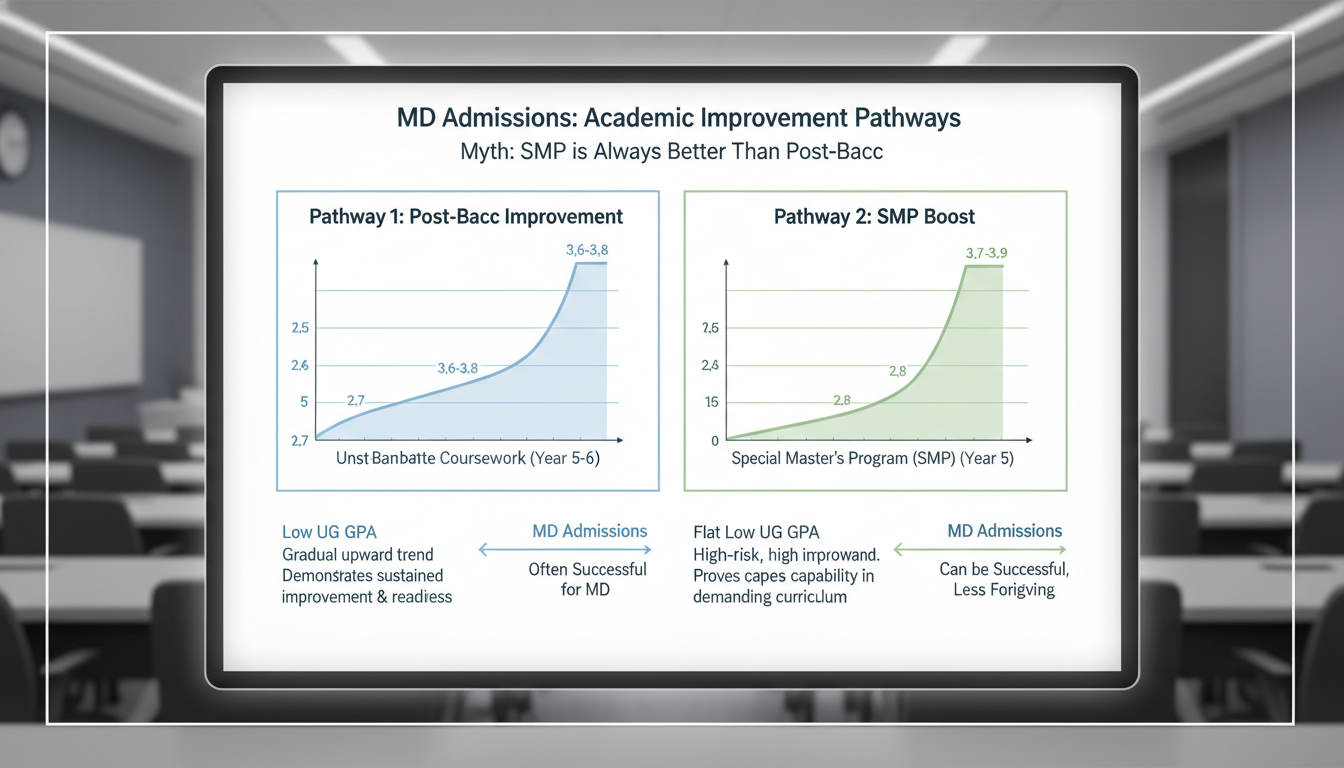
Admissions committees repeatedly emphasize trends. A 3.0 that becomes a 3.6 over two years of post-bacc work is compelling, especially when matched with:
- A strong MCAT relative to your GPA
- Clear explanations in your personal statement and secondaries about what changed
You don’t get extra points for choosing the most extreme-looking repair path. You get points for showing that, across undergraduate-level science coursework, you now perform at or near the level they expect from incoming students.
That is exactly what a thoughtful post-bacc is designed to demonstrate.
So How Do You Actually Decide: SMP vs Post-Bacc?
Strip away the mythology and it comes down to a few hard questions:
Is your undergrad science GPA mathematically recoverable into the 3.2–3.5+ ballpark with 30–40 more credits of As?
- If yes, post-bacc should be your default starting point.
- If no, you may eventually need something like an SMP, but not necessarily immediately.
Do you already have proof that you can dominate upper-level undergrad science classes?
- If yes (recent streaks of 3.7–4.0 in tough courses), then you’re more likely to succeed in an SMP.
- If no, jumping straight to SMP is rolling the dice with your entire future.
Can you afford a $60k+ all-in experiment?
- If the answer is no—and for many it is—using more affordable post-bacc options is not a sign of weakness. It’s good strategy.
What kind of narrative will your transcript tell after your repair work?
- “Undergrad shaky → post-bacc strong → MCAT aligned with improvement”
often plays better than - “Undergrad poor → average SMP → MCAT meh.”
- “Undergrad shaky → post-bacc strong → MCAT aligned with improvement”
Ask what story you’re building, not which program sounds more impressive on paper.
The Bottom Line: SMPs Are Tools, Not Requirements
The myth that “you must do an SMP instead of a post-bacc for MD admissions” survives because it sounds bold and decisive. It offers a single, dramatic solution to a deeply personal, complex problem.
Reality is messier.
Most borderline applicants with modest GPA issues are better off:
- Repairing their academic record through undergraduate post-bacc coursework
- Building a sustained trend of excellence in the same type of classes med schools actually weight the most
- Pairing that repaired transcript with a thoughtfully timed, strong MCAT
SMPs have a role. A narrow, high-stakes, high-cost role.
Use them when:
- Your undergraduate record is beyond standard repair
- You’ve already proven you can ace advanced science work
- You fully understand the risk–benefit tradeoff
Three key points to remember:
- MD schools do not require an SMP; they require evidence you can excel in rigorous science. That can absolutely be done via post-bacc.
- Undergraduate GPA trends usually matter more than a single year of graduate work, especially when your base GPA is still in play.
- The “hardest” or most expensive option is not automatically the best. The right choice is the one that fixes the actual weakness in your record with the least unnecessary risk.
Myth busted: you do not need an SMP instead of a post-bacc. You need a strategy that matches your numbers, your history, and your bandwidth—not someone else’s panic-driven narrative.