The real reason some post-baccs feed more students into med school has almost nothing to do with their glossy brochures or “90% acceptance” claims. It comes down to two things most applicants never actually see: who is quietly protecting those students behind the scenes, and how much risk medical schools are willing to take on that program’s word.
You’re comparing course lists and MCAT prep. Admissions committees are looking at trust, data, and politics.
Let me tell you what actually happens on the other side of the table when your post-bacc name shows up in an application.
The Hidden Currency: Trust Between Programs and Admissions
When an application hits a med school committee, one of the first subconscious filters is: “Do we know this post-bacc, and can we trust their grades and letters?”
That trust is not created by a website blurb or a brochure. It’s built over years of informal back-and-forth between:
- The post-bacc director or advisor
- The med school’s admissions dean, committee members, and faculty who interview
Here’s what no one tells you:
(See also: How Admissions Committees Really Read Post-Bacc Transcripts for more details.)
At several schools I’ve worked with or been privy to, there were literally three mental “buckets” for post-baccs:
Known quantity, high signal programs
“If this student got a 3.7+ in the UC Berkeley Extension formal program / Bryn Mawr / Goucher / Hopkins / Temple ACMS / Loyola MAMS / BU MAMS / Scripps, we know what that means. Their A in organic is comparable to our own A.”Moderately known, mixed signal programs
“We’ve had some good and some not-so-great students from this program. Their GPA helps, but we need more evidence from the MCAT and interviews.”Unknown or low-rigor programs
“We don’t really know this place. We rely heavily on the MCAT and letters. Their 4.0 might not mean much.”
You see “4.0 in post-bacc coursework.”
Admissions sees: “A 4.0 from where, under what standards, and do we trust those people?”
The programs that feed more students into med school have quietly climbed into that first bucket. That’s where the real advantage lives.
Why Some “Feeder” Post-Baccs Really Dominate
Forget marketing slogans. Look at these questions instead:
- Does the program director personally know multiple med school admissions deans?
- Have their students consistently performed well as M1s and M2s at those schools?
- Do committee members roll their eyes or nod when that program’s name shows up?
Programs that dominate tend to have a quiet track record that looks like this behind the scenes:
- Over a decade of sending multiple students each year to the same set of med schools
- An identifiable pattern of those students doing well once they matriculate
- Directors who pick up the phone and give unvarnished assessments of borderline students, which builds credibility when they strongly endorse someone else
What you see as “feeder” is often just the downstream effect of dozens of conversations like:
“Yes, she had a rough undergrad, but in our program she was top 10%. Toughest professor in the department says she’s one of the best he’s seen in years. We would stake our reputation on her.”
When that comes from a director the admissions dean already trusts, your odds quietly double or triple.
And here’s the part that stings: two students with identical stats, same MCAT, same GPA, but different post-bacc names—one from a high-trust program, one from a random DIY—do not have the same chances. Committees will never say that publicly, but you see it in the closed-door conversations.
Linkage Agreements: The Part You Don’t See on the Website
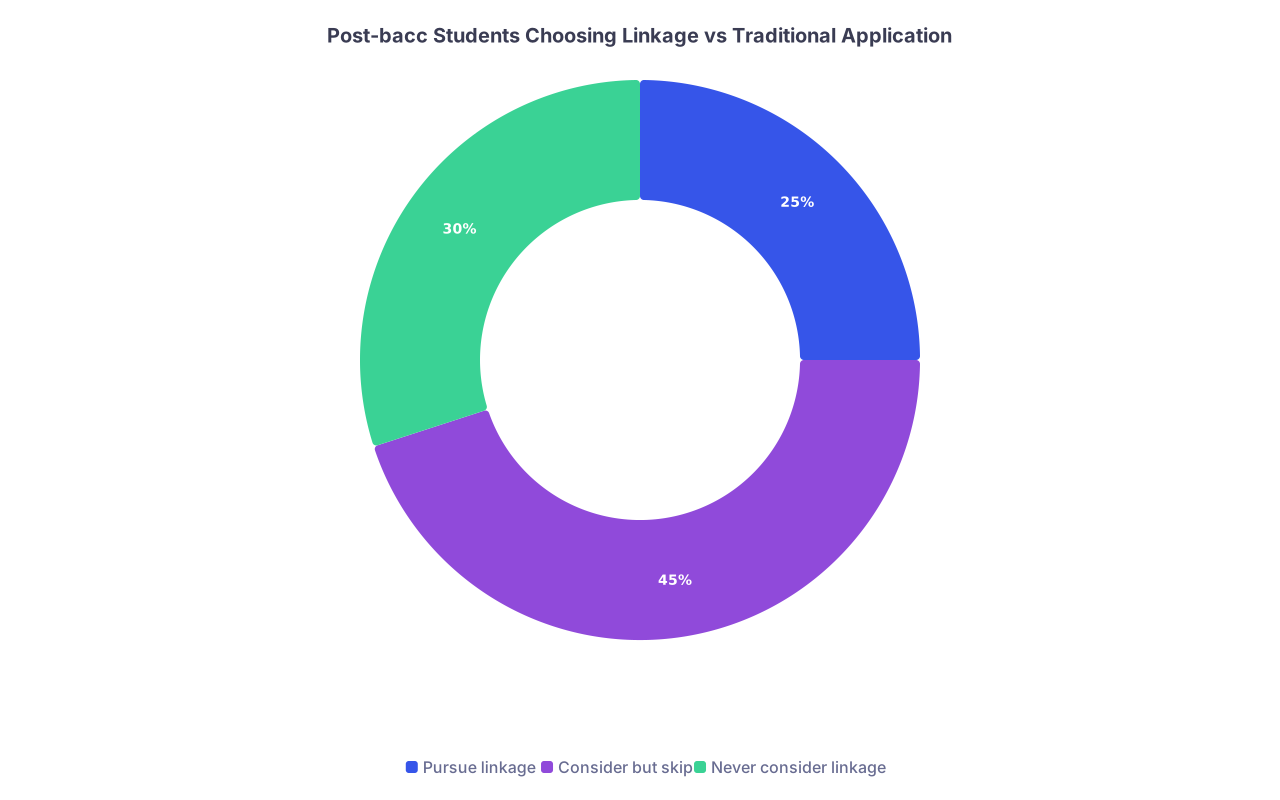
Everyone obsesses over the publicly posted “linkage” agreements—those magical bridges where you complete a post-bacc and walk straight into a partnered med school if you meet certain criteria.
What you don’t see is how those linkages are actually managed.
Most students imagine a mechanical rule:
Hit 3.7+, 510+ MCAT, strong professionalism → you’re in.
In reality, at many institutions it’s more like:
Hit the threshold → we’ll take a very serious look, and if the post-bacc director goes to bat for you, we’re highly inclined to accept, unless there’s a red flag.
There are three layers of power here:
The formal linkage document
The public-facing rules. GPA cutoffs, MCAT minima, no grade below B, etc. This is what you see.The unwritten bar
The real threshold the med school cares about. Maybe they say 3.5 and 508, but internally they’re only thrilled with 3.7+ and 512+. Anything less triggers more scrutiny.The director’s credibility
If the director has a history of overselling weak candidates, the linkage becomes toothless. If they’re known to be brutally honest, their “This student is ready” carries substantial weight.
Strong post-baccs that truly feed students into med school are relentless about protecting that third layer. Some directors will quietly block a student from using a linkage if they think it will damage the relationship:
“Look, you met the minimum, but I can’t in good conscience send you forward for this linkage. Let’s apply broadly instead and not burn this bridge.”
That conversation feels awful as a student. But that’s exactly why those programs keep their linkage pipelines alive—and why their match rates stay high year after year.
Weaker or newer programs often do the opposite. They push marginal students through to “prove” they place people into med school. Admissions notices. And the unspoken trust account between the post-bacc and the med school drains quickly.

Grade Inflation vs. Academic Signaling
Here’s a less comfortable secret: some post-baccs quietly inflate grades to advertise “success,” while others deliberately keep grading harsh to signal rigor to med schools.
Admissions can see the pattern.
Over time, schools build internal data:
- “At X program, almost everyone has a 3.8+ yet their MCATs are unimpressive and first-year performance is mediocre.”
- “At Y program, the GPA distribution is wider, but their 3.7s perform like our own 3.9s, and their MCATs are strong.”
Guess which program becomes the “real” feeder.
The paradox is painful. Students gravitate to programs where “everyone does well” because they want a high GPA. Admissions committees gravitate toward programs where grades actually mean something.
I’ve seen this play out in committee discussions:
“She’s got a 3.9 in the ___ post-bacc, but we’ve had students from there struggle. I’d want to see a stronger MCAT.”
Then two files later:
“3.6 from ___ post-bacc. That’s more impressive than a 3.9 from some other places. Their courses are no joke.”
You do not see that calibration. But it absolutely exists.
The programs that feed more students into med school don’t just hand out high GPAs. They manage their narrative: rigorous coursework, hard-won grades, and consistent downstream performance.
The Quiet Power of Committee Letters
You’ve probably heard of “committee letters,” but you likely underestimate how much they shape outcomes.
From the admissions side, not all committee letters are equal. Certain post-baccs have letters that:
- Are brutally specific about academic performance relative to peers
- Separate fluff from substance in activities and clinical work
- Flag professionalism concerns instead of hiding them
Over years, med schools learn: “If ____ program gives a strong committee letter, they mean it. They’re not afraid to write a lukewarm one when needed.”
That reputation is golden.
Here’s what that means for you: a student from a respected post-bacc with a glowing, specific committee letter and “only” a 3.6 post-bacc GPA can easily outcompete a 3.9 from a generic DIY with scattered letters.
Some post-baccs also coordinate their letters in a way DIY students never get:
- They curate who actually writes for you
- They coach faculty to include the kind of detail committees want: comparison to class, specific examples of resilience, evidence of growth
- They frame your earlier academic missteps in a coherent narrative, not a random collection of excuses
Programs that consistently feed students into med school almost always have a director or advisor who is both ruthless and strategic with these letters. They will tell certain students:
“We’re not giving you a committee letter this year. You’re not ready, and a mediocre letter from us will hurt you more than applying later will.”
From the outside, you just see the program’s “high acceptance rate.” Inside, you’re not seeing how many borderline students were counseled to delay or not apply under the program’s banner.
That gatekeeping is precisely why their numbers look good.
Who Gets Protected, and Who Gets Sacrificed
This is the part most people never suspect.
Every serious post-bacc has internal politics. There are students they are fully invested in protecting—and others they are prepared to let go.
The protected group usually has some combination of:
- Strong MCAT or clear potential for it
- Solid upward academic trend and good test-taking history
- Excellent professionalism: shows up, no drama, respected by faculty
- Good “story” for admissions: clear reason for prior underperformance and a convincing pivot
Program directors know these students are safe to vouch for. They’ll burn capital with their med school contacts to help them.
Then there’s the gray zone:
- Students who need the post-bacc but aren’t fully fixing the underlying issues
- People who show improvement but still struggle with basic science exams
- Those with spotty professionalism or unreliable communication
Here is what really happens: the director will quietly decide how far they’re willing to go for each person. The strong ones might get calls, custom advocacy, careful committee letters, and push for linkage or top choices. The gray zone gets more generic support, broad guidance, and in some cases a soft nudge toward DO-only or lower-tier MDs.
Two students may think they’re in the “same program.” They are not receiving the same level of behind-the-scenes advocacy.
Some post-baccs feed many students into med school because they are ruthless about aligning their strongest students with their strongest relationships. Less discriminating programs treat everyone the same on paper and send unfiltered waves of applicants to med schools—then wonder why their influence never grows.
You need to be honest about which camp you’ll likely fall into at a given program.
Reputation Follows the Students, Not the Sales Pitch
You know how a building gets a reputation over time—great plumbing, terrible wiring, noisy neighbors? Post-baccs are the same. Their real reputation in admissions is built by what their graduates actually do in medical school.
When a med school sees:
- Post-bacc A’s students repeatedly failing Step 1/Level 1 or repeating years
- Post-bacc B’s students solidly middle or top of the class, reliable in clinic, easy to teach
the effect is massive but delayed. After enough cycles, committees start to:
- Downweight grades and letters from A
- Quietly favor B’s students in borderline decisions
No public statement. Just a slowly shifting internal bias.
That’s why some older, established post-baccs have disproportionate power. They’ve been sending alumni into multiple med schools for 10–20 years. The people now sitting on admissions committees have directly taught those graduates.
When they see that post-bacc name, they don’t think about the brochure. They think, “Our last three from there were well-prepared, mature, zero nonsense.”
On the flip side, new programs—no matter how well-designed on paper—simply don’t have that track record yet. Their graduates might be great, but it takes years to build that shared memory in the faculty and admissions ecosystem.
So while you’re thinking “new, exciting, innovative curriculum,” many committees are thinking “unknown, unproven, we’ll proceed cautiously.”
That lag is one of the most underappreciated reasons some post-baccs still dominate placement decades after they launched.
What You Should Actually Look For When Choosing a Post-Bacc
You’re not choosing a list of courses. You’re choosing whose credibility you’re going to borrow.
Instead of obsessing over raw acceptance percentages, focus on these questions when you talk to current students, alumni, or staff:
- Who on your staff is personally known to admissions deans or committee members at regional med schools?
- In the last 5 years, which specific med schools have taken multiple students from your program every year?
- How many of your students use your committee letter vs. applying without it?
- How do you handle borderline students for linkage—who decides who is “ready”?
- When your graduates matriculate, how do they typically perform academically in M1 and M2?
If a program dodges those questions or can’t give you concrete examples, their “feeder” reputation is probably more marketing than substance.
Pay close attention to how candid they are about who doesn’t get in. The more protective they are about their relationships—with stories of telling students to wait a cycle, strengthening files before applying—the more likely they truly have influence.
And look, DIY post-baccs can absolutely work. Some students are disciplined, score strong on the MCAT, and stack high-quality clinical experience independently. Committees respect that.
But recognize what you are trading:
- You gain flexibility and often lower cost
- You lose inherited institutional trust, coordinated letters, and someone with direct phone access to certain med school offices
That trade can be worth it. It just needs to be conscious, not accidental.

What Really Separates the “Feeder” Programs
Strip away the marketing and you see the same pattern over and over.
The post-baccs that truly feed more students into med school do three things differently:
They protect their relationships by gatekeeping hard.
Not everyone gets a glowing committee letter. Not everyone is pushed to use a linkage. They’re willing to have very uncomfortable conversations with students to avoid burning admissions trust.They build and spend political capital strategically.
Directors and advisors call deans, vouch selectively, and let some applicants go through the process with minimal endorsement to preserve their ability to strongly back the right candidates later.They accept short-term discomfort for long-term reputation.
They’d rather have slightly lower enrollment and happier med school partners than pack the program, inflate grades, and send out waves of poorly prepared applicants.
You can’t see any of that on a website.
If you remember nothing else, hold onto this: you’re not just choosing a post-bacc based on courses and cost. You’re choosing whose name will sit at the top of your committee letter—and how much weight that name carries when the admissions committee leans back and says, “We’ve seen students from this program before. We know what that means.”
Pick accordingly.