Understanding Post-Baccalaureate Programs for Medical School Preparation
Embarking on the path to medical school is exciting, but it’s rarely straightforward. For many applicants, a post-baccalaureate program is the bridge between where they are now and where they need to be to become a competitive medical school candidate.
Whether you’re making a career change to medicine from a non-science background or seeking GPA improvement strategies after a tough undergraduate experience, the right post-bacc can dramatically strengthen your academic record, your confidence, and your application story.
This guide expands on the essential considerations when choosing among Post-Baccalaureate Programs, with specific, actionable advice tailored to premed students and career changers who want to optimize their medical school preparation and admissions chances.
What Is a Post-Baccalaureate Program and Who Is It For?
A post-baccalaureate program (often called “post-bacc”) is a structured academic pathway designed for students who already hold a bachelor’s degree and want to enhance or supplement their academic profile before applying to medical school.
While every program has its own character, most serve two primary groups:
1. Career Changers: From Non-Science Backgrounds to Medicine
These students:
- Majored in non-science fields (e.g., English, economics, business, psychology, fine arts).
- Often have had little or no exposure to college-level biology, chemistry, or physics.
- Realize their passion for medicine later in college or after working in another field.
What career-changer post-baccs offer:
- A structured pathway through the core science prerequisites (general chemistry, organic chemistry, biology, physics, sometimes biochemistry and statistics).
- Cohort-based learning with others making a similar career change to medicine.
- Advising tailored to someone starting from scratch in the sciences, including timeline planning for the MCAT and medical school applications.
Typical applicant example:
A 27-year-old marketing professional with a BA in communications who volunteers in a hospital, discovers a calling to medicine, and now needs 1.5–2 years of full-time science coursework.
2. Academic Enhancers: GPA Boosters and Record-Enhancers
These students:
- Already completed the basic prerequisites in college.
- Have a lower-than-ideal overall or science GPA (for example, below ~3.3).
- Need to demonstrate sustained academic excellence in rigorous, upper-level science courses.
What GPA-enhancer post-baccs offer:
- Advanced undergraduate or graduate-level coursework in biomedical sciences.
- Opportunities to show an “academic upward trend” and readiness for medical school rigor.
- Often, targeted advising on GPA improvement strategies and MCAT preparation.
Typical applicant example:
A recent biology graduate with a cumulative GPA of 3.0 and strong junior-senior year grades who wants to show that early struggles don’t define their long-term potential.
Key Advantages of Post-Baccalaureate Programs for Medical School Admissions
While you could theoretically take courses à la carte as a non-degree student, structured post-bacc programs offer several critical advantages:
Strengthened Academic Metrics
- Demonstrate sustained excellence in demanding science courses.
- Provide evidence that you can handle medical school–level workloads.
- Help “recalibrate” admissions committees’ perception of your academic ability, especially if your undergraduate record is mixed.
Completion of Prerequisites and Competencies
- Ensure all required courses (and often recommended ones like biochemistry, statistics, and psychology) are completed in a coherent sequence.
- Provide built-in planning for medical school preparation, including optimal timing of the MCAT and application cycles.
Formal Advising and Application Strategy Support
- Dedicated pre-health advisors who understand current medical school admissions trends.
- Help with school list strategy, personal statements, and letters of recommendation.
Networking and Mentorship
- Access to faculty mentors, current medical students, and alumni in healthcare.
- Structured opportunities for clinical exposure, shadowing, and volunteering.
Clinical and Research Experiences
- Many programs partner with nearby hospitals and clinics.
- Some include research opportunities that can strengthen your CV and give you talking points for interviews.
Types of Post-Baccalaureate Programs for Premeds
Not all post-baccs are created equal. Understanding the main program types is central to choosing the best option for your goals and background.
1. Traditional Undergraduate-Level Post-Bacc Programs
These programs:
- Focus on completing or retaking undergraduate-level science prerequisites.
- Are ideal for career change to medicine applicants and for some GPA enhancers who need to redo key foundational courses.
- Typically last 1–2 years full-time, longer if part-time.
You’ll often see:
- General chemistry I & II, organic chemistry I & II, general biology sequence, physics I & II.
- Possibly biochemistry, genetics, microbiology, statistics, and psychology.
Who they’re best for:
- Non-science majors with few or no premed prerequisites.
- Students whose earlier science grades were very weak and need a fresh academic foundation.
2. Academic Record-Enhancement and Special Master’s Programs (SMPs)
These are more advanced, often graduate-level programs such as:
- Master’s in medical sciences, physiology, biochemistry, or other biomedical fields.
- “Special Master’s Programs” that mirror parts of M1 medical school curricula.
They are designed to:
- Improve the academic record of students who already completed prerequisites.
- Provide a direct demonstration of performance in medical school–style courses.
Who they’re best for:
- Applicants with a full set of prerequisites and a modest GPA who want to prove they can excel in demanding biomedical coursework.
- Those targeting specific affiliated medical schools that recognize the rigor of their SMP.
3. Formal Linkage Programs
A linkage program is a formal agreement between a post-bacc and one or more medical schools, offering a more direct pathway if you meet certain criteria.
Features might include:
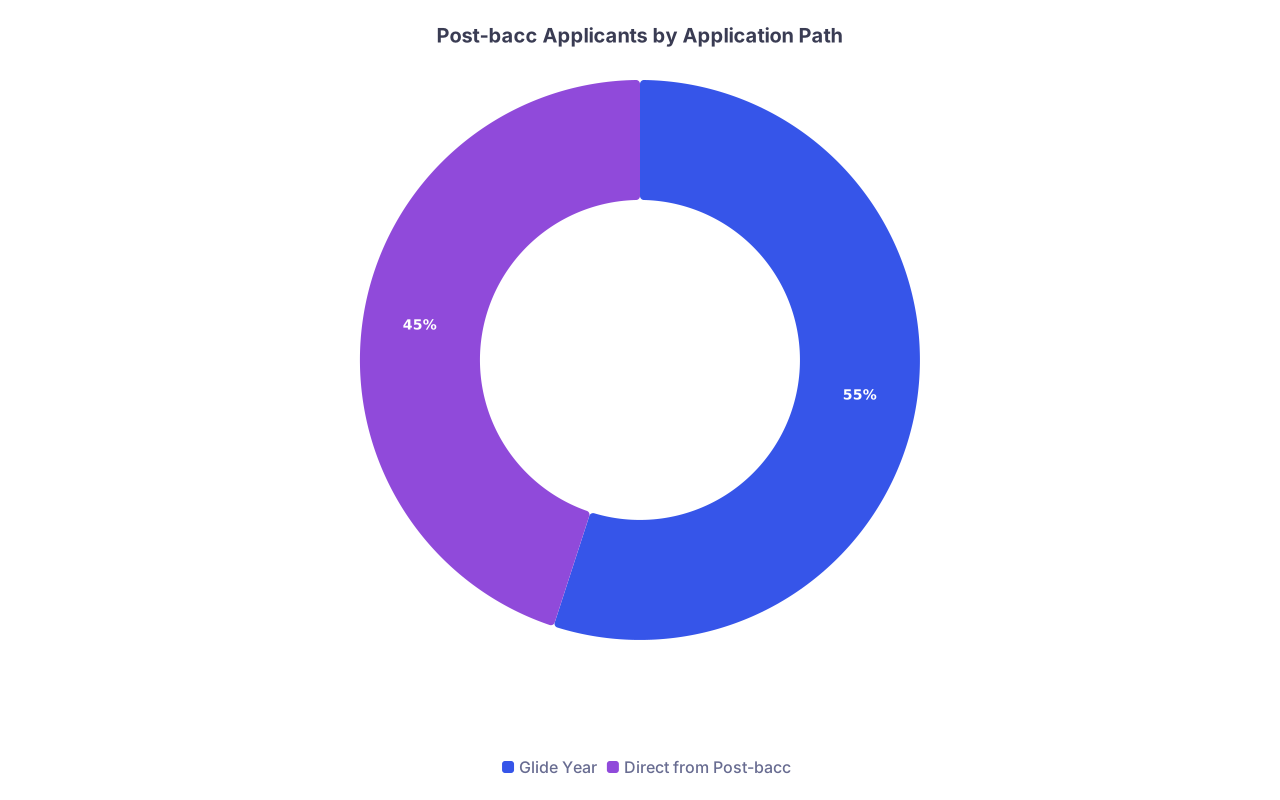
- The option to apply to the linked medical school without a glide year (i.e., immediately after the post-bacc, skipping the usual application gap).
- Conditional acceptance based on maintaining a specific GPA and achieving a particular MCAT score.
- Often highly structured and intensive; typically no breaks or MCAT retakes.
Pros:
- Potentially faster route to medical school.
- Clear performance targets and expectations.
Cons:
- High pressure: limited flexibility if you don’t hit the MCAT or GPA thresholds.
- Restricted school list; not ideal if you want to keep broad options.
4. Certificate Programs and Hybrid Formats
Some institutions offer:
- Graduate certificate programs in biomedical sciences.
- Hybrid programs that mix online didactics with in-person labs.
- Part-time options for working professionals.
These can be ideal if:
- You must continue working while studying.
- You want to test the waters before committing to a full master’s program.
- You need targeted coursework (e.g., more upper-level biology) rather than a full second degree.
Core Factors to Consider When Choosing a Post-Baccalaureate Program
Once you understand your profile and target program type, evaluate specific programs using these key dimensions.
1. Curriculum, Rigor, and Flexibility
Match to Your Goals
Ask yourself:
- Do you need prerequisites or record enhancement (or both)?
- Does the curriculum include all courses required by your target medical schools?
- Are there recommended courses like biochemistry, statistics, psychology, or sociology included?
Review sample course plans and syllabi when available. Programs serious about medical school preparation are usually very transparent about:
- Which courses they require.
- Typical timelines for MCAT prep and exam dates.
- How their coursework aligns with AAMC competencies.
Schedule and Delivery Format
Consider:
- Full-time vs. part-time: Can you dedicate yourself fully, or must you work?
- Day vs. evening classes: Critical if you’re balancing jobs or family responsibilities.
- In-person vs. online: Many medical schools still prefer or require in-person labs; confirm this before committing to mostly online coursework.
Actionable tip:
Make a weekly schedule including classes, study time, commuting, work, and any family obligations. If it looks impossible on paper, it will be worse in real life.
2. Location, Setting, and Cost of Living
Where you complete your post-bacc can shape your experience as much as the program itself.
Proximity to Medical and Clinical Facilities
Programs located near academic medical centers or teaching hospitals often provide:
- Easier access to shadowing, volunteering, and scribing opportunities.
- Guest lectures from physicians and residents.
- Potential for longitudinal clinical experiences over the entire duration of the program.
Urban vs. Suburban vs. Rural
Each environment has pros and cons:
- Urban: More clinical and research opportunities, but often higher cost of living and more distraction.
- Suburban: Balanced access to hospitals with somewhat lower living costs.
- Rural: Potential for unique clinical experiences and close-knit communities, but fewer research opportunities.
Financial Reality Check
Don’t just look at tuition. Make a realistic budget including:
- Rent, utilities, transportation, food, and health insurance.
- Books, lab fees, and exam prep materials.
- Application costs for medical school (AMCAS fees, secondary applications, MCAT registration).
Your financial plan should align with program length and intensity. For some students, choosing a slightly less “prestigious” program in a more affordable city is a smarter long-term decision.
3. Advising, Mentorship, and Application Support
Advising quality is one of the most important differentiators between programs.
Ask programs directly:
- How many students does each advisor support?
- Is advising mandatory or optional?
- Do they provide:
- Individualized school list guidance?
- Personal statement and secondary essay review?
- Mock interviews (traditional and MMI)?
- Support if your first application cycle is unsuccessful?
Programs with strong advising infrastructures will often highlight:
- Acceptance statistics (including MD vs. DO breakdown).
- Support for non-traditional and career-change applicants.
- Workshops on MCAT strategy, time management, and resilience.
4. Program Cost, Financial Aid, and Return on Investment
Post-baccs can be expensive, and unlike undergrad, not all qualify for federal aid.
Key questions:
- Is the program classified as undergraduate, graduate, or continuing education for financial aid purposes?
- Are you eligible for:
- Federal loans?
- Institutional scholarships or need-based aid?
- Teaching or research assistant positions?
When considering return on investment:
- Look beyond immediate cost to long-term outcomes—your ability to become a physician and future earning potential.
- However, be realistic about debt burden and include your anticipated medical school debt in your calculations.
5. Outcomes, Match to Medical School Admissions Expectations, and Reputation
Programs that are serious about outcomes will usually share:
- Medical school acceptance rates (over several years, not just one standout year).
- The distribution of schools where alumni matriculate.
- Average MCAT scores and GPA changes among their students.
When interpreting these numbers:
- Check whether they report outcomes for all students or only for those who complete the program and apply with the program’s committee letter.
- Compare their outcomes to national averages for non-traditional or post-bacc applicants.
Reputation matters, but not in the same way as for undergrad rankings. Medical schools mainly want to see:
- Rigorous coursework.
- Clear academic improvement or successful performance.
- Credible letters from faculty who know you well.
Beyond Coursework: Enhancing Your Post-Bacc Experience
In a competitive medical school admissions landscape, “just doing the classes” is rarely enough. The most compelling applicants use their post-bacc period to grow in multiple dimensions.
Clinical and Volunteer Experiences
Look for programs that either:
- Integrate clinical experiences into the curriculum (e.g., required shadowing, hospital volunteering), or
- Have established partnerships with local hospitals, clinics, and community health organizations.
Aim for:
- Consistent involvement (e.g., 3–4 hours per week over a year) rather than short, sporadic bursts.
- Roles that allow meaningful patient interaction when possible (scribing, clinical assistant, patient navigator).
Research Opportunities
Research is not mandatory for all medical schools, but it is highly valued, especially for academic or research-focused programs.
Ask about:
- Access to basic science or clinical research labs.
- Opportunities to work with physician-investigators.
- Whether post-bacc students are eligible for poster presentations or publications.
Professional Development and Soft Skills
Strong programs often offer workshops or seminars on:
- Professionalism and ethics in medicine.
- Communication skills and teamwork.
- Burnout prevention and resilience—skills you’ll need throughout medical training.
Use your time in the program to:
- Build relationships with faculty who can later write strong, detailed recommendation letters.
- Reflect on your personal motivations and refine your narrative for personal statements and interviews.
A Step-by-Step Approach to Evaluating and Selecting a Post-Bacc Program
To move from vague options to a concrete decision, follow a structured process.
Step 1: Clarify Your Starting Point and End Goals
Ask yourself:
- Am I primarily a career changer or a GPA enhancer (or both)?
- What are my approximate GPA and MCAT goals for competitiveness?
- Do I have a preferred geographic region or type of medical school (MD vs. DO, public vs. private)?
Write this out as a short statement; you’ll use it to evaluate program fit.
Step 2: Build a Target Program List
Use:
- AAMC post-bacc program directory.
- Individual university websites.
- Premed forums and networking groups (with caution; verify all information with official sources).
Categorize programs as:
- Reach (highly selective admission, often requiring solid current stats).
- Target (your profile aligns well with their typical entrants).
- Safety (less selective or more flexible admissions criteria).
Step 3: Deep-Dive Research for Each Program
For each program on your list, investigate:
- Curriculum and sample schedule.
- Cost breakdown and financial aid options.
- Outcomes statistics and advising structure.
- Typical student profile and average age.
If possible, attend:
- Virtual or in-person information sessions.
- Pre-admissions advising calls offered by some programs.
Step 4: Talk to Current Students and Alumni
Nothing replaces firsthand experience. Ask them:
- What surprised you about the program (good or bad)?
- How accessible were advisors and faculty?
- Did the program deliver on its promises about clinical opportunities and support?
- Would you choose it again?
Their answers will often reveal culture and support level in a way brochures cannot.
Step 5: Assess Personal Fit and Practical Feasibility
Create a comparison chart that includes:
- Program type (career-changer vs. enhancer vs. SMP).
- Location and cost of living.
- Level of structure vs. flexibility.
- Clinical and research opportunities.
- Outcomes and advising strength.
Then ask:
- Which program best matches my academic needs and learning style?
- Where am I most likely to thrive, not just survive?
Step 6: Apply Strategically and Prepare for Interviews
When you’re ready to apply:
- Treat applications like mini-med school applications—personal statements, recommendation letters, and CVs matter.
- If interviews are required, practice articulating:
- Why you’re pursuing medicine now.
- Why this specific program is the right fit for you.
- What you’ve learned from your past academic or professional experiences.
Once you receive offers, revisit your comparison chart, update it with final financial aid information, and choose the program that offers the best combination of academic fit, support, and affordability.

Frequently Asked Questions About Post-Baccalaureate Programs
1. What is the difference between a traditional post-bacc, a linkage program, and a special master’s program?
Traditional post-bacc:
Undergraduate-level coursework focused on completing or retaking prerequisites. Ideal for career changers and some GPA enhancers.Linkage program:
A specific kind of post-bacc (usually traditional) with formal agreements with one or more medical schools, allowing you to apply early and potentially matriculate without a glide year if you meet strict GPA and MCAT criteria.Special Master’s Program (SMP) or record-enhancer master’s:
Graduate-level work, often mimicking medical school curricula. Best suited for applicants who already completed prerequisites and want to demonstrate they can excel in medical school–style coursework.
All three can support medical school preparation, but the right choice depends on your background, GPA, and goals.
2. Can I work while enrolled in a post-bacc program?
It depends on the program’s intensity and your own bandwidth:
- Full-time, rigorous programs (especially linkage or SMPs) often make full-time work unrealistic and sometimes strongly discouraged.
- Part-time or evening programs are explicitly designed for working students, especially non-traditional career changers.
Be honest about:
- How many hours you need to work to meet financial obligations.
- How many hours per week you realistically need for class, studying, commuting, and sleep.
Medical schools care more about sustained academic excellence than about whether you worked full-time during your post-bacc, so do not overextend to the point that your grades suffer.
3. Will completing a post-bacc program guarantee admission to medical school?
No program can ethically guarantee medical school admission.
However, a strong post-bacc:
- Can significantly boost your academic metrics and narrative.
- Often provides targeted MCAT and application support.
- Enhances your clinical experiences and letters of recommendation.
Admissions committees still consider:
- Cumulative and science GPA (including both undergrad and post-bacc).
- MCAT score.
- Clinical exposure, volunteering, research, and leadership.
- Personal statement, secondary essays, and interview performance.
- Professionalism and fit with the school’s mission.
Think of a post-bacc as a highly effective tool within a broader, well-planned application strategy—not a guarantee.
4. How do I decide if a post-bacc is right for me versus applying directly?
You might be a good candidate for a post-bacc if:
- Your overall or science GPA is significantly below the average of your target schools.
- You lack several core science prerequisites or have been away from science coursework for many years.
- Your academic record is inconsistent, and you need a clear demonstration of recent excellence.
- You’re making a career change to medicine and need both coursework and structured guidance.
If you already have:
- Strong, consistent grades in rigorous science coursework,
- A competitive MCAT score, and
- Substantial clinical and extracurricular experiences,
then you may be ready to apply directly without a post-bacc.
5. What if I’ve been out of school for many years and feel “rusty” academically?
You are exactly the kind of applicant many post-bacc programs are designed to serve. Programs that welcome non-traditional students typically offer:
- Orientation sessions that review study skills and time management.
- Access to tutoring, academic coaching, and writing centers.
- Supportive peer communities of older students returning to the classroom.
Medical schools increasingly value diverse life experiences. If you can demonstrate recent academic success and articulate how your prior career or life experiences inform your motivation to practice medicine, your time away from school can become a strength, not a liability.
Choosing the right post-baccalaureate program is one of the most consequential early decisions in your journey to medicine. By understanding your needs, carefully evaluating program types and outcomes, and planning strategically, you can select a program that maximizes your growth, your confidence, and your competitiveness for medical school admissions.
Use this guide as a roadmap, but remember: the most important factor is not just where you go—it’s how intentionally and wholeheartedly you engage with the opportunities your program provides.