Introduction: Why Post-Baccalaureate Programs Matter for Future Physicians
For many aspiring physicians, the path to medical school is not a straight line. You might have discovered your interest in medicine late, struggled academically during college, or pursued another career before realizing you’re called to clinical care. Competitive Medical School Admissions standards can make these realities feel like closed doors—but they don’t have to be.
Post-Baccalaureate Programs (often called “post-bacc” programs) have become an important and respected pathway for applicants who need to strengthen part of their profile before applying. These programs can support Academic Enhancement, facilitate a Career Change into medicine, and create structured opportunities for Healthcare Experience, research, and professional development.
This guide explains:
- What Post-Baccalaureate Programs are and who they’re designed for
- The main types of post-baccs and how to choose between them
- How these programs enhance your medical school admissions competitiveness
- Examples and strategies to maximize your time in a post-bacc
- Common questions about cost, timing, and outcomes
By the end, you’ll be better prepared to decide whether a post-bacc aligns with your goals—and how to leverage one effectively if you choose this path.
Understanding Post-Baccalaureate Programs for Premed Students
What Is a Post-Baccalaureate Program?
A Post-Baccalaureate Program is a structured educational pathway designed for students who have already completed a bachelor’s degree and want additional preparation specifically for medical school (and sometimes other health professions). Unlike a second bachelor’s degree or a traditional master’s program, post-bacc programs are purpose-built for premed and pre–health professions preparation.
They typically focus on one or more of the following objectives:
- Completing medical school prerequisite coursework
- Demonstrating improved academic performance in science
- Gaining clinical and research experience
- Receiving targeted advising, MCAT preparation, and application support
These programs may be housed within undergraduate institutions, medical schools, or graduate divisions, and can range from one to two years in length, sometimes with flexible timelines.
Main Types of Post-Baccalaureate Premedical Programs
While there are hybrids, most Post-Baccalaureate Programs fall into three broad categories:
1. Academic Enhancement Programs
These programs are ideal if:
- You completed most or all of the prerequisite courses, but
- Your undergraduate GPA (overall or science) is not competitive, or
- You need to demonstrate your ability to excel in a rigorous curriculum.
Key features:
- Upper-division undergraduate or graduate-level science coursework (e.g., biochemistry, physiology, microbiology, neuroscience)
- Emphasis on achieving a high GPA in challenging courses
- Often includes structured MCAT prep and advising
- Sometimes offers linkage agreements (more on this later) with specific medical schools
Academic enhancement post-baccs send a clear signal to admissions committees: your earlier academic performance does not define your current capabilities.
2. Career-Changer Programs
Career-Changer Post-Baccalaureate Programs are designed for students who:
- Majored in non-science fields (e.g., English, history, business, fine arts)
- Completed few or no medical school prerequisites
- Have decided relatively late that they want to apply to medical school.
Key features:
- Foundational science sequences (general chemistry, biology, physics, organic chemistry, sometimes math/biostatistics)
- Cohort-based learning with other career changers
- Often integrated with volunteering and shadowing experiences
- Intensive, structured curriculum to complete core requirements in 12–24 months
These programs are especially common among applicants transitioning from other careers such as education, consulting, engineering, public policy, or the arts.
3. Specialized or Pre-Medical Post-Bacc Programs
Some post-bacc programs blend components of both academic enhancement and career-change, or are embedded as formal pre-medical certificate or special master’s programs (SMPs).
Key features may include:
- A mix of undergraduate and graduate-level coursework
- Opportunities to take classes side-by-side with first-year medical students (in SMPs)
- Built-in research, lab experience, and sometimes thesis projects
- Strong advising, MCAT prep, and personal statement/interview support
These options can be especially powerful for applicants who want a graduate credential while also enhancing their academic record.
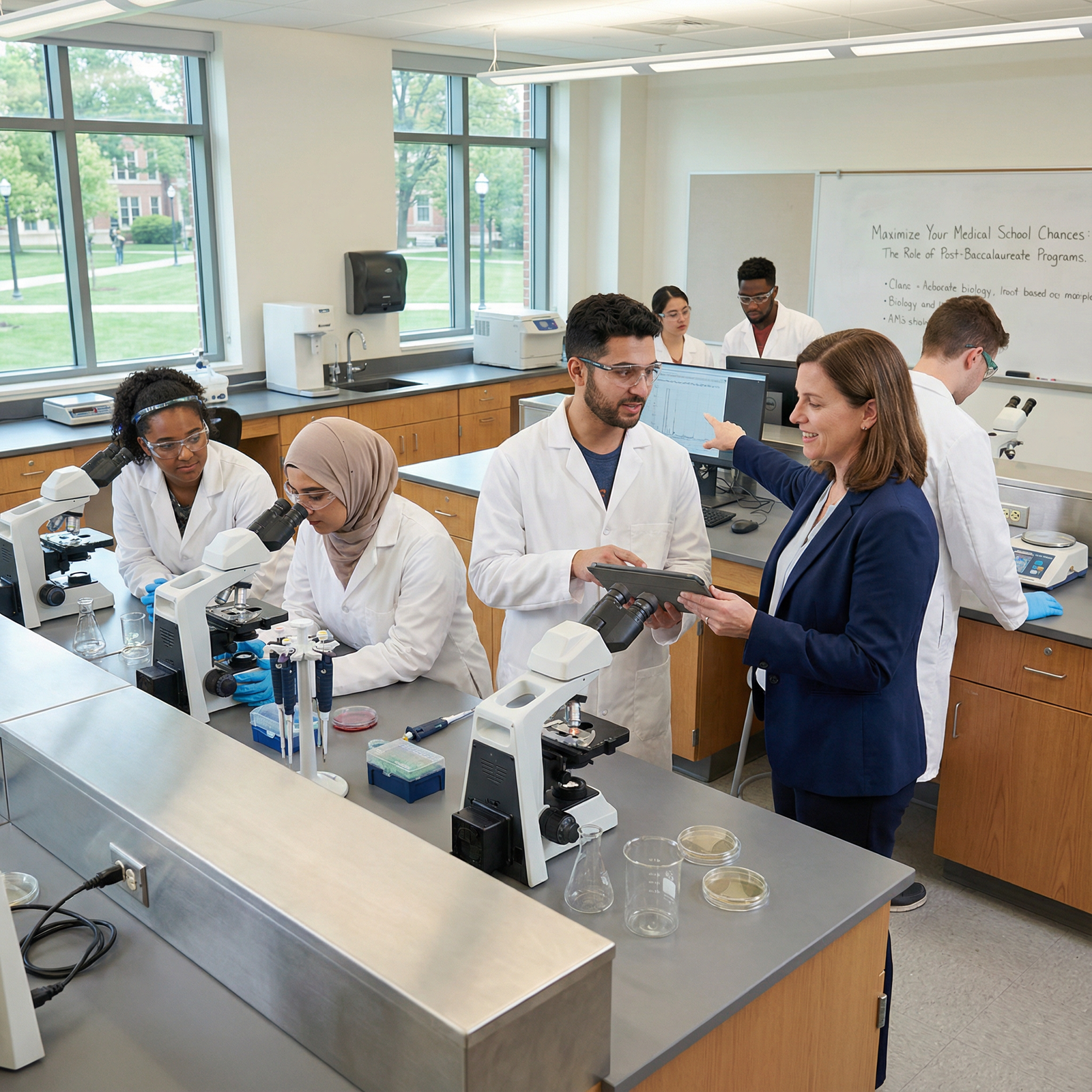
How Post-Baccalaureate Programs Strengthen Medical School Applications
1. Academic Enhancement: Rebuilding or Completing Your Science Foundation
Medical schools heavily scrutinize academic performance, especially in science coursework. A post-bacc gives you a structured way to address academic concerns or fill gaps.
Raising Your GPA and Demonstrating Readiness
If your undergraduate GPA is below the competitive range for your target schools, a strong post-bacc performance can:
- Show a clear upward academic trend, which many admissions committees value
- Provide a more recent and relevant sample of your abilities
- Potentially improve your science GPA (BCPM), which is calculated separately by many application services
Example:
A student with a 2.9 cumulative GPA and 2.7 science GPA from undergrad completes a one-year Academic Enhancement Post-Baccalaureate Program, earning a 3.9 in 30–40 credits of upper-level sciences. Admissions reviewers now see a sustained period of excellence in coursework that closely mirrors medical school content.
Completing or Strengthening Prerequisites
For Career-Changers, the primary goal is to complete the core prerequisites:
- General biology with labs
- General and organic chemistry with labs
- Physics with labs
- Biochemistry
- Statistics or calculus (depending on schools)
Even for students who’ve already taken these courses, repeating or augmenting them in a post-bacc—especially if the originals were taken long ago or with low grades—can help solidify your foundation before the MCAT and medical school.
2. Building a More Competitive Application Beyond Grades
Medical School Admissions committees use holistic review. Strong academics alone are not enough—you also need evidence of maturity, motivation, and fit for a career in medicine. Post-Baccalaureate Programs typically integrate experiences that strengthen key domains of your application.
Clinical Exposure and Healthcare Experience
You must be able to answer the question: “Do you understand what it means to practice medicine?” Post-baccs often help you:
- Arrange consistent clinical volunteering (e.g., hospital volunteering, patient transport, emergency department support)
- Secure physician shadowing in primary care, specialties, or underserved settings
- Work as a scribe, medical assistant, EMT, or patient care technician if your schedule allows
These experiences serve two crucial purposes:
- They help confirm whether medicine is truly the right path for you.
- They provide concrete stories and insights for your personal statement and interviews.
Research Opportunities
Many Post-Baccalaureate Programs include or facilitate:
- Basic science or clinical research experiences
- Quality improvement projects in healthcare settings
- Public health or population health research
Research is not strictly required by every medical school, but it strengthens your application by showing:
- Comfort with scientific inquiry and data
- Ability to work on teams and follow through on long-term projects
- Curiosity about the mechanisms and systems underlying health and disease
Even career changers without prior lab experience can often find introductory or mentored research opportunities through a post-bacc.
Networking and Professional Mentorship
Being embedded in a post-bacc community connects you to:
- Faculty who can later write strong, detailed letters of recommendation
- Advisors knowledgeable about medical school admissions trends
- Medical students, residents, and physicians who can offer mentorship and perspective
Strong letters and genuine mentorship can be pivotal in shaping not only your application, but also your specialty interests and long-term career goals.
3. Targeted Advising and Application Strategy Support
For many applicants—especially first-generation college graduates, nontraditional students, and career changers—the logistics of applying can be overwhelming. Post-Baccalaureate Programs often include robust advising services that demystify the process.
Common support services include:
- Individual advising sessions to assess your competitiveness and timeline
- Guidance on choosing between MD vs. DO programs, in-state vs. out-of-state schools, and different mission fits
- MCAT preparation planning (course selection, study schedules, recommended resources)
- Personal statement and activities section workshops focused on narrative coherence and impact
- Mock interviews (traditional and MMI) with feedback
- Help organizing letters of recommendation and secondary application strategies
This structured guidance can dramatically reduce costly mistakes—such as applying too early, not applying broadly enough, or submitting a weak personal statement.
4. Filling Gaps in Experience and Skills
If your undergraduate years did not include much volunteering, leadership, or community engagement, a post-bacc can help fill those gaps.
Examples of opportunities commonly supported or encouraged:
- Volunteering at free clinics, health fairs, or community organizations
- Tutoring or mentoring in science, math, or health education
- Leadership roles in premed or service organizations
- Participation in pipeline or outreach programs serving underserved populations
These experiences not only enhance your application but also deepen your understanding of health disparities, social determinants of health, and patient-centered care—topics central to modern medical education.
5. Embracing Diverse Educational and Professional Backgrounds
Medical schools value diverse backgrounds, experiences, and perspectives. Post-Baccalaureate Programs are uniquely positioned to welcome:
- Humanities and social science majors
- Artists, engineers, business professionals, educators, veterans, and more
- Individuals from underrepresented backgrounds in medicine
- Students returning to school after several years in the workforce
A former marketing professional might bring strong communication and teamwork skills. A social worker might offer deep insight into mental health and social services. An environmental scientist may foreground sustainability and planetary health. Post-baccs help translate these assets into a coherent premed narrative that medical schools understand and appreciate.
Real-World Examples: How Post-Baccs Can Transform an Application
1. The Career-Changer Educator
Sarah spent years as a high school teacher before volunteering at a community health clinic, where she discovered a passion for patient care and health education. She had no prior college-level science coursework.
- She enrolled in a Career-Changer Post-Baccalaureate Program that offered all core prerequisites in an intensive 18-month sequence.
- The program connected her with a local clinic for longitudinal volunteering and shadowing.
- With structured MCAT prep, she scored competitively, built strong relationships with faculty, and earned excellent letters of recommendation.
Outcome: With a clear narrative blending education, community service, and medicine, she gained admission to multiple medical schools, many with a strong focus on primary care and underserved populations.
2. The Academic Rebound Story
John was a biology major whose undergraduate GPA suffered due to serious personal challenges. After time away from school, he wanted to return with renewed focus.
- He chose an Academic Enhancement Program offering upper-level courses like human physiology, immunology, and biochemistry.
- Taking a full course load, he earned a 4.0 GPA over two years.
- He participated in a small research project and volunteered weekly at a hospital.
- With advisor support, he wrote a personal statement that honestly addressed his earlier difficulties and highlighted his growth.
Outcome: Admissions committees saw sustained academic excellence and resilience. He received several interviews and ultimately matriculated at a medical school that valued his upward trajectory and maturity.
3. The Sociology Graduate Building a Healthcare Network
Emily completed a degree in sociology and developed a strong interest in health disparities. However, she lacked science coursework and clinical exposure.
- She enrolled in a Pre-Medical Post-Bacc Program that combined prerequisites with seminars on health policy and social determinants of health.
- The program’s structured shadowing and mentorship events connected her with physicians working in urban and community health.
- Through these mentors, she gained insights into public health, health advocacy, and potential future combined degrees (e.g., MD/MPH).
Outcome: Emily’s application showcased a thoughtful integration of sociology, patient advocacy, and clinical care. She received interview invitations from multiple top-tier schools with strong primary care and public health missions.
How to Choose the Right Post-Baccalaureate Program
Step 1: Clarify Your Primary Goal
Ask yourself:
- Do I need Academic Enhancement (improve GPA and demonstrate recent success)?
- Do I need Career-Change support (complete prerequisites from scratch)?
- Do I want a structured program with strong Healthcare Experience opportunities?
- Do I need intensive MCAT and application advising?
Your answers will help you decide between academic enhancement, career-changer, or hybrid/specialized programs.
Step 2: Evaluate Program Structure and Outcomes
When researching programs, consider:
- Program length and pace (one-year intensive vs. two-year flexible)
- Class size and cohort model (small, tight-knit vs. larger, more independent)
- Access to clinical, volunteer, and research opportunities
- Linkage agreements with medical schools (some programs allow you to apply early to specific partner schools, bypassing the glide year if you meet performance benchmarks)
- Published acceptance rates to medical schools and typical MCAT/GPA outcomes
- Availability of financial aid or scholarships
Step 3: Consider Fit with Your Life Circumstances
Nontraditional students often juggle work, family responsibilities, and geographic constraints. Be realistic about:
- Whether you need part-time vs. full-time enrollment
- Commute times or relocation needs
- Flexibility in scheduling (evening/weekend classes, online components)
- Financial cost and your capacity for loans or part-time employment
A slightly slower but well-balanced program is often better than overcommitting and underperforming.

Practical Tips to Maximize Your Post-Bacc Experience
- Treat it like a rehearsal for medical school. Build disciplined study habits, time management, and resilience.
- Prioritize health and balance. Burnout during a post-bacc can harm your performance; protect sleep, nutrition, and mental health.
- Seek feedback early. Regularly meet with professors and advisors to discuss progress and strategies.
- Document your experiences. Keep a log of clinical encounters, volunteering, research tasks, and reflections—you’ll use this for applications and interviews.
- Plan your MCAT strategically. Align MCAT timing with when you’ve completed key coursework (especially biochemistry and physiology) and can dedicate focused study time.
- Start networking. Attend talks, career panels, and meet-and-greets. Ask physicians and researchers about their paths and lessons learned.
FAQ: Post-Baccalaureate Programs and Medical School Admissions
Q1: Will completing a Post-Baccalaureate Program guarantee admission to medical school?
No. Even the best Post-Baccalaureate Programs cannot guarantee admission. Medical School Admissions decisions are based on multiple factors—GPA, MCAT, letters of recommendation, personal statement, interviews, experiences, and school-specific priorities. However, a strong post-bacc performance combined with thoughtful advising can significantly improve your competitiveness.
Q2: How long do most Post-Baccalaureate Programs take to complete?
Most programs last 12–24 months, depending on:
- Whether you enroll full-time or part-time
- How many prerequisites you still need
- The program’s curriculum structure
Career-changer programs that cover all core sciences are often 18–24 months. Academic enhancement programs may be as short as one intensive year.
Q3: Can I work while enrolled in a post-bacc?
It depends on the program intensity and your individual circumstances. Some students successfully work part-time, especially in related roles (e.g., scribe, medical assistant, EMT). However:
- Full-time, rigorous programs often recommend minimal or no outside work to maintain high academic performance.
- If you must work, choose a program with flexible scheduling and be realistic about your workload.
Q4: How much do Post-Baccalaureate Programs typically cost, and are they worth it?
Tuition varies widely by institution and location—ranging from relatively affordable public university options to expensive private programs. When considering cost, weigh:
- Tuition and fees
- Living expenses
- Lost income if you reduce work hours
- Availability of financial aid, payment plans, or scholarships
For many students, a well-chosen post-bacc is an investment that opens doors to a medical career that would otherwise be out of reach. The key is to choose a program that directly addresses your specific needs and has a clear record of supporting students into medical school.
Q5: How do I know whether I need a post-bacc vs. going straight into applying?
Ask yourself:
- Is my cumulative and science GPA competitive for my target schools?
- Have I completed the core prerequisites recently and with strong grades?
- Do I have sufficient clinical exposure, volunteering, and other experiences?
- Is my MCAT (or potential MCAT performance) aligned with my goals?
If you identify significant gaps in academics, preparation, or experience, a Post-Baccalaureate Program can be a strategic way to address them rather than applying prematurely and risking multiple unsuccessful cycles.
Conclusion: Using Post-Baccalaureate Programs as a Launchpad to Medicine
Post-Baccalaureate Programs are not detours; they are purposeful launchpads for aspiring physicians whose paths don’t fit the traditional premed mold. Whether you are rebuilding your academic record, changing careers into medicine, or seeking structured Healthcare Experience and advising, a well-chosen post-bacc can dramatically strengthen your profile for Medical School Admissions.
By understanding the different program types, clarifying your goals, and engaging fully with the opportunities offered—coursework, clinical exposure, research, and mentorship—you can transform your candidacy and move confidently toward a medical career.
If you’re serious about becoming a physician and recognize areas where your application needs support, exploring Post-Baccalaureate Programs may be one of the most important steps you take in your premedical journey.