
Most premeds choose lab courses to “check a box.” That is a strategic mistake.
If you treat labs as generic requirements instead of targeted tools, you will weaken two pillars of your application at once: your letters of recommendation and your practical skills. The good news: with deliberate planning, your lab schedule can be engineered to produce both stronger LORs and genuinely marketable competencies.
Let me break this down very specifically.
(See also: Advanced Study Skills for Pre‑Med Organic Chemistry and Biochemistry for more details.)
The Real Function of Lab Courses in a Premed Trajectory
Lab courses do three things for a medical school application:
- Demonstrate technical competence and scientific literacy
- Provide high-quality “face time” with faculty who can write detailed LORs
- Show progression from basic, structured work to advanced, semi‑independent work
Most students only think of #1. Adcoms care about all three.
How adcoms actually read your lab background
When admissions committees review your file, they triangulate:
- Transcript – What lab courses, at what level, at what institution rigor?
- LORs – Do any writers comment specifically on your lab performance, technique, reliability, or scientific thinking?
- Experiences section – Do your research and clinical activities show skills that connect to your coursework?
If you have straight‑A grades but every letter reads as “smart, quiet, did well on exams,” you have not leveraged your labs.
What they want to see:
- A pattern: Intro labs → challenging intermediate labs → at least one advanced/specialized lab or research‑style course
- Mentors who can say: “I directly supervised this student in the lab, watched them troubleshoot, and trusted their data”
- Evidence that you can function in a realistic scientific environment: safety, documentation, collaboration, persistence
Your lab choices either make that narrative easy to write…or force your letter writers to generalize.
The Three Tiers of Lab Courses – And How To Use Each
Think of lab courses in three functional tiers, not just course numbers.
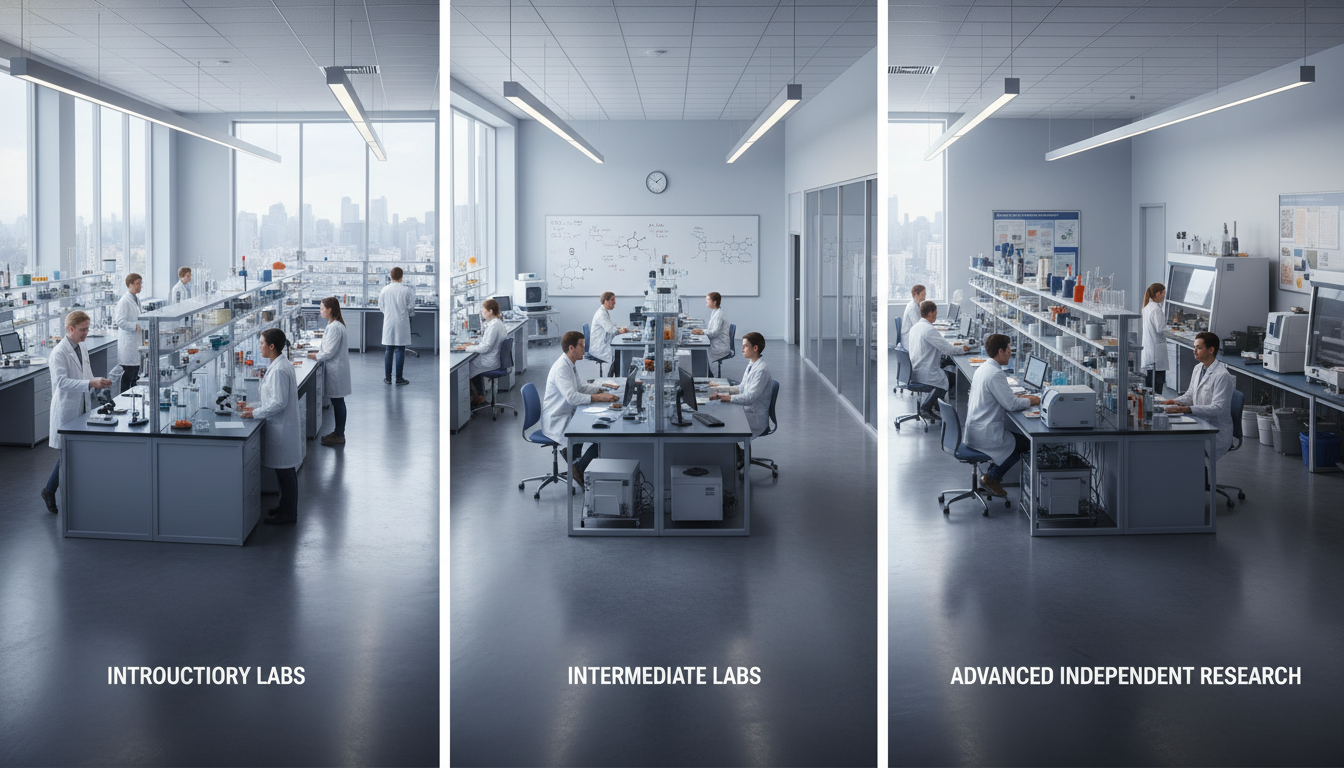
Tier 1: Foundational Labs (Checking the Box, But Doing It Well)
Examples:
- General Chemistry I & II labs
- Introductory Biology labs
- Algebra‑ or calculus‑based Physics labs
These are high‑enrollment, often semi‑scripted labs. Most premeds treat them as “survive and move on.” That is a lost opportunity.
Primary goals in Tier 1:
Show reliability and professionalism
- You arrive early, prepared (pre‑lab done, protocol read), and you do not skip.
- You follow safety rules without repeated reminders.
- You submit reports on time and respond to feedback.
Stand out for clarity in written work
- Your lab reports are precise, organized, and not obviously copied from lab partners.
- You demonstrate clear understanding of error analysis, controls, and limitations.
Start building micro‑relationships with TAs and instructors
- Ask 1–2 substantive questions per lab period, not constant hand‑holding.
- Attend office hours once or twice during the term, even if you are doing well, to talk about concepts or broader applications.
These courses rarely yield your strongest letters, but they create a reputation: “This student is serious and dependable.” That reputation matters when you progress to Tier 2 and 3, where that same faculty network is often involved.
Course choice advice at this level:
When you have options for where to take prerequisites:
- Prefer on‑campus labs at your primary institution over community college or online substitutes if you are aiming for MD programs at mid‑ to high‑tier schools. Stronger rigor and more letter potential.
- If balancing a heavy term (e.g., Organic Chemistry + Biochemistry), consider pairing with one lab, not two, so your lab performance does not become rushed and sloppy. A strong A with good engagement is better than two rushed B’s and no one remembers you.
- If you already have weak sciences, avoid compressing labs into summer mini‑terms unless you truly can dedicate the time. Fast labs = less relationship building.
Tier 2: Career‑Defining Intermediate Labs
Examples:
- Organic Chemistry lab
- Cell Biology lab
- Genetics or Molecular Biology lab
- Microbiology lab
- Human Physiology lab with wet‑lab component
- Neuroscience lab (if offered at the 300‑level)
These are the labs where your file begins to look “premed versus generic STEM major.”
Primary goals in Tier 2:
Signal your scientific orientation
If you are aiming for a research‑heavy MD or MD/PhD trajectory, priority choices often include:
- Cell Biology lab
- Molecular Biology or Genetics lab
- Biochemistry lab (if offered as separate lab)
- Neuroscience lab with electrophysiology or imaging components
If you are more clinically oriented but still want solid science:
- Microbiology with lab
- Human/vertebrate Physiology lab
- Anatomy & Physiology sequence with cadaver lab (when available)
- Immunology lab
The point is not to collect every possible lab. It is to pick two to three intermediate labs that align with where you want your story to go.
Deliberately position yourself for at least one strong science LOR
These labs usually have:
- Smaller sections
- More complex, multi‑week experiments
- Greater faculty or PhD‑level TA contact
You want at least one of these courses to result in:
- The instructor learning your name early
- You visiting office hours regularly (not just around exams) to talk about lab data, not just multiple‑choice questions
- A project, presentation, or lab practical where you clearly distinguish yourself
Then, you can return 6–12 months later and request a letter that references specific lab behaviors and achievements.
Develop a skill set that is legible on a med school application
When you describe experiences, you want to be able to say:
- “In my Cell Biology lab, I gained experience with mammalian tissue culture, sterile technique, and fluorescence microscopy, which directly supported my later work in Dr. X’s cancer biology lab.”
- “Our Microbiology lab emphasized quantitative plating, aseptic technique, and interpreting antibiograms; that hands‑on work prepared me to understand antibiotic stewardship during my clinical volunteering.”
That is far more compelling than “took labs required for my major.”
Course choice strategy at this level:
Limit yourself to 1 serious lab per term in most cases. These courses are time‑intensive: pre‑labs, post‑labs, write‑ups, group coordination. If you stack Organic lab + Cell Bio lab + Physics lab in one semester, one of three things usually happens:
- Your grades decline in at least one
- You become invisible (no office hours, no deeper engagement)
- You burn out and start skipping
Better pattern:
- Fall: Organic Chem I + Organic Chem I Lab + one non‑lab science
- Spring: Cell Biology + Cell Bio Lab
- Next Fall: Physics sequence with lab
Prefer labs with real experimentation over canned confirmation labs. If your department offers:
- BIOL 312: Cell Biology (with weekly cookbook‑style labs)
- BIOL 412: Advanced Cell Biology Laboratory (project‑based)
Consider doing both but prioritize the advanced, project‑based one as the foundation for LORs and skills.
Ask upperclassmen specific questions:
Instead of “Is Micro lab hard?”, ask:
- “How much direct interaction did you have with the professor versus TAs?”
- “Were there multi‑week projects with your own experimental design?”
- “Did the professor actually get to know students well enough to write detailed letters?”
Choose sections and instructors that maximize contact and genuine mentorship potential.
Tier 3: Advanced Labs and Research‑Style Courses – Your LOR Engine
This tier is where many competitive applicants differentiate themselves.
Examples:
- Physical Chemistry lab (for chemistry‑heavy routes)
- Advanced Biochemistry lab
- Molecular Techniques / Methods in Biotechnology
- Advanced Neuroscience lab with recording or imaging
- Immunology laboratory with independent project
- Capstone research seminar with lab component
- Year‑long honors thesis or independent research credited as a lab
These courses can function almost like structured research experiences. They frequently involve:
- Longer projects with multiple iterations
- Student‑generated hypotheses
- Significant data analysis, statistics, and interpretation
- Formal written reports in near‑manuscript format
- Oral or poster presentations to the department
Primary goals in Tier 3:
Anchor at least one “signature” science letter
The best premed LORs often come from:
- A professor who supervised you for two consecutive semesters (e.g., advanced lab + research credit)
- A capstone course where you managed a major project from start to finish
- A PI for whom you functioned as a semi‑independent undergraduate researcher
Your goal when choosing Tier 3 courses: create one such scenario.
Example pattern:
- Junior Fall: “Molecular Techniques in Biology” with Dr. Patel
- Junior Spring: Read Dr. Patel’s work, approach for research position
- Senior Year: BIOL 499 “Senior Research” with Dr. Patel for 4–6 credits, resulting in abstract/poster
- Outcome: 2‑semester relationship + research → detailed LOR with clear lab‑based commentary
Develop skills that translate directly to research or M.D. training
Skills that make sense on a med school application:
- PCR, qPCR, gel electrophoresis, cloning
- Western blotting, ELISA, flow cytometry
- Basic microscopy (fluorescence, confocal)
- Cell culture, primary cell handling, aseptic technique
- Basic statistics in R, SPSS, or Python
- Experimental design and troubleshooting
You do not need all of these. But you need some that you can speak about concretely in secondaries and interviews.
Produce something tangible
Aim for:
- A poster at your university’s undergraduate research day
- A brief presentation in a departmental seminar
- A well‑written lab report that resembles a mini‑manuscript
These become specific talking points and prove that your LOR writers are not exaggerating.
Choosing among advanced options: concrete examples
Let us say you attend a mid‑sized university. Options for your junior/senior years include:
- BIOL 384: Microbial Genetics Lab
- BIOL 412: Advanced Cell Biology Lab
- BIOL 450: Immunology Lab
- CHEM 431: Biochemistry I Lab
- NEUR 420: Systems Neuroscience Lab
You are:
Leaning MD/PhD, interested in cancer biology:
- Prioritize: Advanced Cell Bio Lab + Biochemistry Lab
- Secondary option: Molecular Techniques if offered
- Seek out professors whose research overlaps and layer on research credits
Leaning primary care, but want solid science:
- Prioritize: Immunology Lab + Physiology Lab
- Possibly Microbial Genetics if you are thinking about infectious disease
- Focus less on number of advanced labs, more on excelling in 1–2 and connecting your learning to clinical shadowing experiences
Uncertain, but enjoy neuro:
- Prioritize: Systems Neuroscience Lab + one core molecular lab (Cell, Molecular, or Biochem)
- Aim for a neuro‑focused research placement if possible
The theme is deliberate alignment, not maximal course load.
How To Turn Lab Courses Into Strong LORs
The core mistake: students complete three or four lab‑heavy courses and then ask for letters from professors who barely know them.
You need to reverse‑engineer this.

Step 1: Choose 2–3 “relationship anchor” courses
Not every lab will turn into a letter. Identify, ahead of time, which ones you want as your anchor points:
- One intermediate lab (e.g., Organic lab or Cell Bio lab)
- One advanced/research‑style lab (e.g., Advanced Cell Lab, Immunology Lab, or Senior Thesis)
In those courses:
- Sit near the front during lectures tied to lab
- Introduce yourself in week 1–2: name, major, interest in medicine/research
- Visit office hours by week 3 with a lab‑specific question, not just homework
Step 2: Behave like a junior colleague, not just a student
Letter writers notice students who:
- Own their mistakes: If you contaminate a plate or mis‑pipette, you tell the TA/instructor, analyze what went wrong, and document it in your notes.
- Help the lab run smoothly: You clean your area, help partners understand protocols, and do not vanish when there is shared work to finish.
- Ask higher‑order questions: “Why are we using this control?” “In a clinical lab, how would they validate this assay?”
These are behaviors that translate directly into memorable letter content: “X was the student others relied on to validate their calculations and help troubleshoot protocols.”
Step 3: Concretely signal that you value their mentorship
Near the end of a successful lab course:
- Send a brief, specific thank‑you email: mention one or two concepts or skills that were especially impactful.
- Ask if they have ongoing research or advanced labs they recommend, especially if aligning with your interests.
- If they are not taking students, ask whether another colleague in the department might be a good match.
This moves you from “student in my course” to “mentee in my orbit.”
Step 4: Time your LOR request correctly
Timeline:
Junior Spring / Early Senior Year is ideal for core science letters.
Ask 6–8 weeks before you need the letter submitted.
When you ask, provide:
- A brief CV or activities list
- Unofficial transcript
- A paragraph reminding them of your work in their lab: specific experiment, project, presentation, or characteristic behavior
- A summary of what types of programs you are applying to and what qualities you hope they can address (e.g., “lab skills, reliability, ability to work in a team and troubleshoot experiments”)
If you have completed both a course and research with them, remind them of both contexts.
Tactical Scheduling: Building a Lab Plan from Freshman to Senior Year
Let us put this together as a concrete, semester‑by‑semester structure for a “typical” biology‑major premed at a 4‑year university. Adjust the specifics to your curriculum.
Year 1: Establish Baseline Competence and Professionalism
Fall
- General Chemistry I + Gen Chem I Lab
- Intro Biology I (no lab or very basic lab)
- Core courses / writing intensive / elective
Spring
- General Chemistry II + Gen Chem II Lab
- Intro Biology II + Intro Bio Lab
- Non‑science course(s)
Goals:
- Get A/A‑ range in both sets of labs
- Learn safety, documentation, and basic error analysis
- Start hinting at interest in science during office hours (without yet asking for letters)
Year 2: Pivot to Identity‑Forming Labs
Fall
- Organic Chemistry I + Organic I Lab
- Physics I + lab (if your schedule allows)
- Possibly one non‑lab biology course
Spring
- Organic Chemistry II (often no separate lab if I + II share one)
- Cell Biology + Cell Bio Lab or Genetics + lab
- Non‑science course
Goals:
- Choose either Organic Lab or Cell/Genetics Lab as your first “anchor” LOR course
- Stand out for participation and project work
- By late spring, start scanning for advanced labs and research opportunities associated with professors you liked
Year 3: Advanced Skills and Relationship Consolidation
Fall
- Biochemistry + Biochemistry Lab (if available)
- Immunology lecture (lab if offered) or Microbiology + lab
- Possibly a statistics or programming course (very useful for data‑heavy research)
Spring
- Advanced Lab (e.g., Advanced Cell Biology Lab, Molecular Techniques)
- Begin research for credit or volunteer research in a lab whose PI teaches courses you have taken
- Non‑science / humanities
Goals:
- Secure at least one science LOR commitment by end of junior year: “Would you feel comfortable writing a strong letter for me when I apply next cycle?”
- Develop at least one or two marketable lab skills you can describe precisely (PCR, culture, flow cytometry, etc.)
- Possibly present a poster at a departmental or campus‑wide event
Year 4: Depth, Not Breadth
Application timing dictates the exact pattern, but for a traditional applicant:
Summer after Junior Year
- Submit AMCAS/AACOMAS and secondaries, using your lab courses and research to illustrate your scientific development.
- Letters from lab‑involved professors should be in or requested by mid‑summer.
Senior Year
- Capstone research, Honors thesis, or advanced seminar with a lab or project
- Only take additional advanced labs if they clearly add to your narrative or skills; do not overload just to “look impressive,” especially while interviewing.
Goals:
- Show continuity and increasing independence in lab‑based work
- Maintain high performance without grade slippage during the application year
- Use interview answers to connect lab experiences to how you think, how you handle failure, and how you work in teams
Common Missteps in Lab Selection and How To Avoid Them
Let us be blunt about some patterns that weaken applications.
Mistake 1: Chasing “Easy A” Labs
Students sometimes avoid rigorous labs because of GPA anxiety and end up with:
- A transcript heavy in lower‑division labs
- No advanced or research‑style science experiences
- Generic LORs commenting only on exam performance
Short‑term GPA protection can cost you stronger letters and more convincing evidence of readiness.
Fix: Choose a manageable number of advanced labs and execute them extremely well, rather than avoiding them entirely. One or two B+ grades in challenging, skill‑heavy labs accompanied by excellent LORs can be more valuable than a perfect GPA with no depth.
Mistake 2: Overloading Lab‑Heavy Semesters
It is easy to think, “If I take Organic Lab, Cell Lab, and Physics Lab together, I will be done sooner.”
You will also likely:
- Rush pre‑lab reading
- Cut corners on lab reports
- Avoid office hours because you are constantly behind
- Fail to stand out in any one environment
Fix: Cap yourself at one truly demanding lab per term in most situations, especially if you are also taking 2–3 other core sciences.
Mistake 3: Neglecting Non‑Molecular Interests
Some students think only molecular/cell labs “count.” They then neglect physiology, micro, or anatomy.
In reality, adcoms like to see a coherent pattern that matches your stated interests:
- If you talk about loving public health and infectious disease, Microbiology and Immunology labs fit beautifully.
- If you discuss an interest in neurology or psychiatry, at least one neuroscience lab or relevant advanced neuro course makes your story stronger.
Fix: Align 2–3 of your upper‑division choices with the specialties or research domains you find compelling, without forcing a premature commitment.
Mistake 4: Treating Labs as Separate from Research
Students sometimes silo “lab courses” and “research experience” as unrelated. That is a mistake.
- The most efficient path is lab course → advanced lab → research with same or allied faculty.
- Your performance in the lab course is often the gatekeeper for getting into a good research lab.
- Those same faculty may sit on pre‑health committees or serve as key recommenders.
Fix: Use each lab course as a networking and skills‑building step toward eventual research or capstone work.
What This Looks Like in a Med School Application File
To make this concrete, here is what a well‑leveraged lab trajectory looks like from the committee side.
Transcript snapshot
- A’s in Gen Chem/Bio/Physics labs
- A/A‑ in Org Chem Lab and Cell Biology Lab
- A‑ in Advanced Cell Biology Lab
- B+ in Immunology Lab (rigorous course known in that department)
- Senior thesis research credits for 2 semesters
LOR comments
From Cell Bio Lab instructor:
“I worked with [Student] first in a 300‑level Cell Biology lab and later in our Advanced Cell Biology Lab. In both, they demonstrated meticulous technique, careful record‑keeping, and a high level of independence. They consistently identified sources of error before I or the TA did and often stayed late to repeat experiments rather than submit questionable data.”
From research PI:
“[Student] joined my lab through our advanced lab course and rapidly became one of the most reliable members of the team. They independently managed a set of experiments involving Western blotting and confocal microscopy and presented their findings in a well‑organized poster at our departmental symposium. I would trust them in a clinical or research environment that demands attention to detail and persistence.”
Experiences section (AMCAS / AACOMAS)
Clinical and non‑clinical entries are accompanied by:
- “Advanced Cell Biology Laboratory – This course functioned as my entry into experimental design. I learned to plan and troubleshoot experiments over multi‑week cycles and present data in written and oral formats.”
- “Undergraduate Research in Cancer Cell Biology – My previous experience in cell culture and microscopy from Advanced Cell Biology Laboratory allowed me to contribute meaningfully from day one in Dr. Patel’s lab…”
That is an integrated narrative. The lab choices, skills, and letters all reinforce each other.
Key Takeaways
- Treat lab courses as strategic tools, not just requirements: select 2–3 intermediate and advanced labs that align with your interests and will allow close faculty contact.
- Limit yourself to one demanding lab per term when possible and execute it at a high level, using it to cultivate at least one strong, lab‑based science letter.
- Build a progression: foundational labs → intermediate discipline‑defining labs → advanced/research‑style work, so your transcript, skills, and LORs tell a coherent story of increasing scientific maturity.