
The biggest mistake students make with away rotations is starting 3 months late and assuming VSLO will be forgiving. It will not.
You plan aways on a 12–15 month clock, not a 3–4 month clock. From MS3 winter onward, every month has a job. Miss a window, and you lose options. Or the specialty you wanted.
Here is a concrete, time-stamped away rotation planning timeline: what to do in MS3 winter, spring, summer, and into MS4, and exactly when key deadlines usually land.
Big-Picture Timeline: When Things Actually Happen
Let me anchor you first. Then we will go month-by-month.
Typical timing for aways in the U.S. (VSLO / VSAS era):
- Applications open: March–May of MS3 year (exact date varies by school and specialty)
- Earliest submission: Often late March or April
- Most competitive specialties: Dermatology, orthopedics, neurosurgery, ENT, plastics, EM – you must be ready to submit within the first 1–2 weeks of their portal opening
- Away rotation dates: Common blocks July–November of MS4
- Immunizations / titers / drug screens: Often must be completed before you can even submit
Here is the rough time budget:
| Phase | Typical Timeframe | Primary Focus |
|---|---|---|
| MS3 Winter | Dec–Feb | Research, strategy, prerequisites |
| Early MS3 Spring | Mar–Apr | VSLO setup, documents, early apps |
| Late MS3 Spring | May–Jun | Submitting apps, tracking responses |
| MS3 Summer | Jul–Aug | Confirming sites, housing, backup plans |
| MS4 Early Year | Jul–Nov (MS4) | Doing aways, letters, adjusting schedule |
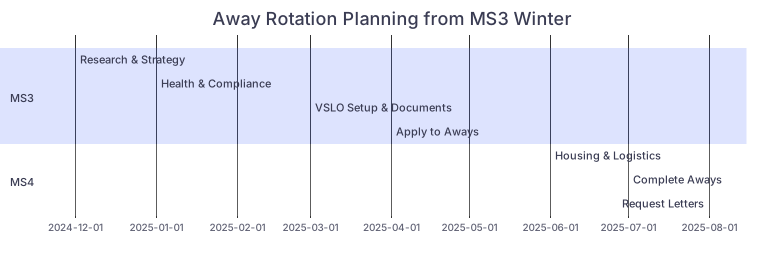
| Task | Details |
|---|---|
| MS3: Research & Strategy | a1, 2024-12, 3m |
| MS3: Health & Compliance | a2, 2025-01, 2m |
| MS3: VSLO Setup & Documents | a3, 2025-03, 2m |
| MS3: Apply to Aways | a4, 2025-04, 3m |
| MS4: Housing & Logistics | a5, 2025-06, 2m |
| MS4: Complete Aways | a6, 2025-07, 5m |
| MS4: Request Letters | a7, 2025-08, 4m |
Now we go granular.
MS3 Winter (December–February): Strategy, Data, and Prerequisites
At this point you should stop guessing and start building your away rotation strategy on actual constraints.
December (MS3)
At this point you should:
Clarify your specialty target
- Decide if you are:
- 90% sure about a single specialty (e.g., ortho, EM, derm)
- Truly split between two (e.g., IM vs anesthesia)
- Your away strategy is different:
- Highly competitive fields: 2–3 aways is common
- Less competitive or broad fields: 0–1 away may be enough or even optional
- Decide if you are:
Learn your home school’s rules
- Meet with:
- Your dean’s office / student affairs
- Specialty advisor or department coordinator (e.g., EM clerkship director)
- Ask directly:
- “How many away rotations can I do?”
- “Which blocks are reserved for required MS4 rotations?”
- “What is the earliest and latest I can schedule an away and still be OK for graduation?”
- “Do you require a home sub‑I before I go on an away?”
I have watched students get blocked from a prime August away because their school required a home sub‑I first and they never checked.
- Meet with:
Identify which months you want to be away
- In a competitive specialty that values aways:
- Ideal away months: July, August, September
- October can work but letters may be late for ERAS
- Sketch a rough MS4 calendar:
- 1 home sub‑I (in your chosen specialty or close)
- 1–3 aways (depending on specialty)
- Required rotations (ICU, EM, etc.)
- Time off for ERAS and interviews (usually late fall / winter)
- In a competitive specialty that values aways:
January (MS3)
At this point you should focus on prerequisites and paperwork.
Check Step 1/Step 2 / COMLEX requirements
- Many programs now:
- Do not care about Step 1 being pass/fail for scheduling
- But some require Step 1 passed or even Step 2 completed before an away
- Look explicitly at:
- “Eligibility criteria” on VSLO listings for your target departments
- If Step 2 is required before away: you must rethink your test date.
- Many programs now:
Start the health clearance checklist For aways, schools usually require:
- Immunization records:
- MMR, Varicella
- Hep B series + Hep B surface antibody titer
- Tdap
- TB screening:
- Quantiferon or PPD within the last 6–12 months
- Flu vaccine (for fall/winter rotations)
- COVID vaccine and possibly boosters
Action items for January:
- Request records from your school health service or previous providers.
- Schedule labs and TB testing now. Labs get lost. Titers come back low. You want time to fix that.
- Immunization records:
Read the actual VSLO/away policies for 5–10 target institutions
- Go to their:
- Medical education / visiting students page
- VSLO listing descriptions
- Note:
- Earliest application date
- Required documents (CV, step scores, immunizations, BLS/ACLS)
- Course codes and names
- Build a spreadsheet. Seriously. Columns:
- Institution
- Specialty / rotation name
- Blocks offered (Jul–Nov)
- Application open date
- Requirements
- Notes (e.g., “must upload transcript and CV,” “only 1 EM away allowed”)
- Go to their:
February (MS3)
At this point you should lock in foundational stuff so you are not scrambling in April.
Draft a clean CV
- 1–2 pages
- Sections:
- Education
- USMLE/COMLEX scores (if taken)
- Research
- Leadership / volunteering
- Honors / awards
- You will upload this to VSLO and sometimes email it to coordinators.
Finish health and compliance
- Get any missing:
- Titers
- TB testing
- Drug screen if your school requires it for away paperwork
- Upload everything to your school’s compliance system.
- Confirm with student health or registrar that your VSLO profile can pull this data (some schools require separate forms).
- Get any missing:
Talk to residents / recent grads in your specialty Questions to ask:
- “How many aways did you do and where?”
- “Any programs you think are not worth doing an away at?”
- “How early did you submit VSLO applications?”
- “Did you need a home sub‑I first, or was it OK to go cold?”
You want your strategy mostly decided by the end of February: target specialty, number of aways, rough months, 10–20 possible programs.
Early MS3 Spring (March–April): VSLO, Documents, and Early Submissions
This is where students who started late start panicking. You will not.
March (MS3)
At this point you should prep your application infrastructure.
Get VSLO activated
- Your school must:
- Authorize you for VSLO participation
- Add your basic info, including expected graduation date
- Your step:
- Log in and verify everything:
- Name, email
- Home institution info
- Graduation date
- Uploaded documents (transcript, CV, immunization form, BLS/ACLS if available)
- Log in and verify everything:
- Your school must:
Order an updated transcript
- Some programs require an:
- Official transcript uploaded directly by your school
- Make sure:
- Your core clerkship grades through at least part of MS3 are posted
- If grades are delayed, talk to your clerkship office; I have seen a missing grade delay a VSLO approval by 3–4 weeks.
- Some programs require an:
Draft a generic personal statement / short interest paragraph
- Some aways ask:
- “Why this institution?” or “Why this specialty?”
- Prepare:
- 1 short general paragraph (for generic forms)
- 1–2 slightly tailored versions for top-choice programs
- You will copy-paste this into online forms repeatedly.
- Some aways ask:
Refine your target list
- Based on:
- Competitiveness
- Geography
- Where you might realistically match
- Have tiers:
- Tier 1: Dream programs but realistic
- Tier 2: Solid programs where you would be happy and have a good shot
- Tier 3: Safety options in case aways are scarce
- Based on:
April (MS3)
This is usually when applications start to open. Timing varies.
At this point you should be ready to submit on day 1 for any competitive program.
Monitor exact application open dates
- Many programs post:
- “We begin accepting applications on April 1st” (or May 1st, etc.)
- For derm/ortho/ENT/NSGY/EM, spots can literally go within days.
- Many programs post:
Finalize documents You should have ready to upload:
- CV (PDF)
- Transcript (PDF, official if required)
- Immunization form + lab results
- BLS / ACLS card (if you have it; some require only BLS)
- Photo (some ask for it)
- Copy of USMLE/COMLEX score report
Submit early applications Strategy:
- Prioritize:
- July and August rotations
- Your highest-priority institutions
- Submit to more sites than you think you need:
- If you want 2 aways, applying to 8–12 programs is not excessive in competitive fields
- Watch for application fees and budget accordingly.
- Prioritize:
Tell your home specialty advisor where you applied
- Sometimes they:
- Know the rotation directors personally
- Can quietly vouch for you
- A simple: “I have applied to aways at X, Y, Z for July–September” can trigger helpful behind-the-scenes advocacy.
- Sometimes they:
Late MS3 Spring (May–June): Submitting, Waiting, and Adjusting
Now you are in the 2–3 month period where the majority of away applications go out and offers come back.
May (MS3)
At this point you should:
Finish any remaining applications
- Some programs do not open until:
- May or even June
- Continue:
- Checking program sites weekly
- Submitting within a week of openings
- Some programs do not open until:
Track statuses carefully
- Maintain a simple tracker:
- Program
- Block requested (e.g., July, Aug)
- Date applied
- Status: Submitted / Under review / Waitlisted / Accepted / Declined
- You will be juggling multiple offers and contingencies. Memory will fail you.
- Maintain a simple tracker:
Respond quickly to any communication
- Typical messages:
- “We can offer you September instead of August. Do you accept?”
- “We need an updated TB test”
- Same-day or next-day responses matter. Programs move on quickly.
- Typical messages:
Start outlining housing and logistics plan
- Decide your default approach:
- Short-term Airbnb?
- Rotating Rooms / Med student housing?
- Staying with friends / family?
- Some hospitals have:
- On-site or affiliated student housing that fills early
- Once you have a likely month at a site, you want to be ready to reserve housing within 1–2 weeks.
- Decide your default approach:
June (MS3)
At this point you should be locking in at least some of your away plans.
Accept and lock down at least one away
- Especially a July or August block if:
- Your specialty expects aways for matching
- Communicate clearly with other sites:
- Decline dates you cannot take
- Ask about alternative months if your prime month is taken
- Especially a July or August block if:
Coordinate with your home school for schedule approval
- Submit:
- Official away rotation request forms
- Confirm:
- You will receive credit
- The correct course number will show on your MS4 schedule
- You do not want an “unapproved” away that satisfies nothing for graduation.
- Submit:
Book housing for the earliest confirmed away
- Once an away is fully confirmed:
- Book refundable housing if possible
- Look at commute times and parking permits
- Ask:
- Housing office or past classmates about safe neighborhoods and common scams.
- Once an away is fully confirmed:
Clarify expectations with your specialty advisor
- Quick meeting:
- Review where you are going
- Confirm whether 1 vs 2 vs 3 aways looks appropriate
- Discuss if you need to pivot based on strength of offers (e.g., if no top-tier places invite you, think about realistic match strategy early).
- Quick meeting:

MS3 Summer (July–August): Finalizing Logistics and Preparing to Perform
By mid-summer MS3, you will be doing clinical work and planning MS4 simultaneously. This is where poor planners fall apart.
July (end of MS3 academic year)
At this point you should:
Have your first away fully confirmed
- Site, dates, contact info
- Housing reserved
- Onboarding instructions received
Complete site-specific onboarding Typical onboarding items:
- Online EMR training modules
- HIPAA modules
- Hospital badge forms
- Background check / drug screen (even if you had one through your home school)
Do not leave this to the last week. Some hospitals take 7–10 days just to process badges.
Clarify expectations for letters of recommendation
- Plan:
- Which away will likely give you a strong SLOE/type letter?
- Ask your advisor:
- “Which attendings at this site are known for writing good letters?”
- Go in knowing who to impress and how.
- Plan:
Prepare practically for the rotation
- Review:
- Common cases in that specialty
- The hospital’s preferred resources (e.g., EM uses Rosh, ortho uses certain fracture classification systems)
- Make sure you know:
- Dress code
- Daily start time
- Call schedule
- Review:
August (transitioning to MS4 year)
At this point you should be either starting or about to start your first away.
Double-check ERAS vs away timing
- ERAS opens for editing in June, submissions mid-September (varies by year)
- If your only away is in October, letters may arrive late.
- Make sure:
- At least one strong letter will be ready by ERAS submission.
Confirm any later away rotations
- September/October aways should be:
- Confirmed
- Housing at least tentatively planned
- If you do not have enough away offers:
- Email coordinators asking about:
- Cancellations
- Waitlist movement
- Later blocks (October/November)
- Email coordinators asking about:
- September/October aways should be:
Backup plan if aways fall through
- Talk with:
- Your home specialty department
- Options:
- Additional home sub‑I
- Research month
- Local “away-like” experience at affiliated community sites
- Talk with:
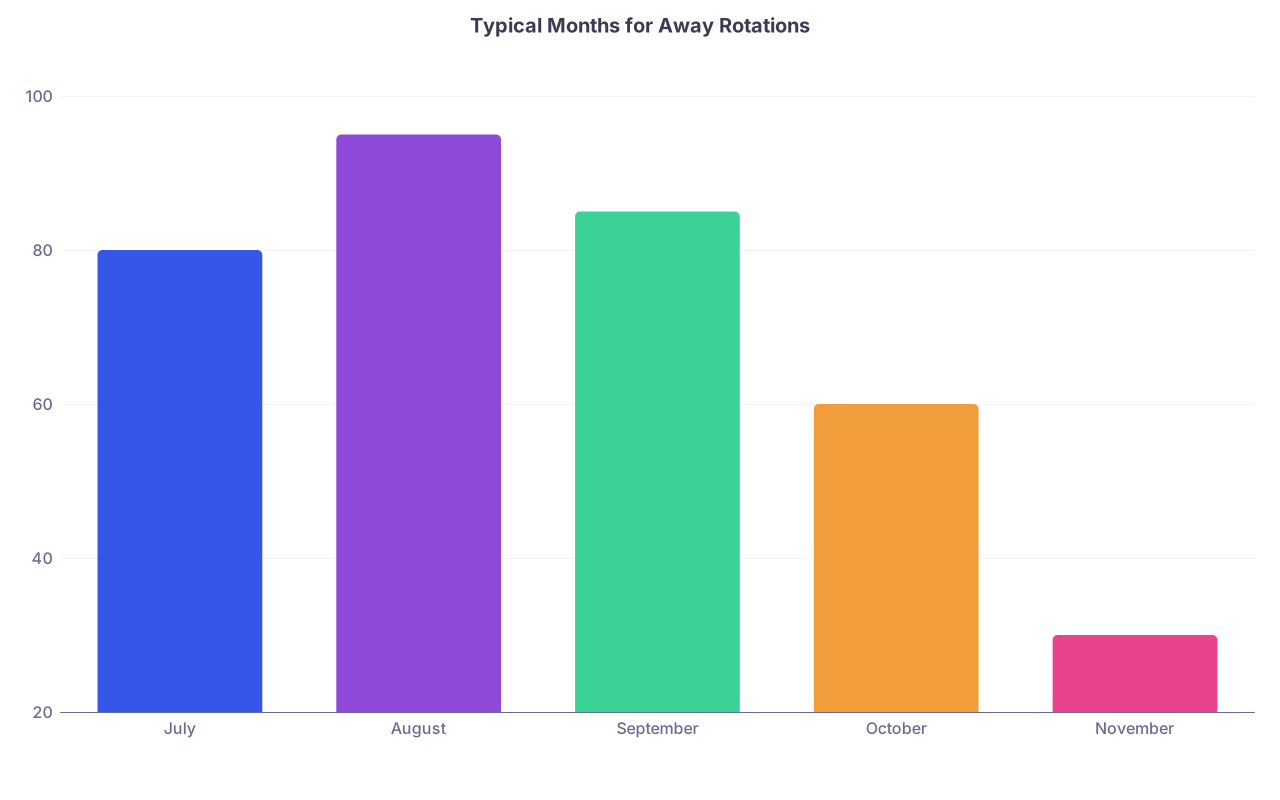
| Category | Value |
|---|---|
| July | 80 |
| August | 95 |
| September | 85 |
| October | 60 |
| November | 30 |
MS4 Early Year (July–November of MS4): Execution, Letters, Adjustments
Now you are on the away itself. Planning does not stop here; it just shifts to performance and letters.
During Each Away Rotation (4-week blocks)
At this point you should:
Clarify goals in week 1
- Ask your site director or key attending:
- “What do successful students do here?”
- “What makes a student stand out in a good way versus a bad way?”
- Let them know:
- You are strongly interested in the specialty
- You are considering them highly for residency (if true)
- Ask your site director or key attending:
Identify potential letter writers by week 2
- You want:
- Someone who has seen you work closely
- Someone who writes strong, detailed letters routinely
- Make it easy:
- Share your CV and a short “brag sheet” at the time you request the letter.
- You want:
Ask for letters before the last day
- Ideal: End of week 3 or beginning of week 4
- Script:
- “I have really appreciated working with you. I am applying in X and would be honored if you would feel comfortable writing a strong letter of recommendation for me.”
- Confirm:
- ERAS submission instructions
- Deadlines (early to mid‑September for most)
Document your performance
- Keep a quick log:
- Procedures you performed
- Presentations given
- Feedback you received
- This helps:
- Personal statement
- Future interviews
- Gentle reminders to letter writers of specific examples
- Keep a quick log:
After Each Away Rotation
At this point you should:
-
- Thank your:
- Letter writer
- Clerkship coordinator
- Key residents who helped you
- Attach:
- ERAS letter request form if not already submitted
- Thank your:
Verify that letters were uploaded
- Check ERAS:
- Status of letters as “received”
- If missing 3–4 weeks later:
- Send a short, polite reminder to the letter writer.
- Check ERAS:
Update your ERAS and rank list thinking
- Based on:
- How you liked the program
- How much interest they showed you
- Not every away site will end up on your final rank list. That is normal.
- Based on:

Micro-Timeline: Compressed Checklist from MS3 Winter Onward
If you want the high-yield “do not miss” list:
Dec–Jan (MS3 Winter)
- Decide specialty and rough away months
- Learn your school’s away limits and requirements
- Start immunizations, titers, TB testing
- Build a target program spreadsheet
Feb
- Finish health compliance
- Draft CV and generic interest blurb
- Talk with specialty advisor and residents
Mar
- Get VSLO access
- Upload transcript, CV, health forms
- Identify exact application open dates
Apr–May
- Submit applications to top programs within 1 week of opening
- Apply broadly enough to secure 1–3 aways
- Track all applications and respond quickly
Jun–Jul
- Confirm at least one July/August away
- Book housing and complete onboarding
- Coordinate with home school for credit and schedule approval
MS4 July–Nov
- Show up early, work hard, be teachable
- Identify and ask letter writers early
- Verify letters in ERAS well before you submit
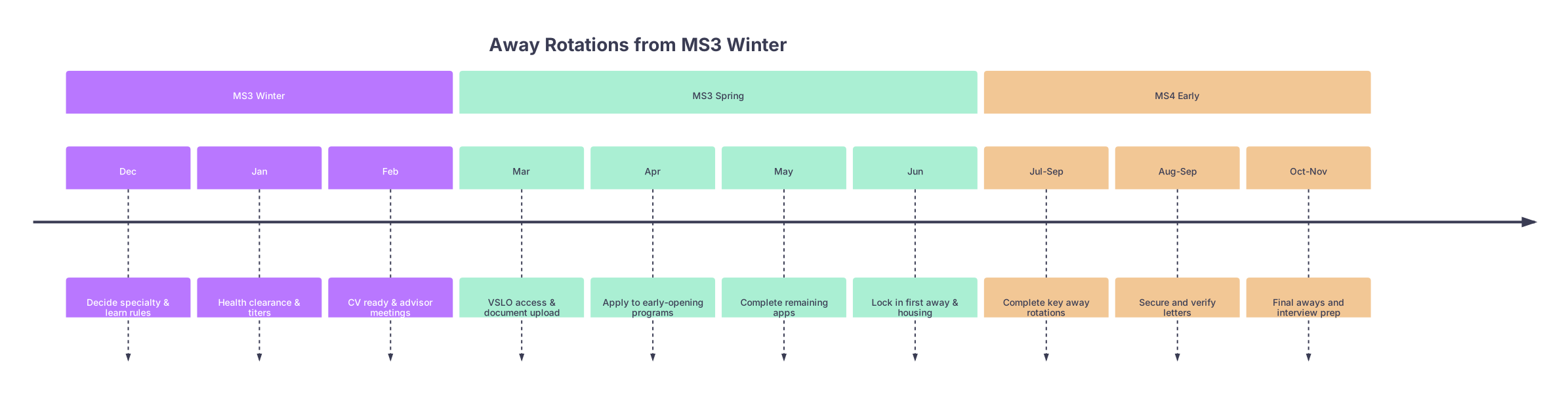
| Period | Event |
|---|---|
| MS3 Winter - Dec | Decide specialty & learn rules |
| MS3 Winter - Jan | Health clearance & titers |
| MS3 Winter - Feb | CV ready & advisor meetings |
| MS3 Spring - Mar | VSLO access & document upload |
| MS3 Spring - Apr | Apply to early-opening programs |
| MS3 Spring - May | Complete remaining apps |
| MS3 Spring - Jun | Lock in first away & housing |
| MS4 Early - Jul-Sep | Complete key away rotations |
| MS4 Early - Aug-Sep | Secure and verify letters |
| MS4 Early - Oct-Nov | Final aways and interview prep |
Boiled Down to Essentials
- Away rotations run on MS3 winter deadlines, not MS4 summer vibes. Start in December; be VSLO-ready by March.
- Health clearance, transcripts, and advisor sign-off are rate-limiting steps. Handle them early or you will watch ideal programs fill while your TB titer is “in process.”
- Apply early, apply broadly, and treat every away as a month-long audition for both a letter and a rankable residency spot.