
The residency application rumor mill is wrong about this one: yes, you can apply to both categorical and preliminary spots in one cycle—and many smart applicants should.
If you’re asking this question, you’re probably in one of three situations:
- You want a categorical position in a competitive specialty (like derm, radiology, anesthesia, ophtho) and need a prelim year.
- You’re not sure how competitive you really are and want both categorical IM/FM and prelim options as backup.
- You’ve heard mixed advice from advisors, residents, and Reddit, and you need someone to cut through the noise.
Here’s the answer, with no fluff.
Short Answer: Yes, You Can. The NRMP Allows It.
You absolutely can apply to both categorical and preliminary spots in the same Match cycle.
The NRMP and ERAS systems are built for this. The structure literally assumes:
- You might apply to a categorical position (e.g., Internal Medicine categorical).
- You might apply to a preliminary or transitional year position.
- You might then link those in your rank list or keep them separate.
And programs know this. Internal medicine PDs, surgery PDs, and TY programs see this pattern every year. It doesn’t raise eyebrows by default.
So the real question isn’t “Is it allowed?”
The real questions are:
- When does it help you?
- When can it hurt you?
- How do you structure your ERAS and rank list so you do not sabotage yourself?
Let’s walk through those.
Key Definitions: Categorical vs Preliminary vs TY
If you’re fuzzy on terminology, you’ll get confused fast.

Categorical Position
- Full training program from PGY-1 to completion.
- Example: Internal Medicine categorical (3 years), General Surgery categorical (5 years), Family Medicine categorical (3 years).
- You match once and, as long as you perform adequately, you finish the residency.
Preliminary Position
- Typically a 1-year position (PGY-1).
- Often in Internal Medicine or General Surgery.
- Standalone year, often used by:
- Applicants going into advanced specialties like Radiology, Anesthesiology, PM&R, Neurology (depending on program), Derm, Rad Onc.
- Applicants who didn’t match categorically and want a year to build their application.
- No guaranteed PGY-2 spot afterward.
Transitional Year (TY)
- Also a 1-year internship, but usually more cushy and mixed:
- Some IM, some electives, fewer hardcore surgery months.
- Popular among:
- Future radiologists, anesthesiologists, ophthalmologists, etc.
- People wanting a “less malignant” intern year (with caveats—some are still rough).
When It Makes Sense To Apply To Both
Here’s where applying to both categorical and prelim is not just OK—it’s smart.
1. You’re Applying to an Advanced Specialty (Anes, Rads, Derm, etc.)
If your primary goal is an advanced position (PGY-2 start), like:
- Anesthesiology
- Diagnostic Radiology
- Radiation Oncology
- Dermatology
- PM&R (often)
- Ophthalmology (via separate SF Match, but you still usually need an intern year)
- Neurology (many are categorical now, but some are advanced)
You usually need:
- An advanced spot (PGY-2+), and
- A PGY-1 year (prelim or TY).
In that situation:
- You apply to advanced programs in your specialty.
- You also apply to prelim IM, prelim surgery, and/or transitional year programs.
You might apply to some categorical IM/FM/Surg as an insurance policy if you’re worried about not matching into your advanced field at all. That’s common and allowed.
2. You Want IM or FM, But You’re Worried About Competitiveness
Example:
You’ve got:
- Step 2 = 220
- A couple of red flags (maybe a Step 1 fail, or failed a required clerkship then remediated)
- Mostly low-tier interviews
You can:
- Apply mainly to categorical IM or FM.
- Add some prelim IM or prelim surgery as a backup so you have something if categorical doesn’t work.
Then, if you match prelim only, you use that PGY-1 year to:
- Network
- Improve your application
- Re-apply to categorical spots next cycle
3. You’re Pivoting or Undecided
Some applicants hedge between:
- A more competitive specialty (e.g., anesthesia, rads)
- And a more available one (e.g., categorical IM/FM)
They’ll:
- Apply to advanced spots and prelim/TY.
- Also apply to categorical IM/FM so they still land in a full training program if the advanced dream doesn’t happen.
Does it make your season more complicated? Yes. But better than going unmatched.
How Programs View Applicants Who Apply to Both
Programs are not shocked if you apply to both categorical and preliminary positions. They see it constantly.
But there are some landmines.
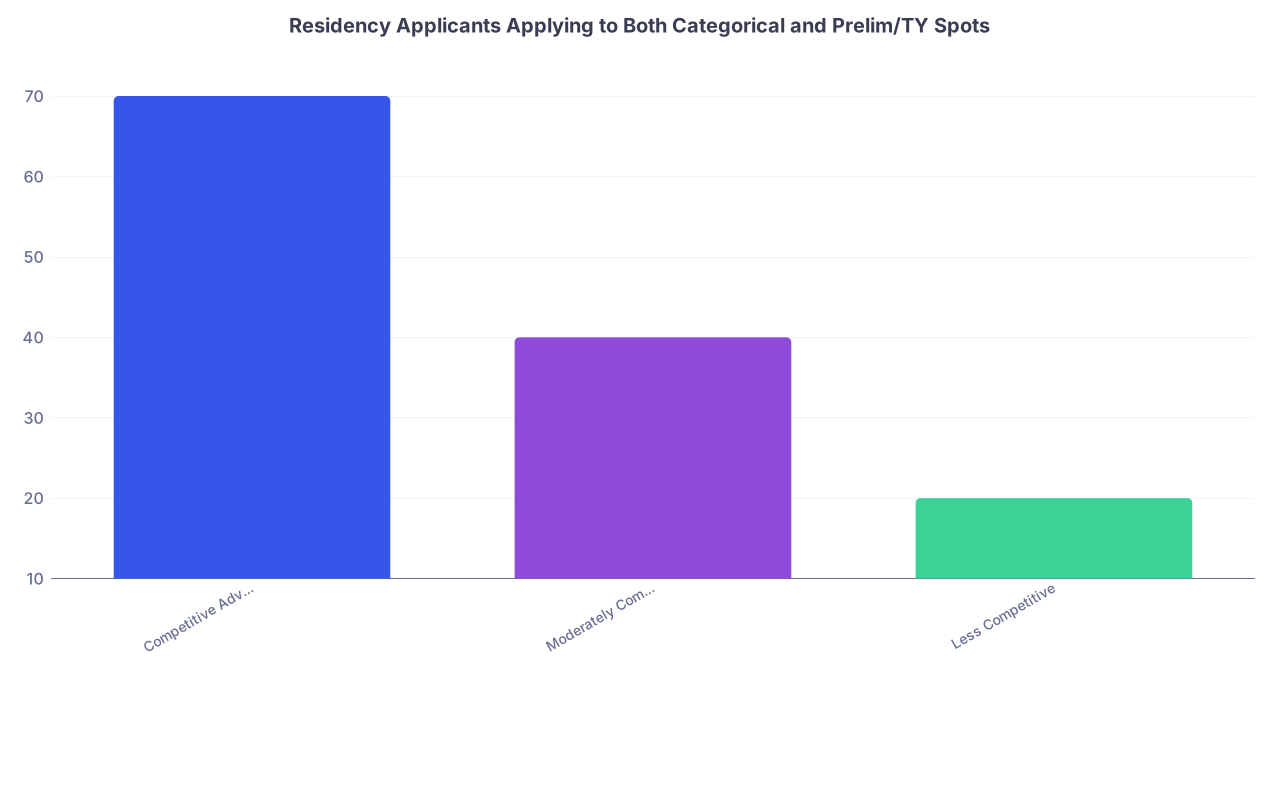
| Category | Value |
|---|---|
| Competitive Advanced | 70 |
| Moderately Competitive | 40 |
| Less Competitive | 20 |
Interpretation:
- Roughly: high proportion of advanced specialty applicants also apply to prelim/TY.
- Fewer IM/FM-only applicants do it, but it still happens.
What Categorical Programs Think
If you’re applying to categorical IM while also applying to prelim IM/TY, a few things matter:
Your personal statement and ERAS signals.
If your PS screams “I only want radiology” and you’re applying to categorical medicine, IM PDs notice. Many won’t rank you highly because they know you’ll bolt the second you get a spot elsewhere.Letters of recommendation.
If all your letters are from derm or rads talking about your future as a dermatologist, IM programs will assume they’re your Plan B.Your interview behavior.
If you treat categorical IM interviews like a backup and it shows, they’ll rank you accordingly. People can tell when you’re faking enthusiasm.
What Prelim/TY Programs Think
Prelim and TY PDs know they are often a stepping stone.
They mostly care about:
- Will you be reliable, hardworking intern material?
- Will you embarrass them? Cause drama? Fail?
- Will you show up and not disappear mid-year?
They are much less sensitive to “you’re using us as a year before rads/anes” — that’s their entire ecosystem.
So applying to both advanced + prelim/TY is not a red flag. It’s expected.
How To Structure Your ERAS If You Apply To Both
This is where people screw things up. You need a coherent strategy.

| Step | Description |
|---|---|
| Step 1 | Decide Primary Goal |
| Step 2 | Apply Advanced + Prelim/TY |
| Step 3 | Apply Categorical IM/FM |
| Step 4 | Customize PS for each type |
| Step 5 | Optionally Add Prelim Backup |
| Step 6 | Tailor LORs and Filters |
| Step 7 | Build Smart Rank List |
| Step 8 | Advanced Specialty? |
Personal Statements
You cannot use one generic PS for everything if you’re playing this dual game. That’s lazy and it shows.
Better approach:
- One PS for your advanced specialty (radiology, anesthesia, etc.)
- One PS for IM/FM categorical if you want them to see you as truly interested.
- One PS for prelim/TY that emphasizes:
- Your desire for strong clinical training.
- Being a solid intern.
- How this year fits into your long-term plan without trashing your categorical interests.
You assign different PS versions to different programs in ERAS. Use that feature.
Letters of Recommendation
Ideal setup if you’re applying advanced + prelim/TY + maybe categorical:
- 2–3 letters from your advanced specialty (at least 1 if small specialty like Derm).
- 1–2 letters from core specialties (IM, Surgery, or both).
Then:
- For advanced programs: use mostly advanced specialty letters + 1 core IM/Surg.
- For categorical IM/FM: use mostly IM/FM and core letters; you can include a specialty letter if it still makes you look like a good doc, not just a niche person.
- For prelim surgery: include at least one surgery letter if possible.
- For TY: balanced mix is fine. They want evidence you won’t crumble on basic wards.
The Rank List: Where People Really Get Burned
Applying to both is easy. Ranking them well is where people tank themselves.
Here’s the reality:
- You submit one rank order list for Categorical/Prelim and separate lists for advanced if needed.
- You can link prelim/TY programs to advanced programs in “supplemental rank lists.”
- You can rank categorical programs along with prelims if you’re okay with either outcome.
| Rank | Program Type | Example Entry |
|---|---|---|
| 1 | Advanced + Linked | Advanced Anes @ Big U + TY @ Community |
| 2 | Advanced + Linked | Advanced Anes @ Big U + Prelim IM @ VA |
| 3 | Categorical | Categorical IM @ State U |
| 4 | Categorical | Categorical IM @ Community Program |
| 5 | Prelim Only | Prelim IM @ County Hospital |
Key points:
- If you’d rather do categorical IM than be forced into some random prelim with no advanced spot, rank categorical IM above “prelim only” entries.
- If you’d rather secure an advanced spot even at a weaker place than do categorical IM, rank the linked advanced + prelim combos higher.
Be brutally honest with yourself about your preferences.
Situations Where Applying To Both Can Backfire
Let me be blunt: sometimes applying to both categorical and prelim is a sign of no clear plan. PDs can smell that.
Here’s where it can hurt you:
You look non-committal.
Your app says:- Personal statement: “I love surgery, I dream about the OR, the OR is my home.”
- But you’re applying to categorical IM, prelim surgery, prelim IM, TY, and psych.
That looks like flailing, not strategy.
You confuse your messaging.
If categorical IM PDs read an app that screams radiology, they may drop you down their list because they believe you’ll just leave.You over-apply and dilute quality.
If you’re blasting 120+ programs across three directions, you won’t customize anything well, and your interviews will feel thin and generic.You don’t think through your worst-case outcome.
Example:
You rank a bunch of prelim surgery spots low “just in case,” but you hate surgery and don’t want a brutal gen surg intern year.
Then you match into exactly that. One of the longest years of your life, by your own doing.
Practical Recommendations by Scenario
Let me give you a few concrete templates.
Scenario 1: Applying to Anesthesiology (Advanced) + Backup IM
You should:
- Apply to:
- Advanced Anesthesia spots.
- Transitional Year and Prelim IM programs.
- A limited number of categorical IM programs you’d actually attend.
- PS:
- One for anesthesia.
- One for IM categorical.
- One for TY/prelim.
- Rank:
- Top: Anesthesia + preferred TY/Prelim combos.
- Middle: Categorical IM you truly like.
- Bottom: Standalone prelims you can tolerate.
Scenario 2: Applying Categorical IM with Prelim Backup Only
You:
- Apply broadly to categorical IM.
- Add select prelim IM or prelim surgery in locations you’d be okay spending a year.
- Use IM-focused PS for all IM programs, prelim or categorical.
- Rank:
- All categorical IM first (in your true preference order).
- Then prelim-only positions lower as a last resort.
Scenario 3: You’re Not Competitive For Your Dream Specialty
Say you want radiology but your metrics scream “long shot.”
Your choices:
- Go “all in” on rads + prelim/TY, accept the risk of SOAP/unmatched.
- Or run a dual strategy:
- Advanced rads + prelim/TY.
- Plus a real, well-presented application to categorical IM/FM where you genuinely commit in those materials.
What you must not do:
Half-hearted IM/FM app where every line says “I actually want rads, but I’ll tolerate your program.”
Red Flags and Reality Checks
A few hard truths:
- If your advisor says: “Your dream specialty is very unlikely,” applying to both categorical and prelim might be essential, not optional.
- If you are unwilling to do anything other than that one specialty, then be honest with yourself: backups may not make sense, and applying to categorical IM/FM is misleading.
- Program directors are not dumb. They read between the lines of your app. Your goal is not to “trick” them but to present a coherent story that matches your actual risk tolerance.
FAQ: Can I Apply to Both Categorical and Preliminary Spots?
1. Will applying to both categorical and prelim hurt me with categorical programs?
It can, if your application screams you are only using them as a backup. If your IM or FM personal statement is clearly secondary to another specialty, or all your letters are in a different field, some categorical PDs will rank you lower. If you want categorical as a real option, you must present as someone who would genuinely show up and stay.
2. Do I need separate personal statements for categorical vs preliminary?
You really should. Use:
- One PS for your main specialty (if advanced).
- One PS for categorical programs you’d truly attend.
- One PS for prelim/TY focusing on your desire to develop strong clinical fundamentals and be a reliable intern. ERAS lets you assign different PS to different programs. Use that feature.
3. How many prelim or TY programs should I apply to?
If you’re going into an advanced field, most people apply to at least 15–25 prelim/TY spots, sometimes more if they’re risk-averse or have geographic limitations. If prelim is purely a last-ditch backup to categorical IM/FM, you might apply to fewer (5–15), mainly in cities or regions where you’d realistically live for a year. The number depends heavily on your competitiveness and flexibility.
4. Can I match a prelim spot without an advanced or categorical spot?
Yes, and it happens every year. You can end up with:
- Only a prelim IM or prelim surgery spot.
- No advanced position lined up for PGY-2. You’d then need to reapply during or after your prelim year for a categorical or advanced position. That’s why rank list strategy matters: if you’d rather have categorical IM than a random prelim year, rank categorical IM higher than prelim-only options.
5. Do programs see all the other positions I applied to?
Programs don’t see your entire ERAS list of applications. They see what you send to them: your personal statement, letters, and common ERAS content. But they don’t get a master list saying “this person also applied to 30 derm programs and 25 prelims.” Where they figure things out is from your materials and what you say on interview day. That’s where coherence—or lack of it—shows.
Bottom line:
You can apply to both categorical and preliminary spots in one cycle. Many applicants should. The key is to (1) be honest about your priorities, (2) align your personal statements and letters with each track, and (3) build a rank list that reflects what you can actually live with, not just what looks impressive on paper.