
The honest answer: most applicants do not rank enough programs to be truly “safe.”
You’re probably underestimating how many programs you need.
Let me give you actual numbers, not vibes.
The Core Answer: How Many Programs Is “Safe”?
Here’s the blunt framework:
- Below a certain number of ranks, you are objectively unsafe
- Beyond a certain number, you hit diminishing returns
- What’s “safe” depends heavily on specialty competitiveness and how strong you are
Use this as a realistic baseline for U.S. MD seniors applying in a single specialty:
| Specialty Type | Competitive Examples | Safer Rank Range (MD Seniors) |
|---|---|---|
| Ultra-competitive | Derm, Plastics, Ortho, ENT, Neurosurg | 18–25+ |
| Competitive | EM (recently volatile), Anes, Rad, Urology | 15–20+ |
| Mid-range | IM (university heavy), Gen Surg, OB/GYN | 12–18+ |
| Less competitive | FM, Peds, Psych, Neuro | 10–14+ |
| SOAP-risk profiles | Red flags, low scores, IMGs | 20–30+ (if possible) |
Now adjust those numbers up significantly if:
- You’re a DO or IMG
- You have major red flags (failures, leaves, big gaps)
- You’re switching specialties
- You applied mostly to reach programs
For DO seniors, I usually tell people: take the MD numbers above and add 5–10 programs.
For IMGs (US or non-US): often you need 25–40+ ranks in many fields to feel anything close to “safe.”
One more harsh truth: nobody is truly safe. But you can get into the “I’d be shocked not to match” territory. That’s what we’re aiming for.
What the NRMP Data Actually Shows (Not My Opinion)
Let’s anchor this in numbers, not folklore from the workroom.
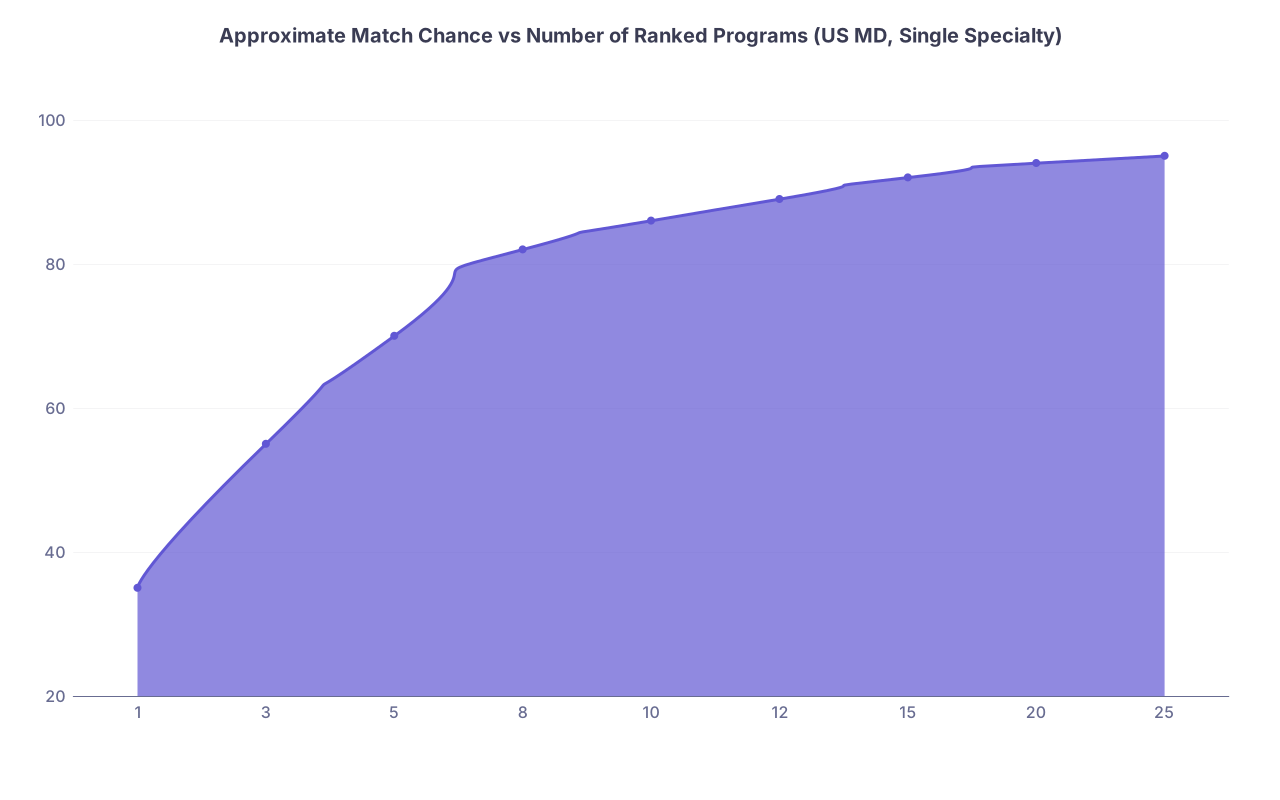
The National Resident Matching Program (NRMP) publishes data on match probability vs. number of ranked programs. The pattern is the same every year:
- The first 5–7 programs you rank give a big jump in match chances
- By 10–12 programs, your odds improve substantially
- After about 20–25 programs, the curve flattens; you still gain something, but not huge
For U.S. MD seniors overall:
- Ranking ≤5 programs is dangerous in almost every specialty
- Ranking 10–12 puts you in a decent zone for many non-ultra-competitive fields
- Ranking 15–20 is where most people with reasonable applications start to feel “safe-ish”
| Category | Value |
|---|---|
| 1 | 35 |
| 3 | 55 |
| 5 | 70 |
| 8 | 82 |
| 10 | 86 |
| 12 | 89 |
| 15 | 92 |
| 20 | 94 |
| 25 | 95 |
Are these exact for every specialty? No. But the shape holds: fast gains early, slow gains later.
Where people screw this up is thinking:
“I interviewed at 10 places; I liked 6; I’ll just rank those. I don’t want to end up somewhere I don’t love.”
Translation: “I’m OK with a real risk of not matching.”
Step 1: Define What “Safe” Means For You
You cannot answer “how many is enough” until you decide what risk you’re willing to tolerate.
Most applicants secretly fall into one of these three buckets:
- Risk-averse – “I’d rather match somewhere I’m lukewarm about than SOAP or reapply.”
- Moderate – “I want to be realistic but I don’t want to chain myself to a place I’ll hate.”
- Aggressive – “I’d rather take a swing, aim higher, and accept real risk of not matching.”
Be explicit with yourself. Because the advice changes:
- Risk-averse → push toward the upper end of the ranges I gave
- Moderate → middle of the ranges
- Aggressive → you may live in the lower end, but do not dip into “statistically dumb” territory (like ranking 5 programs in general surgery as an average applicant)
If you’re reading an article about “how many programs to feel safe,” odds are you are not the aggressive-reapplicant type. So err on the side of more.
A Simple Framework: The 3-Layer Rank List
Instead of obsessing over one magic number, think in layers:
- Dream programs (reach) – maybe 20–30% of your list
- Realistic fits (sweet spot) – about 40–60%
- Safety-ish options – 20–30% you’d still be willing to attend
If your list is all dream and “top choice or bust,” that’s how people end up unmatched with 8–10 interviews in hand.
Here’s how this might look for different applicants:
Mid-range IM applicant (US MD, no red flags) with 14 interviews
- Rank all 14
- 4–5 are academic reaches
- 6–7 are realistic mid-tier
- 2–3 are community or lower-tier you’d still attend
Competitive surgical applicant (Ortho, US MD, average board scores) with 18 interviews
- Rank all 18
- Maybe 6–7 reach
- 7–8 realistic
- 3–5 places you’d be fine with but not thrilled
The mistake I’ve watched live: people chop their “safety” tier because “I can’t see myself there.” Then March hits. Suddenly, any ACGME-accredited program looks gorgeous compared to SOAP.
Specialty-Specific Reality Checks
Let’s be more concrete. These are ballpark targets, assuming:
- Single specialty
- You actually interviewed at these places
- You don’t have catastrophic red flags
Ultra-Competitive (Derm, Plastics, Ortho, ENT, Neurosurgery)
If you’re asking “How many to feel safe?” in these fields, the truth is: safety doesn’t exist; only risk management.
General guidance:
- Aim to rank 18–25+ programs
- If you have <10 interviews → extremely high risk no matter what
- Mix in programs across tiers and geographies, not 15 versions of the same top-20 academic shop
For IMGs in these fields: even 20–25 ranks does not equal safe. You’re playing a long-odds game.
Competitive but Not Insane (Radiology, Anesthesia, EM, Urology)
Here I like:
- 15–20+ ranked programs if possible
- If you’re US MD with 12+ solid interviews and no red flags, you can sleep reasonably well
- EM is volatile lately; I’d sit closer to 18–20 than 12, especially if your SLOEs aren’t glowing
Mid-Range (IM, Gen Surg, OB/GYN)
For US MDs:
- 12–18 ranks is a realistic “I should match” zone
- 10 is the bare minimum I’m comfortable with
- If you’re aiming heavy on university programs and your stats are mediocre, push toward 15–18+
For DOs/IMGs:
- Try for 18–25+
- And accept that geography dreams may need to soften
Less Competitive (FM, Peds, Psych, Neurology)
For US MDs with no big red flags:
- 10–14 programs is usually enough to feel pretty good
- But I still tell anxious FM applicants: if you have 15+ interviews, just rank them all. Why not?
For DOs and IMGs:
- 15–25 is more comfortable, especially in crowded metro areas
What If I’m Applying to Two Specialties?
This is where people get sloppy and lose their “safety cushion.”
You need to think of each specialty separately:
- If you’d genuinely be OK matching either, then treat both as “real” paths
- You still need a safe-ish number of ranks in each, not 3 in one and 7 in the other
A decent pattern:
- Primary specialty: aim for the middle–upper end of the recommended range
- Backup specialty: you still want 8–12+ ranks if you actually want to match there
Do not count “total number of programs” across both specialties and feel reassured. The Match algorithm doesn’t care that you ranked 18 programs if 12 of them are in a field where you’re a long shot.
How to Use Your Interview Count (Not Misuse It)
Important: you cannot rank more programs than you interviewed at. So your interview count sets your ceiling.
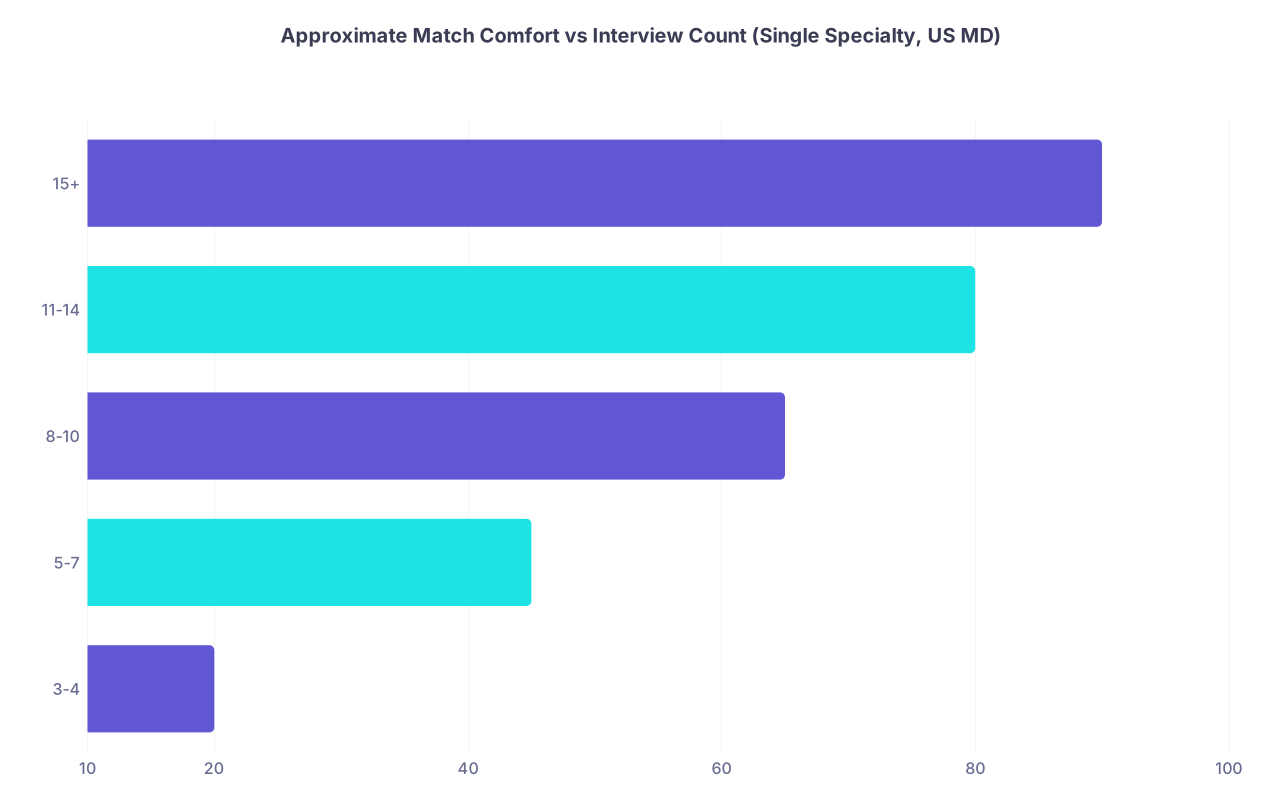
Rough rule for a single specialty, US MD:
- 3–4 interviews → extremely high risk, rank all, consider backup/SOAP planning
- 5–7 → you’re in coin-flip territory; rank all, expand if possible
- 8–10 → survivable but not “safe”; rank all and don’t get picky
- 11–14 → reasonably comfortable in many non-ultra-competitive specialties
- 15+ → if you’re ranking all, your odds are very good in most fields
For DO/IMGs, shift that whole scale upward. 8–10 interviews as an IMG in IM does not feel like 8–10 as a US MD.
Here’s how this looks visually:
| Category | Value |
|---|---|
| 3-4 | 20 |
| 5-7 | 45 |
| 8-10 | 65 |
| 11-14 | 80 |
| 15+ | 90 |
And again: rank every single program you’d be willing to attend. Leaving an interview off your list is essentially telling the algorithm, “I’d rather go unmatched than go there.” Make sure you actually mean that.
The Geography Trap
People quietly torpedo their match chances over geography. I’ve heard all of these verbatim:
- “I only want to be in California or New York.”
- “My partner insists we stay within 2 hours of her job.”
- “I can’t do winters.”
You can absolutely prioritize geography. But then you must accept:
You are choosing higher risk of not matching.
If you’re trying to feel “safe,” do this:
- Choose a primary region you prefer
- Add secondary regions where you’d be fine but not thrilled
- Add at least a few places that are geographically less ideal but programmatically solid
If your entire rank list is 8 programs in one major metro area in one competitive specialty… you’re not trying to be safe. You’re rolling dice.
When Should You Not Rank a Program?
There’s only one good reason:
You would genuinely prefer to go unmatched and SOAP (or reapply) than train there.
Not “I didn’t vibe with the residents.”
Not “The city seemed boring.”
Not “They work too hard.” (Most do.)
Good reasons to leave a place off:
- Serious concerns about abusive culture or mistreatment
- Program is obviously unstable (mass exodus of faculty, on probation, major gossip from current residents)
- Personal situation that would make living there untenable (safety, immigration, family issues)
Everything else? Rank it. Maybe low. But rank it.
I’ve sat with unmatched applicants who “couldn’t see themselves” at a program they left off. Every single one later said: “I should have ranked it.”
Quick Sanity Checklist
Ask yourself these questions before you certify your list:
- Am I ranking every program I’d be willing to attend, even if it’s not exciting?
- Do I have at least 10–12 ranks if I’m in a non-ultra-competitive field as a US MD?
- If I’m DO/IMG or in a competitive field, am I closer to 15–25+ programs?
- Did I avoid the “all reach programs” trap? Is at least 40–60% of my list realistic fits?
- Did I consciously decide how much geographic risk I’m taking?
If you’re answering “no” to several of these, then you already know: your list is not as safe as you want it to be.
Bottom Line: The Real Answer You’re Looking For
- Most U.S. MD seniors should aim to rank around 12–20 programs, depending on specialty and risk tolerance; DOs/IMGs and competitive fields should push into the 18–25+ range when possible.
- “Feeling safe” is less about one magic number and more about having a balanced list (reaches, realistic programs, and some less-prestigious but acceptable options) and not chopping programs for trivial reasons.
- You should rank every single program you’d be willing to attend; leaving a place off is the same as saying “I’d rather go unmatched than go there.” Make sure that’s truly how you feel before you hit certify.