
The idea that you must either take Step 2 CK early and risky or late and “safe” is false — and dangerous.
Here’s the real answer: for most applicants, the best Step 2 CK timing is as early as you can take it and still be highly likely to hit your target score. Taking it too early and bombing is worse than taking it a bit late with a strong score. But taking it so late that programs never see it can quietly kill your application in competitive specialties.
Let’s break it down like someone who’s actually watched people match — and not match.
The Core Question: Early With Risk vs Late With Certainty
You’re not deciding “early vs late.” You’re deciding among three real-world scenarios:
- Early, underprepared → higher risk of underperforming
- Reasonably early, adequately prepared → programs see score for most of application season
- Very late, ultra-prepared → great score, but many programs never see it when they screen
So which is better?
Here’s the framework I actually use with students:
If your NBME/UWorld self-assessments are already at or above your target range, and you can keep that trajectory with 2–4 more weeks →
Take Step 2 CK early enough that scores return before Sept 15.If your practice scores are significantly below what you need (10+ points), and you’re 4–6 weeks out from your planned date →
Delay. A “safe” later high score is much better than a written-in-stone low one.If you have a weak/average Step 1 or pass only and you’re going for a competitive specialty →
You don’t have the luxury of very late. You probably need a strong Step 2 CK visible by the time programs start reviewing apps (Sept–Oct).
So the answer isn’t “early or late.” It’s: How early can you take it while still being very confident you’ll hit your realistic target?
How Programs Actually Use Step 2 CK
Forget the mythology. Here’s how PDs and selection committees actually behave.
| Situation | Typical Program Behavior |
|---|---|
| Strong Step 1 + No Step 2 yet | Usually okay, especially less competitive specialties |
| Weak Step 1 + No Step 2 yet | Often pushed to bottom, or screened out |
| Strong Step 2 after weak Step 1 | Seen as major positive, shows improvement |
| Step 2 very late (Nov–Jan) | Might not factor into interview offers |
| Marginal Step 2 score | Can quietly limit interview invites |
Short version:
Competitive specialties (derm, ortho, plastics, ENT, neurosurg, some gas and EM):
Step 2 CK is a major screening tool. Programs want to see it early.Less competitive fields (FM, psych, peds, IM at community programs):
Timing is a bit more forgiving, but a bad score still hurts.If your Step 1 is pass only or weak:
Programs lean heavily on Step 2 CK to decide whether you’re capable.
No Step 2 score at the time of screening = big red flag in many places.
So: late with “certainty” only works if you can afford for many programs to not see your score until after interviews start. A lot of you can’t.
Real Timeline: When “Early” and “Late” Actually Are
Let me be concrete, because vague advice is useless.
Step 2 CK scores usually come back in about 2–3 weeks.
Match timeline sanity check:
- ERAS opens for applicants: usually June
- ERAS submission + programs start seeing apps: mid-September
- Interviews: October–January
- Rank list due: late February
So:
“Early enough to matter for screening” = Score available by mid-September
→ Test date roughly late August or earlier“Still somewhat useful” = Score available by mid-October
→ Test date roughly late September“Probably too late to help you get more interviews” = Score after November
→ Test date mid–late October or later
Here’s what that looks like graphically.
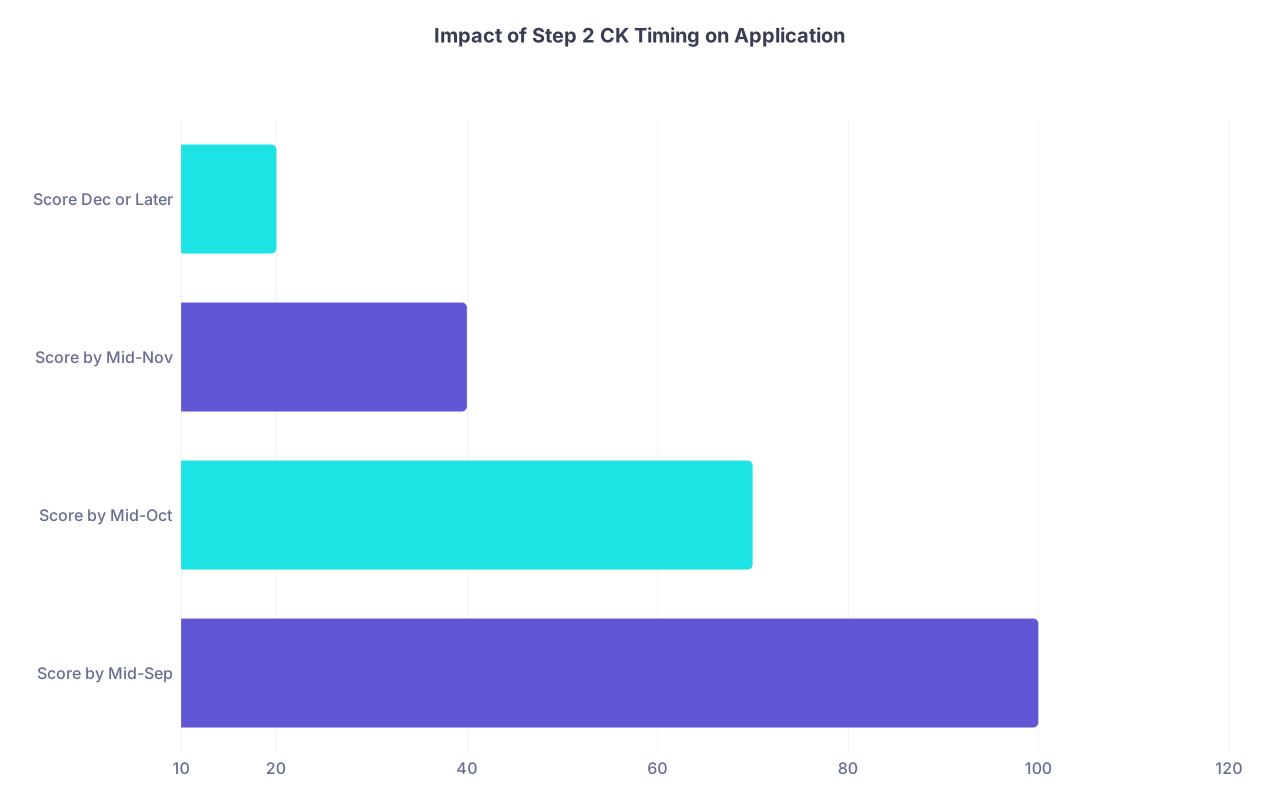
| Category | Value |
|---|---|
| Score by Mid-Sep | 100 |
| Score by Mid-Oct | 70 |
| Score by Mid-Nov | 40 |
| Score Dec or Later | 20 |
Think of those numbers as “percent of programs likely to consider your Step 2 score in their initial interview decisions.” Not exact, but directionally right.
So ask yourself: can you honestly afford for 60–80% of programs to not see your Step 2 CK when they’re deciding who to interview?
If you’re aiming high or trying to compensate for a weak Step 1 — probably not.
How to Decide: A Simple Decision Framework
Let’s cut through the noise. Use this 4-step decision process.
1. Look at your practice scores honestly
Don’t guess based on vibes. Use data:
- Recent NBME/Self-Assessments (preferably 2+ in last 3–4 weeks)
- UWSA 1/2
- Last 1–2 weeks of UWorld performance (if you’ve done a majority of the bank)
Rule of thumb:
- If 2+ recent assessments are within 5–7 points of your target, and trending stable or up → you’re in the “reasonable early” zone.
- If you’re >10 points below what you need or all over the place → rushing is asking for trouble.
2. Define your target score based on reality, not ego
Don’t say “I want 260” because Reddit. Ask:
What’s my Step 1?
- Strong (top quartile or clearly above class mean)
- Average
- Weak/pass only
What specialty and tier of programs am I genuinely targeting?
For example:
- Going for community IM with average Step 1? Realistic target may be 235–245+
- Aiming for ortho/derm/anesthesia at strong academics with average Step 1? You probably want 250+, and every extra point counts
- Weak Step 1 → Step 2 is your redemption. You want clearly above specialty norms, not just “good enough”
3. Check your calendar against application timing
Ask yourself:
- If I test on Date X, will my score be back by mid-September? By mid-October?
- How many weeks of truly focused study do I have left? Not fantasy weeks. Real ones.
If you need 3–4 more weeks to realistically move your practice scores 10+ points, and you’re already in mid-August heading into a competitive specialty → you have a real tradeoff. You might have to choose between:
- A slightly lower, but available early score
- A probably higher score that most programs won’t see for screening
There’s no one-size answer here. But if your current practice range is catastrophic for your goals (e.g., aiming for derm with practice 225s), a later higher score is the only rational choice.
4. Factor in your Step 1 and specialty
Here’s the blunt hierarchy:
Weak Step 1 + competitive specialty
- You must have Step 2 in time for screening.
- If that means you need to delay applications a cycle to get a strong Step 2, that’s better than rushing, underperforming, and sinking two cycles.
Weak Step 1 + less competitive specialty
- A strong but slightly later Step 2 can still bail you out.
- But December scores are pushing it.
Strong Step 1 + competitive specialty
- You have a bit more timing flexibility.
- But a clearly weak Step 2 will still hurt you badly.
Strong Step 1 + non-competitive specialty
- You have the most freedom.
- Here, “later with certainty” is usually fine, as long as you don’t take it so late you fail and can’t retake before rank lists.
Concrete Scenarios (These Actually Happen)
Let’s make this real.
Scenario 1: The panicked June tester
- Step 1: Just passed, borderline
- Specialty: EM or anesthesia
- Current NBMEs: 215–220 in June
- Planned test date: Early July, “so programs see I’m done”
This is bad. This person is about to lock in a low Step 2, destroying their ability to use it as a recovery from Step 1.
What they should do:
Push test date 4–6 weeks, grind targeted weaknesses, aim for 230s+, and schedule so score posts before or shortly after ERAS submission. Late August test is way smarter than early July flop.
Scenario 2: The “I’ll just crush it in October” optimist
- Step 1: Pass, but low or unknown
- Specialty: Ortho
- No Step 2 date scheduled, busy on aways June–September
- Plan: Take Step 2 in late October “when life calms down”
This is fantasy. Most ortho programs will already have sent the bulk of their interview invites by the time that score appears.
What they should do:
- Either prioritize Step 2 earlier (July/August, even if it means limiting aways)
- Or accept that this cycle is probably not viable and plan to apply next year with a strong early Step 2
Scenario 3: The strong tester debating risk
- Step 1: Strong
- Specialty: IM or peds
- Practice Step 2 scores: 245–252 range
- Current date: Early July, considering July vs late August
This person is in a good spot. If they feel reasonably steady and not burned out, taking it in July is a solid “early with low risk” move. If they feel shaky or exhausted, pushing to early August is fine.
Here, “late with certainty” doesn’t mean November. It means “a few more weeks to convert 245 practice into a stable ~250 score,” still in time for ERAS.
Hard Truths About “Certainty”
Everyone loves the idea of “late with certainty.” It’s comforting. It’s also mostly a myth.
There is no such thing as certainty on Step 2 CK. What you actually control is probability:
- Your practice exams give you a score range, not a guarantee
- Testing later might shift the whole range upward, but it also introduces risk:
- Fatigue
- Unexpected life events
- Clinical responsibilities ramping up
- Burnout from dragging out prep
So you’re not choosing between:
- Early + 50% chance of disaster
- Late + 100% chance of success
You’re choosing between different probability distributions and different application visibility windows.
That’s why the best answer is almost always:
Take Step 2 CK as early as you can get your practice scores into the range you’d be proud to submit — and early enough that programs will actually see it when it matters.
Not earlier than that. And not months later “just to feel more ready.”
Visual: Reasonable Step 2 CK Timing Strategy
Here’s the rough flow I’d use if I were you:

| Step | Description |
|---|---|
| Step 1 | Check latest practice scores |
| Step 2 | Delay test 3-4 weeks, focused prep |
| Step 3 | Test on earliest reasonable date |
| Step 4 | Strongly consider earlier date, adjust schedule |
| Step 5 | Test slightly later but avoid Nov+ dates |
| Step 6 | Within 5-7 points of realistic target? |
| Step 7 | Score back by mid-Sep if I test? |
| Step 8 | Competitive specialty or weak Step 1? |
FAQs: Step 2 CK Timing (7 Key Questions)
1. If my Step 1 is pass only, is it better to rush Step 2 CK early so programs see something?
No. A rushed low Step 2 is worse than no Step 2. Programs will interpret a weak score as current capability, not “just rushed.” You need a score that clearly reassures them. That usually means pushing the exam enough to get practice scores into a strong range, while still trying (if possible) to have it reported by early fall.
2. Will programs wait for my Step 2 score if I indicate on ERAS that I plan to take it?
Some will. Many won’t. For competitive specialties and big-name academic programs, they’re not sitting around saving spots for people who might eventually send a good Step 2. They filter with what’s in front of them in September–October. “Planned” or “pending” is not nearly as powerful as a real strong score.
3. Is it ever smart to take Step 2 CK after submitting ERAS?
Yes. If you truly need more time to lift your score into a respectable range, testing in late September or early October can still help, especially for less competitive fields or for programs that review applications more slowly. But don’t kid yourself: a November or December score won’t rescue an app that was weak when they did their first pass.
4. What if my practice scores are low and I don’t have time to both do aways and study enough?
Then you’re in the classic trap. If your specialty is extremely competitive, the honest answer might be: this is not your year. Focus on doing very well clinically, then take Step 2 in a way that maximizes your chance of a strong score, and apply next cycle. Burning a cycle with a mediocre score and weak application is worse than waiting and applying once with a strong one.
5. How many practice tests should I have before I feel “safe” to schedule early?
At least 2–3 recent self-assessments (NBMEs and/or UWSA) within a few weeks of your test date, showing:
- Scores clustered in a narrow range, and
- That range is within ~5–7 points of your realistic target.
If your scores are jumping from 225 to 245 to 230, that’s a sign you’re not stable yet.
6. Does a very strong Step 1 let me take Step 2 very late without concern?
It gives you more breathing room, but it’s not a free pass. A clearly low Step 2 after a high Step 1 can still raise red flags. And some specialties have quietly shifted to caring a lot about Step 2 regardless. I’d still aim for score visibility by mid-October at the latest, unless you truly don’t need Step 2 for your specialty/program tier.
7. If I already took Step 2 CK late and got a great score, will programs reconsider me for interviews?
Sometimes. A few will send additional invites later in the season based on updated data. Some might shift you from “rejected” to “waitlist” for an interview. But many have limited spots and don’t reopen the pool once they’ve filled. A late great score helps more for:
- Avoiding getting ranked low after interview
- Strengthening your file for SOAP or next cycle
But it’s not a guaranteed interview-generator in November or December.
Open your calendar and your latest NBME scores right now. Ask one direct question: What’s the earliest date I can test and still be highly likely to hit a score I’d be willing to live with for the rest of my career — and will that score be visible to programs when they’re actually choosing who to interview? That answer should drive your Step 2 CK timing, not fear or wishful thinking.