
The biggest mistake couples make in the Match is pretending it’s just “two normal ERAS cycles happening at once.” It’s not. It’s a logistics problem, a strategy problem, and a relationship stress test—on a countdown clock.
You do not wing a Couples Match. You run it off a calendar.
Below is a step-by-step planning calendar—from 12 months before ERAS opens through Rank List Certification—designed specifically for couples coordinating two residency applications. I’ll walk you month by month, then zoom into key weeks when timing gets brutal (interview offers, scheduling, rank list crunch).
12–9 Months Before ERAS Opens: Foundation Phase
Timeframe: September–December MS3 (or PGY-1 if reapplying)
At this point you should stop thinking “What do I want?” and start thinking “What can we realistically match into together?”
12 Months Out (Early Fall)
Your job now is alignment, not details.
By the end of this month, you two should:
- Decide if you’re definitely Couples Matching
- Not “maybe,” not “we’ll see.” Decide.
- Clarify non‑negotiables:
- Must live together vs okay with temporary long distance
- Geographic hard nos (e.g., “I will not live in the rural South”)
- Minimum program quality (community vs large academic vs “anything that will take us”)
- Get baseline competitiveness on paper:
- Step/COMLEX scores
- Class rank or quartile
- Honors/HP/P on cores, especially in target specialties
- Research, leadership, special circumstances
Have a blunt conversation:
- “If we weren’t together, what tier of programs would I target?”
- “Given our scores, where can our Venn diagram overlap and still be realistic?”
You’re not picking programs yet. You’re defining the sandbox.
11 Months Out
Now you start mapping scenarios.
Create a shared spreadsheet (Google Sheets, Notion, whatever) with tabs for:
- Potential cities/regions (Northeast, Midwest, West Coast, etc.)
- Programs for each of you in those areas
- Rough competitiveness tiers (Reach / Target / Safer)
Start with regions, not individual programs.
By the end of this month, you should:
- List 5–8 metro areas or regions where:
- Both specialties have at least 3–4 programs each
- You’d both actually live there without resentment
- Rank those areas together:
- Tier 1: Ideal
- Tier 2: Acceptable
- Tier 3: Only if everything else fails
You’re building the skeleton your entire Couples Match will hang on.
10 Months Out
This is your strategy month.
Tasks:
- Meet with:
- Your Dean’s office / advising
- A mentor in each of your specialties
- Ideally, someone who has actually Couples Matched in the last 3–4 years
Questions to answer:
- How competitive is each of you relative to that specialty?
- Does one person need to “flex” more (apply broader, be more geographically flexible)?
- Do you need:
- Extra away rotation(s)?
- More research before ERAS opens?
- A backup specialty conversation for either person?
By the end of this month, you should have:
- A written “couple profile”:
- Partner A: specialty, competitiveness level, unique strengths/risks
- Partner B: same
- Joint story: how long together, plan to live together, any constraints (kids, visas, family care)
- A realistic sense of:
- Whether you’re aiming for high-tier academic vs mid-tier vs heavy safety-net
9–6 Months Before ERAS: Building the Application Base
Timeframe: December–March
Now you’re doing normal ERAS prep—but with a couple overlay.
9 Months Out
At this point you should shift from strategy to execution.
Work on:
- ERAS CV draft for each of you
- Brain dump of experiences that support:
- Your specialty choice
- Your geographic story (ties to regions, family, long-term goals)
- Couples narrative:
- You do not write a joint personal statement
- But you both need a consistent story when asked:
- “How are you approaching the Couples Match?”
- “What happens if one of you doesn’t match here?”
Start listing:
- Every program in your target regions for both specialties
- Mark which institutions have both specialties in-house
- Flag:
- Programs known to be couples-friendly (ask upperclassmen, residents, Reddit, mentors)
- Programs infamous for being rigid or unfriendly to couples
8 Months Out
LOR planning and clinical positioning.
By the end of this month:
- Each of you should:
- Identify 3–4 likely strong letter writers
- Schedule meetings/emails to confirm they’re on board
- Discuss away rotations:
- Are you both applying to the same institution for away?
- Is it strategically useful (shared top city)?
- Or would it be better for one person to away at a reach program while the other targets a broader safety net?
Crucial couples question here:
Who is the “limiting factor” for match geography?
- If one of you is in a very competitive specialty (e.g., derm, ortho, plastics) and the other in a more abundant one (e.g., IM, FM), you already know who’s setting the ceiling.
Spell it out. It will affect everything.
7–6 Months Out
This is where planning sloppiness starts to hurt later.
At this point you should:
Lock in core rotations that showcase you for your specialty
Lock in any key aways (especially for competitive fields)
Start light personal statement outlining (both of you)
Refine your shared program list as you hear more from:
- Residents
- Recent grads
- Specialty advisors
This is also the time to agree on a communication rule:
No major interview scheduling decisions are made without both of you looking at the calendar together.
If you don’t set this rule now, you’ll fight about it in November.
5–3 Months Before ERAS Opens: Application Assembly
Timeframe: April–June
Now we’re moving into real timeline mode.
5 Months Out (April)
At this point you should be in build mode.
Tasks for each of you:
Personal statement draft #1 done by end of month
CV updated and structured in ERAS-like format
Narrow your program list by:
- Removing places that clearly won’t rank both of you (e.g., only one of your specialties exists, or the second program is so tiny it’s basically lottery odds)
- Prioritizing cities where you have 3+ overlapping institutions
Joint tasks:
- Create a Program Pairing Sheet:
| City/Region | Institution | Partner A Specialty Program? | Partner B Specialty Program? | Priority Tier |
|---|---|---|---|---|
| Boston | Big U Med | Yes | Yes | 1 |
| Boston | City Gen | Yes | No | 2 |
| Chicago | Lakeside | Yes | Yes | 1 |
| Chicago | County | No | Yes | 2 |
You’ll live in this sheet once interview season hits.
4 Months Out (May)
Now you start bringing reality into your wish list.
At this point you should:
Finalize who’s writing your letters, confirm deadlines
Start inputting data into ERAS (demographics, experiences, etc.)
Reality-check your program volume:
- Highly competitive specialties may need 60–80+ applications
- Less competitive fields may be fine with 25–40
Couples twist:
- The more geographically constrained you are, the more programs you often need to apply to, not less.
- If you’re both insisting on 3–4 cities only, you must be willing to apply broadly within those cities and tiers.
Have a “worst case” talk:
- If one of us doesn’t match, what’s the plan?
- Are we okay with one person SOAPing anywhere while the other stays unmatched and re-applies?
- Or do we prefer to keep geography together at the expense of program prestige?
It’s uncomfortable. Do it now, not on Match Week.
3 Months Out (June)
This is ERAS prep crunch.
By the end of this month:
- Each of you should have:
- PS ~90% finished
- Experiences entered in ERAS draft
- LORs requested formally
- Jointly you should:
- Have a preliminary list of:
- “Must apply” programs (both specialties present and rankable)
- “Solo” programs (e.g., one of you applies there even if the other doesn’t have a program in that institution, but can aim for another hospital in the same city)
- Have a preliminary list of:
Drop the fantasy that every program will have both specialties and gladly coordinate. A non-trivial portion of your rank list will be creative pairings like:
- Partner A at County Hospital, Partner B at University Hospital across town
2–0 Months Before ERAS Submission: Finalization and Launch
Timeframe: July–September
2 Months Out (July)
At this point you should move from draft to submission mode.
Tasks:
- Finalize personal statements
- If you reference your partner or Couples Match in your PS, keep it brief and professional
- Final review of experiences and descriptions for both of you
- Request transcript and MSPE through your school
Joint tasks:
- Rebuild your program list with up-to-date intel:
- Programs that closed
- New programs
- Places with recent scandal/toxic reputation that you’re dropping
- Assign tiers (High, Medium, Safer) for each of you separately
You should start seeing:
- Where Partner A’s “reach” is Partner B’s “safety”
- Where both of you are in the same tier (these become centerpieces of your rank list strategy)
1 Month Out (August)
This is where details matter.
At this point you should:
- Finalize number of programs for each person
- Double-check:
- ERAS entries
- Program requirements (Step 2 deadlines, visa rules, etc.)
- Confirm all LORs are either in or clearly on the way
Couple-specific discussion now:
- How much weight are you putting on:
- Geography vs program reputation vs work hours vs fellowship match?
- If a city has:
- A top‑tier program for one partner
- And a low‑tier, borderline program for the other
- Where does that fall on your shared priority scale?
This conversation drives how you’ll rank pairs later. Write down your principles; don’t rely on memory after 25 interviews and 10 night shifts.
ERAS Submission Month (September)
You should submit relatively early in the month. Procrastinating kills you here.
Checklist pre-submission:
- Both ERAS applications complete
- Payment capacity for two full ERAS cycles (it adds up fast)
- Matching program lists in your spreadsheet:
- For every program applied to, you know:
- What city it’s in
- What the partner options are nearby
- For every program applied to, you know:
After you submit:
- Breathe.
- Then immediately switch to interview prep mode.
Interview Invite Season: October–December
Here’s where couples blow it if they don’t have a system.
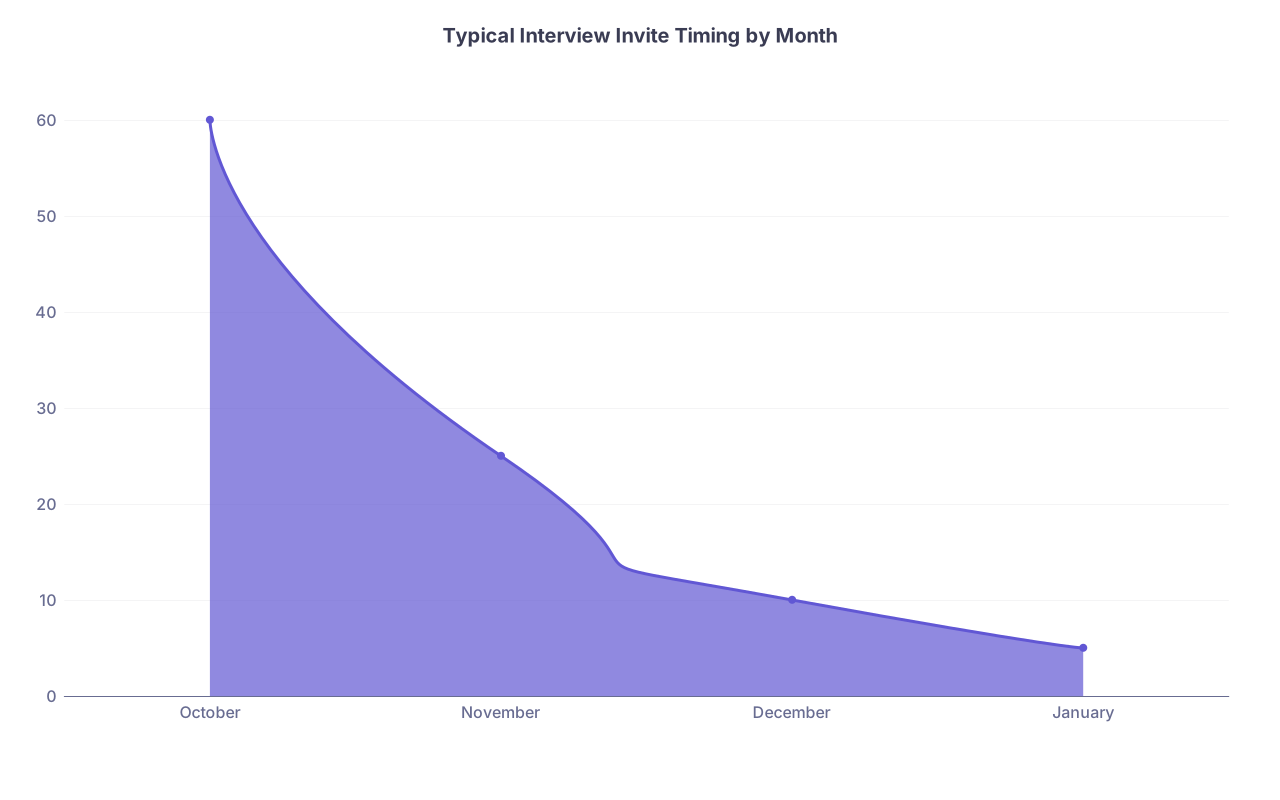
| Category | Value |
|---|---|
| October | 60 |
| November | 25 |
| December | 10 |
| January | 5 |
Most interview invites come in waves—often mid-October and early November. For a couple, those 48–72 hours are critical.
October: Invite Wave #1
At this point you must:
- Have a shared master calendar (Google Calendar works best) with:
- Color-coding for each person
- Travel times
- Known “must keep open” dates (family events, exams)
Rules to follow:
- No one accepts or declines an interview without checking the shared calendar.
- You prioritize:
- Programs in cities where both of you have interviews
- Programs that are high tier for both of you
- You avoid:
- Accepting multiple single-partner interviews in small cities where the other partner has zero prospects
Tactically:
- When one of you gets an invite:
- Check immediately if that program’s institution or city has the other partner’s specialty
- If so:
- The second partner should consider a proactive email:
- Brief, professional
- Highlight your application and mention you are Couples Matching and that your partner has just received an interview invite
- The second partner should consider a proactive email:
Sometimes this nudges an interview you might have gotten later—or not at all.
November: Invite Wave #2 and Heavy Scheduling
By now your calendar might look like assault.
At this point you should:
- Start grouping interviews by geography when possible:
- Example: “Boston week,” “Chicago week”
- Prioritize coordinated days:
- Same institution, same day = ideal
- Same city, adjacent days = acceptable
- Different cities, overlapping days = generally bad unless one is truly expendable
You’ll also start getting email from coordinators asking about alternative dates. Answer quickly, but don’t panic-book.
This is also when resentment can creep in:
- One partner getting more invites
- One partner seeming “pullable” for same-city interviews more often
Name that dynamic out loud. Remind each other of the strategy you agreed on months ago.
December: Last Invites and Cancellations
This month is mostly:
Cleaning up:
- Cancelling interviews at programs/cities that have become low-yield for you as a couple
- Firming up travel
Doing a reality-check count:
- Partner A: X interviews total
- Partner B: Y interviews total
- Number of overlapping cities/institutions where both have interviews
If overlapping options are thin, consider:
- Hanging on to some “solo” interviews for safety
- Strategically dropping lower priority ones to avoid burnout
January–February: Rank List Construction (Couples Mode)
This is where the Couples Match becomes an actual algorithm problem.
How the Couples Match Changes Ranking
You’re no longer ranking single programs. You’re ranking pairs.

| Step | Description |
|---|---|
| Step 1 | List As programs |
| Step 2 | Create all reasonable pairs |
| Step 3 | List Bs programs |
| Step 4 | Remove impossible combos |
| Step 5 | Prioritize by shared rules |
| Step 6 | Enter pairs into NRMP as rank list |
You sit down with:
- Partner A’s program list with impressions and tiering
- Partner B’s list
- Your shared principles (geography vs program quality vs support)
At this point you should:
List every program either of you interviewed at in your spreadsheet.
Mark:
- City
- Institution
- Program tier (for each person)
- Gut feeling notes (culture, residents, PD)
Start generating pairs:
- Same institution pair (strongest)
- Same city different institution pair
- Same region pairs that are realistically commutable (rare but occasionally works)
You will end up with dozens of possible combinations. Then you must:
- ruthlessly delete:
- Pairs where one partner would be miserable or academically stunted
- Cities you both ranked mentally as “only if we have no other option”
You should aim for:
- A rank list that is longer than a typical solo applicant’s
- With a front-loaded set of:
- Same-institution pairs you both liked
- Then same-city, cross-institution pairs
Late February: Final Rank List and Sanity Check
In the last 1–2 weeks before rank certification:
- Revisit your top 10–15 pairs:
- Do they still reflect your real preferences?
- Did recency bias creep in from a good last interview dinner?
- Confirm:
- You’ve ranked enough combinations to protect against a lopsided match
- You truly understand that ranking an “unhappy but together” pair above a “happy but long-distance” pair means just that—you’re choosing the first if it comes up
Have one last hard talk:
- “If we land at pair #X on this list, will we both be okay with that in 6 months?”
If the answer is no, adjust.
Match Week: Reacting, Not Planning
By Match Week, the planning is mostly over. The key for couples:
Before Monday:
- Reconfirm your SOAP plan if needed
- Decide:
- Are we willing to go long-distance temporarily?
- What happens if one of us matches and the other partially matches or has to SOAP?
After you get your result:
- Celebrate or regroup together, not separately
- If you didn’t land in your top region:
- Give yourselves a concrete time (12–24 months) to reevaluate for fellowship or re-match planning
One-Glance Couples Match Planning Gantt
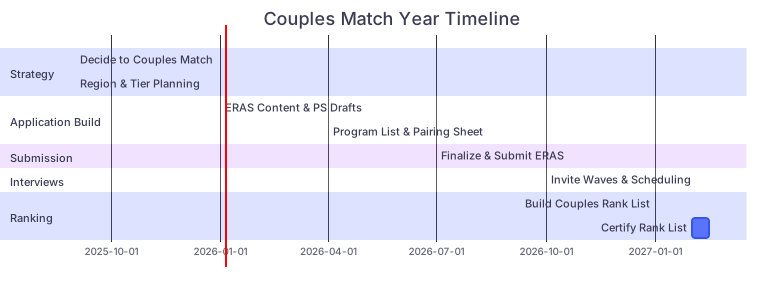
| Task | Details |
|---|---|
| Strategy: Decide to Couples Match | a1, 2025-09, 1m |
| Strategy: Region & Tier Planning | a2, after a1, 2m |
| Application Build: ERAS Content & PS Drafts | b1, 2026-01, 4m |
| Application Build: Program List & Pairing Sheet | b2, 2026-04, 3m |
| Submission: Finalize & Submit ERAS | c1, 2026-07, 3m |
| Interviews: Invite Waves & Scheduling | d1, 2026-10, 3m |
| Ranking: Build Couples Rank List | e1, 2027-01, 2m |
| Ranking: Certify Rank List | e2, 2027-02, 2w |
Final Takeaways
- Decide early, plan explicitly. Treat the Couples Match as a separate beast, not two parallel solo applications. Your calendar and spreadsheets should reflect that from 12 months out.
- Use geography and overlap as your north star. From program selection to interview scheduling to rank pairing, every major decision orbits around where both specialties realistically coexist.
- Have the hard talks before the chaos. Non‑negotiables, worst‑case plans, and what “together vs prestige” actually means for you—those conversations belong in the strategy phase, not mid‑interview season.
Run the year off the calendar. The couples who do that are the ones who walk into Match Day less surprised—and far more satisfied.