
What actually happens if you don’t have a chair’s letter when you apply to residency—do programs care, or is it just something older residents keep telling you about?
Here’s the answer: for some specialties, a chair’s letter is basically mandatory. For others, it’s nice but optional. And for a few, it’s almost irrelevant.
Let’s walk through this by specialty so you don’t waste time chasing a letter that doesn’t move the needle—or worse, miss one that programs quietly expect.
First: What Exactly Is a Chair’s Letter?
Quick definition so we’re on the same page:
A “chair’s letter” is a letter of recommendation written or signed by the department chair (or sometimes vice chair/program director acting in that role) from the specialty you’re applying into.
Sometimes:
- The chair actually knows you and writes it personally.
- More often: a faculty member who worked with you drafts it; the chair edits and signs.
- In some schools/specialties, it’s a standardized “department letter” summarizing your performance.
Key point: Programs see this as the official voice of your department. It can carry weight beyond a regular attending letter, especially in more traditional fields.
Specialties Where a Chair’s Letter Is Basically Expected
If you’re in one of these, assume you need a chair’s letter unless your school literally doesn’t have the department.
| Specialty | Chair/Dept Letter Status | Notes |
|---|---|---|
| Internal Medicine | Often expected | Especially university programs |
| General Surgery | Strongly expected | Often a formal dept letter |
| Orthopedic Surgery | Strongly expected | Very traditional |
| Neurosurgery | Strongly expected | Small world, chair letters key |
| OB/GYN | Often expected | Many require one dept letter |
| ENT (Otolaryngology) | Strongly expected | Often standardized letters |
Internal Medicine
Do you need a chair’s letter for medicine? At many academic IM programs: yes, or at least they’ll strongly prefer it.
Typical expectations:
- 1 letter from department chair or official “department of medicine” letter
- 1–2 letters from subspecialty faculty (cards, heme/onc, pulm, etc.)
- Sometimes 1 letter from research or a strong outpatient preceptor
What the chair’s letter does in IM:
- Confirms you’re safe, reliable, and not a problem child
- Summarizes medicine clerkship + sub-I performance
- Signals: “We’d be fine having this person in our residency”
If your school has a formal “department of medicine” composite letter, that’s your chair’s letter equivalent. Don’t skip it.
General Surgery
Surgery is very old-school about hierarchy. Chair’s letter is often standard.
Patterns I’ve seen:
- Many departments issue a formal “Department of Surgery” letter signed by the chair or program leadership.
- Some programs explicitly say on their website: “One letter must be from the Chair of Surgery or designee.”
In surgery, this letter often:
- Comments on operative performance, work ethic, and “surgical personality”
- References how you compare to prior applicants
- Occasionally soft-flags concerns (lateness, attitude) in coded language
If you’re applying to gen surg and not planning for a chair/department letter, that’s a mistake. Fix it.
Orthopedic Surgery & Neurosurgery
These are hyper-competitive, hyper-traditional, and small communities. The chair’s letter matters a lot.
Why?
- Chairs know each other. These letters become quiet back-channel signals.
- If you’re from a known ortho/neuro department and don’t have a chair’s letter, programs will wonder why.
You want:
- 1 strong departmental letter (chair/vice chair/PD, depending on the local norm)
- 2–3 letters from subspecialty attendings or research mentors in the field
If your own school has no home ortho or neurosurgery program:
- Get the closest thing you can: the site director or service chief where you did your away rotation.
- An external “site director” letter can function almost like a chair’s letter in that situation.
OB/GYN
OB/GYN sits a bit in the middle. Many places either:
- Expect a department letter
- Or at least 1 letter from a senior OB/GYN faculty member (PD, APD, clerkship director, or chair)
For OB/GYN:
- Check ERAS program requirements on individual program pages; several explicitly want “one letter from OB/GYN chair or clerkship director.”
- If your school has a standardized OB/GYN department letter, that’s your chair-level letter.
Specialties Where a Chair’s Letter Is Helpful, But Not Required
Now we’re in the gray zone. Here a chair/department letter can help, but not having one isn’t fatal—strong clinical letters matter more.
These include:
- Pediatrics
- Emergency Medicine
- Anesthesiology
- Radiology (Diagnostic)
- PM&R
- Neurology
- Psychiatry (varies by region; some old-school academic places like it)
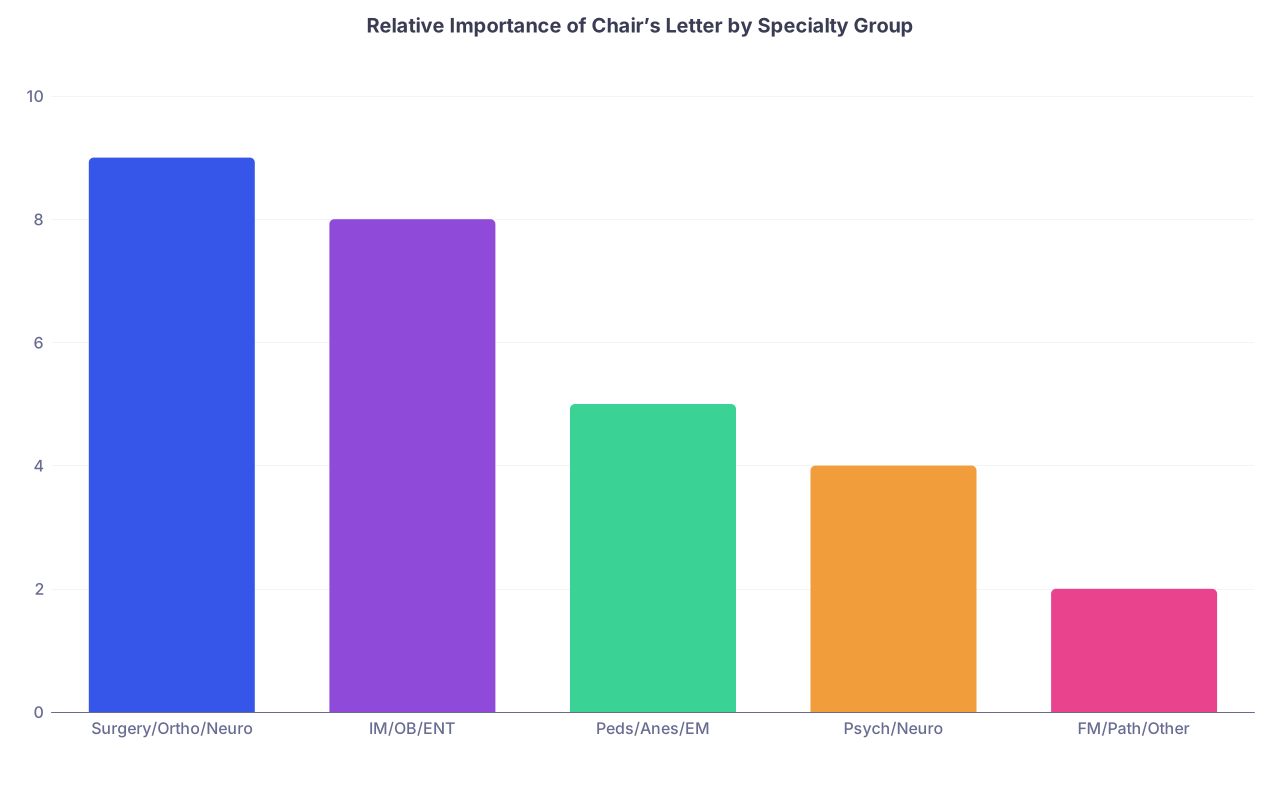
| Category | Value |
|---|---|
| Surgery/Ortho/Neuro | 9 |
| IM/OB/ENT | 8 |
| Peds/Anes/EM | 5 |
| Psych/Neuro | 4 |
| FM/Path/Other | 2 |
Scale 1–10: higher = more impact/expectation.
Pediatrics
Peds cares more about:
- Strong clinical letters from people who actually worked with you
- Comments on communication, teamwork, and reliability
A chair’s letter can:
- Summarize your performance and say “we’d take them”
- Help slightly at large academic programs
But if the chair doesn’t know you and the letter is generic, a strong sub-I attending letter is more valuable. If forced to choose, pick the attending who knows you.
Emergency Medicine
EM historically relied more on SLOEs (Standardized Letters of Evaluation) than chair’s letters.
Rough rule:
- 2 SLOEs (home EM + away rotation) > any chair’s letter
- If your chair is also EM and writes a SLOE-style letter, great.
- A generic “department chair” non-EM letter won’t help much.
If you’re EM-bound and debating: Spend your political capital getting strong SLOEs, not chasing a generic chair letter.
Anesthesiology / Radiology / PM&R / Neurology / Psychiatry
For these:
- Programs mainly want: 2–3 letters from faculty in the field who actually supervised you.
- A chair’s letter is a nice “stamp of approval” but not mandatory at most places.
Chair letter becomes more valuable if:
- You’re from a well-known department and the chair is known in the field.
- You have some red flag and need a credible senior voice vouching for you.
- You did substantial research with the department tied into that letter.
Otherwise, prioritize:
- Your sub-I attending
- Research mentor (if same specialty)
- Clerkship or site director who can be specific about your performance
Specialties Where a Chair’s Letter Is Rarely Necessary
These are the fields where a traditional chair’s letter is low priority unless required by a specific program:
- Family Medicine
- Pathology
- Dermatology (odd one: prestige-driven, but usually not chair-letter focused)
- Ophthalmology (separate SF Match process; letters matter, but “chair letter” is less standardized)
- Transitional Year / Preliminary Medicine or Surgery (unless you’re trying to impress a very academic prelim program)
Family medicine:
- Wants 2–3 letters, often including one from a family physician.
- Being known as kind, hardworking, and good with patients matters more than a formal department stamp.
Pathology:
- Chair letters can matter for academic powerhouse departments, but most programs are satisfied with letters from path attendings you actually worked with, plus research mentors.
Derm:
- Hyper competitive, but fixated on: research, productivity, clinical performance, letters from well-known dermatologists.
- A derm chair who really knows you? Gold.
- A random internal medicine chair letter “because that’s what I thought I needed”? Useless.
Bottom line here: read program requirements; don’t assume a chair’s letter is universal currency. It isn’t.
How to Decide if You Personally Need a Chair’s Letter
Use this quick decision framework.
Ask yourself:
What does my specialty expect on average?
- If you’re in surgery, ortho, neurosurgery, ENT, OB, or academic IM: strongly lean yes.
What do my target programs explicitly say?
- Some list “letter from chair or department of X required” on their website or in ERAS details. Take that literally.
Does my school have an official department letter system?
- If yes, that usually is the chair-level letter. Follow your school’s process.
Does the chair actually know me?
- If not, and your specialty doesn’t really care, a generic chair letter is weaker than a detailed letter from an attending who worked with you for 4–8 weeks.
How to Ask for a Chair’s Letter (Without Making It Awkward)
If you decide you do need one, here’s the practical playbook.
Step 1 – Figure out the local process
Every department has its own ritual:
- Some: “Submit CV, personal statement, and letter request form to the residency office by X date.”
- Others: “Meet with the chair for 15–20 minutes; they’ll decide and then coordinate.”
Ask:
- Your clerkship director
- The residency coordinator
- Fourth-years who matched last cycle
Step 2 – Set up a brief meeting
Send a short, direct email:
- Who you are
- Specialty you’re applying to
- That you’d like to request a department/chair letter
- Attach CV, personal statement, and ERAS letter request (if available)
Step 3 – Give them real material
Chairs crank out a lot of letters. Help them help you:
- Bullet list of rotations in that specialty and how you performed
- Names of faculty who know you best (they may contact them or co-sign)
- Any standout projects, teaching, or research
Step 4 – Lock in logistics early
Ideal: request no later than July–August of application year so the letter is ready by September.
Chairs are busy. If you wait until the week before ERAS opens, you’re just adding stress for everyone, including yourself.
Common Mistakes With Chair’s Letters
I’ve watched people mess this up. Don’t do these:
Skipping a required department letter because “my sub-I attending knows me better.”
- You can have both. Programs that require a chair/department letter still want other strong letters.
Getting a generic chair letter instead of a detailed clinical letter.
- If you’re limited to 3–4 letters, don’t waste a slot on a vague chair letter when your specialty doesn’t care.
Assuming all specialties treat chair letters the same.
- They don’t. Surgery ≠ EM ≠ FM.
Not reading program websites.
- Several explicitly specify “one letter must be from the department of X at your medical school.” That’s not negotiable.
Waiting until mid-September to ask.
- At that point, you’re more likely to get a rushed, boilerplate letter—or a frustrated “no.”
Quick Specialty Snapshot Table
Here’s a condensed cheat sheet.
| Specialty Group | Need Level | Practical Advice |
|---|---|---|
| Gen Surg, Ortho, Neuro, ENT | Very High | Plan early; department letter is standard |
| Academic IM, OB/GYN | High | Strongly preferred or required at many programs |
| Peds, EM, Anes, Rads, Neuro, Psych | Moderate | Helpful but not universal; prioritize strong SLOEs/attending letters |
| FM, Path, Derm, Ophtho, TY/Prelim | Low–Variable | Only chase if programs or mentors advise it |

FAQs About Chair’s Letters for Residency
1. If my school doesn’t have a department in my specialty, what do I do?
Use the closest equivalent:
- Site director or service chief from a major rotation or away rotation
- Program director or associate program director from your home affiliate
- For IM/surgery-type expectations, a letter from the medicine/surgery department summarizing your performance is acceptable if that’s all your school can offer.
Explain briefly in your ERAS experiences (or, if needed, in a secondary communication) that your school lacks a home department; programs see this often.
2. How many total letters should include a chair’s letter?
Most programs allow 3–4 letters. If a chair/department letter is expected:
- 1 should be that chair/department letter
- 2–3 should be from faculty who directly supervised you (sub-I, away rotation, research mentor in the field)
Don’t send two generic “big name” letters instead of substantive clinical letters. Depth beats title.
3. What if my chair doesn’t know me at all—will the letter be weak?
Probably. But:
- Many chairs ask other faculty who know you to provide input or draft content.
- Your job is to give them enough concrete material (evaluations, rotation list, achievements) so they can say something specific.
If your specialty doesn’t require a chair’s letter and the chair truly has zero basis to comment, you may be better off using that slot for someone who actually worked with you.
4. Can a program director letter substitute for a chair’s letter?
Sometimes, yes—if:
- The program director is explicitly the designee for writing the department letter
- Or your school doesn’t issue “chair letters,” only PD/Clerkship director letters
If a program’s requirement says “chair or program director / clerkship director,” then you’re fine. If it says “chair or department of X,” ask your home department what counts as that letter.
5. Should I get a chair’s letter if I’m dual-applying to another specialty?
Think strategically:
- For your primary specialty: follow that specialty’s norms.
- For your backup specialty: a chair letter from the backup field is more helpful than an irrelevant chair letter.
Example: You’re applying Ortho + IM as a backup. An IM chairman’s letter helps with IM, but many ortho programs won’t care. Prioritize the ortho department letter first, then look at IM expectations.
6. When is it too late to ask for a chair’s letter?
Ideally, request by:
- June–July before ERAS submission
“Last possible moment”:
- Early September, knowing you may delay completion at some programs or get a rushed letter.
After mid-September, you’re asking for a favor that can only hurt the quality and likely won’t reach all programs in time to matter.
Key takeaways:
- Chair’s letters are near-mandatory in surgery-type fields and often expected in academic IM/OB/ENT; optional-to-low-value in many others.
- When in doubt, prioritize strong, specific letters from people who actually worked with you over generic prestige letters.
- Read each program’s requirements, learn your school’s system early, and don’t wait until September to figure this out.