
The worst way to handle a mid-year leave of absence is to pretend it was not a big deal. Programs know it is a big deal. Your job is to show them it is a contained big deal.
If you had to leave medical school mid-year—whether for health, family, academic remediation, mental health, pregnancy, legal trouble, burnout, whatever—you’re in a sensitive but survivable situation. Many people match with a leave on their record. The difference between those who match and those who don’t usually comes down to two things:
- How clearly and consistently they document it on ERAS.
- How calmly and insightfully they talk about it in interviews.
I’m going to walk you through exactly how to do both.
Step 1: Get Crystal Clear on What Your School Is Saying About Your LOA
Before you touch ERAS, you need to know two things:
- How your school is labeling the leave
- Exactly what is going into your MSPE (Dean’s Letter) and transcript
Do not guess. Do not rely on a classmate’s experience from three years ago.
Email or meet with:
- Student affairs or your dean, and
- The registrar (for transcript language if needed)
Ask them specifically:
- “How will my leave be titled in my official record?”
Examples: “Leave of Absence – Personal,” “Medical Leave,” “Academic Leave,” “Administrative Leave.” - “Will dates be provided? Exact or just academic year?”
- “Will a reason be specified in the MSPE? If so, in what language?”
- “Will there be any narrative explanation of performance or professionalism related to the leave?”
You want to line up your ERAS language with your school’s language. Not word-for-word, but same category. If your MSPE says “medical leave” and your ERAS says “family obligations,” programs will notice the mismatch and assume there’s more you’re hiding.
Here’s the rule:
Your version should be slightly more detailed and more human, but not contradictory.
Step 2: Where Exactly to Put the LOA in ERAS
ERAS gives you a few places where this might show up. You don’t need to use all of them. In fact, you shouldn’t.
The three key locations:
- Education Timeline (dates of enrollment)
- “Interrupted Medical Education” question (or equivalent)
- Personal Statement / Additional Information
Let’s walk these systematically.
1. Education Dates
You must make the dates accurate. Do not compress or hide the gap.
If you started in 2020 and would’ve graduated in 2024, but took a leave during MS3 and are now graduating in 2025, your education section should reflect the actual dates of graduation. That part is non-negotiable.
Most schools send the “Expected Graduation Date” to ERAS and it shows up automatically. If your graduation date shifted because of the leave, confirm the updated date with student affairs.
2. The “Interrupted Medical Education” Question
This is the main place to address your mid-year LOA directly.
You’ll see some variation, but it’s usually something like: “Was your medical education ever interrupted or extended? If yes, please explain.”
If you had a mid-year leave, the answer is yes.
Do not get cute here. Programs already see the gap and usually see a note in your MSPE. “No” makes you look evasive.
Your goal here:
- State what happened in one line
- Give a brief, non-dramatic explanation
- End with how you’re doing now and that you fully returned to training
Template you can adapt:
“Yes. I took a [medical/personal/family/academic] leave of absence from [Month Year] to [Month Year] during my [third] year of medical school. This was related to [brief category-level explanation]. I fully completed the required remediation/medical treatment/personal responsibilities and returned to my program in good standing, with strong performance on subsequent clinical rotations.”
A few concrete examples:
Medical/mental health:
“Yes. I took a medical leave of absence from January 2023 to July 2023 due to a health issue. I received treatment and, upon medical clearance, returned to full-time clinical training and have since completed all rotations without limitations.”
Family:
“Yes. I took a personal leave of absence from February 2022 to August 2022 to manage an acute family health crisis. My family member’s condition stabilized, and I returned to my studies and clinical duties in good standing.”
Academic:
“Yes. I took an academic leave of absence from December 2021 to June 2022 to complete a structured remediation program after struggling early in my core clerkships. I successfully completed the remediation, returned to rotations, and subsequently received strong evaluations, particularly in Internal Medicine and Surgery.”
Notice what’s not happening here:
You’re not unloading your entire life story. You’re giving them enough to understand that:
- This was real and finite
- It has been addressed
- You’re stable and functioning now
That’s what PDs care about.
3. Personal Statement / Additional Info
You don’t mention the leave in the personal statement unless:
- It’s legitimately central to your story in a way that directly shaped your specialty interest, and
- You can talk about it without sounding like therapy on paper.
Otherwise, put any elaboration in either:
- The “Additional Information” section (if available), or
- Nowhere else—just the “Interrupted Education” box
If you do add a short note outside the required box, keep it tight:
“During my third year, I took a medical leave of absence to address a health issue. This experience deepened my empathy for patients navigating prolonged illness and uncertainty. Returning to the wards, I found myself more attuned to patients’ fears and more deliberate about communication and follow-up. I have since maintained full engagement in clinical duties without restriction.”
Short, anchored to impact on you as a clinician, and done.
Step 3: Matching the Strategy to the Type of Leave
Different leaves carry different risk signals. You handle them slightly differently.
| LOA Type | Risk Perception | Core Strategy |
|---|---|---|
| Medical | Moderate | Emphasize stability now |
| Mental Health | Moderate | Normalize + boundaries |
| Family/Personal | Low–Moderate | Show resolution |
| Academic | Higher | Prove academic rebound |
| Disciplinary | Highest | Full ownership + repair |
Medical / Mental Health Leave
Program directors see these constantly. What they’re asking themselves:
- Are you medically stable now?
- Is this likely to recur during residency?
- Can you handle the hours and stress?
You don’t owe them your diagnosis. In fact, you should not share specific DSM labels unless you’re very sure it’s strategic (it usually isn’t).
ERAS / interview focus:
- There was a health issue
- It was treated / managed
- Your treating professionals cleared you
- You’ve since handled full-time clinical load without restrictions
In interviews, a clean version sounds like:
“I had a health issue that required focused treatment. I worked with my physicians, stepped away temporarily, and returned only after being fully cleared. Since then, I’ve completed my rotations full-time, taken Step 2, and maintained my responsibilities without limitation. I’m happy to talk about how the experience changed how I care for patients, but I prefer not to go into medical specifics.”
You set a boundary without sounding defensive.
Family / Personal Leave
These are generally viewed sympathetically if:
- The situation is clearly resolved or stable
- It doesn’t look like an ongoing, unpredictable drain on your time
Bad version:
“I had a lot going on at home.”
Better version:
“My parent developed an acute, life-threatening illness, and I became the primary coordinator of their care. It was a finite, intense period. Once their condition stabilized and long-term supports were in place, I returned to school and have been fully dedicated to my training since.”
Again: finite window, concrete resolution, full return.
Academic / Remediation Leave
Programs see “academic leave” and immediately think:
- Step scores?
- Failed rotations?
- Can this person keep up?
You cannot spin this away. You have to show:
- What changed (study habits, support, approach)
- Contained problem + consistent improvement after
Example explanation (ERAS + interview aligned):
“Early in my third year, I struggled to adapt to the pace and expectations of clinical rotations, which led to a leave of absence to complete a formal remediation program. During that time, I worked closely with our learning specialist on time management, test-taking strategies, and clinical reasoning. Since returning, I’ve passed all rotations on first attempt and saw my Step 2 score improve significantly compared to Step 1.”
If your post-leave performance is solid, that becomes your shield. Always pivot to it.
Disciplinary / Professionalism Leave
This is the hardest category, but people do still match if they handle it correctly and it’s not something catastrophic (assault, persistent dishonesty, etc.).
The mistake here is minimization. Programs almost always see more detail in the MSPE than you think. If they catch you downplaying, that’s game over.
Skeleton of a decent explanation:
- What happened (category, not lurid detail)
- What consequences you faced
- What you changed and how behavior has been since
For example (a boundary-pushing but realistic one):
“During my second year, I was placed on a leave related to unprofessional behavior—specifically, repeated lateness to required sessions and poor communication with faculty when I was struggling. It was a painful wake-up call. As part of my remediation, I worked with a faculty mentor, created structured scheduling and back-up systems, and met regularly to review my follow-through. Since returning, I’ve had no further professionalism concerns, and my clerkship evaluations consistently mention reliability and communication as strengths.”
If this is you, you also need:
- A faculty advocate who knows the full story and is willing to go to bat for you
- Letters that emphasize professionalism explicitly
Step 4: How to Talk About It in Interviews without Crumbling
Program directors don’t love surprises. If your LOA is mentioned in the MSPE, you should assume you’ll get asked about it. Sometimes bluntly.
You need a 60–90 second answer you can say under stress. Not a script to memorize word-for-word, but a reliable outline.
Think in three moves:
- Brief fact
- Core reason (category)
- What’s different now / what you learned
Example for a mid-year medical LOA:
“During my third year, I took a medical leave of absence for several months. I had a condition that required focused treatment and recovery. I stepped away with support from student affairs, completed treatment, and returned only after being medically cleared. Since then, I’ve completed all remaining rotations full-time, taken Step 2, and have had no restrictions. The experience made me much more attuned to how vulnerable patients feel when they’re sick and not in control, and I think that’s made me a better listener on the wards.”
Notice: they get the category, a time frame, the resolution, and one or two reflective points. That’s it.
Common Ways This Goes Wrong (and How to Avoid Them)
Oversharing so much that the interviewer feels like your therapist
- Fix: Stay at the level of categories, not soap-opera detail.
Getting defensive or edgy when asked
- Fix: Expect the question. Practicing it makes your tone calmer.
Acting like it was nothing
- Fix: You can be matter-of-fact and still acknowledge it was a serious and meaningful event.
Turning the whole interview into “The LOA Show”
- Fix: Answer clearly, pivot back to your clinical performance, interests, and fit with the program.
A useful pivot phrase:
“I’m happy to answer more questions about that if helpful, but I’d also love to talk about [your subinterest / research / what you value in a residency program].”
You don’t need to say that every time. Just keep your own mental balance: this is one chapter, not your whole book.
Step 5: Repairing the Overall Application Around the LOA
An LOA is rarely what kills an application by itself. It’s usually LOA + weak recent performance + vague explanation + shaky letters.
Your job is to shore up everything around the leave.
Here’s how I’d triage:
Academics and Clinical Evaluations
For academic/medical leaves especially, post-leave performance must look solid.
- Aim for strong evaluations on core clerkships and sub-Is after your return
- If you had stumbles earlier, point interviewers to clear upward trends
- If Step 1 was weak, Step 2 should be clearly stronger (if still pending, that’s risky—get it done early)
Letters of Recommendation
At least one letter should come from someone who:
- Knows you post-leave
- Can implicitly counter concerns (reliability, stamina, professionalism, clinical ability)
You don’t need them to write, “They had a leave and now they’re perfect.” You need things like:
- “Consistently on time and well-prepared”
- “Excellent follow-through on patient care tasks”
- “Handles stress calmly and productively on busy services”
That’s what PDs read between the lines.
Specialty Choice and Program Selection
You can match into competitive fields with an LOA. But you must be realistic about the full picture: scores, school, research, timing.
Blunt rule of thumb:
- Competitive specialty + LOA + mediocre scores + average letters = high risk
- Middle-of-the-road specialty + LOA + strong recent performance + clear story = absolutely possible
Protect yourself by:
- Applying across a reasonable range of programs
- Including some “safety” specialties or preliminary years if your metrics are borderline
- Having a back-up plan that doesn’t rely on a miracle
Step 6: Special Situations and Edge Cases
Mid-Year LOA During M4 While Applying
Tricky, but not impossible. You have to update programs if the leave happens after you submit ERAS.
Steps:
- Inform your dean / student affairs immediately.
- Clarify how it will be reflected in your MSPE addendum.
- Send a short, composed update email to programs if the LOA affects:
- Your graduation date
- Planned sub-Is or key letters
- Your ability to start residency on time
Basic structure:
“I wanted to inform you of an update regarding my medical education timeline. In [Month Year], I began a [medical/personal/etc.] leave of absence. At this time, I remain on track to graduate in [Month Year] and to begin residency as scheduled. I’ve discussed this with my dean, who can provide additional context if needed. I remain very interested in your program and appreciate your consideration of my application.”
If graduation is delayed, you have to say so. Trying to sneak this past programs will blow up later when they can’t credential you.
Multiple Leaves
Multiple LOAs raise the question of chronic instability. You don’t solve that with wordplay. You need:
- A coherent through-line explanation (e.g., one extended medical issue, not eight unrelated crises)
- A longer period of recent stability and solid performance
- Very strong advocacy from your school
This is where specialty choice, program range, and letter strength matter even more.
Visual: How the LOA Fits in the Timeline
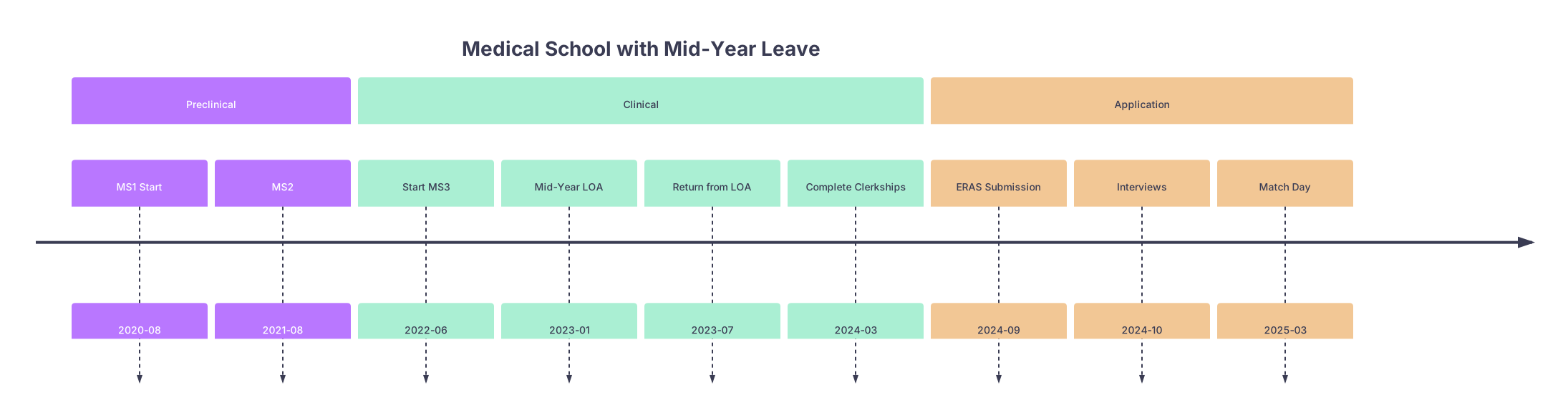
| Period | Event |
|---|---|
| Preclinical - MS1 Start | 2020-08 |
| Preclinical - MS2 | 2021-08 |
| Clinical - Start MS3 | 2022-06 |
| Clinical - Mid-Year LOA | 2023-01 |
| Clinical - Return from LOA | 2023-07 |
| Clinical - Complete Clerkships | 2024-03 |
| Application - ERAS Submission | 2024-09 |
| Application - Interviews | 2024-10 |
| Application - Match Day | 2025-03 |
You can see why pretending January–July 2023 did not exist is absurd. You have to show it, own it, and then anchor attention on everything after July.
Simple Mental Checklist Before You Submit
Run through these in your head:
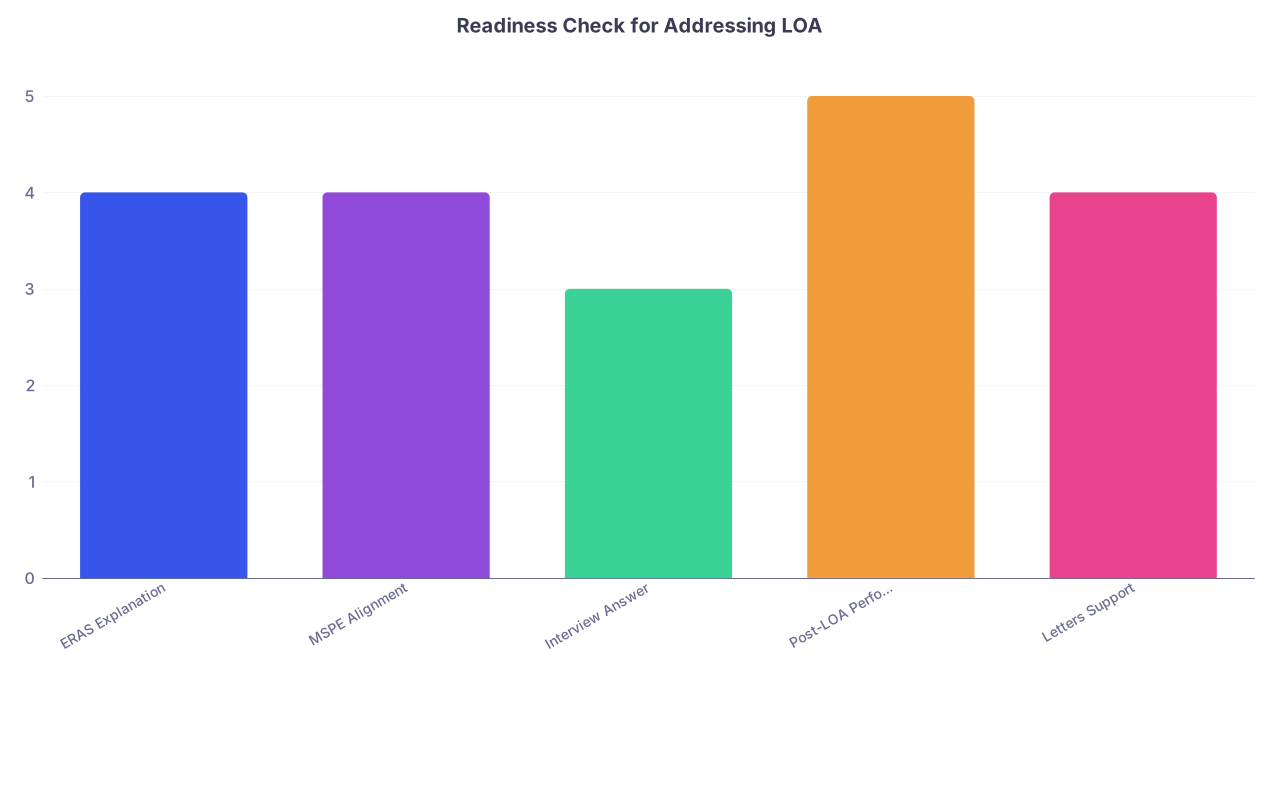
| Category | Value |
|---|---|
| ERAS Explanation | 4 |
| MSPE Alignment | 4 |
| Interview Answer | 3 |
| Post-LOA Performance | 5 |
| Letters Support | 4 |
On a 1–5 in your own mind (5 = solid):
- Is my ERAS explanation clear, brief, and aligned with my school’s language?
- Does my MSPE not contradict my story?
- Can I give a 60–90 second spoken answer without spiraling?
- Do my grades and Step scores after the leave show stability or improvement?
- Do I have at least one letter that quietly reassures programs about reliability and performance?
If you’re below 3 on any of these, fix that before hitting submit.
FAQ (Exactly 5 Questions)
1. Should I mention my leave of absence in every interview even if they do not ask?
No. You’re not required to preemptively confess things the interviewer doesn’t bring up, as long as your ERAS and MSPE are accurate and transparent. The LOA is already visible in your application. If they want more, they’ll ask. You should, however, be ready with a calm, concise explanation for any interview where it does come up.
2. My LOA was for depression/anxiety. Do I need to say that specifically?
No, you do not need to give a psychiatric diagnosis. It’s enough to say you took a medical leave to address a health issue, received appropriate treatment, and have returned to full function with good support in place. Focus on stability, insight, and how you manage stress now, rather than labels. If you choose to mention mental health explicitly, keep it high-level and emphasize that it’s well-managed.
3. My school called it an “academic leave,” but I feel it was mostly personal/mental health. Can I relabel it on ERAS?
Don’t contradict the official terminology. If your MSPE or transcript uses “academic leave,” your ERAS cannot say “family leave” or “personal leave” without raising red flags. You can add nuance verbally: “It was categorized as an academic leave, but a significant part of what I was dealing with involved stress and burnout that affected my performance.” The core labels still have to line up.
4. How bad is it to just say ‘no’ to the interrupted education question and hope they do not notice?
It’s a mistake. Programs almost always see your leave in the MSPE and transcript. If your ERAS says “no interruptions,” they won’t assume you forgot. They’ll assume you’re hiding it or testing what you can get away with. That kind of perceived dishonesty is far more toxic than the leave itself. Own it directly and briefly instead.
5. Can a strong Step 2 score or great clinical evaluations ‘erase’ an LOA?
They don’t erase it, but they can absolutely neutralize most of the concern when combined with a clear explanation. Many PDs care more about the trajectory after the problem than the problem itself. A clean, stable track record after your LOA—solid Step 2, strong clerkship comments, reliable behavior—lets them say, “This was a contained issue with a good recovery,” and move on. That’s the goal: not to erase it, but to make it a closed chapter, not the whole book.
Key Takeaways:
Handle a mid-year LOA by being transparent on ERAS, aligned with your MSPE, and concise about the reason and resolution. Focus interview answers on three things: what happened in category terms, that the issue is contained and treated/resolved, and how your subsequent performance shows stability and growth. Your leave is a serious data point—but with a coherent story and strong performance after, it doesn’t have to be a fatal one.