
The standard advice to pick a “safety specialty” is wildly overused and often intellectually lazy.
You’ve probably heard the script: “Derm? Ortho? ENT? You must have a backup specialty or you’ll go unmatched.” People whisper it in hallways like it is gospel. Attendings say it. Seniors repeat it. Group chats panic about it.
Most of them have never actually read the NRMP data they’re invoking.
Let’s fix that.
The Myth: Everyone Aiming High Needs a “Safety Specialty”
The myth goes like this:
- Competitive specialty = automatic need for a backup
- Backup = apply to a “less competitive” specialty simultaneously
- That’s the only way to “protect yourself” from going unmatched
Sounds prudent. Feels safe. Also: often wrong, and occasionally self‑sabotaging.
Here’s the real problem: the phrase “safety specialty” is used without any nuance. It treats EM, IM, pysch, FM, neuro, peds, everything that’s not derm/ortho/ENT/plastics/neurosurg as some amorphous low‑risk blob you can just bolt onto your ERAS and magically secure a Plan B.
The data does not support that simplistic story.
What the Match Data Actually Shows
Let’s talk numbers, not vibes.
The NRMP publishes the “Charting Outcomes in the Match” and an annual Match report. A few consistent patterns show up year after year.
1. Unmatched risk is real — but not evenly distributed
US MD seniors don’t all have the same risk of going unmatched. It varies by:
- Specialty
- Step 2 score
- Number of ranks in your primary specialty
- Whether you dual apply (and how)
You’ll see terrifying anecdotes online, but the macro view is more measured. For US MD seniors overall, match rates are high. Where things get dicey is in the ultra‑competitive specialties and for applicants with weak applications in middle‑tier specialties who apply too narrowly.
2. “Safety” specialties are not that safe anymore
Look at the “softer” fields people casually label as backup options: anesthesia, EM (historic mindset), radiology, psych, etc. Many of these have become more competitive or have large applicant pools fighting for limited spots, especially at desirable programs and locations.
You aren’t competing against generic humans. You’re competing against people who actually want those fields, structured their CV accordingly, and often have better‑aligned LORs and personal statements than you, the panic dual‑applicant, will be able to present.
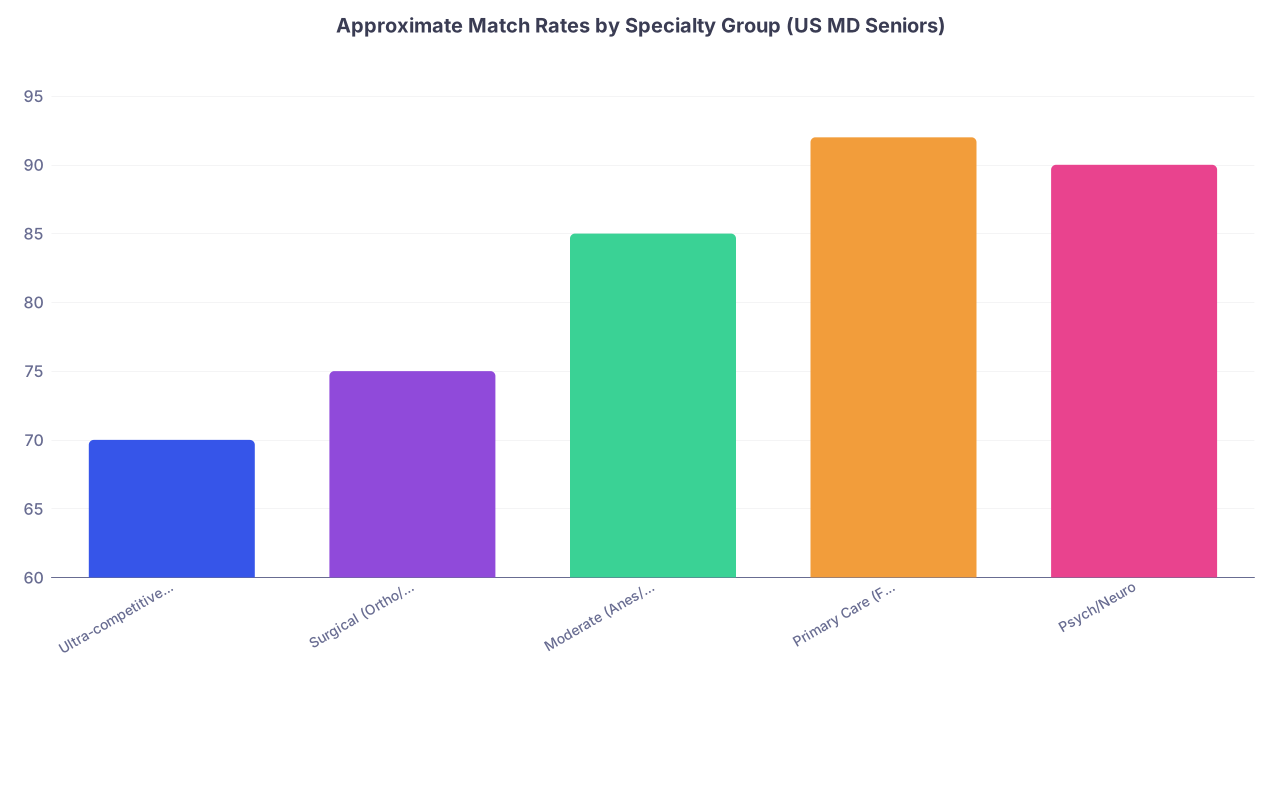
| Category | Value |
|---|---|
| Ultra-competitive (Derm/Plastics/ENT) | 70 |
| Surgical (Ortho/Neurosurg) | 75 |
| Moderate (Anes/Rads/EM) | 85 |
| Primary Care (FM/IM/Peds) | 92 |
| Psych/Neuro | 90 |
The rough pattern is obvious:
- Yes, primary care fields tend to have higher match rates.
- No, that doesn’t mean they’re a guaranteed soft landing for a late, half‑hearted dual applicant.
The Real “Safety” Variable: Rank List Length, Not Backup Specialty
Here’s the most neglected fact in this entire conversation: your number of ranks in your primary specialty is one of the strongest predictors of whether you match.
Look at NRMP’s own tables. They’re brutal and simple:
- US MD seniors in many specialties with 10–12 ranks have extremely high match rates.
- Those same specialties see sharp spike in unmatched risk when applicants rank 4–5 programs total.
You’ll hear students obsess about whether they need to tack on a backup specialty. Meanwhile, they’re ranking 6 programs in their primary field because they only interviewed at “reach” places in New York and California.
I’ve sat in on these conversations:
“I don’t want to go to the Midwest. I’d rather not match.”
Then, a month before rank list due, you see panicked DMs asking if they should suddenly add FM or IM.
That’s not a strategy. That’s denial.
If you want an actual safety mechanism, it looks more like:
- Apply broadly in your primary specialty
- Interview broadly (yes, including non‑sexy locations)
- Rank deeply (10–15 if the field’s moderately competitive, often more for surgical subs)
Adding a “safety specialty” on top of a dangerously short primary rank list is putting a band‑aid on a bullet wound.
Dual Applying: When It Helps vs When It Hurts
Dual applying isn’t inherently good or bad. It’s a tool. Used wrong, it can tank both applications.
When a backup specialty can make sense
Dual applying is most rational when all of these are true:
You’re targeting a truly ultra‑competitive specialty
Think derm, plastics, ENT, neurosurgery, sometimes ortho, sometimes integrated vascular or cardiothoracic.Your metrics / portfolio are borderline for that field
For example:- Step 2 CK just above the mean for that specialty
- Average or light research for a research‑heavy field
- Mid‑tier school with weaker home department and letters
You’d genuinely be okay doing the backup specialty
Not “I guess I could tolerate it until I reapply.”
Actually okay. Meaning:- You can articulate why you like it.
- You’ve got at least one rotation and letter in it.
- You’re not going to look obviously disinterested during interviews.
You have enough time and bandwidth to create two authentic applications
That means:- Two separate personal statements
- Distinct experience descriptions
- Tailored letters (no generic “To whichever program” nonsense)
- Faculty in both fields willing to advocate for you
In that situation, yes — a backup specialty may meaningfully reduce your unmatched risk without destroying credibility in your primary field.
When “safety specialty” logic is actually self‑sabotage
I’ve seen people blow themselves up with bad dual‑apply moves:
- Applying to IM as “backup” with zero IM letters, a surgery‑heavy CV, and a PS about “always knowing I wanted to operate.” Then they wonder why IM programs don’t rank them highly.
- Applying late to FM with a generic personal statement and no evidence of outpatient interest, family systems, continuity of care, etc. Programs can smell it.
- Throwing EM on as a backup because “I like procedures” without any EM rotation before ERAS submission.
You end up with:
- A weaker primary application (time and focus diluted)
- A transparently fake secondary application
- Interview questions you can’t answer convincingly in either field
Dual applying is only protective when both applications are believable.
Data Reality: Many Unmatched Outcomes Are Self‑Inflicted
The uncomfortable truth: a non‑trivial number of unmatched outcomes are not pure bad luck. They’re predictable from decisions made 12–18 months earlier.
Common patterns:
Applying to a competitive specialty with:
- Subpar board scores for that field
- Minimal research in that area
- No home program backing
- Late or generic letters
Geographic rigidity:
- Only ranking coastal or big‑city programs
- Refusing to apply to or rank community or “less prestigious” sites
Very short rank lists:
- 4–5 programs total in a medium‑competitive field
These are the situations where people panic‑add a “safety specialty” at the last second, which usually:
- Doesn’t change the outcome
- Creates more stress
- Wastes money
- Leaves them with two weak narratives instead of one coherent one
Real protection doesn’t come from the word “backup” in your strategy. It comes from matching your competitiveness to the field, adjusting your list appropriately, and starting early enough to fix deficits.
False Safety: “I’ll Just Do IM Then Switch Later”
Here’s another fantasy sold as strategy: “If I don’t match into [hyper‑competitive field], I’ll just do IM/FM/Anes and then switch to [field] later.”
You can change specialties. People do it. But calling it a “safety path” is dishonest.
Barriers in real life:
- Many specialties do not routinely take residents from other fields.
- You may need to repeat years, lose PGY credit, or restart training.
- You’ll need new letters, new research, and usually a Step 2+ story that explains why the switch is credible.
I’ve heard PDs in competitive fields say flat out: “We almost never take transfers; if we do, it’s someone we already know extremely well.” That’s not safety. That’s a high‑variance bet.
If your true goal is “I will only be happy in derm/ENT/plastics,” then sure, maybe you take that long game and accept the risk. But call it what it is: a gamble, not a safety plan.
What Actually Lowers Your Unmatched Risk
Let’s stop hand‑waving and be concrete. You want to reduce unmatched risk. Fine. Here’s where the leverage actually is.

| Step | Description |
|---|---|
| Step 1 | Choose Primary Specialty |
| Step 2 | Assess Competitiveness Honestly |
| Step 3 | Apply Broadly in Primary Field |
| Step 4 | Consider Genuine Backup Specialty |
| Step 5 | Focus Intensely on Primary Field |
| Step 6 | Build Authentic Second Application |
| Step 7 | Rank 12-15+ Programs |
| Step 8 | Long, Realistic Rank List |
| Step 9 | Ultra-competitive? |
| Step 10 | Borderline Applicant? |
Practical levers, based on NRMP patterns and what PDs say out loud when you’re not in the room:
Align field competitiveness with your metrics early
- If you’re going for derm with a 230 Step 2 and no derm research, your problem is not the absence of a backup specialty. Your problem is misalignment.
- Either upgrade your profile (research, letters, signal wisely), or pivot to a field better matched to your current numbers and experiences.
Maximize quality and number of applications within your chosen competitiveness band
- For moderately competitive fields, most US MD seniors who apply broadly, interview at multiple tiers, and rank deeply do match.
- Don’t apply to 20 programs then only interview at 5 and rank 5. That’s not safety — that’s gambling.
Be geographically humble
- You can use the NRMP data to see how many positions exist in a region. If you restrict yourself to “only California” in a competitive specialty, you are choosing risk, full stop.
- Putting 8 “name” programs in the same city and nothing else on your list is how good applicants go unmatched.
Use a backup strategy, not a backup specialty, first
Before you tell yourself you need a whole second specialty, ask:- Have I broadened my primary list enough?
- Have I signaled or couples‑matched in a way that constrains my rank options?
- Have I talked to actual PDs or advisors in the specialty about my risk profile?
Only after that conversation should the word “backup specialty” even come up.
When You Truly Do Not Need a Safety Specialty
Let me say this bluntly, because no one else will: a lot of students applying to “competitive” specialties are perfectly fine without a second specialty.
You generally do not need a “safety specialty” if:
- You’re a US MD senior
- You’re applying in a moderately or mildly competitive specialty (IM, peds, FM, psych, neuro, gas, often EM)
- Your Step 2 CK is at or above the mean for that field
- You have at least average‑to‑good letters from that specialty
- You apply and rank broadly (not 5 programs in one metro area)
In that context, adding a different “safety” field often does nothing except:
- Dilute your narrative
- Add time and stress
- Make some PDs wonder if you’re actually committed
I’ve watched students with strong IM applications panic‑add FM or prelim surgery for no reason other than Reddit culture. It doesn’t help. It just scatters your focus.
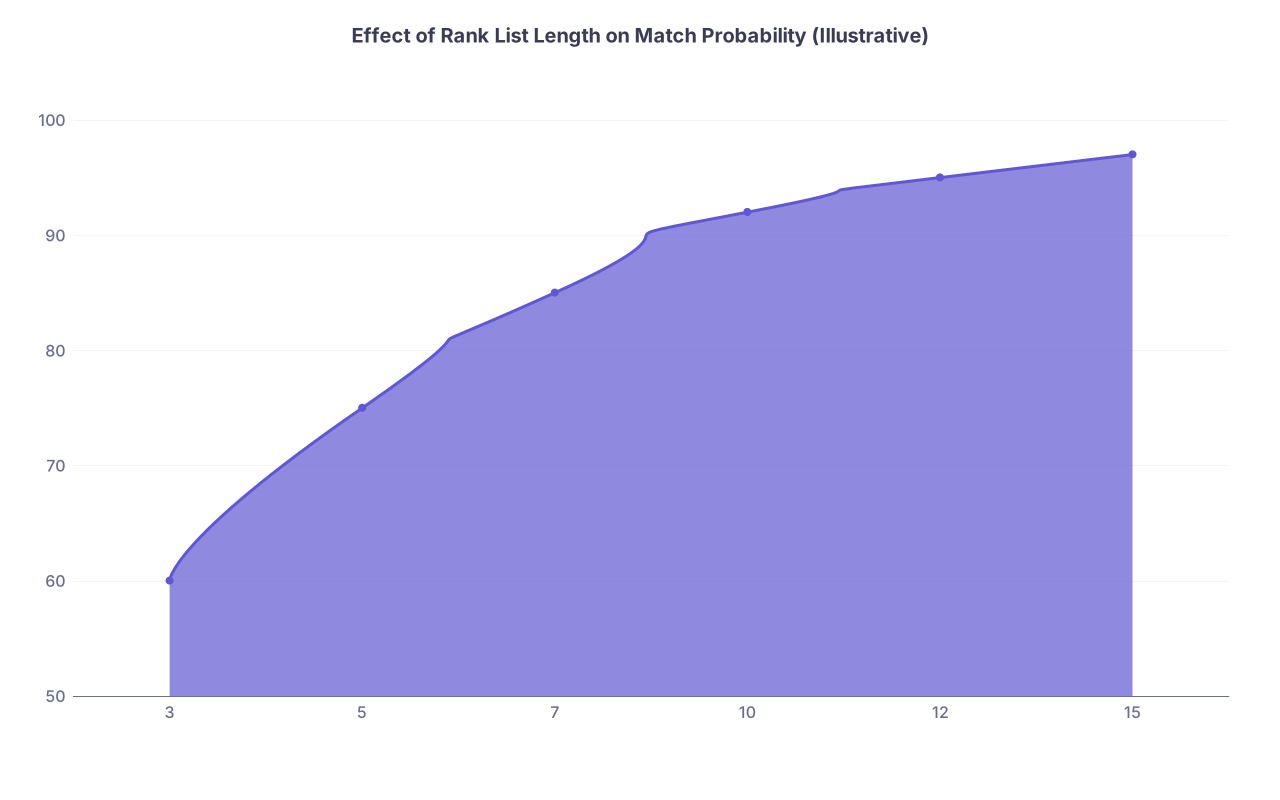
| Category | Value |
|---|---|
| 3 | 60 |
| 5 | 75 |
| 7 | 85 |
| 10 | 92 |
| 12 | 95 |
| 15 | 97 |
That curve is where your safety really comes from. Not from pretending you’re equally passionate about two unrelated fields at the same time.
A Straight Answer: Is a “Safety Specialty” Necessary?
Most of the time? No.
Let me be explicit:
- If you’re applying to ultra‑competitive specialties and you’re a borderline applicant, a genuine backup specialty might be wise — but only with a fully built, believable application in that second field.
- If you’re applying to moderately competitive fields with reasonable metrics and you’re willing to go to a range of program types and locations, your real “safety” is a long, thoughtful rank list. Not a panic‑backup.
- If you can’t imagine yourself doing the backup specialty for life, it is not a safety. It’s a future burnout story.
How to Decide Your Own Backup Strategy (Not Just Specialty)
If you want an actual framework, here it is:
Look at your numbers vs the NRMP data for your desired specialty
Don’t guess. Pull the most recent “Charting Outcomes” and compare:- Step 2 CK
- AOA / class rank if applicable
- Research productivity
- Home program presence
Talk to someone who knows your file and your field
Not just the chill resident you like. A PD, APD, or genuinely involved faculty advisor.Decide on one of three tracks:
- “All‑in primary specialty, no backup” — reasonable for strong candidates in mild/moderate fields.
- “Primary + broad geographic and program‑type spread” — most common sane approach.
- “Dual apply with real second narrative” — for borderline applicants in ultra‑competitive fields who’d truly accept that second career.
If you dual apply, commit fully to both narratives
Two complete stories. Two sets of aligned letters. Two believable interview personas. Or don’t do it.

- Build a long, honest rank list
Rank every program where you’d actually go. Remove places you truly could not tolerate for specific, serious reasons, not because the city isn’t cool enough.

| Step | Description |
|---|---|
| Step 1 | All Interviewed Programs |
| Step 2 | Remove from Rank List |
| Step 3 | Keep on List |
| Step 4 | Order by Preference, Not Perceived Odds |
| Step 5 | Submit Long, Honest Rank List |
| Step 6 | Would I Actually Go Here? |
The Bottom Line
Strip away the folklore and it comes down to this:
- A “safety specialty” is not universally necessary; for many applicants, it’s a distraction from the real safety lever: a broad, realistic, deep rank list in a well‑chosen primary field.
- Dual applying only helps when both applications are authentic, supported by aligned experiences and letters, and you’d honestly be okay matching into either.
- Unmatched risk usually tracks misalignment (field vs metrics), geographic rigidity, and short rank lists far more than the absence of some magical backup specialty.