
The biggest lie people tell anxious applicants is: “Location shouldn’t matter. Just go wherever you match.”
No. Location absolutely matters. It affects your sanity, your relationships, your support system, and honestly, your odds of getting through residency in one piece. You’re not crazy for worrying about being sent to some tiny program in the middle of nowhere with no friends, no family, and a Walmart as the only “nightlife.”
Let’s just say the quiet part out loud:
You’re scared of waking up on Match Day and realizing you’re stuck for 3–7 years in a place you actively hate.
I’ve heard the same fears over and over again:
- “What if I match somewhere my partner can’t find a job?”
- “What if I’m the only brown/Black/queer person in a very conservative town?”
- “What if I’m isolated and depressed and there’s no way out?”
- “What if I tank my chances by being too picky with location?”
So let’s unpack this mess. Because you’re walking a tightrope: wanting to protect your mental health and relationships, but also terrified that caring about geography will get you unmatched.
You’re not wrong to be worried. But you are overestimating how powerless you are.
The Myth That “You Can Do Anything for 3 Years” Is Garbage
People love saying this. Attendings who did residency 20 years ago love saying this. People with no dependents, no partner, no chronic illness love saying this.
But here’s what actually happens when location is a bad fit:
- Residents quietly crying in their cars after night float because they have no support system nearby.
- Partners stuck in towns with zero jobs in their field, slowly building resentment.
- People who are visibly “different” (race, religion, gender identity) feeling hyper-visible and unsafe in some communities.
- Folks with seasonal depression sent to places with dark winters and zero mental health infrastructure.
- Residents burning out faster because the hospital is miserable and there’s nothing restorative around them.
And then what? You’re not just “sucking it up for 3 years.” You’re dealing with:
- Worse sleep.
- Worse relationships.
- Worse mental health.
- Worse performance at work.
So no, it’s not “just 3 years.” It can be the difference between surviving residency and barely holding it together.
You’re allowed to care. The trick is to care strategically.
How Much Does Location Actually Affect Your Match Odds?
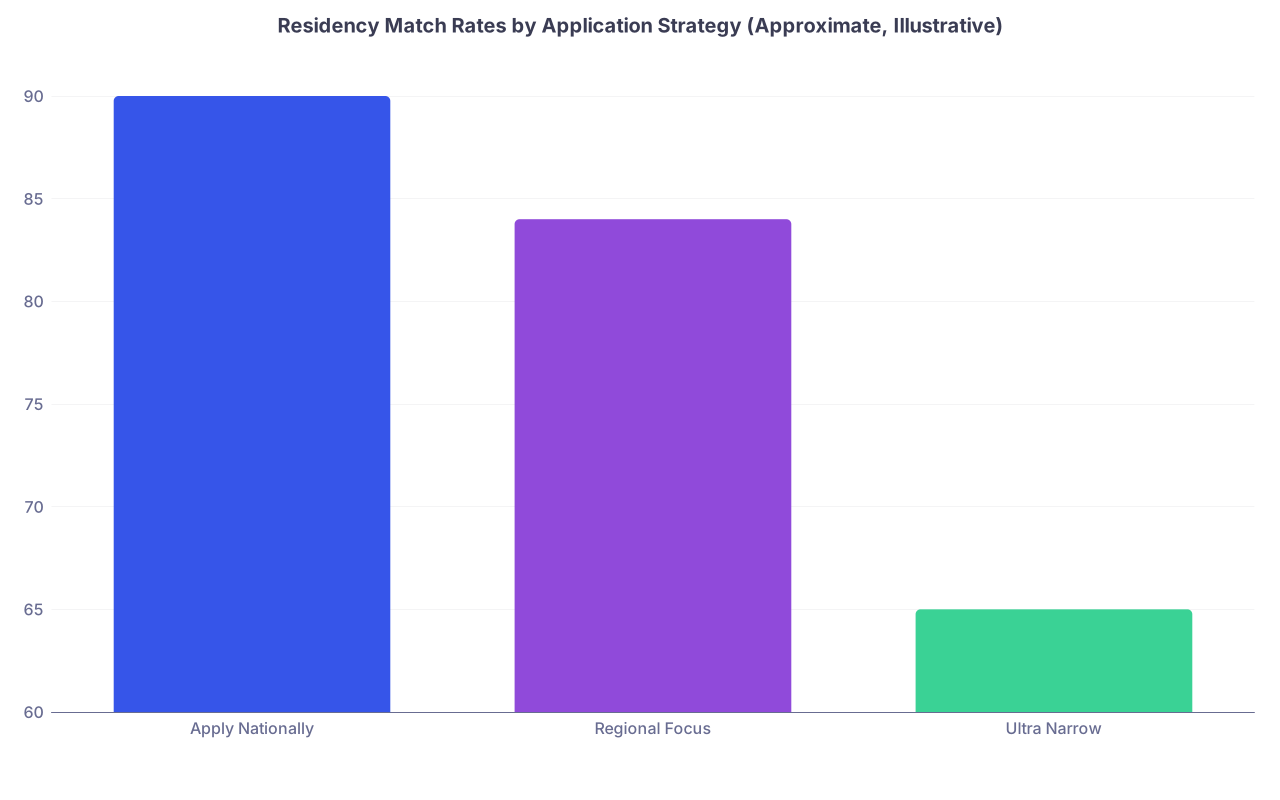
Here’s the thing your anxiety is mangling: location matters, but not in a simple “if I don’t apply everywhere, I won’t match” way.
| Category | Value |
|---|---|
| Apply Nationally | 90 |
| Regional Focus | 84 |
| Ultra Narrow | 65 |
Rough idea of patterns I’ve seen across cycles (not strict NRMP numbers, more like lived reality):
- People who apply broadly across many regions: highest match rate, but often end up somewhere random.
- People with a regional focus but not insanely restrictive: still good odds, especially if their stats and experiences align with their target programs.
- People with ultra-narrow geography (e.g., “only this one city or I’m out”): dramatically higher risk of going unmatched, unless they’re rock-star applicants or in less competitive specialties.
So your real question isn’t “Can I care about geography?” It’s:
“How narrow can I safely be with my location without putting myself at serious risk of not matching?”
That depends on:
- Your specialty (FM ≠ Derm)
- Your competitiveness (scores, red flags, research, home program)
- Your flexibility within a region (entire coast vs single city)
- Your backup plans (prelim, SOAP willingness, reapply, etc.)
Step One: Get Brutally Honest About Your Needs vs Your Preferences
You can’t let your anxiety lump everything into the same category of “If I don’t get this, my life is over.” There’s a huge difference between:
- “I’ll feel isolated and unsafe there”
- “I’d really prefer not to live there”
- “I’d be fine, just mildly annoyed”
You need to sort your geography into three buckets.
1. Non‑negotiables (True Dealbreakers)
This is a very short list. Stuff like:
- You’re a parent who must be within driving distance of your kid’s other parent due to custody.
- Your partner’s career or visa status makes certain regions impossible.
- You have a medical condition that requires access to specific specialists.
- You’re from a marginalized group and there are places where you would realistically be unsafe or constantly targeted.
You’re not being dramatic for saying “I will not live there.” But if you throw half the country into this bucket, that’s not strategy, that’s panic.
2. Strong Preferences (But Not Life-or-Death)
This is the big middle. Things like:
- “I really want to be within a few hours of family, but I could be farther if needed.”
- “I’d much rather be in an urban than rural setting.”
- “I prefer the West Coast climate, but I won’t die in the Midwest.”
These are important. They should shape where you prioritize applications, not where you allow applications.
3. Nice-to-Haves
These are comfort wishes:
- “I’d like a big airport nearby.”
- “I want hiking/skiing/beach.”
- “I’d prefer a blue state / red state but I can tolerate the opposite if the program culture is good.”
These should not control your rank list. They influence ties more than anything.
If you confuse all three buckets, you’ll either:
- Overconstrain yourself and blow up your odds, or
- Ignore your real non-negotiables and end up hating your life.
Balancing Family, Partners, and Your Actual Career
This is the part that gets messy. Because your heart wants one thing, and the Match algorithm does not care about your heart.
I’ve seen:
- Couples both go unmatched trying to force a specific city.
- Partners “take one for the team” and then simmer with resentment when they can’t work.
- People break up mid-PGY-1 under the strain of long-distance that nobody was emotionally ready for.
You’re not wrong to be terrified of that. But hiding from it won’t help. You need a plan with your people. A concrete one, not “we’ll figure it out.”

| Step | Description |
|---|---|
| Step 1 | Start: You & partner |
| Step 2 | Target overlapping regions |
| Step 3 | Define primary career priority |
| Step 4 | Create shared geographic tiers |
| Step 5 | Decide absolute no-go areas |
| Step 6 | Apply broadly within allowed regions |
| Step 7 | Revisit plan before ranking |
| Step 8 | Same field or couples match? |
Questions you actually have to ask (and answer honestly):
- If we end up long-distance, for how long is that tolerable? One year? All of residency?
- Whose career takes priority this round? Yours, theirs, equal? Equal sounds nice until reality hits.
- Would we rather:
- Be together in a location that’s not ideal for one of our careers, or
- Be in better-fit locations separately?
There isn’t a “right” answer. There’s only what you can both live with without destroying the relationship.
If you’re doing couples match, you must accept this: you are trading geographic flexibility and program prestige for the chance to be together. If you both also want top-tier cities and top-tier programs? Fine. But that’s a high‑risk bet. Go in with open eyes, not magical thinking.
How to Use Geography Strategically Without Sabotaging Yourself
Here’s the part your brain wants: “Tell me exactly how many regions I’m allowed to rule out before I’m in danger.”
I can’t give you a magic number. But I can give you a framework that doesn’t suck.
First, be honest about your competitiveness. Not in a self‑loathing way. In a cold, numbers‑and‑CV way.
| Profile Type | Specialty Example | Geographic Flexibility You Can Safely Limit |
|---|---|---|
| Rock-star (top scores, strong CV) | Derm, Ortho | Can target 1–2 regions, still risky if ultra narrow |
| Solid, no red flags | IM, Peds, FM | 2–3 regions, plus a few programs outside |
| Borderline / red flags | Any | Need broad geography, minimize no-go areas |
| Applying very competitive field | ENT, Plastics | Broader geography strongly recommended |
Then, do this:
Pick your “priority regions”
Example: “Northeast + Mid-Atlantic” or “West Coast + Mountain West.”Within those, apply very broadly
Community, academic, mid-tier, smaller cities. Don’t just shotgun the same 10 shiny name‑brand cities everyone wants.Add a smaller set of “acceptable but not preferred” programs outside your main region
This is your safety net. Places you don’t love, but could survive if that’s where you end up.Avoid listing anywhere on your ERAS or rank list that is truly a no-go.
If you cannot emotionally or practically live somewhere, don’t rank it. The worst isolation is “I did this to myself because I was scared to not rank everywhere.”
What If I End Up Isolated Anyway?
Here’s the nightmare scenario your brain keeps replaying: you match in a small city, far from family, limited diversity, region you didn’t want.
Deep breath. Say that happens. Not ideal. But it’s not a life sentence.
Real talk about what you can actually do:
- Before you start, identify residents there who look like you / live like you (parents, LGBTQ+, people of color, internationals, etc.) and talk to them frankly. They know the work-arounds and safe spaces.
- Build micro‑community aggressively early: co-residents, nurses, social workers, church/mosque/temple, hobby groups, gyms, whatever you’ve got.
- Use your vacation to go home or to your people. Yes, you’ll be tired. No, it’s not a waste. It can keep you from burning out.
- Therapy. Seriously. Especially if you already struggle with anxiety or depression and now you’re also geographically isolated.
You can also change things:
- For some specialties, you can try to transfer after PGY‑1. Hard, not guaranteed, but it happens every year.
- You can angle for fellowships in your ideal region. Residency isn’t your forever home.
- You can survive a less-than-ideal city if the program itself is supportive, humane, and you’re treated well.
I’ve seen people absolutely thrive in random places they never would have chosen for themselves, because the program culture was incredible and the city was “fine enough.” I’ve also seen people hate famous coastal cities because the program was toxic and they never saw the ocean anyway.
Which leads to this ugly truth: “Geographic isolation” can be about people more than place. A cold, cliquey program in your hometown can feel more isolating than a warm, inclusive one in a random state.
Red Flags for Programs Where You Might Feel Isolated
Location is one thing. But isolation can also come from program culture. Some signs to watch for on interview day or during social events:
- Current residents don’t hang out with each other outside of work at all.
- Nobody can name anything they like about the city besides “cheap rent” and “it’s fine.”
- Residents who share your background (racial, gender, family status, etc.) look exhausted and vague when you ask how they’re treated.
- High attrition. People leaving. Transfers. That’s not random.
- Program leadership dismisses your questions about support, wellness, or community as “you’ll be too busy to care.”
If you’re already on the edge about location and then you see cultural red flags? Don’t ignore that just because you’re scared of unmatched. You’re trading one fear for a much bigger, daily reality.
How to Make Your Rank List When You’re Terrified of Being Isolated
Here’s the ugly moment: you’ve got a mix of programs. Some in ideal locations. Some in okay ones. Some in “oh God please no but I interviewed there.”
Your brain will scream: “Rank everything or you’ll be unmatched.”
But the only programs you should rank are ones where you can say, with a straight face: “If this is where I end up, I can get through it.”
Not “I’ll be ecstatic.” Not “this is my dream.” Just: “I can function here.”
If you rank places you absolutely cannot handle, you might match there. And then what? You’re stuck, because backing out after the Match is a disaster.
So, rank in this order:
- Best combo of program fit + geography + life fit.
- Good programs in less ideal places, but still survivable.
- Solid backup programs you wouldn’t choose in a perfect world, but you can honestly manage.
Stop before you hit “places that will wreck me.” Don’t put them on your list to “be safe.” That’s not safety.
FAQ (Exactly 5 Questions)
1. Will limiting my application to 1–2 regions automatically tank my chances of matching?
Not automatically, but it raises your risk. If you’re a solid applicant in a less competitive specialty and your regions include a decent number of programs (not just 3 shiny ones), you can be regionally focused and still match. If you’re applying to something very competitive or you have red flags, a tight geographic limit is dangerous. The narrower your region AND the more competitive your field, the more you’re playing roulette.
2. Is it ever reasonable to say “I would rather not match than live in X area”?
Yes, if X is truly unsafe or unworkable for you—because of custody, health, safety, or identity‑related reasons. If what you really mean is “I’d be very unhappy but could probably survive,” then you’re not talking about a true non-negotiable; you’re talking about a strong preference. Only you can decide where that line is, but don’t lie to yourself in either direction. Both over‑dramatizing and minimizing are dangerous.
3. How do I talk about geographic preferences in interviews without sounding inflexible?
Be honest but not rigid. Say things like: “My support system is primarily in [region], so I have a strong interest in training there, but I’m applying broadly because program fit is also important to me.” That shows you care about location but aren’t delusional about how the Match works. Don’t say: “I’m only ranking programs in [tiny area]” or “I refuse to leave [city].”
4. What if my partner and I disagree about how much we’re willing to compromise on location?
Then you have a relationship problem, not an application problem. You two need to decide before rank lists what you’re actually willing to do—together or apart. If they say “I’ll follow you anywhere” but then you both rank only your dream city, that’s not following you anywhere; that’s gambling. You’re better off having a painful, honest talk now than an explosive one after the Match.
5. I’m already feeling depressed about possibly ending up isolated. Does that mean I shouldn’t apply broadly?
It means you should take your mental health seriously while you apply broadly. Apply where you need to to protect your match chances and don’t rank anywhere you truly cannot cope. Simultaneously, set up support: therapy, honest conversations with loved ones, realistic expectations. Your brain wants a guarantee of “no isolation ever.” You won’t get that. What you can get is: “If I end up somewhere hard, I’ll have tools and people to help me survive it.”
If you remember anything, make it this:
- You’re not dramatic or weak for caring about where you’ll live for the next 3–7 years.
- You can care about geography and protect your match odds—if you’re honest about your competitiveness and your true non‑negotiables.
- Never rank a program you know will break you, no matter how scared you are of going unmatched. The Match ends one day. Living with the consequences doesn’t.