
The worst way to talk about specialty switching in residency interviews is to pretend it never happened.
If you are changing specialties—or even just pivoting from a previous strong interest—interviewers will notice the shift. They read your personal statement. They saw your previous ERAS applications (if you applied before). They talk to each other. Trying to dodge or sugarcoat this is exactly how applicants torpedo otherwise solid chances.
Let me walk you through the most common mistakes I see when people talk about specialty switching in interviews, and how to avoid sounding flaky, deceptive, or directionless.
Mistake #1: Acting Like Your First Specialty Was a “Phase”
This one kills credibility faster than a low Step score.
You sit down in an internal medicine interview after previously aiming hard for ortho. The PD or faculty asks, “So I see you had a strong interest in orthopedics last cycle. Tell me about your decision to pursue internal medicine.”
And you say something like:
- “I realized I was never really that interested in ortho.”
- “I don’t know, I just kind of changed my mind.”
- “I think IM is a better lifestyle.”
That’s the wrong answer every time. It signals three things you do not want attached to your name:
- Poor self-awareness
- Poor decision-making
- Shallow commitment
Medicine is built on the assumption that your judgment evolves, yes—but not that it flips overnight without a story. If you claim your previous interest was basically fake, then everything you say now could also be fake.
The safer, stronger approach: respect your past choice.
You do not have to trash your old specialty. In fact, you shouldn’t. You’re better off framing it like this in your own words:
- What genuinely drew you to the first specialty (details, not vague “I like procedures” fluff)
- What you learned from actually seeing it up close (clerkship, sub-I, research, shadowing)
- The specific experiences that shifted your understanding of what you want long term
- How that led you to your current specialty in a way that actually makes sense
Bad: “I realized ortho surgery wasn’t for me.”
Better: “I loved the anatomy and the tangible outcomes in ortho, and that’s what pulled me in initially. But during my sub-I, I noticed that what I enjoyed more than the OR time were the complex medical problems and longitudinal follow-up on the wards. I found myself more energized on the medicine consults than in the OR itself. That’s when internal medicine started to feel like a better fit.”
See the difference? You’re not saying you were wrong before. You’re saying you learned, refined, and corrected course. Big distinction.
Mistake #2: Blaming People Instead of Owning the Pivot
If you start your switching story with, “Well, my advisor told me I wasn’t competitive for derm,” you’ve already lost ground.
Blame-based stories sound like:
- “My school didn’t support me.”
- “My letter writers didn’t help.”
- “The PD in that department was toxic, so I left.”
- “They told me I’d never match that specialty, so I had to switch.”
Interviewers hear this and immediately think: this person externalizes everything. If something goes wrong during residency, it will always be someone else’s fault. That is a liability.
You can absolutely talk about competitiveness, reality checks, and mentorship. But you must avoid the tone of victimhood.
Bad framing:
“I wanted ENT but my school doesn’t have an ENT program, so I had no chance and had to switch.”
Better framing:
“I was initially very interested in ENT, and I did seek out experiences and mentors. As I learned more about the match statistics and my own profile, I realized that the path would likely involve one or two gap years plus a heavy research commitment. In weighing that against what I enjoyed most day to day—especially on my medicine and ICU rotations—I decided that internal medicine actually aligned more with both my interests and my long-term goals.”
You’re allowed to say:
- “I reassessed my competitiveness.”
- “I took an honest look at my application and the match data.”
- “I realized that I didn’t want to commit several additional years to research.”
You’re not allowed (if you want to match) to sound like the universe forced you into this specialty against your will.
Mistake #3: Pretending the Switch Came Out of Nowhere
Randomness is your enemy.
A sudden, unexplained switch from OB/GYN to psychiatry with zero story behind it? That terrifies programs. Because sudden, unexplained choices are how people end up leaving residency mid-year.
The red flag: a narrative that jumps straight from “I always wanted X” to “So now I’m applying to Y” with nothing in between. No rotation turning point, no specific patient, no mentorship, no slow build in interest. Just a flip.
You need a timeline. It doesn’t have to be dramatic or cinematic. It just has to be coherent.
Interviewers want to understand:
- When did you first become interested in the original specialty?
- When did you start to question it?
- What experiences started shifting your thinking?
- When did you seriously consider the new specialty?
- What did you do to confirm this wasn’t just a momentary impulse?
If you can’t outline that arc, it sounds like impulse, not growth.
Here’s what does not work:
“I just woke up during 4th year and realized psychiatry would be better.”
Here’s a more credible version:
“During third-year, I really thought OB/GYN would be my path, especially after enjoying my OB rotation. I liked the OR time and the intensity. But on my psych consult and inpatient psych rotations later that year, I found myself constantly thinking about those patients even after I left the hospital. I kept reading, asking follow-up questions, and talking about those cases. Over the next few months, I sought out an outpatient psych elective and met with a few psychiatry attendings to understand the field better. By the end of that process, it was clear to me that psychiatry was a much better match for how I like to think and work.”
Specific. Gradual. You can see the line from point A to point B. That’s what you want.
Mistake #4: Offering a Story with Zero Evidence Behind It
Here’s a brutal truth: if you say you’re now “passionate” about a new specialty but your ERAS looks empty for that specialty, people will doubt you.
No letters. No electives. No sub-I. No research. No student interest group involvement. No mentor.
Then you sit in front of a PD and swear, “I’ve always been interested in family medicine.” They’re staring at a CV that screams, “Did three ortho rotations and a spine research year.”
This doesn’t mean you’re doomed. It means you need to be smart and honest.
Interviewers are thinking:
- What has this person actually done to test this new interest?
- Did they scramble into the first “backup” specialty they could find?
- Will they leave if they get another opportunity in the original field?
You need to be able to say what you did after your pivot:
- Rotations: “I did an audition rotation in ____ to confirm my interest.”
- Mentorship: “I sought out a mentor in this field and met regularly to understand the work.”
- Reading/independent learning: “I started following ___ journal, listening to ___ podcast, or working through ___ cases.”
- Concrete changes in your plans: “I shifted my research from X to Y,” or “I took on quality improvement work on the ___ service.”
If all you have is “I thought about it a lot and feel really sure”… that’s weak. You need actions.
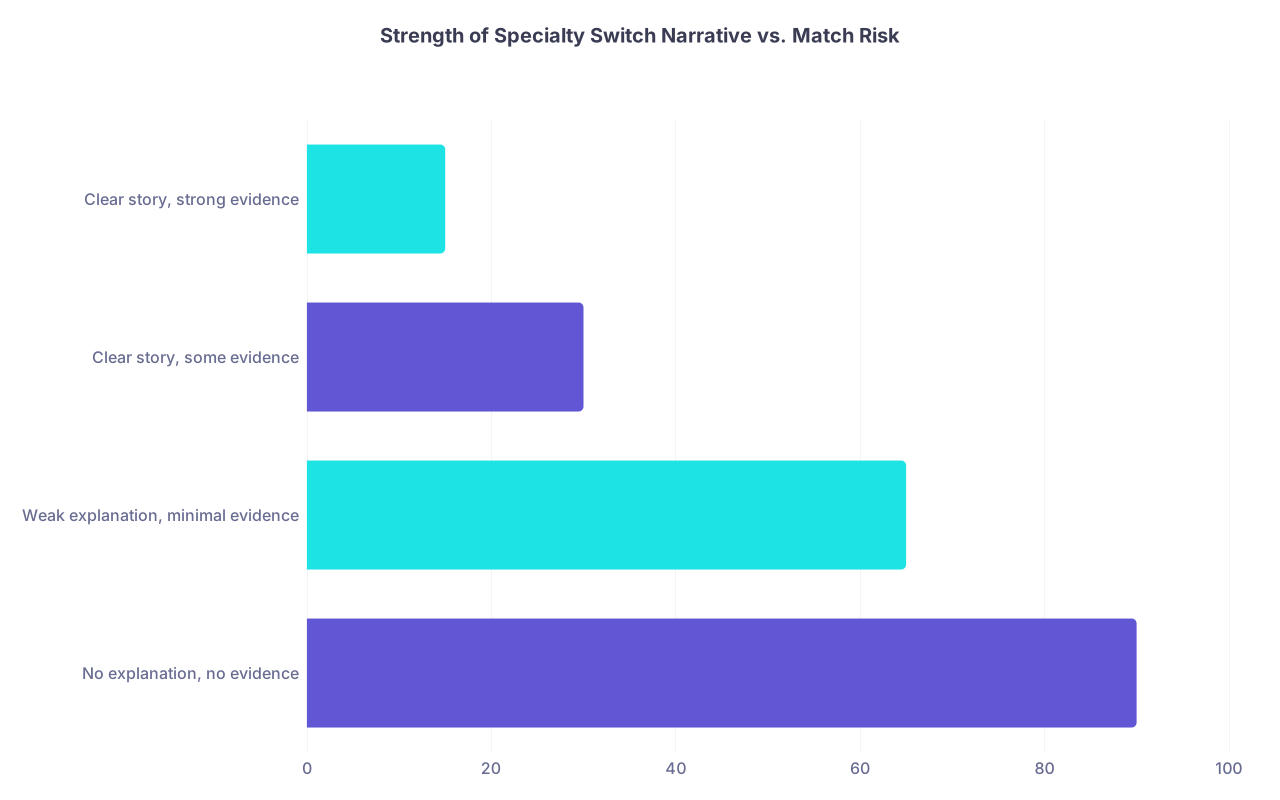
| Category | Value |
|---|---|
| No explanation, no evidence | 90 |
| Weak explanation, minimal evidence | 65 |
| Clear story, some evidence | 30 |
| Clear story, strong evidence | 15 |
The higher the bar, the higher the perceived risk of you as an applicant. You want to live in the “clear story, strong evidence” zone.
Mistake #5: Over-Explaining. Or Under-Explaining.
Both extremes are dangerous.
Under-explaining sounds evasive. Over-explaining sounds defensive.
Under-explaining examples:
- “Yeah, I initially thought about anesthesia but realized this was a better fit.”
- “I changed my mind between third and fourth year.”
- “I just felt more at home here.”
Those are half-answers. Every PD has heard them a thousand times. They invite follow-up questions because they don’t actually say anything.
Over-explaining examples:
- A 5-minute monologue with your entire life story and ten patient anecdotes
- Detailed recounting of every political issue inside your old department
- Emotional oversharing about burnout, conflict, or “toxic” seniors
The interviewer’s internal reaction: “This sounds chaotic. This person might bring drama.”
You want a tight, 60–90 second core story. Then you can expand if they ask.
Structure it like this:
- One or two sentences: what originally drew you to the first specialty.
- Two to four sentences: what you experienced that made you question it.
- Two to four sentences: how you explored the new specialty and what confirmed the fit.
- One or two sentences: why you’re confident about this choice now and what you’re looking for in training.
Delivered calmly, without drama.
If the interviewer wants more, they’ll ask. Then you can go deeper. But do not start with a 10-minute TED talk about your identity crisis.
Mistake #6: Trashing Your Old Specialty (or Old Program)
This one’s ugly, and I’ve seen it sink people in real time.
You’re in a pediatrics interview and you say:
- “Surgery people are all jerks.”
- “The lifestyle in EM is just insane and everyone is burned out.”
- “Radiology was boring, I couldn’t stand sitting all day.”
You think you’re bonding with your interviewer. You’re not. You’re broadcasting that you’re comfortable disrespecting colleagues and using broad stereotypes.
It’s even worse if you’re switching from a prior residency. If you say:
- “The program was toxic.”
- “The attendings didn’t care about teaching.”
- “They didn’t support me at all.”
Every interviewer immediately imagines you saying the same about them next year. And wonders what your prior PD wrote in your letter.
You can convey that a place or specialty wasn’t a fit without trashing it.
Bad:
“General surgery is miserable. I don’t know how anyone does it.”
Better:
“I’m grateful for the time I spent in general surgery residency; it taught me a lot about acute care and handling high-pressure situations. Over time, though, I realized that the aspects I enjoyed most were the longitudinal clinical decision-making and outpatient continuity. That’s what ultimately led me to pursue internal medicine instead.”
Respectful. Honest. No grenades.
Mistake #7: Making It All About Lifestyle (Even If That’s True)
Let me be blunt: if your switching story is 90% “lifestyle,” programs get nervous.
Do people switch for lifestyle? Of course. All the time. But if you sit there and say:
- “I didn’t want to work that hard.”
- “I wanted more time off.”
- “I wanted a chill specialty.”
You just told a PD you might not grind when it matters. And it will matter.
You can absolutely reference work–life balance and sustainability. You just have to anchor it in professional identity and fit, not in sounding lazy.
Bad:
“I switched from surgery because the hours were just too much.”
Better:
“During my time in surgery, I realized that while I could handle the hours, I didn’t see myself thriving in that environment over a 30-year career. I found that I missed the cognitive side of medicine and longer-term patient relationships. In [new specialty], I still expect to work hard, but the nature of the work and the schedule structure feels more sustainable for how I want to practice.”
Notice: you’re not saying, “I wanted to work less.” You’re saying, “I want to work hard in a way that matches who I am and what I can sustain.”
Subtle but crucial.
Mistake #8: Dodging the “Will You Try to Go Back?” Question
If you’re switching from a competitive field—ortho, derm, ENT, plastics, neurosurgery—programs in your new field will wonder if you plan to jump ship later.
Wrong move: evading the question or giving a vague, noncommittal answer.
Interviewer: “Do you see yourself ever going back to [original specialty]?”
You: “You never know what the future holds…”
Translation: “Yes, absolutely, and I’ll leave the minute I can.”
You need to shut this door clearly without sounding fake.
Stronger response:
“I’ve thought a lot about that, especially given how invested I was in [original specialty] earlier. After actually working in both environments, talking with mentors, and reflecting on what kind of day-to-day work energizes me, I’m fully committed to building a career in [new specialty]. I’m not using this as a bridge back; I’m looking for a program where I can train fully and stay in this field long term.”
You’re allowed to have changed your mind. You’re not allowed—if you want people to trust you—to sound like you’re still half in, half out.
Mistake #9: Ignoring the Data and Competitiveness Piece
There’s another way applicants mess this up: they pretend competitiveness was not a factor when it clearly was.
If you had a 220 Step 1, weak research, and were originally “derm or bust,” everyone in that room knows you didn’t just “grow out of it.” They know you got realistic.
Lying or acting oblivious insults their intelligence.
You don’t have to say, “I wasn’t good enough.” That sounds self-punishing and insecure. But you can say:
“I did take a hard look at my application and the match data for [original specialty]. While I was initially attracted to that field, when I compared the type of work I enjoyed most on rotations and my realistic trajectory, it became clear that [new specialty] was not only a better fit for my interests, but also a field where I could build the kind of practice I want without committing multiple additional years to research or prelim work.”
That’s honest, mature, and not self-destructive.
| Explanation Style | How Programs Perceive You |
|---|---|
| “I just changed my mind” | Impulsive, shallow, risky |
| “They said I’d never match X” | Blame-shifting, insecure |
| “I reassessed after real experience” | Thoughtful, maturing |
| “Lifestyle only” | Possibly lazy or unrealistic |
| “Fit + evidence + clear timeline” | Safe bet, stable choice |
Mistake #10: Not Practicing the Story Until It’s Boring
The last major mistake: winging it.
You think, “I lived this, I can just talk about it.” Then in the actual interview, your story comes out rambling, emotional, inconsistent, or different each time. That inconsistency is a red flag.
Programs do compare notes after interview day. If you told one interviewer you changed your mind last summer, and another that it was during third year, someone is going to notice.
You need your core story:
- Same skeleton every time
- Same timeline
- Same key turning points
Then you adapt the emphasis depending on who you’re talking to.
For a PD: focus on maturity, stability, what you’ve done to commit.
For a faculty in the field: highlight the clinical cases and aspects of the specialty that draw you.
For a resident: you can be a bit more personal, but still consistent.
If you haven’t said it out loud 15–20 times before interview day, you’re not ready. You’ll find yourself oversharing, minimizing, or getting thrown off by one tough follow-up question.
Practice to the point where it feels boring to you. That’s when it starts sounding confident and clear to them.
A Simple, Safe Framework for Talking About Your Switch
Let me give you a bare-bones template you can adapt. Don’t recite it verbatim; that will sound robotic. But use it as a spine.
Past:
“I was initially drawn to [original specialty] because [specific reasons, not generic]. I pursued that through [rotations, research, mentors].”Pivot:
“During [time period], I started to realize that the aspects I enjoyed most were actually [X, Y, Z], and I found myself more engaged on [other rotations/consults/electives].”Exploration:
“So I deliberately explored [new specialty] through [sub-I, elective, mentorship, reading, projects], and the more I experienced, the more it fit with how I like to think and work.”Present commitment:
“At this point, I’m confident that [new specialty] is where I want to build my career. I’m looking for a program where I can [specific goals], and I’m not viewing this as a stepping stone back to [original specialty].”
That hits the main landmines: respect for the past, explanation of the pivot, evidence of exploration, clear commitment now.
Your Next Step
Open a blank document right now and write out—in full sentences—your specialty switching story in under 200 words.
Then ask yourself, ruthlessly:
- Do I sound impulsive, bitter, or like a victim anywhere?
- Is there at least one concrete experience that explains my switch?
- Did I clearly show what I did to confirm the new choice?
- Would a PD trust that I’m not going to bail in a year?
If the answer to any of those is “no,” rewrite it until it is. Then read it out loud three times. That’s your baseline.