
It is late June of MS3. Your clerkship shelf just ended, your classmates are talking about away rotations and personal statements… and you just got your score back.
Fail.
Whether it is Step 2 CK, COMLEX Level 2, or a retake of Step 1, you are now sitting in the worst combo possible:
- A failed board exam
- ~90 days until ERAS opens (and not much more until programs start downloading)
You feel behind. You feel exposed. You are wondering if this sunk your match.
Let me be blunt: this is a serious red flag. Programs notice. Some will auto-screen you out. But it is not an automatic death sentence if you handle the next 90 days like a professional, not a panicked student.
What follows is a strict, time-based plan: month-by-month, week-by-week, and then day-level structure for the critical stretches. At each point I will tell you:
- What to prioritize
- Who to talk to
- What to put in writing (and what not to)
You are on a clock. Let us use it.
Global Overview: Your 90-Day Window
First, anchor the big picture.
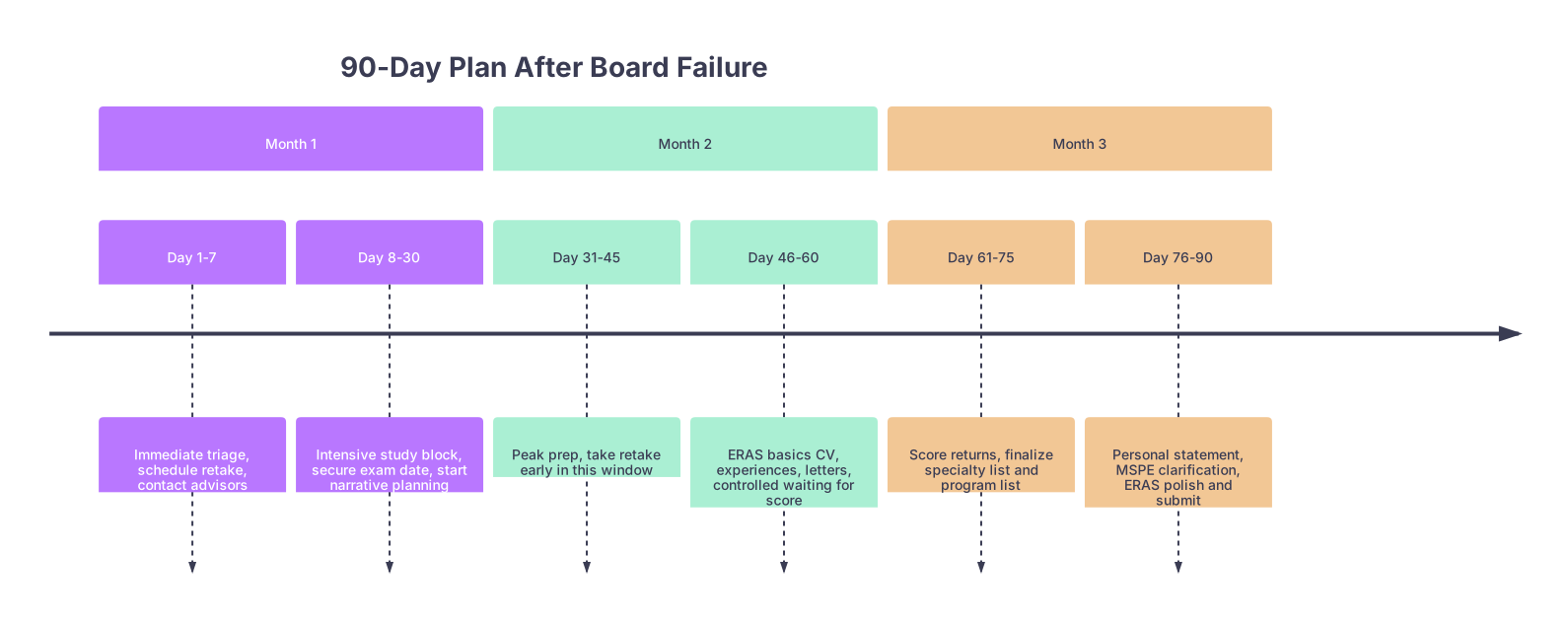
| Period | Event |
|---|---|
| Month 1 - Day 1-7 | Immediate triage, schedule retake, contact advisors |
| Month 1 - Day 8-30 | Intensive study block, secure exam date, start narrative planning |
| Month 2 - Day 31-45 | Peak prep, take retake early in this window |
| Month 2 - Day 46-60 | ERAS basics CV, experiences, letters, controlled waiting for score |
| Month 3 - Day 61-75 | Score returns, finalize specialty list and program list |
| Month 3 - Day 76-90 | Personal statement, MSPE clarification, ERAS polish and submit |
Your non-negotiable priority:
A clear pass with significantly higher score on your retake, before ERAS is reviewed by most programs.
Everything else (research, extra volunteering, last-minute leadership) is secondary. If your next score is weak or delayed, all the perfect formatting in ERAS will not rescue you.
Month 1 (Days 1–30): Immediate Damage Control + Retake Setup
At this point you should stop thinking about “how bad this looks” and start running a playbook.
Days 1–3: Triage and Reality Check
You have your failing score in front of you. You feel sick. Do this anyway.
1. Get actual numbers in front of you
- Write down:
- Your failed score (e.g., Step 2 CK 203 fail)
- Your previous scores (Step 1 / Level 1, NBME practice tests, shelf percentiles)
- Your target retake date (back-calculated from ERAS deadlines)
2. Loop in the right people – quickly
Within 72 hours, you should have spoken (not just emailed) with:
- Dean of Student Affairs / Academic Support
- Clerkship Director or Career Advisor in your intended specialty
- A trusted attending or mentor who knows your clinical work
Your questions are concrete:
- “I failed [exam] with a score of X. Historically at this school, what have successful re-applicants done?”
- “What exam timing do you recommend so the new score appears before most programs review applications?”
- “Given my clinical evals and this failure, is [specialty] still realistic, or should I build a parallel plan?”
Do not hide this. I have seen students wait 3–4 weeks out of shame. That delay cost them a cycle.
3. Schedule the retake
Within these first few days you should have:
- A scheduled retake date (or the earliest possible window if systems are backed up)
- A weekly study-hour target that fits around any remaining rotations
Your retake timing goal:
- Ideal: Take the retake 40–60 days from today, so the score posts before or near ERAS opening / early review
- Risky but sometimes necessary: Up to ~70 days, but then some programs may not see the score in time
Days 4–10: Forensic Autopsy of Your Failure
Yes, an autopsy. Not just “I guess I did not study enough.”
You need to know whether this was:
- A knowledge/content problem
- A test-taking/exam strategy problem
- A life chaos / burnout / mental health problem
- Or some combination
1. Data review
Pull:
- Your score report breakdown (discipline and system-level bars)
- NBME or COMSAE practice test scores and trajectories
- Any question bank performance (percentage correct, weak categories)
You are looking for patterns like:
- “UWorld average 48%, plateaued for 3 weeks”
- “NBMEs never above passing; took exam anyway”
- “All biostats and ethics in the red”
2. Decide the primary failure mode
At this point you should be brutally honest:
- If you were at <55% correct on reputable Qbanks and practice scores below passing, this was mostly misjudgment of readiness
- If your practice tests were borderline passing or slightly above but the real scored exam tanked, suspect:
- Test-day anxiety / poor stamina
- Timing, second-guessing, over-marking questions
- If certain content blocks are bright red (e.g., neuro, renal, OB), then you have a content gap that must be repaired systematically
Document this in 3 bullet points. This will later shape your study plan and your future explanation to programs.
Days 11–30: Build and Execute the Intensive Study Block
At this point you should be in monk mode.
Primary objective: Position yourself to pass comfortably and, if possible, overshoot the passing threshold by 15–25+ points.
Weekly Structure (Weeks 2–4)
Aim for 45–60 focused study hours per week, assuming you negotiated lighter clinical duties or a short leave. If you are still in full-time rotations, you must either:
- Push for protected time / elective
- Or seriously consider delaying application cycle (hard truth, but a second failure is worse)
A typical high-intensity week:
- Daily (6 days/week):
- 80–120 Qbank questions in timed random blocks
- 2–3 hours targeted content review (videos, Anki, notes)
- 30–45 minutes test-taking strategy (review of missed questions, patterns)
- Once weekly:
- NBME / COMSAE / practice test under real conditions
- Full debrief: error log, topic list for the week
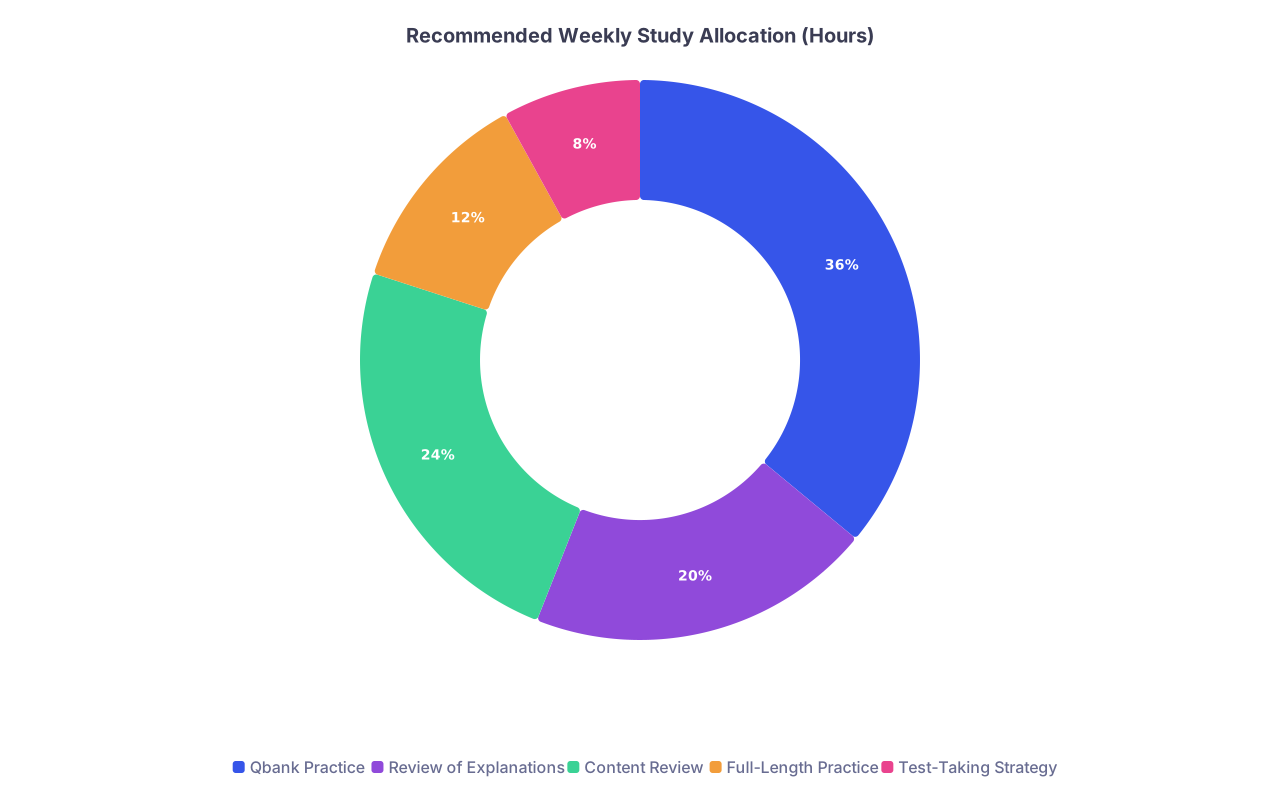
| Category | Value |
|---|---|
| Qbank Practice | 18 |
| Review of Explanations | 10 |
| Content Review | 12 |
| Full-Length Practice | 6 |
| Test-Taking Strategy | 4 |
What you should change this time
If you failed once, your old method was not good enough. Do not just “do more of the same.”
Examples of necessary upgrades:
- Switch from passive reading to aggressive question-based learning
- Add a tutor or coach if:
- Your baseline is low
- You have already failed once
- You cannot objectively identify your own patterns
- Hard rules:
- No “reviewing” by just watching videos at 1.5x without active recall
- Every missed question must be classified: knowledge gap vs. misread vs. overthinking vs. time pressure
By Day 30, you should have:
- 2–3 fresh practice test scores showing a clear upward trend, ideally passing or very close
- A firm retake date in the 10–20 days ahead
- An advisor or tutor who agrees you are on track
Month 2 (Days 31–60): Retake, ERAS Skeleton, and Controlled Panic
This is the squeeze period. Two competing demands:
- Peak performance on the retake
- Not falling behind on ERAS infrastructure
Days 31–45: Peak Prep and Retake
At this point you should lock in.
10-Day Exam Run-Up
Here is a day-level template for the final 10 days before your retake.
- Days -10 to -7:
- 2 blocks of 40 Qs timed per day
- 1 practice exam in this window (NBME/COMSAE)
- Identify last 3–5 major weak systems; schedule targeted review
- Days -6 to -4:
- 1 block of 40–80 Qs per day, still timed
- Heavy review of biostats, ethics, and common traps
- Sleep schedule normalized; caffeine use stabilized
- Days -3 and -2:
- Lighter: ~40 Qs max, mostly review
- Revisit error log, high-yield tables, formulas
- No new resources
- Day -1:
- 0–20 questions, if any
- Focus on logistics: route to the testing center, snacks, timing
- Intentional downtime; you want a calm brain, not a crammed one
If you are still taking 200+ questions two days before the exam, you are cramming, not mastering.
Test Day
Basic, but people still mess it up:
- Arrive early, food prepped, earplugs if allowed
- Hard time rule: if you are stuck at 60 seconds, you must move on
- Do not change answers without a concrete reason (“I misread”, “I realized X contradicts Y”). Vague feelings do not count.
Once the retake is done, you shift into dual-track mode:
- Recovery and rest
- Early ERAS preparation
Days 46–60: ERAS Infrastructure While You Wait for Your Score
Score reporting will take 2–4 weeks. You cannot accelerate that. You can control how ready you are when it drops.
At this point you should not be writing the final personal statement “board failure story.” You do not yet have the key fact: your improvement.
What you can and must do:
1. Build the ERAS skeleton
- Update CV: all experiences, leadership, research, volunteering through MS3
- Draft ERAS Experiences entries:
- Clear descriptions emphasizing clinical performance, reliability, teamwork
- Avoid overcompensating by stuffing in low-value fluff activities
- Start Program List v1.0:
- Categorize into Reach / Core / Safety
- For those with known board cutoffs, mark which ones will be sensitive to your failure
| Tier | Characteristics | Your Volume Target |
|---|---|---|
| Reach | Highly competitive, strong cutoffs | 10–20% of list |
| Core | Solid mid-tier, more holistic review | 50–60% of list |
| Safety | Community / less competitive, DO-friendly or IMG-friendly if relevant | 20–30% of list |
2. Lock in Letters of Recommendation
This is where your clinical reputation can mitigate a board red flag.
At this point you should:
- Identify 3–4 attendings who:
- Have seen you work hard on wards
- Can credibly say you are reliable, teachable, and clinically strong
- When asking, give them context (briefly and professionally):
- “I had a setback with a board exam earlier this year, which I have retaken. I am committed to [specialty] and would value a letter that speaks to my clinical performance and resilience.”
You are not asking them to comment on your score. You are asking them to counterbalance it.
3. Decide on Specialty Strategy (With Contingencies)
By the end of Day 60, you should have:
- A primary specialty decided
- A realistic sense of whether you need:
- A less competitive backup specialty
- Or a true parallel application (two specialties)
If you failed Step 2 CK and want dermatology with no publications, no home program, and mediocre clinical comments, someone needs to tell you “no.” That “someone” should be you, with advisor input.
Month 3 (Days 61–90): Score Returns, Narrative Control, and ERAS Submission
This is where the whole thing can pivot from “probably not matching” to “realistic shot at a decent program.”
Days 61–70: Score Day and Immediate Response
The email lands. Your heart rate spikes. Two main scenarios.
Scenario A: Significant Improvement and Pass
Example: Failed Step 2 CK with a 202. Retake: 232.
At this point you should:
Meet with your dean / advisor within a week
- Ask explicitly how this will be framed in the MSPE
- Request that the trajectory is highlighted:
- “Student initially struggled but showed substantial improvement with a passing score of X on the second attempt.”
Lock in your specialty choice
- With a 20–30 point jump and strong clinicals, many core specialties remain realistic: IM, Peds, FM, Psych, Neuro, etc.
- For highly competitive fields, you may still apply, but you must also apply broadly to safer specialties or programs.
Draft your explanation strategy
This is not a full confession. It is a concise, professional account. Your core message:
- You identified the failure early
- You analyzed the causes
- You made concrete changes
- You improved substantially
Scenario B: Barely Passing or Small Improvement
Example: Failed at 203. Retake 214.
Now it is more serious.
At this point you should:
Have a hard conversation with your dean and specialty mentor:
- “With this score profile and a prior fail, which specialties remain realistic?”
- “Should I adjust to [less competitive specialty] this cycle?”
- “Are there programs known to be more forgiving about board history?”
Consider application volume and breadth:
- You will likely need to apply to more programs than average
- You may strategically emphasize:
- Strong clinical comments
- Community service
- Any non-academic strengths that fit certain program missions
Double down on polished, humble, accountable narrative. No excuses. No blaming.
Days 71–80: Personal Statement, MSPE Coordination, and Final Program List
At this point you should be turning your story into something programs can process in 30 seconds.
1. Personal Statement: Where and How to Mention the Failure
You have two options:
- Option 1: Direct but Brief Mention (Preferred)
- Option 2: Defer detailed context to MSPE / Dean’s letter and just signal growth
A clean, effective pattern inside your personal statement:
1–2 sentences acknowledging the event:
“During my third year I failed my initial attempt at Step 2 CK. That result forced me to re-evaluate my study approach and time management. I sought mentorship, changed my preparation strategy, and on my second attempt I earned a score of [X], reflecting the progress I made.”
Then you pivot immediately to what you changed and how you practice differently now:
- More systematic learning
- Early asking for help
- Taking responsibility under pressure
What you do not do:
- Blame family emergencies for the entire thing
- Write three paragraphs about your anxiety
- Center your whole application on the test failure
Board failure is part of your story. It is not your entire identity.
2. Coordinate with MSPE / Dean’s Letter
At this point you should:
- Request to see the MSPE section (if your school allows it) related to academic issues
- Confirm:
- Language is factual and neutral, not dramatic
- The improvement is explicitly mentioned
If your school is supportive, they will often include something like:
“After an initial unsuccessful attempt at Step 2 CK, the student engaged with academic support resources, modified their preparation, and subsequently passed with a significantly improved score.”
That sentence matters. Program directors read it.
3. Finalize Program List
Based on your full profile (scores, clinical evals, research, red flags), do a final program distribution.
For a prior board failure, I usually recommend:
- Core specialties (e.g., IM, FM, Peds, Psych):
- Aim for 60–80+ total programs, depending on geography flexibility
- More competitive specialties:
- Apply broadly, but understand many will filter you out automatically
At this point you should also:
- Give slightly more weight to:
- Community programs
- Institutions with a history of taking students from your school
- Programs that explicitly value “holistic review”
Days 81–90: ERAS Polish, Application Submission, and Communication Plan
The final stretch. No more major content changes. This is presentation and timing.
1. ERAS Final Pass
Go through your application like a skeptical program director.
At this point you should:
- Remove:
- Fluffy, low-commitment activities that look like padding
- Overdramatic language around your failure
- Emphasize:
- Concrete achievements (Ex: “Honors in IM and Surgery”)
- Sustained involvement (multi-year roles)
- Any recognitions or awards
Have one harsh reviewer (not your nicest friend) read your entire application and personal statement specifically looking for:
- Redundancy
- Self-pity
- Vague language
2. Decide How You Will Answer “Tell Me About the Failure” in Interviews
You will be asked. If they interview you, they already know. They want to hear your thinking.
Have a 90-second script roughly like this structure:
- Fact: “I failed my first attempt at Step 2 CK.”
- Ownership: “I underestimated how much focused prep I needed while on heavy rotations and did not seek help early enough.”
- Action: “After that result, I met with academic support, changed to a question-based approach, tracked my NBME scores, and adjusted my schedule.”
- Outcome: “On my second attempt I passed with a score of X, which better reflects my current knowledge base.”
- Reflection: “The process changed how I approach weaknesses. I now ask for help sooner and build more realistic plans, which has improved my performance on the wards as well.”
Practice this answer out loud. Not robotic. Just steady.
3. Submit ERAS Strategically
You do not gain points for being the first application at 7:00 AM on opening day. You lose points for submitting a rushed, typo-filled mess.
At this point you should:
- Submit once everything is clean and your retake score is reported (or at least pending with a clear date and explanation)
- Inform any key mentors / letter writers that you have applied, and thank them
What You Should Do Today
You are somewhere in this 90-day arc. Your exact date does not matter. Your next concrete step does.
Do this right now:
- Open a blank document.
- At the top, write: “Board Failure Recovery Plan – [Your Name] – 90 Days”
- Create 3 headings: Month 1, Month 2, Month 3.
- Under Month 1, list three actions you will complete in the next 72 hours:
- Schedule retake or confirm date
- Email dean / advisor for a meeting
- Pull and review all prior practice test data
Then put those three tasks in your calendar with actual times.
You are not fixing a red flag in theory. You are running a 90-day operation. Start the clock.