
The biggest red flag in a residency application isn’t always your leave of absence. It’s how chaotically you come back from it.
If you handle your return like an afterthought—no timeline, no coordination, no narrative—you practically gift programs a reason to screen you out. But if you plan the year deliberately, week by week, you can turn “LOA” from a silent alarm into a controlled, honest, and sometimes even compelling part of your story.
I’m going to walk you through exactly what to do—from the moment you decide to return, all the way to Match Week—so that by each point in time you know: “Here’s what I should be doing right now.”
6–12 Months Before Your Planned Return: Stabilize and Strategize
At this point you should stop thinking vaguely about “coming back someday” and commit to a specific return term.
Step 1: Lock in your return date and status
You need three clear answers:
- When exactly are you coming back? (Month and academic term/rotation block)
- What year/status will you be (MS3 repeat, MS4, extended curriculum)?
- What, if any, conditions are attached to your return?
Action items this month:
- Meet (formally) with:
- Dean of Students or equivalent
- Registrar / Curriculum Office
- Student Affairs or Wellness (especially if LOA was health-related)
- Get your return plan in writing: email summary from the dean, including:
- Start date
- Remaining requirements (clerkships, electives, exams)
- Any required clearances (occupational health, counseling, compliance)
Programs will later ask, “Were there any conditions on your return?” You want a clean, well-documented answer.
Step 2: Understand your remaining requirements and timing
You’re not just “coming back to finish.” You’re coming back on a tight clock relative to ERAS and Match.
At this point you should build a rough Gantt-style map of:
- Required core rotations left (e.g., IM 8 weeks, Surgery 8, Peds 6, etc.)
- Key exams: Step 1 (if not done), Step 2 CK, OSCEs
- Electives and sub-internships (especially in your target specialty)
- Application milestones: ERAS, MSPE, letters, interviews
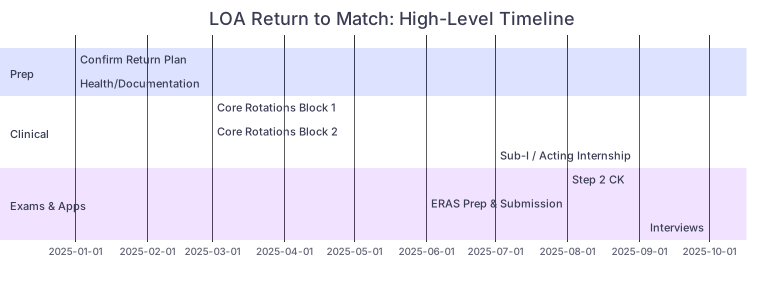
| Task | Details |
|---|---|
| Prep: Confirm Return Plan | a1, 2025-01, 1m |
| Prep: Health/Documentation | a2, after a1, 1m |
| Clinical: Core Rotations Block 1 | b1, 2025-03, 2m |
| Clinical: Core Rotations Block 2 | b2, after b1, 2m |
| Clinical: Sub-I / Acting Internship | b3, 2025-07, 1m |
| Exams & Apps: Step 2 CK | c1, 2025-08, 1m |
| Exams & Apps: ERAS Prep & Submission | c2, 2025-06, 4m |
| Exams & Apps: Interviews | c3, 2025-10, 4m |
If your remaining requirements push crucial items (like Step 2 or sub-I) too close to ERAS, that’s a problem. This is when you and your dean tweak the schedule, not three weeks before applications open.
Step 3: Clean up the why behind your LOA
Programs are much more concerned with an unclear, evasive story than with the fact of the LOA itself.
During this phase you should:
- Clarify for yourself:
- Exact cause: medical, mental health, family, academic, financial, or mixed
- What changed or stabilized during the LOA
- What support/structures are now in place
- Decide your disclosure level:
- What will appear in:
- MSPE (Dean’s Letter)
- School transcript
- What you’ll explain in:
- Personal statement
- Interview responses
- What will appear in:
If your LOA was for health reasons, complete the necessary clearances now—mental health, occupational health, or specialist letters—so they’re not blocking your return or raising last-minute flags later.
3–6 Months Before Return: Build the Return Infrastructure
At this point you should stop operating solo. You need a small “committee” around you.
Step 4: Assemble your support + advocacy team
Your goal is to have multiple people who can later say, “I saw this student after their LOA. They were solid.”
Minimum team:
- Dean or Associate Dean who knows your story and supports your return
- At least one faculty member in your target specialty
- A clinical educator who will see you early in your return (course/clerkship director)
- Mental health professional or coach (if relevant) who helps maintain stability
You’re not just asking for emotional support; you’re planting the seeds for:
- Future letters of recommendation that explicitly mention your strong return
- Behind-the-scenes reassurance when program directors call to ask, “What really happened?”
Step 5: Draft your “LOA narrative” in 3 versions
Do this before you’re buried in clinical work.
Write three versions:
One-sentence version (good for applications and quick questions):
- “I took a leave of absence in my third year due to a health issue that is now fully treated and stable, and I returned to complete my clinical rotations at full capacity.”
Two–three sentence version (for personal statement and MSPE alignment):
- Cause, action, resolution:
- Briefly what happened (without unnecessary medical detail)
- What you did during the leave (treatment, caregiving, remediation)
- What has changed and how you’ve performed since your return
- Cause, action, resolution:
One–two minute spoken version (for interviews):
- Calm, direct, no dramatics
- Clear “arc”: challenge → action → lessons/structure → current stability
You want consistency. The dean, your personal statement, and your interview answers should all feel like they’re referencing the same reality.
0–2 Months Before Return: Logistics and Skill Reactivation
Now it’s about execution. Programs will judge you based on your post-LOA performance. You’re setting up that performance now.
Step 6: Update clinical and test-taking skills
At this point you should treat yourself like a rusty MS3 about to re-enter the wards.
In the 4–8 weeks before your first rotation:
- Clinical refresh:
- Re-read pocket resources: MGH Handbook, Pocket Medicine, surgical or OB guides
- Practice:
- Writing H&Ps
- Oral case presentations (timebox to 2–3 minutes)
- Basic orders (admit, daily, discharge)
- Question banks:
- Start light: 10–20 questions/day in the specialty of your first rotation
- Focus on:
- Reading speed
- Clinical reasoning
- Test endurance if Step 2 is pending
- Practicalities:
- Renew BLS/ACLS if needed
- Re-activate EMR, badges, passwords, immunizations
The worst red flag you can create now is an early rotation eval saying, “Student appears unprepared after time away.”
Step 7: Lock your first 4–6 months of rotations strategically
These first blocks after LOA will heavily shape your MSPE and letters.
Priority order:
A core rotation with strong teaching infrastructure and supportive leadership
- Internal Medicine or Family Medicine is often ideal.
- You want: clear expectations, mid-rotation feedback, and faculty face time.
An early rotation in (or adjacent to) your target specialty
- Not necessarily your sub-I yet.
- Goal: build a relationship with someone who can later write, “I worked with this student after their leave and…”
Avoid starting with:
- Extremely malignant or notoriously disorganized services
- The hardest rotation at your school if your skills are very rusty
You’re not dodging rigor. You’re sequencing it so you can ramp up and perform well from day 1.
First 8–12 Weeks Back: Prove You’re Back
At this point you should be thinking: “Every attending I work with is a potential letter writer and a credibility witness.”
Week-by-week focus (first rotation)
Week 1: Re-entry and expectations
- Introduce yourself to residents and attendings with a version of:
- “I’m returning from a leave and very motivated to get back into clinical work. I’d really appreciate feedback as I go.”
- Clarify:
- How they like presentations
- Typical student responsibilities
- How feedback is usually given
Week 2–3: Tighten your clinical performance
- Daily checklist:
- Pre-round preparation done early
- One solid patient presentation you’re proud of
- One question you look up and share with the team
- Ask explicitly by end of Week 2:
- “How am I doing compared to expectations for this stage?”
- “What’s one thing I can improve this week?”
Week 4–6: Build evidence and advocates
By the end of rotation 1–2, you want:
- At least one attending who:
- Has seen you consistently
- Knows you returned from LOA
- Can speak to your reliability and growth
- Written evals that mention:
- Work ethic
- Professionalism
- Responsiveness to feedback
If an early eval looks shaky, don’t panic. Use it as data and adjust now rather than getting defensive.
6–9 Months Before Match (Spring–Early Summer): Set Up Your Application
At this point you should shift part of your bandwidth from “prove I can function clinically” to “build a competitive application around my new reality.”
Step 8: Choose your specialty with clear eyes
A leave of absence can amplify concerns about highly competitive fields. That doesn’t automatically mean you must abandon them, but you do need to be realistic.
Look at three things:
- Post-LOA performance:
- Clinical grades since return
- Shelf scores
- Step scores (especially Step 2 if available)
- Specialty competitiveness:
- Derm, ortho, plastics, ENT, neurosurg: major uphill battle if red flags stack
- IM, peds, psych, FM, PM&R: more program-to-program variability, more room for narrative
- Advocate feedback:
- Ask one honest faculty member in the field:
- “With my LOA and current performance, do you think I’m a reasonable candidate in this specialty? If yes, what tier of programs should I target?”
- Ask one honest faculty member in the field:
Commit by this stage. Pivoting late (e.g., in October) is how you end up unmatched.
Step 9: Sequence sub-I and key electives
Your sub-I timing relative to ERAS is critical.
Ideal:
- Sub-I in your chosen specialty:
- Finishes no later than September
- But starts by June–July if possible
- One or two additional electives in the same or related field:
- At least one completed before ERAS submission so those comments can inform the MSPE
If your schedule is already set in a bad way (e.g., sub-I in November), talk to the dean’s office now. Rearranging is painful but often doable if you explain the Match implications.
4–6 Months Before Match: Build the Paper Trail
Now your focus splits: still performing on rotations, while methodically de-risking your LOA on paper.
Step 10: Letters of recommendation strategy
You cannot let your LOA be the loudest part of your file. Strong, recent letters are what mute that red flag.
Aim for:
- At least 3–4 letters, with:
- 1 from your sub-I or acting internship
- 1 from a core rotation after your return
- 1 from department or program leadership (if possible)
- At least one letter that explicitly addresses:
- “I am aware the applicant took a leave of absence. Since returning, they have demonstrated…”
When you ask for letters:
- Do it early (right after you’ve impressed them, not months later)
- Provide:
- CV
- Draft personal statement (even if rough)
- A short paragraph about your LOA and how you’d like it framed
You are not scripting their letter. You’re giving them context, so they do not accidentally raise new questions.
Step 11: Coordinate the MSPE (Dean’s Letter)
This is where many returning students get burned because they’re passive.
At this point you should:
- Request a meeting with the MSPE author (dean or designee)
- Clarify:
- How the LOA will be described
- Where in the letter it will appear
- Whether any comparative language (e.g., “performed at or above level of peers”) can reference post-LOA performance
- Politely advocate for:
- Factual, non-sensational language
- Clear timeline: “Student took an approved leave from X to Y; returned and successfully completed…”
Your goal is not to erase the LOA. It’s to make it clear, contextual, and boring.
3–4 Months Before Match: ERAS and Step 2
At this point, every week counts.
Step 12: Step 2 CK timing and score
For LOA students, Step 2 is under a microscope. Programs look at it as proof of current functioning.
Ideal:
- Take Step 2 CK:
- Between June and August of the application year
- With enough buffer that the score is back before most interview invites go out (September–October)
If your Step 1 was weak or failed, Step 2 must be solid. Not “fine.” Solid.
If you’re behind:
- Decide with your dean:
- Whether to delay ERAS submission a couple weeks to get the Step 2 score in
- Or to submit on time and let scores roll in later
Step 13: ERAS content and LOA positioning
Your ERAS application should not read like you’re dodging your own history.
Concrete moves:
- Education section:
- Dates should accurately reflect LOA gaps
- Experiences:
- If you did anything substantial during your LOA (research, caregiving, treatment, work), list it if appropriate
- Personal statement:
- Use the 2–3 sentence version of your LOA narrative
- Put it in the middle, not the first line and not as a dramatic finale
- Emphasize:
- What you learned
- How you function now
- How your recent performance backs it up
Red flag behavior: pretending the LOA never existed and hoping programs “don’t notice.” They notice.
Interview Season (October–January): Control the Conversation
At this point you should be very consistent. No new stories. No improvisation.
Step 14: Prepare your LOA interview script
Before your first interview:
- Rehearse your 1–2 minute LOA explanation out loud:
- Once in front of a mirror
- Once recorded on your phone
- Once with a mentor or advisor
- Aim for:
- Calm tone
- Non-defensive posture
- Clear structure:
- Brief cause
- Actions you took
- Structures/supports now
- Evidence: “Since returning I have…”
Common mistakes to avoid:
- Over-disclosing sensitive medical details that make attendings wonder about future reliability
- Sounding angry at your school or at circumstances
- Turning the entire interview into a therapy session
You want your LOA to be a chapter, not the entire book.
Step 15: Reinforce your current stability
Throughout interviews:
- When asked about challenges:
- Mention the LOA once, but also talk about more “normal” adversities (tough rotations, complex patients) to show growth is ongoing, not just crisis-based.
- When asked about strengths:
- Pull directly from post-LOA performance:
- “My residents consistently commented on my reliability and follow-through after I returned.”
- Pull directly from post-LOA performance:
- When asked, “Anything else we should know about your record?”:
- Briefly re-affirm that your health/academic situation is stable and supported.
Programs worry about future disruptions. Your job: show them a track record that says, “This is under control.”
Rank List to Match Week: Final Risk Check
Step 16: Follow-through and no new red flags
Final months:
- Do not:
- Ghost a rotation
- Drop professionalism because “apps are in”
- Blow off Step 2 or late electives
- Do:
- Keep showing up, on time, present
- Maintain communication with your dean if any new issues arise
Last-minute disasters (new LOA, failed rotation, professionalism complaint) are catnip for program directors looking for reasons to move you down the list.
Step 17: Rank list strategy for LOA students
At this point you should assume you’re slightly higher risk in the eyes of some programs. Adjust your rank list accordingly.
Practical approach:
- Make sure you have:
- A solid number of realistic programs ranked where:
- You clicked with residents
- Faculty seemed supportive of nontraditional paths
- There’s a track record of taking students from your school
- A solid number of realistic programs ranked where:
- De-emphasize:
- Programs that made you feel interrogated or skeptical about your LOA without any warmth
- Reach out (via your dean) to:
- A few key programs where you’re particularly interested, so they can quietly advocate or provide updates.
Quick Chronological Checklist
| Timeframe Before Match | Focus Area | Key Actions |
|---|---|---|
| 12–9 months | Return plan | Confirm date, status, conditions |
| 9–6 months | Support team | Build advocate network, draft LOA narrative |
| 6–4 months | Clinical ramp-up | Refresh skills, schedule early rotations |
| 4–3 months | Specialty & sub-I | Commit specialty, lock sub-I timing |
| 3–2 months | Letters & MSPE | Secure LoRs, coordinate LOA language |
| 2–1 months | Step 2 & ERAS | Take Step 2, finalize ERAS + PS |
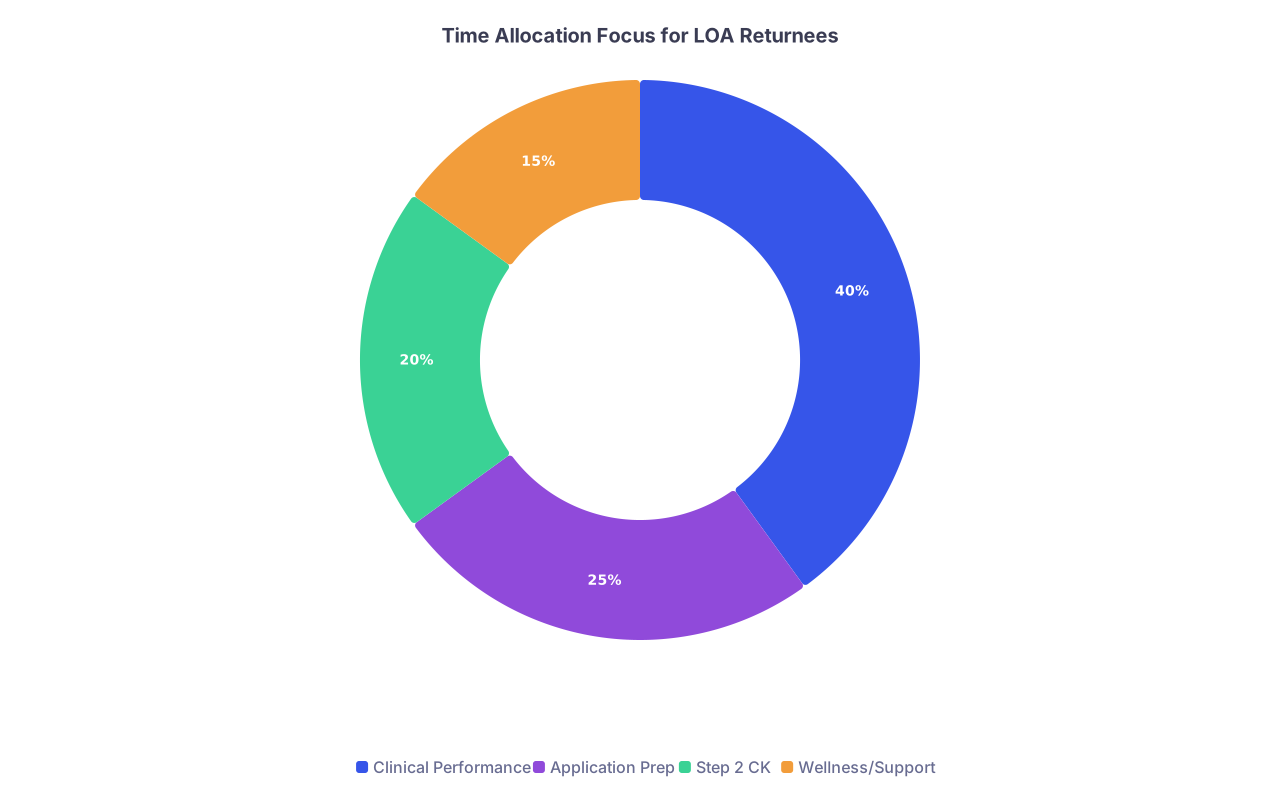
| Category | Value |
|---|---|
| Clinical Performance | 40 |
| Application Prep | 25 |
| Step 2 CK | 20 |
| Wellness/Support | 15 |
Your Next Step Today
Do one concrete thing right now: open your email and schedule a 30-minute meeting with your Dean of Students (or equivalent) to confirm your return timeline in writing. Until that’s nailed down, every other part of your LOA-to-Match plan is guesswork.