
What if the first thing a program director thinks when they open your ERAS is: “So… what have they been doing for the last year?”
And then they just close the tab.
That’s the nightmare, right? You’ve got a gap since your last real clinical work. No USCE in the past year. Maybe Step took longer. Maybe you graduated a while ago. Maybe life fell apart for a bit. And now you’re trying to convince residency programs that you’re not rusty, dangerous, or some sort of walking malpractice case.
Let me be blunt: yes, gaps and lack of recent clinical experience can be a red flag. Program directors are human. They worry about patient safety. They’re terrified of taking someone who can’t hit the ground running on day 1 of intern year.
But “can be a red flag” is not the same as “automatic game over.”
You’re not doomed. You are under a higher level of scrutiny, though. So you have to be smarter, clearer, and more intentional than the people who just graduated last May and rolled straight in.
Let’s talk about what you’re actually up against, how PDs really think about this, and what you can still do this season even if your last real clinical anything was… embarrassingly far back.
How Program Directors Actually See Applicants With Old Clinical Experience
They don’t all think the same way, but there are patterns. I’ve heard variations of this exact line from PDs and faculty:
“I don’t care if they took time off, I care if they can function safely on day one.”
That’s the core fear. “Rusty” and “risky” are just two versions of the same concern: are you safe to put in front of real patients under pressure?
Here are the unspoken questions a lot of PDs ask when they see a gap or no recent US clinical experience:
- Have their clinical skills decayed?
- Can they still take a decent history and physical?
- Are they up to date on guidelines, meds, basic inpatient management?
- Are they going to struggle with EMR, orders, consults, night float?
- Are they hiding something (failure, professionalism issue, burnout, visa problems, personal mess)?
They do not love uncertainty. If your file raises more questions than it answers, that’s when you quietly slide into the “no” pile.
Now the brutal part: applicants without recent clinical experience are competing with:
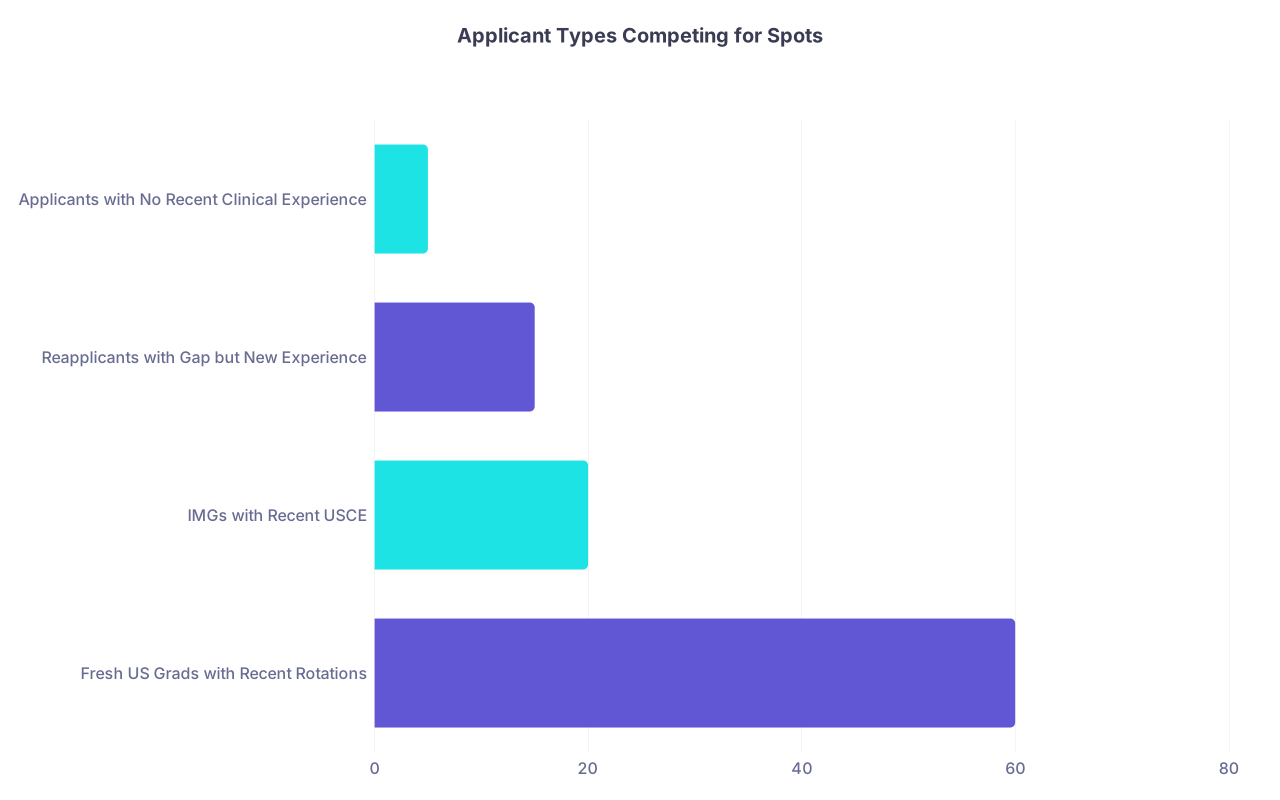
| Category | Value |
|---|---|
| Fresh US Grads with Recent Rotations | 60 |
| IMGs with Recent USCE | 20 |
| Reapplicants with Gap but New Experience | 15 |
| Applicants with No Recent Clinical Experience | 5 |
You can see the problem. You’re in that last category. The smallest one. The one that requires explanation.
But explanation is not the same as apology. You don’t need to grovel. You need to reduce uncertainty.
When “No Recent Clinical Experience” Is a Real Red Flag vs Just a Yellow One
Not every gap is equal. Some situations really do set off alarm bells. Others are more like “okay, convince me.”
Here’s the uncomfortable breakdown.
| Situation | How PDs Commonly See It |
|---|---|
| 6–12 month gap, clear reason, some ongoing involvement | Yellow flag, explainable |
| 1–2 year gap, minimal clinical or academic activity | Yellow-red, must be strongly addressed |
| >2 year gap, no clinical contact, no exams | Major red flag, many auto-filter out |
| Old graduate (>5–7 years) with no recent USCE | High risk in competitive programs |
| Old graduate but with structured recent USCE or observerships | Still risky, but some programs will listen |
So yeah, if you’re 4+ years out of medical school with nothing clinical in the last 2 years… that’s not a “tiny concern.” Programs will absolutely wonder if you can still function.
But here’s the nuance almost nobody online talks about:
PDs don’t just ask “How long has it been?”
They ask “What did they do with that time, and what evidence do I have that they’re still sharp?”
No recent formal clinical experience is not the same as “no connection to medicine at all.” You can’t rewrite the past, but you can control whether you look like someone who drifted aimlessly… or someone who used a rough situation to mature and refocus.
The Stories That Calm PDs Down (And the Ones That Don’t)
You need a story that answers three questions fast:
- Why was there a gap / why no recent clinical experience?
- What did you do during that time that still matters for residency?
- Why should they trust you now?
The mistake a lot of applicants make? They either overshare and sound chaotic, or they under-explain and sound evasive.
Let’s go through a few scenarios. If one of these is basically you, pay attention to how you’d spin it.
1. “I Graduated 2–3 Years Ago and Just Kept Delaying Applying”
This is the one PDs hate the most when it’s not clearly explained. It can sound like: lack of direction, low motivation, or repeated failures you’re hiding.
Better version:
You tie the delay to something concrete and growth-oriented.
Example spine of a story:
- You needed to secure immigration status, so you worked in a medically adjacent role (scribe, MA, research).
- You had to retake an exam and spent time both studying and working clinically or academically.
- You were supporting family, working full-time, but kept some connection to medicine (health coaching, telemedicine triage abroad, etc.).
What they want to see is: you weren’t just sitting. You were building skills, staying near clinical thinking, and moving toward residency, not away from it.
2. “I Had Serious Personal / Health / Family Issues”
Programs are not heartless. They’ve seen residents get sick, have crises, lose family. They actually like seeing evidence that you can go through hell and still come back functional.
Bad version:
“My dad was sick and it was really hard, so I had to stop everything.” And then… nothing else.
Stronger version:
You briefly name the situation, anchor it to clear dates, and show a return to structure.
Something like:
- X happened in 2022–2023. You became the primary support / caregiver.
- During that time, you did what you could: maybe online CME, some remote research, some exam prep.
- You show that now it’s resolved or at least stable, and you’ve already restarted structured academic or clinical work (even if it’s shadowing, observership, research with clinical relevance).
Programs mostly fear ongoing instability. You need to show: it was bad, it’s now managed, and you’re back with a plan.
3. “I’m an Old Grad (5+ Years) Without Recent Clinical Work”
This is tough. I won’t sugarcoat it. Some programs filter you out automatically based on year of graduation. Many will be hesitant unless they see fresh evidence of competence.
You need three things, minimum, to stay in the running at any decent number of places:
- Recent exam or strong score (e.g., Step 3, or at least recent Step 2 CK with good performance).
- Recent structured exposure (observership, externship, hands-on at home country, telemedicine with documentation).
- A clear, consistent story about what you’ve done since graduation that still relates to medicine (teaching, research, public health, clinical practice abroad).
If all you have is: “I graduated in 2017 and then kind of didn’t do anything clinical for 5 years”… I’m not going to lie to you. That’s near-fatal for most specialties.
But the moment you show effort to re-enter—even small, not-glamorous roles like scribing, free clinic volunteering—it changes how they see you. You stop being a ghost and start looking like someone clawing their way back.
How to Look Less Rusty When You Actually Kind of Feel Rusty
Let’s say your last real hands-on patient contact was over a year ago. Or more. You know you’re rusty. You feel slower when you practice cases. You can’t just fake that.
The trick is: you don’t have to be perfect; you just have to be trainable and safe.
Here’s what actually helps you look less like a risk:
Some kind of recent clinical-adjacent activity
I don’t care if it’s an unpaid free clinic, telehealth scribing, hospice volunteering, MA work, or structured observerships. What matters is that someone in a clinical environment has seen you show up consistently and is willing to vouch for you.Fresh letters of recommendation Old letters from 3–4 years ago scream “stale.” Try hard to get at least one recent letter from someone who’s seen you in a clinical or academic medical context in the last 12–18 months. That one letter can sometimes outweigh the date on your diploma.
Proof you still know the medicine This can be: a strong recent exam (Step 2 CK, Step 3), or active research in the specialty, or CME certificates, or a clear list of ongoing academic engagement (journal club, online courses, formal certificate programs).
Your own narrative control If you ignore the gap, PDs fill in the blanks with the worst-case scenario. If you address it briefly, clearly, and confidently in your personal statement and (if needed) ERAS “education interruption” section, you lower their anxiety.
They’re not looking for excuses. They’re looking for predictability.
Where To Explain the Gap So You Don’t Sound Defensive
You’ve probably been spiraling about this: “Do I put it in my personal statement? Will that make everything about my gap? Should I put it in the experiences? Or is that weird?”
Here’s the sane way to structure it.
1. ERAS Application – “Education/Training Interruptions”
Use this for clear, factual explanation. Short. Zero drama. Something like:
“From 07/2021–05/2022, I took time away from clinical rotations to provide full-time care for an immediate family member with a serious illness. During this period, I completed online CME in internal medicine and continued Step 2 CK preparation. The situation is now stable, and I have since returned to structured clinical and academic activities.”
That’s it. Date range. Reason. What you did. Status now.
2. Personal Statement
You do not want your entire PS to be a sob story about your gap. That backfires. But you also don’t want to pretend nothing happened.
Mention it once, strategically:
- A short paragraph that gives context (not your whole life story).
- Then quickly pivot to what you’ve learned and how it reinforced your commitment to your specialty.
- End with what you’re doing now to be residency-ready.
Your PS should still mostly be about why this specialty, who you are clinically, and what you bring. Not: a 2-page justification for why they should forgive your timeline.
3. Interviews
If you get interviews, assume they will ask:
“Can you walk me through what you’ve been doing since graduation?”
You should have a clean, chronological, non-apologetic answer. Not a rambling, guilty monologue.
Practice saying something like:
“I graduated in 2021. That year, I focused on preparing for Step 2 CK and worked as a scribe in the ED, which really sharpened my comfort with acute presentations. In 2022, I had to step back temporarily to support my family during a health crisis, but I stayed engaged academically with CME and online case conferences. Over the past year, I’ve completed observerships in internal medicine and have been working on a QI project related to hospital readmissions. I’m now fully focused on residency and feel ready to step into an intern role.”
No drama, but not evasive. Confident, linear, and oriented toward the present.
If You’re Mid-Season Right Now With No Recent Experience… What Can You Still Do?
You might be thinking, “Okay, this is all great conceptually, but it’s October/November/whenever and my ERAS is already submitted. My last real clinical thing is still old. Am I just screwed for this cycle?”
Not automatically. But you do need to move fast and be intentional.
Here’s a realistic timeline approach:

| Step | Description |
|---|---|
| Step 1 | Today: Identify Your Gap Story |
| Step 2 | This Week: Start Any Clinical-Adjacent Role |
| Step 3 | Next 2-4 Weeks: Ask for Future LORs |
| Step 4 | Update Programs with New Activities |
| Step 5 | Interview Season: Practice Gap Explanation |
Today/tomorrow-type actions you can still take this cycle:
- Reach out to free clinics, community health centers, or hospital volunteer offices and ask specifically for roles where you’ll interact with patients or medical teams. Even if it’s 4–6 hours a week. That’s something.
- Email any academic contacts about late-joining ongoing research or QI projects—especially ones with clinical overlap.
- Start (today, not next week) a consistent habit of 1–2 hours of clinical reading or question banks daily. It’s not just for you; you can mention it in interviews and updates: “I’ve been maintaining a structured study schedule using XYZ.”
- If you manage to secure even a short observership or virtual rotation, you can send a brief, professional update to programs later: “Since submitting my application, I have begun an observership in [specialty] at [institution]…”
No, it doesn’t erase the gap. But it changes the story from: “I haven’t done anything clinical” to “I realized this was a weakness and I took concrete steps to fix it.” PDs respect that more than you’d think.
The Hard Line: When You Might Need to Rethink Your Timeline
I know you probably don’t want to hear this, but I’d be lying if I said everyone with old or no recent clinical experience should just “follow their dreams this year.”
There are situations where the smarter move is:
- Apply very broadly to less competitive programs this year to see what happens.
- Simultaneously build real, recent clinical activity over the next 6–12 months.
- Treat this match as “data gathering” and mentally commit to a stronger re-application if needed.
If you’re:
5 years from graduation,
- with no USCE in the last 2 years,
- no recent exams,
- and minimal current clinical contact where anyone can write a letter…
You’re trying to fix a 5-year problem in 5 weeks. That’s not realistic. But you can start fixing it now so that Future You isn’t in the same panic one or two cycles from now.
Key Takeaway You Probably Need to Hear
Programs don’t reject people because of “no recent clinical experience” as a concept.
They reject because: they’re not convinced you’ll be safe and functional on July 1.
Your entire job, with every line of ERAS, every sentence of your personal statement, every activity you take on now, is to quietly hammer one message:
“I have been away from formal clinical work, yes. I know that’s a concern. Here’s exactly what I’ve been doing, here’s why I’m still sharp and committed, and here’s why you can trust me with your patients.”
You don’t have to be flashy. You just have to be believable.
FAQs
1. Is a 1-year gap without clinical experience automatically a deal-breaker?
No. A 1-year gap is survivable if you explain it well and show some kind of ongoing engagement: studying for exams, research, telehealth work, caregiving plus CME, etc. It becomes a real problem if it looks like a black hole where you did nothing and learned nothing. The story and the current activity matter just as much as the raw length.
2. Will programs think I’m unsafe if my last rotation was 2+ years ago?
Some will, honestly. Especially more competitive or high-volume programs that can be picky. But others will give you a chance if you can produce recent evidence that you’re still clinically engaged—new letters, observerships, work as an MA/scribe, strong recent scores. Your job is to reduce the “mystery” factor. The more concrete proof you give that you’re still functioning in a clinical or near-clinical setting, the less you look like a safety risk.
3. Should I delay applying until I get recent US clinical experience?
If your profile is very gap-heavy—old graduate, little to no recent clinical work, no fresh scores—then yes, seriously consider delaying or at least treating this year as exploratory. But if you already applied, don’t abandon the cycle. You can still add experiences, send updates, and practice your explanation. Just be honest with yourself: if you don’t match, you’ll need to spend the next year actively fixing this, not just reapplying with the same file.
4. Can non-physician roles (scribe, MA, RN, EMT) actually help my residency chances?
Yes, more than people think. PDs know that scribes, MAs, nurses, EMTs get very real exposure to workflows, documentation, acute care, and interprofessional communication. Those roles don’t replace formal clerkships, but for someone with an old degree or a gap, they show: you can function in a clinical environment, take direction, and work with patients and teams. Get a strong letter from a supervising physician in those settings and it can absolutely soften the “rusty” concern.
5. How honest should I be about personal or mental health issues causing my gap?
Honest, but controlled. You don’t need to share every diagnosis or detail. Programs mainly want to know: there was a legitimate reason, you addressed it responsibly, and it’s now stable enough that you can handle residency demands. Avoid vague language that sounds like ongoing chaos. One or two clear sentences in ERAS plus a concise, confident explanation in interviews is usually enough.
6. What’s one thing I can start doing today that actually moves the needle?
Identify one realistic clinical-adjacent activity you can start or apply for within 48 hours—free clinic volunteering, hospital volunteer department, scribe program, observership inquiry, locally or via alumni connections. And then, tonight, open your personal statement or ERAS and write a tight 3–4 sentence explanation of your gap that you’d feel okay reading out loud in an interview. Don’t just think about it—put actual words on the page.