
Switching specialties after failing to match is not an automatic death sentence—but it absolutely can blow up your next cycle if you handle it badly.
Let’s just say the quiet part out loud: you’re scared programs will see “unmatched + switched specialties” and immediately think, “This person is flaky, desperate, or hiding something.” You’re worried they’ll assume you just panicked, picked a new specialty at random, and now you’re trying to sneak in through a side door.
And the worst part? You don’t even totally trust your own narrative yet. You’re still replaying what went wrong. Did you shoot too high? Were your letters weak? Was your personal statement terrible? Are you now just… damaged goods?
You’re not. But you could look like it if you aren’t intentional.
Let me walk through how programs actually think about this, what makes them trust or not trust a “failed to match + switched specialties” applicant, and what you need to fix right now so you’re not just running the same painful experiment again with a new specialty name on your ERAS.
What Programs Really Think When They See a Specialty Switch After Not Matching
Programs don’t automatically hate a switch. They hate chaos. They hate risk. They hate investing time in someone who might:
- Quit halfway through intern year
- Switch out again
- Burn out and become toxic on the team
- Struggle academically or clinically because this isn’t actually what they want
They’re not sitting there like, “How do we punish unmatched people?” They’re thinking, “If I rank this person, what’s the chance I regret it at 2 a.m. when they’re cross-covering three services and something explodes?”
The red flags in your situation aren’t just:
- You didn’t match, and
- You changed specialties
It’s the story those two facts might tell if you don’t explain them well.
Worst-case narrative in a PD’s head looks like this:
“They went all in on [competitive specialty], didn’t match, panicked, and now they’re applying to my field as a backup because they just want any job. In a year, they’ll be trying to switch out of my specialty. Hard pass.”
The narrative you need instead:
“I initially committed to [first specialty], didn’t match, did serious reflection and real clinical exposure, and realized [new specialty] actually fits me and my strengths much better. I’ve taken concrete steps since then to prove I can thrive in this field—here’s the evidence.”
Programs will trust you when your timeline, actions, and letters all line up with that second story.
Not your vibes. Not your “I promise I really want this.” Evidence.
The Core Problem: Your Paper Trail vs Your New Story
Your worst fear is probably this: programs will look at your application and feel like something doesn’t add up.
You’re not wrong to worry about that. They absolutely notice.
Let’s say you:
- Applied to Ortho last year
- Didn’t match
- Now you’re applying to Internal Medicine
They look at your ERAS and see:
- MS3–MS4: Ortho sub-Is, ortho research, ortho letters
- Personal statement last year (if they somehow saw it through SOAP or prelim apps) was all “cutting-edge surgical innovation, working with my hands”
- Now suddenly your PS says “lifelong passion for longitudinal patient care and complex medical management”
That whiplash is what kills trust. Not the switch itself.
So your job is to close the gap between:
- What you did in the past (prior specialty actions), and
- What you say you want now (new specialty)
You do that with a coherent narrative + new, specialty-appropriate work + letters that back you up.
Let’s make this concrete.
Step 1: Build a Timeline That Doesn’t Look Like Panic
You need to be able to answer “Why the switch?” in a way that doesn’t sound like: “I failed, freaked out, and then pivoted to whatever seemed easier.”
Programs know people grow and change. What they don’t like is impulsive chaos.
Work backwards and build a believable internal timeline for yourself:
- When did you first seriously consider the new specialty?
- What concrete experiences in that specialty did you have? (rotations, electives, research, volunteering)
- What happened after you didn’t match? Did you actually explore and reflect—or did you just flip a coin?
Then make sure this timeline is reflected in:
- Your CV (if you can do a new rotation, do it)
- Your PS (show progression, not overnight epiphany)
- Your letters (“I’ve worked with them over X months as they’ve deepened their interest in [specialty]”)
If you only touched the new specialty after not matching, that’s survivable, but you must show that:
- You did more than one shift and a Google search
- You’re not switching just because it feels “less competitive”
- Someone in that specialty is willing to put their name on you
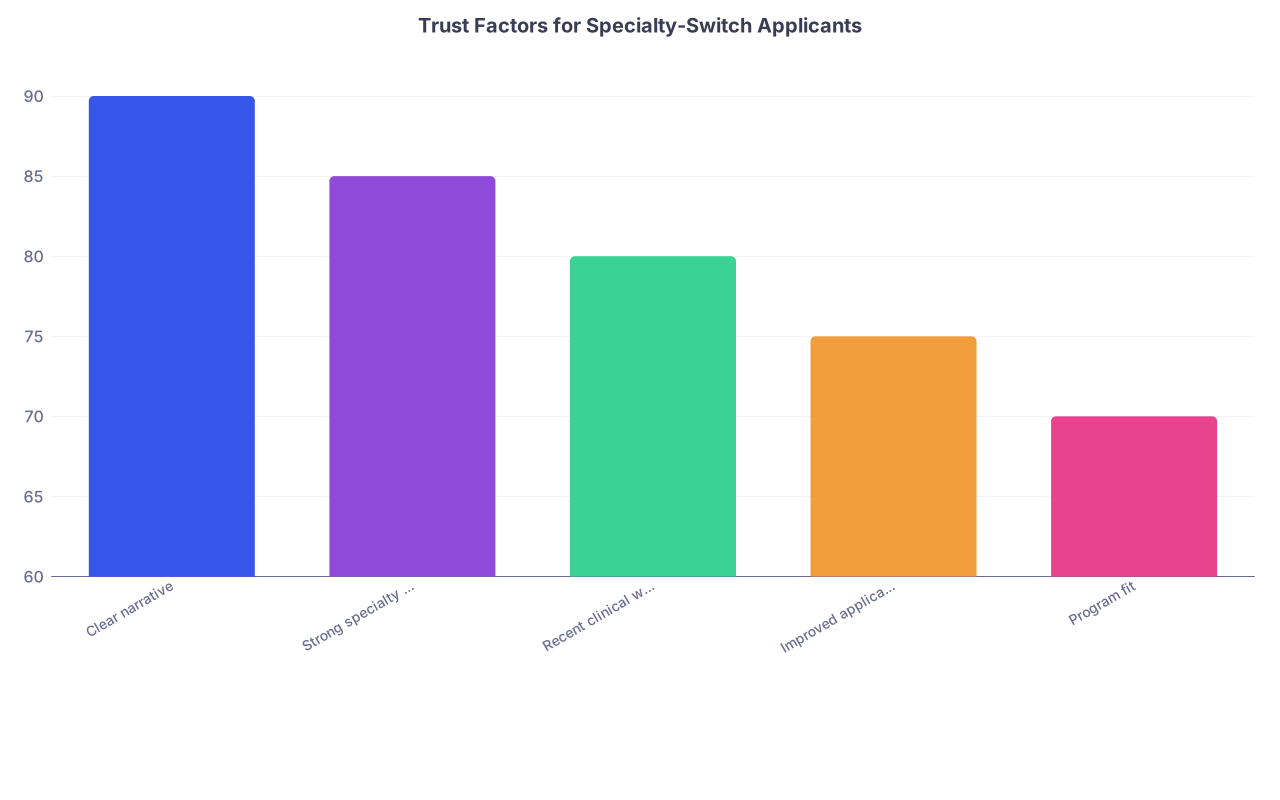
| Category | Value |
|---|---|
| Clear narrative | 90 |
| Strong specialty letters | 85 |
| Recent clinical work | 80 |
| Improved application | 75 |
| Program fit | 70 |
Step 2: Stop Hiding the Failure to Match (They Can See It)
The instinct is to downplay the failed match or pretend it was just “a bad year.” That instinct will ruin you.
Programs know you didn’t match. They see your graduation year, your lack of prior training, maybe a SOAP attempt. If you pretend it’s not a thing, they assume:
- You lack self-awareness
- You aren’t honest with yourself
- You’ll blame others when things go wrong
You don’t need to write a 1,000-word confession. But you do need a clean, mature explanation. Something like:
- “I initially applied to [Specialty A], a field I genuinely enjoyed but where my application was not competitive enough. Not matching forced me to step back and really examine what I wanted long-term. During that time, I re-engaged with [Specialty B] through [X, Y, Z], and realized that the aspects I value most in medicine—[A, B, C]—are core to this field.”
Notice what that does:
- Acknowledges the failure without melodrama or excuses
- Shows reflection, not just rerouting
- Connects specific values/traits to the new specialty
The people who crash and burn are the ones who either:
- Blame the system (“too competitive!” “the match is broken!”), or
- Pretend like nothing happened (“I’ve always wanted this new specialty!” with zero prior evidence)
You’re not fooling anyone with either approach.
Step 3: Your New Specialty Needs Real Receipts, Not Just Pretty Words
This is the part that really separates “programs might trust me” from “this is a hard sell.”
Ask yourself bluntly: What have I actually done in this new specialty since not matching?
Not what you plan to do. What’s on paper now.
Programs care about three things here:
Recent clinical exposure in the new specialty
You need something like: rotations, observerships, a sub-I, or real work with attendings in that field. Not just, “I liked it in MS3.”Letters from people in the new specialty who know you well
If you’re applying to IM from a failed Derm cycle and all your letters are still from Dermatologists, that screams “backup.”Evidence that you can actually handle residency now
This can be: a prelim year, research year with clinical exposure, strong Step 2, or solid evaluations in recent rotations.
If you’re sitting here with:
- Old letters from prior specialty
- No recent rotations in new specialty
- No one who can say “I’ve seen them do this work and they fit our field”
Then no, programs probably won’t trust your switch yet. Not because you’re a bad person, but because there’s nothing to anchor your story.
You can fix that. But not by editing a paragraph in your personal statement at 1 a.m. This requires action: reaching out, finding rotations, getting in front of the right attendings.
Step 4: Own the Risk Factors Before the PD Does
Another uncomfortable truth: being a reapplicant + specialty switcher automatically puts “red flag” vibes on your file even if you’re good.
You don’t fix that by being vague. You fix it by preemptively answering the scary questions they won’t say out loud.
Questions in their head:
- Are they switching because my field is “easier to get into”?
- Will they get bored and try to leave once they re-apply to their old dream specialty?
- Are they just trying to escape a bad record in their prior field?
- Are they emotionally resilient enough to handle the stress after already going through one failed match?
You counter these by weaving into your story:
- Concrete reasons unique to your new specialty that attract you—things you definitely wouldn’t say about your old one
- Specific clinical moments that made things click (“I realized I felt most energized when…” etc.)
- A tone that shows you’ve processed the failure, not still drowning in it
When PDs hear: “I learned a ton from not matching. It forced me to ask hard questions and find the place where I actually belong,” that’s someone who might actually stick around and grind through hard nights.
When they hear: “I always liked both specialties, and I just want to be a doctor,” that’s someone who might bail the second things get rough.
Step 5: You Must Show Growth, Not Just Redirection
This is where most reapplicants screw up. They change specialty, but the quality of their application is basically the same as last year.
Programs think: “You didn’t match with this profile once already. Why is this going to go differently now?”
So besides switching fields, what actually got better?
- Step 2 score went up?
- New research or QI in the new specialty?
- Stronger letters this time—more specific, from people who actually know your current work?
- You did a prelim year or meaningful clinical work and got good evals?
If nothing’s changed except “now I’m pointing this at Family Med instead of EM,” that’s not growth. That’s just repositioning the same problem.
You need clear deltas—things that are different, better, stronger.
| Area | Weak Change | Real, Convincing Change |
|---|---|---|
| Exams | Same scores | Higher Step 2 / CK or strong shelf exams |
| Clinical Exposure | Old rotations only | New sub-I / observership in new specialty |
| Letters | Recycled from last year | Fresh, specialty-specific, detailed LORs |
| Narrative | “I like this too” | Clear, reflective, specialty-specific story |
Step 6: How Honest Do You Need To Be in Your Personal Statement?
You don’t need to write a trauma memoir about not matching, but you do need to be strategically transparent.
General structure that works:
Open with a moment or theme that clearly belongs to the new specialty.
Don’t start with the old specialty at all. Start with what drew you here.Middle: explain your path with surgical precision—short, direct, and grown-up.
One short paragraph acknowledging prior path + failed match + genuine reorientation, framed around growth.Close: future-focused.
What you’re bringing to the table now, and why you’re confident this is the right place for you.
Something like:
“I initially pursued [Specialty A] and did not match. That experience forced me to slow down and re-examine what I wanted from my career. While working on [X experience] afterward, I found myself consistently drawn back to [aspects of Specialty B]. Through [rotation/experience], I realized that the problems I enjoy thinking about, the pace I thrive in, and the type of patient relationships that matter most to me are central to [Specialty B]. Since then, I’ve committed to this path through [concrete steps].”
That’s clean. No self-pity. No excuses. No pretending.
Step 7: The Interview Question You’re Afraid Of
You will get asked: “So tell me about your prior application cycle and your switch.”
If they don’t ask, they’re thinking it anyway.
Your answer needs to be:
- Calm
- Short
- Reflective
- Consistent with what’s in your application
Do not launch into a therapy session. Do not trash your old specialty or complain about competitiveness.
Something like:
“During my initial application, I applied to [Specialty A]. I enjoyed aspects of it, but I didn’t match. That was hard, but it gave me time to reassess what I wanted long-term. As I worked more closely with [Specialty B] through [X and Y], I realized that [specific aspects] better match how I like to think and work with patients. Since then, I’ve focused fully on this field—doing [rotations/research/clinical work]—and I’m confident that this is where I want to build my career.”
Then shut up. Let them ask follow-ups if they want more.
If you start spiraling into over-explaining, they’ll feel your anxiety and doubt, and it makes them doubt too.
So… Will Programs Trust You?
They can. They sometimes do. I’ve seen applicants:
- Fail to match into EM → do a year of research + IM rotations → match solid IM
- Miss Derm → switch honestly to Pediatrics with great narrative + strong new letters → match at a great program
- Not match Surgery → pivot authentically to Anesthesia, crush a year of work, and match well
But in every success story, the pattern is the same:
- They stopped running from the failure and started using it.
- They got real about what went wrong the first time.
- They built a new path that wasn’t just a cosmetic specialty swap—it was deeper, smarter, cleaner.
Programs don’t need you to be flawless. They need to believe:
- You know yourself better now.
- You’re not going to run again.
- You can show up on July 1 and actually help.
If your application and your story do that? Yes, they will trust you. Even with the red flags.
If your plan is to just change ERAS filters and hope “less competitive specialty” = guaranteed safety? That’s setting yourself up to relive the same nightmare.

| Step | Description |
|---|---|
| Step 1 | Didnt Match |
| Step 2 | Reflect Honestly |
| Step 3 | Reapply Same Field with Improvements |
| Step 4 | Get Real Exposure in New Specialty |
| Step 5 | Secure New Specialty Letters |
| Step 6 | Rewrite Narrative Honestly |
| Step 7 | Apply with Documented Growth |
| Step 8 | Switching Specialty? |
FAQ (Exactly 6 Questions)
1. Is switching to a “less competitive” specialty after not matching going to look desperate?
It can if that’s your only move. If your story is basically “I couldn’t get Derm, so now I want FM,” with no FM rotations, no FM letters, no specific reasons tied to FM itself, then yeah—it screams desperation. If instead you show a clear link between your values, your experiences, and the new specialty—and you’ve done real work in it—programs see a mature recalibration, not desperation.
2. Do I have to explicitly say I didn’t match in my personal statement?
You don’t need to say the words “I failed to match,” but you do need to acknowledge your prior path if it’s obvious from your record. A brief, direct sentence about applying previously, reflecting, and then redirecting is better than pretending it never happened. Silence makes PDs fill in the gaps themselves, and their version is usually harsher than the truth.
3. How many letters from the new specialty do I absolutely need?
If you’re fully switching specialties, you should aim for at least two strong letters from attendings in the new field who’ve supervised you recently. One might work in a pinch, but less than that looks sketchy. The rest can be from other specialties if they highlight work ethic, clinical skills, and professionalism—but you can’t avoid getting real buy-in from your new field.
4. What if I genuinely liked my old specialty but just like the new one more? Won’t that sound fake?
You’re allowed to have liked both. You just need to be precise. Instead of “I’ve always loved both equally” (which sounds noncommittal), say something like, “I appreciated [X] about my prior field, but in working more closely with [new specialty], I realized that [Y and Z]—which matter most to me—are better aligned here.” You’re not trashing the old one; you’re explaining why this one fits you better.
5. Will doing a prelim year in another field hurt my chances in the new specialty?
Not automatically. In fact, a strong prelim year with good evals can help by proving you can function clinically. What hurts you is if your prelim story + new specialty story don’t line up at all, or if your evaluations are mediocre. You’ll need to connect the dots for programs: what you learned, why you’re switching, and how that year makes you a stronger incoming resident now.
6. What’s one concrete thing I can do this month to make programs trust my switch more?
Get at least one attending in your new specialty to see you in action and agree to write a detailed letter. That means emailing, calling, begging for a rotation, observership, or clinic days—whatever you can realistically get. A single strong, specific letter from someone who says, “I’ve seen them do this work, and they belong in our field,” will do more to build trust than five beautifully rewritten personal statements.
Open your personal statement draft right now and find the part where you talk about your switch—if it sounds vague, defensive, or like it could apply to any specialty, rewrite it until a program director could read it and immediately know why you belong specifically in this field, now, after everything that’s happened.