
The fact that you were dismissed and then readmitted is not a death sentence for residency—but it is a trust problem you have to fix head‑on.
If you pretend it’s minor, you lose. If you own it and show you’re a different person now, you give programs a reason to take a risk on you.
This is about rebuilding trust. Not spinning. Not hiding. Trust.
Let me walk you through exactly how to do that.
What Your Dismissal Really Signals to Programs
Residency programs do not obsess over perfection; they obsess over risk.
When they see “dismissed and readmitted,” they immediately worry about three things:
Reliability:
Will this person show up, pass boards, finish the program?Professionalism and insight:
Do they own their mistakes, or blame everyone else?Pattern vs. one‑off:
Was this a one‑time collapse in a bad year, or a lifelong habit in disguise?
You’re not just explaining “what happened.” You’re convincing them:
- The problem is clearly understood
- The root causes are fixed or actively managed
- The risk of recurrence is low
- You’re now stronger because of it, not fragile from it
If you cannot do that across your whole application—personal statement, ERAS entries, MSPE, letters, interviews—then you will look unsafe. And unsafe applicants do not get ranked.
Step 1: Get Completely Clear on What Actually Happened
Most dismissed‑then‑readmitted students talk in vague, soft language:
“I struggled with personal issues.”
“I had challenges adjusting.”
“I faced health concerns.”
That’s not good enough. Programs are reading that as: “I’m still not fully honest with myself.”
You need a blunt, internal version first. Not for ERAS. For you.
Sit down and answer these, in writing:
Exactly why were you dismissed?
Academic failure? USMLE/COMLEX failure? Unprofessional behavior? Attendance? Lapse in integrity?What were the 3–5 concrete behaviors that led there?
Skipping lectures? Studying alone without questions? Not asking for help? Anger in clinical settings? Poor time management? Substance use?What changed between dismissal and readmission?
Counseling? Coaching? New study system? Medication? Time off to stabilize health/family issues?What has your track record since readmission looked like?
Grades? Clinical evals? Step scores? Dean’s comments? Any further issues?
If your answers are still fuzzy, you are not ready to convince a PD. Sharpen until you can say in one sentence:
“I was dismissed for X, which was caused by A, B, and C behaviors. Since then I have done D, E, and F, and my performance since readmission shows G, H, and I.”
You will use versions of that sentence everywhere.
Step 2: Measure Your Risk Profile Honestly
Your dismissal is not the only thing they’ll see. They’ll stack it with your numbers.
Use this as a quick reality check:
| Factor | Lower Risk Signal | Higher Risk Signal |
|---|---|---|
| Step 1/Level 1 | Pass on first or second try | Multiple attempts / fail |
| Step 2/Level 2 | Strong pass, upward trend | Borderline pass / fail |
| Clinical Grades | Mostly High Pass/Honors | Multiple Marginal/Low Pass |
| Post-Readmission Issues | None | Any professionalism concerns |
| Letters of Rec | Strong, specific advocacy | Generic or lukewarm |
If you’re high‑risk on multiple fronts, you need:
- A narrower, more realistic specialty list
- Serious networking and away rotations
- Extra emphasis on concrete growth and monitoring in your story
If you’re mostly lower risk except the dismissal, then your job is to make the dismissal look like a single, well‑contained crisis that is now fully in the past.
Step 3: Build a Coherent Redemption Story (Not a Sob Story)
Programs are listening for a redemption arc, not a redemption speech.
That means:
- Clear problem
- Clear intervention
- Clear results over time
The internal skeleton of your story
You can adapt this to your personal statement, interviews, and conversations:
- What went wrong: one blunt sentence
- Why it went wrong: root causes, not excuses
- What you did about it: concrete changes, not “I worked really hard”
- Evidence it worked: sustained performance since
- Why this makes you a safer, stronger resident
Example structure:
- “During my second year, I was dismissed for failing two courses and Step 1.”
- “Looking back, I see that I isolated myself, refused to ask for help, and tried to push through worsening depression without treatment.”
- “I took a leave, entered therapy, started medication, and worked with a learning specialist. I built a weekly accountability structure with faculty and peers.”
- “Since readmission, I have passed every exam on the first attempt, scored 241 on Step 2, and received strong clinical evaluations highlighting my reliability and communication.”
- “That experience forced me to build systems I’ll carry into residency: early help‑seeking, structured schedules, and transparency with my mentors when I’m overloaded.”
That is the tone. Direct. Concrete. Boringly specific.
Step 4: Fix Your Written Application to Point in the Same Direction
You need to assume that any PD who’s even mildly interested in you is going to do a “trust scan”:
- Personal statement
- MSPE/dean’s letter
- Transcript
- ERAS entries
- LoRs
They’re looking: does the story match, or does it smell off?
Personal Statement: Where to Address the Dismissal
You do not build your entire statement around the dismissal, but you also don’t bury it in one vague sentence at the bottom.
A good place: middle third.
Rough pattern:
- Opening: Why this specialty, core identity as a future resident
- Middle: The dismissal and transformation, framed as part of your professional growth
- Ending: Who you are now, what you’ll bring to a residency team
The key: Be specific but not graphic. Own your role. End the paragraph on actions and results, not on pain.
Bad version:
“I went through some personal issues which led to academic struggles and temporary dismissal. This was a very challenging time but I persevered and returned stronger.”
Better version:
“Midway through medical school I was dismissed after failing two didactic courses and Step 1. I had tried to push through mounting depression and family stress by studying longer hours, but I refused to ask for help and my performance collapsed. During my time away I began therapy, started treatment, and worked with a learning specialist to rebuild how I study and manage time. Since readmission, I’ve passed all remaining courses on the first attempt and scored comfortably on Step 2, and my clinical evaluations consistently highlight preparation and follow‑through. That period forced me to build habits I now rely on daily.”
If your dismissal was professionalism‑related (e.g., unprofessional behavior, boundary issues, plagiarism), the same principle holds: direct acknowledgment, clear change, and evidence it’s held over time.
Step 5: Coordinate With Your School So You’re Not Undermined
Your MSPE (Dean’s letter) and any internal letters are either going to save you or sink you.
You need your school to say three things, in their own language:
- What happened is real and serious
- You addressed it in a meaningful way
- Faculty have seen sustained improvement and trust you now
Do this:
Schedule a direct meeting with:
- Dean of Students / Student Affairs
- Or the person writing your MSPE
Say something like:
“I know my dismissal and readmission are major concerns for residency programs. I’m not asking you to hide anything. I am asking if we can make sure my MSPE clearly reflects the progress and stability I’ve shown since, so programs see a full picture.”Ask directly:
- “How is this currently described in my file?”
- “What language do you typically use for readmitted students?”
- “Is there anything I can do this year to further demonstrate reliability or professionalism that you’d feel comfortable highlighting?”
If they’re on board, they’ll often add phrases like:
- “Since readmission, [Student] has been consistently reliable and fully met expectations in all clerkships.”
- “Faculty describe [Student] as mature, self‑aware, and effective at using feedback.”
Those phrases are gold.
Step 6: Choose Your Specialty and Programs Strategically
You can apply anywhere you want. But if you pretend your record doesn’t matter, you’ll burn an application cycle.
Real talk:
- Hyper‑competitive specialties (Derm, Ortho, ENT, Plastics, etc.) with a dismissal on your record and no exceptional offset (e.g., 260s+, big‑name research) are usually a fantasy
- Community programs are often more open to non‑traditional or bumpy paths than top‑tier academic powerhouses
- Primary care–oriented fields (FM, IM, Psych, Peds) are more likely to consider growth arcs, but nothing is guaranteed
Use this simple reality check:
| Category | Examples | Typical Openness to Red Flags* |
|---|---|---|
| Very Competitive | Derm, Ortho, ENT, Plastics | Very Low |
| Competitive | EM, Anesthesia, Rad, Gas | Low–Moderate |
| Moderately Competitive | IM, Psych, OB/GYN | Moderate |
| Less Competitive | FM, Peds, Neuro, Path | Moderate–Higher |
*Assuming solid Step 2, no repeated professionalism issues.
What you actually do:
- Build a heavy base of safer specialties if you have multiple red flags
- Favor programs with a history of taking non‑traditional candidates (community, mid‑tier, newer programs)
- Use your school’s advisors + recent grads who matched with issues to identify friendly programs
Step 7: Prepare for the Awkward Interview Question
You will be asked about your dismissal in some interviews. That’s not a bad thing. It means they’re still interested.
The worst answers:
- Rambling, 5‑minute monologues
- Blaming the school, the system, one unfair attending
- Crying in the room (feeling emotion is fine; losing control in a 15‑minute PD interview is not ideal)
- Vague talk of “personal issues” with no clear change described
You want a 60–90 second, steady, matter‑of‑fact answer.
Think 4 beats:
- Short description of what happened
- Your accountability
- What you changed
- Evidence and reassurance
Example:
“During second year I was dismissed after failing two courses and Step 1. At the time I was dealing with untreated depression and some serious family stress, but I also made poor decisions—I isolated, didn’t ask for help, and tried to just work harder instead of smarter. During my time away I entered therapy, started medication, and worked closely with a learning specialist to build a realistic study plan and accountability. Since being readmitted I’ve passed all remaining courses and exams on the first attempt, scored 239 on Step 2, and received strong clinical evaluations, especially around reliability and communication. That period really changed how I respond to stress; now I’m proactive about seeking support and using the systems I’ve built to stay on track.”
Then stop talking. Let them ask follow‑ups.
Step 8: Use Letters of Recommendation to Rebuild Trust
Your letters need to do more than say “hard‑working” and “pleasant.”
You’re looking for phrases like:
- “I would not hesitate to have them as a resident in our program.”
- “Demonstrated maturity and insight after earlier academic difficulties.”
- “Responds to feedback immediately and consistently.”
- “One of the most resilient students I’ve worked with.”
To get that, you must:
Pick letter writers who actually saw your growth—especially post‑readmission.
- Core clerkship directors
- Sub‑I attendings
- A faculty mentor who knows your full story
Have a candid pre‑letter conversation:
“You know about my dismissal and readmission. Programs will see it. I’m not asking you to ignore it, but if you feel comfortable, it would help if you could comment on what you’ve seen in terms of reliability and professionalism since then.”
If they hesitate? Thank them and pick someone else. A lukewarm letter is worse than no letter.
Step 9: Make Your Behavior Match Your Story This Year
You cannot talk about being “more mature and reliable” while:
- Showing up late to rotations
- Submitting forms late
- Missing deadlines with advisors
- Sending sloppy or emotional emails to staff
From now until rank list certification, you are doing a live audition.
Concretely:
- Be early, not on time
- If you’re struggling, tell your attending early and ask for help before it becomes a failure
- Over‑communicate with coordinators and staff
- Keep email and text tone professional, even if you’re frustrated
- If there’s even a hint of mental health destabilization, get back to your therapist/psychiatrist quickly
Programs care more about the pattern after your crisis than the crisis itself. Your job is to give them a long, clean stretch of boring stability.
Step 10: Have a Backup Plan That Isn’t Delusional
Sometimes, even if you do everything right, the first try doesn’t work. Dismissal is a heavy flag.
You need a rational Plan B:
- Apply more broadly and focus on less competitive specialties
- Be prepared for SOAP and know in advance which programs and specialties you’d be willing to join
- If you don’t match, use the next year to:
- Crush Step 3 if eligible
- Take a research year in your target specialty
- Do meaningful clinical work (research assistant, hospitalist scribe, etc.) with faculty who can later write letters
- Keep performance absolutely clean
What you don’t do is disappear for a year or rage at the system. That just confirms every fear they had.
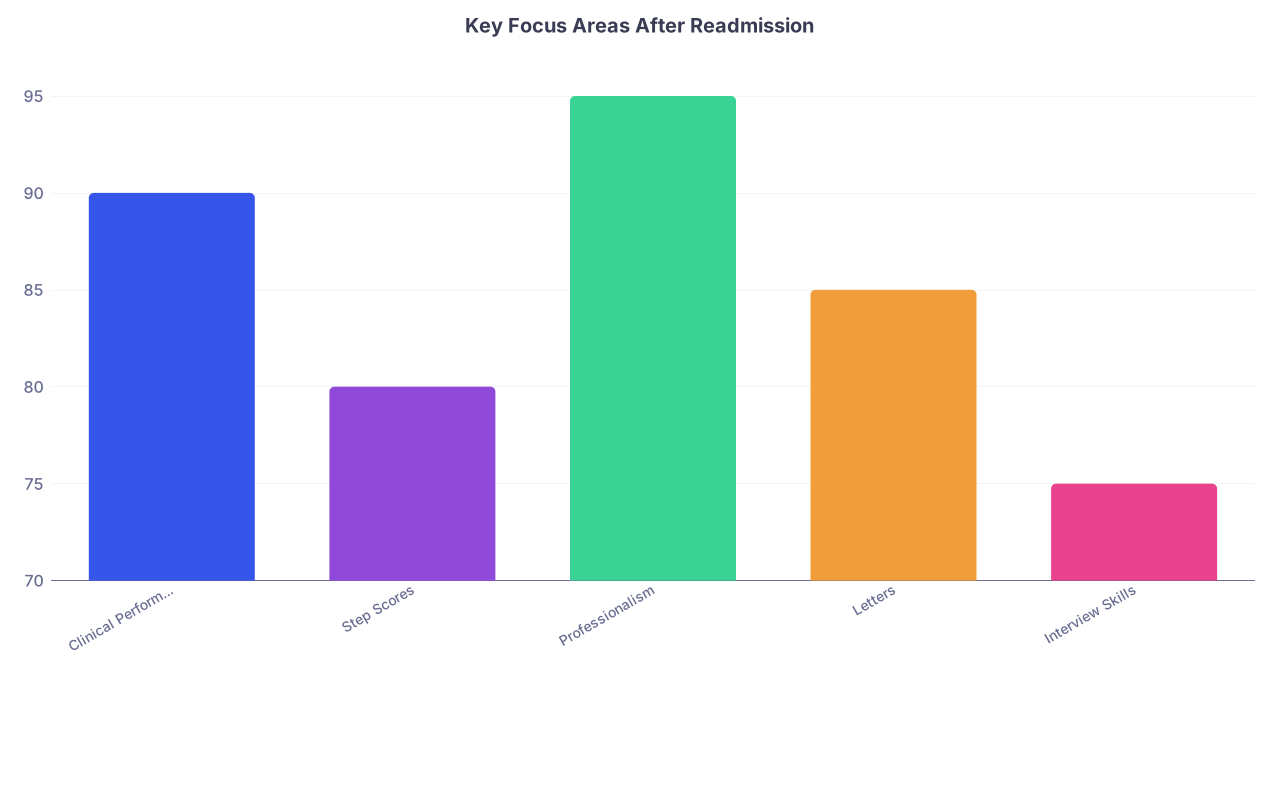
| Category | Value |
|---|---|
| Clinical Performance | 90 |
| Step Scores | 80 |
| Professionalism | 95 |
| Letters | 85 |
| Interview Skills | 75 |
A Quick Reality Check: What Programs Are Actually Thinking
Here’s what’s going on in a PD’s head when they read your file:
“Dismissed. Okay, why? Did they own it? Did they fix it? Do I believe this will not happen again at 2 a.m. in my ICU?”
You’re not trying to be inspirational. You’re trying to make a practical argument:
- “Here’s the problem I had.”
- “Here’s how I’ve mitigated that risk.”
- “Here’s the track record showing the fix is real.”
- “Here’s why I’ll be a safe, teachable, hard‑working intern on day one.”
If your entire application—every component—points in that direction, you can absolutely match. I’ve seen people dismissed twice, readmitted once, and still match FM and Psych at solid programs because their post‑incident record was spotless and their self‑reflection was real.

| Step | Description |
|---|---|
| Step 1 | Dismissed & Readmitted |
| Step 2 | Clarify What Happened |
| Step 3 | Build Redemption Story |
| Step 4 | Align Personal Statement & MSPE |
| Step 5 | Secure Supportive Letters |
| Step 6 | Target Realistic Programs |
| Step 7 | Prepare Interview Answer |
| Step 8 | Demonstrate Ongoing Reliability |