
It’s a Tuesday night. You’re staring at an email that starts with “Due to concerns about…” and ends with some variation of “your position is terminated effective immediately.” Maybe you saw it coming. Maybe it blindsided you after one heated meeting with your PI. Either way, you’ve now got a problem that can leak into your residency application.
You’re not just worried about the lost income or the awkward goodbyes. You’re thinking: “Is this going to show up in my dean’s letter? Are they going to trash me if programs call? Do I have to disclose this in ERAS? Did I just nuke my chances at matching?”
This is the right moment to be strategic, not dramatic. You can’t undo what happened, but you can absolutely contain the fallout.
Let’s walk through what to do, step by step, from the minute you get fired to the moment you hit “submit” on ERAS.
Step 1: Stabilize the Situation in the First 72 Hours
You’re not going to fix the entire mess this week. Your first goal is simpler: stop it from getting worse.
A. Get the facts in writing
If they fired you verbally, you need documentation.
Ask for a written summary that states:
- The end date of your employment/appointment
- That the position is terminated (they can use whatever neutral term they like)
- Any HR-related instructions (final paycheck, access, etc.)
You can say:
“Thank you for discussing this with me. For my records, could HR or you please send a brief written confirmation of my end date and reason for separation in general terms?”
Do not argue the content of that email right now. You just want something on record that isn’t wildly inflammatory.
B. Freeze your impulses
Do not do these things, even if you feel justified:
- Firing off an angry email to your PI or the department
- Venting in your group chat with names and details that could get screenshotted
- Posting about it on Twitter, Reddit, or anywhere searchable
- Storming back to the lab to “set the record straight” with staff
I’ve watched people tank otherwise salvageable situations because they couldn’t shut up for 72 hours. You can process with one trusted, offline person. That’s it.
C. Preserve your work (legally)
If you used institutional equipment and servers, you don’t own the data. Don’t steal it. But you should:
- Save copies of emails that document your responsibilities, deadlines, or praise you received
- Keep your own CV updated with project titles, abstracts, and roles while you still remember everything
- Make a list (for yourself) of what you actually did: methods, hours, responsibilities
You’re not building a legal case; you’re building a memory aid for when you explain later.
Step 2: Diagnose What Kind of “Firing” This Was
Not all terminations are equal, and residency programs know that. You need to be brutally honest with yourself about what actually happened.
Typical categories I see:
Performance / professionalism issues (mild to moderate)
- Chronic lateness
- Missed deadlines, poor follow-through
- “Not a good fit,” but with some specific behaviors cited
Serious conduct problems
- Harassment claims
- Dishonesty or data fabrication
- Inappropriate relationships
- Policy violations (HIPAA, confidentiality, etc.)
Conflict / politics / misalignment
- PI with unrealistic demands, you pushed back
- You refused to work unpaid, nights, weekends
- Personality clash that escalated
Truly neutral / structural
- Grant funding lost
- Lab closed
- Institutional hiring freeze
(These often aren’t labeled “firing,” but sometimes people experience them that way.)
Write down the exact words they used as the reason. Then translate it into a plain-English category like above.
The more you exaggerate or lie to yourself about what happened, the worse your ERAS damage control will be. Programs can smell spin a mile away.
Step 3: Map Out Where This Can Actually Hurt You
You’re worrying about everything. Let’s narrow it to what’s real.
Where this can show up:
-
- If this was an official school-sponsored research year, leadership may reference it, especially if there were professionalism concerns.
- If it was totally external and you were just “working in a lab,” it often never touches the MSPE—unless your behavior overlapped with school professionalism processes.
Letters of recommendation
- A PI who’s mad at you is not going to write you a glowing letter.
- Bigger risk: they get called informally by someone they know in your specialty.
Gaps in your timeline
- If you were supposed to be “full-time research 2023–2024” and it ended halfway through with nothing after it, people might ask.
- Some specialties (like derm, rad onc, neurosurgery) actually read these things line by line.
-
- Small specialties talk.
- If your PI is well-known and furious, they may quietly mention your name to colleagues. That doesn’t always happen—but when it does, it’s usually in tight-knit fields.
Here’s how those risks vary by specialty competitiveness:
| Specialty Type | Typical Impact Risk | Why It Matters |
|---|---|---|
| Ultra-competitive (Derm, Plastics, Ortho, Rad Onc) | High | Tight networks, heavy reliance on research, PIs often know PDs |
| Competitive (EM, Anesthesia, Gen Surg) | Moderate | Research helps but is not everything; some backchannel talk |
| Less competitive (FM, Psych, Peds, IM) | Low-Moderate | Research less central; professionalism issues still matter |
| Primary care–focused, community-heavy | Low | Few backchannels; behavior in clinical rotations matters more |
So your plan needs to be proportional. Burned in a derm lab? That’s different than leaving a random QI project in a community hospital.
Step 4: Decide Who Needs to Know—and What to Say
You can’t tell everyone everything. You also can’t tell no one anything. You need a narrow, consistent story that respects the truth but doesn’t self-immolate.
A. Start with your dean’s office or student affairs
Set up a private meeting with someone whose job is to help you match (dean of students, career advisor, etc.). Do not wait until after MSPEs are drafted.
Your script can be:
“I want to give you a clear, honest picture of something that happened in my research position so that it doesn’t blindside us later. I was let go from my research role in [month/year] due to [short, non-dramatic explanation]. I’ve reflected on what I could have done differently and have taken steps to fix those issues, and I’d like your guidance on how this might show up in my application.”
They’ve seen worse. You’re not the first termination they’ve dealt with. What scares them is secrecy, not imperfection.
B. Decide what you tell peers and faculty mentors
You need:
- 1–2 mentors who know the real story and can advise
- Everyone else gets a sanitized, consistent version
Example of sanitized:
“The fit with that research group wasn’t great, and we ended up parting ways earlier than planned. I’ve since shifted my focus to [X], which aligns better with my goals.”
You’re not required to make your worst day into public entertainment for your classmates.
Step 5: Craft Your “Official” Story – Short, Honest, Not Self-Destructive
You need a 3-part structure if asked in an interview or by a PD:
- Neutral description of what happened
- Ownership of your part
- Concrete changes you made
Here’s an example for a performance/professionalism firing:
“During my research year in Dr. X’s lab, I struggled with managing competing deadlines. My project required independent time management, and I fell behind on several key tasks. After several discussions with my PI, they decided to end the position early.”
“Looking back, I underestimated how different a self-directed research role is from structured coursework. I didn’t seek help early enough when it became clear my system wasn’t working, and I did not communicate proactively about delays. That’s on me.”
“Since then, I’ve worked with [mentor/coach] to rebuild how I manage larger projects—breaking them into weekly deliverables, sending regular progress updates, and asking for feedback at set intervals. In my subsequent [clinical rotations / new project], I’ve consistently met deadlines, and I’ve asked supervisors specifically to evaluate me on follow-through because I don’t want to repeat that mistake.”
Notice what’s missing:
No PI-bashing. No dramatic side stories. No “but they were crazy” rants—even if they were.
For a conflict/politics situation:
“In my research role with Dr. X, we had significant disagreement about working expectations outside our original agreement, particularly regarding evening and weekend commitments. Over time, our relationship became strained, and the position was ended early.”
“I could’ve handled the disagreement more effectively. I waited too long to clearly reset expectations, and some of our conversations became more reactive than productive.”
“I’ve since learned to address misalignment earlier and in writing, and to involve a neutral third party sooner if needed. In my later team experiences—like [rotation or project]—I’ve made a point of clarifying expectations at the outset and giving feedback before frustration builds.”
You own your part. You don’t have to confess to sins you didn’t commit.
Step 6: What to Put in ERAS (and What to Leave Out)
Here’s where people really mess themselves up—by over-disclosing or under-disclosing in the wrong places.
A. ERAS Application Activities Section
If you worked there for a meaningful period (months), it usually still belongs on your CV. But the description should be factual and boring.
Bad:
“Left position due to disagreement with PI on expectations.”
Better:
“Full-time research assistant in [lab name], contributing to [project/topic]. Responsibilities included [data collection, chart review, manuscript preparation].”
You do not use the activities section to narrate your firing. That’s for interviews and conversations if asked.
B. Dates and gaps
Do not lie about dates.
If you worked from July–December and then nothing from January–June, you put July–December. You leave January–June empty and be ready to explain what you did (studying for Step 2, family responsibilities, clinical rotations, another project, whatever is true).
Lying about dates to hide a firing is worse than the firing.
C. Personal statement
Usually, you don’t front-load your worst story in your personal statement unless:
- It was a major turning point in your growth,
- You can write about it with clarity and maturity,
- And it truly shaped why you want that specialty.
Most of the time, I keep it out of the PS and handle it in interviews or a supplemental “adversity” essay if those exist.
Step 7: Reference Letters: Who to Use, Who to Avoid
Your fired PI is almost never your best letter writer. Even if they say “I can still write you a strong letter,” I’ve seen “strong” turn into “damning with faint praise.”
You want letters that show:
- Reliability
- Professionalism
- Teamwork
- Clinical performance (far more important than research for most programs)
If programs ask directly for a research mentor letter (common in competitive specialties), here’s how to handle it:
- If you have another PI or research supervisor who knows your work and isn’t part of the drama, use them instead.
- If this PI is the only option, you need to have a very honest conversation:
“Given how my position ended, I want to be sure that if you write for me, it will be a strong, supportive letter. If you have any reservations, I completely understand and would prefer not to put you in that position.”
If they hesitate even 1 second, walk away and find another letter.
Step 8: Building a New Track Record Fast
You don’t erase a firing with words; you dilute it with better, more recent evidence.
Focus on a 6–12 month window where you are relentlessly reliable. That means:
- Crush your clinical rotations. Ask specifically, “Can you give me feedback on my reliability and follow-through?” then act on it.
- Take on a smaller, contained scholarly project you can actually finish—a case report, quality improvement project, short review.
- Treat every new supervisor like they might be called about you. Because they might.
Here’s how the risk of one negative event changes when you stack positive ones:
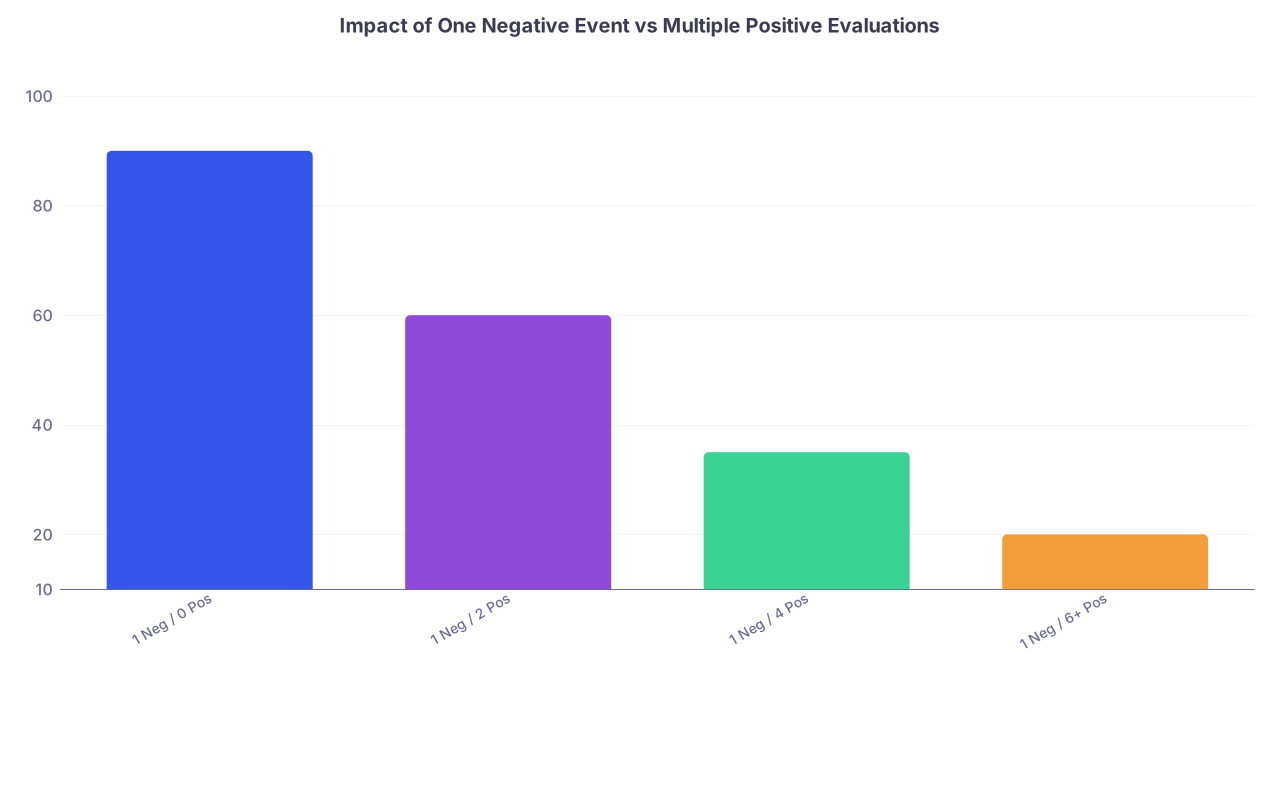
| Category | Value |
|---|---|
| 1 Neg / 0 Pos | 90 |
| 1 Neg / 2 Pos | 60 |
| 1 Neg / 4 Pos | 35 |
| 1 Neg / 6+ Pos | 20 |
Interpretation: The more solid, recent, positive evaluations you stack, the less programs fixate on the one bad episode.
I’ve watched PDs shrug off a research firing when they see consistent “outstanding” comments from attendings who actually worked with you clinically.
Step 9: Handling Interview Questions Without Melting Down
You’ll get some version of:
“I see you did research with Dr. X only until December. Can you tell me about that experience?”
Here’s the structure:
- Answer the question that was asked. Not every question is a trap.
- Use the 3-part structure we talked about: what happened, your role, what changed.
- Stop talking. Do not over-explain into a hole.
Example:
“Yes, I worked in Dr. X’s lab from July to December. The role was more independent than what I’d done before, and I struggled with managing the workload and deadlines. After several discussions, the position was ended early. I’ve spent a lot of time reflecting on that and changed how I approach large projects—breaking them down more intentionally and communicating earlier when I hit obstacles. Since then, in my [medicine and surgery] rotations, I’ve made it a priority to be reliable and proactive, and my attendings have given me very positive feedback on follow-through.”
If they push harder—
“Were you fired?”
You answer directly:
“Yes. The position was terminated early due to those performance concerns I mentioned. It was a hard experience, and I’ve taken it very seriously.”
Then you shift to concrete proof of improvement. Program directors care much more about: “Is this going to be a problem in my residency?” than “Did this student ever have a bad chapter?”
Step 10: When the Firing Was for Something Serious
If the termination involved dishonesty, data fabrication, harassment, or a serious professionalism violation, this is a different league. I’m not going to sugarcoat it. Programs care a lot more.
What you need then:
- A clear, unambiguous acceptance of responsibility (if you did it)
- Evidence of remediation—counseling, professionalism courses, ethics training
- A credible third party (dean, program director, respected mentor) willing to vouch that you’ve done the work to change
This is where I see people try to minimize:
“I just made a mistake with data entry” when it was intentional data manipulation. If the institution documented it as misconduct and that’s in your file, downplaying it will kill you.
We’re now in “salvage over several years” territory, not “quick fix before this September.” You might need:
- An extra year
- A strong record in another structured environment
- Applications to less competitive specialties or community-based programs first
Is it impossible? Not always. But you don’t brute-force your way through this in one ERAS season.
Step 11: When You Should Actually Not Apply This Cycle
Sometimes the right containment move is: sit one out.
Consider delaying if:
- The firing happened within the last 2–3 months, and you have no positive track record after it yet
- Your dean’s office tells you your MSPE will include serious concerns, and there’s no time to balance it out
- You’re aiming for a highly competitive specialty and your only real research letter source is radioactive
Use that “off” year to:
- Get a new position with a very different mentor who is stable and reasonable
- Build a squeaky-clean record of reliability and teamwork
- Work clinically adjacent (scribe, hospital job) and get strong references
Waiting a year feels like failure when you’re in it. A bad, desperate application that brands you as a problem is worse.
Step 12: Tightening Up Your Professionalism Overall
Being fired from research is almost always a sign of one or more of these:
- Weak boundaries / conflict management
- Time management failure
- Poor expectation-setting
- Inability to adjust to different working styles
Residency will stress all of those even more. So you fix them for you, not just for ERAS.
Pick two concrete habits:
- Weekly written check-ins to any supervisor on long-term tasks (“This week I completed X, next week I will do Y.”)
- A time-blocked schedule with protected hours for real work, not just reactive email chaos
And one interpersonal rule:
- Address misalignment early, in writing, and politely.
“Dr. X, I want to clarify expectations for [hours/deadlines/availability] so I can make sure I’m meeting your needs. My understanding is […]. Is that accurate, or should we adjust it?”
It sounds simple. Almost nobody does it consistently.
Step 13: Keep This in Perspective
You feel like this firing is a neon sign on your forehead. It isn’t.
Program directors are juggling:
- Board scores
- Clinical grades
- Fit with their program
- Diversity of experiences
- Letters they trust and letters they ignore
Your research firing is one piece. It can be contained if you’re adult about it.
I’ve seen people:
- Fired from a research year for “poor performance,” then match IM and later subspecialize in competitive fellowships
- Blow up publicly on social media about how unfair their PI was, get a reputation for drama, and then weirdly wonder why no interviews came
The difference wasn’t the original incident. It was everything that came after.
Your Next Step Today
Do one concrete thing right now:
Write a 5–7 sentence draft of how you’d explain your research position ending early, using the 3-part structure: what happened, your role, what changed.
Then send that draft to one trusted mentor or advisor and ask:
“Does this sound honest but not self-destructive? What would you change?”
That’s your first real move in containing the fallout.