
It is August. ERAS opens in a few weeks.
You just downloaded your MSPE draft and there it is in black and white: “Lower third of class.” Or your school’s version of that. No AOA. Maybe even a line about “academic challenges in the preclinical curriculum.”
You know programs will see it. You also know you cannot change it.
This is where most applicants either panic or put their head in the sand. You are not going to do either. You are going to run an actual protocol.
Low class rank is a red flag. Not a death sentence. The difference is whether you pretend it does not exist, or you deliberately build counterweights around it.
Here is the protocol I use when coaching students in this exact mess.
Step 1: Get Clear on How Bad the “Red” Really Is
First job: classify the problem precisely. “Low” is vague. Program directors think in categories.
A. Define your rank reality
Look at your transcript / MSPE language and put yourself in one of these buckets:
| Bucket | Typical Language | Risk Level |
|---|---|---|
| Top 1/3 | "Upper third" | None |
| Middle 1/3 | "Middle third" | Mild |
| Bottom 1/3 | "Lower third" | Moderate |
| Bottom 10–15% | "Lower decile" | High |
| No Rank + Pattern of Marginal Pass/Fail | "Not ranked" but weak grades | Moderate–High |
If your school does not rank, use clues:
- Multiple repeats or remediation
- Several “Pass” in a class that most people “High Pass” or “Honors”
- Comments in MSPE like “required additional support,” “initial academic difficulties,” etc.
B. Know where class rank actually matters
Blunt truth:
It matters a lot:
- Competitive specialties (Derm, Ortho, ENT, Plastics, Urology, IR, Rad Onc)
- Top academic programs in every field (Mayo, MGH, UCSF)
- Heavy-research departments that like “alpha” students
It matters, but can be offset:
- Internal Medicine, General Surgery, EM, Anesthesia, OB/GYN, Pediatrics, Psych
- Solid community and mid-tier academic programs
It matters far less:
- FM, PM&R, Path, some categorical IM in community programs
- Programs desperate for dependable workers over prestige
So if you are bottom third applying to Derm at top-10 places with no other strengths: that is fantasy, not a strategy. But bottom third applying to IM with strong Step 2, good letters, and smart list-building? That is salvageable.
Step 2: Do a Ruthless Inventory of Counterweights
You are not going to “hide” your class rank. You are going to drown it in other data.
Here is the checklist I use.
A. Scores and Exams
Ask yourself, honestly:
Step 2 CK (now the star of the show):
- 260+: Strongly positive signal, can partially erase low rank
- 250–259: Clear asset
- 240–249: Fine for most core fields, neutralizer
- < 235: Vulnerable. You will need more help elsewhere.
Shelf exams / clerkship exams:
- Honors or high percentile on shelves suggests you improved when things became clinical.
- If preclinicals were your weak point but clerkships/shelves are strong, that is a narrative.
B. Clinical performance and narrative comments
Go read your MSPE line by line. You are looking for:
- “Hard-working,” “reliable,” “excellent team member,” “outstanding with patients”
- Concrete praise: “one of the top students I have worked with in the last 5 years”
- Evidence of improvement: “significant growth,” “marked improvement over the course”
If clinical comments are strong and consistent, that is your shield. Many PDs will take a strong clinical worker with mediocre preclinical performance over the opposite.
C. Letters of recommendation
You need at least 2–3 genuinely strong letters, not bland “fine” ones.
Filter:
- Do they actually know you well? Or just remember your face?
- Will they say “top 10%” or “among the best students I have worked with”?
- Are they in your specialty or a closely related one?
If you cannot answer “yes” to at least two of those for each writer, find better letter writers. Even if that means:
- Doing an away rotation purely to get a letter
- Going back to a rotation and scrubbing in / working extra to reestablish relationship
- Meeting with attendings to explicitly request honest feedback and, if appropriate, a letter
D. Research and scholarly work
No, you do not need a first-author NEJM paper. But you do need something you can point to as evidence of discipline and follow-through:
- Posters, abstracts, QI projects
- Retrospective chart review that actually produced a manuscript
- Regional presentations
If you have nothing, you need to realistically assess:
Is there time to complete one focused project before applications go out or before interviews? Sometimes yes, often no. Do not start a massive project that will just die midstream.
E. Non-academic strengths
These actually matter more than you think when your academics are weaker:
- Real job history (EMT, nurse, tech, military, scribe)
- Long-term community service with continuity (not scattered 2-hour shifts)
- Leadership roles where you actually built or fixed something (not just “secretary” on paper)
- Prior career (engineering, business, teaching, programming)
Programs love grown-ups who can function in chaos. If that is you, highlight it.
Step 3: Choose the Right Specialty and Program Tier
Here is where people sabotage themselves. They apply like their record is average, not like they have a red flag.
A. Match your application to your actual profile
Use this simple matrix:
| Profile | Specialty Category | Comment |
|---|---|---|
| Low rank + 250+ Step 2 | Most core specialties, some competitive with heavy backup | Lean on score, explain rank |
| Low rank + <240 Step 2 | FM, Psych, Path, PM&R, community IM, community Peds | Focus on being safe, reliable |
| Low rank + strong research | Academic IM, Neuro, Anesthesia at mid-tier | Sell research productivity |
| Low rank + stellar clinical comments | Any non-ultra-competitive field at non-elite programs | Emphasize clinical performance |
If you are bottom third and dead set on a competitive field, you need:
- A huge application list
- A parallel plan (e.g., IM with a plan for fellowship)
- A very honest mentor who is not afraid to say “you are not competitive here”
B. Build a protective program list
You should be aiming for:
- Wide geographic spread
- Mix of:
- Safety (you are above their usual academic threshold)
- Target (you roughly match their typical profile)
- Stretch (a few aspirational programs)
For a low-rank candidate in IM or FM, a 60–80 program list is completely rational. Yes, it is expensive. But not matching is more expensive.
Step 4: Control the Narrative in Your Application Materials
If you do not explain the low rank, PDs will make up their own explanation. And it will usually not be flattering.
Your job is not to make excuses. It is to:
- Own what happened
- Show what you changed
- Provide hard evidence that those problems are in the rearview mirror
A. Where to address it
Use one or more of these:
- Personal statement (one focused paragraph, not the whole essay)
- ERAS “Additional Comments” section
- MSPE “Academic History” addendum if your dean’s office allows input
- Interview answers (“Tell me about a time you faced adversity” / “Anything in your record you would like to explain?”)
B. How to explain low class rank without sounding defensive
Use a three-part structure:
- Brief cause (no drama, no 500-word backstory)
- Specific changes you made
- Objective results
Example 1 – early academic adjustment:
In my first year of medical school I struggled with the pace of preclinical coursework and earned several lower grades that placed me in the lower third of my class. I realized my study methods from college were not sufficient, so I began meeting with our learning specialist, joined a structured study group, and changed to active recall and spaced repetition. As the curriculum became clinical, these changes took hold; my clerkship grades and shelf scores improved significantly, and I have consistently performed at or above the class average on clinical rotations.
Example 2 – health/family issue (only if true and documented):
During my second-year fall semester I experienced a significant health issue (briefly described) that required treatment and impacted my coursework, contributing to a lower overall class rank. With support from my school and physicians, this has been fully treated and stable for over two years. Since that time I have completed all subsequent coursework and clerkships without accommodations, including strong performance on core rotations and Step 2 CK.
Key moves:
- Do not trash your school, curriculum, or faculty.
- Do not over-share sensitive medical/mental health details.
- Do not sound like it “just happened” to you. Own the part you controlled.
C. Personal statement: what to emphasize
Given a low rank, your statement should do three things:
- Convince them you understand the work of the specialty
- Show you are dependable, self-aware, and coachable
- Offer evidence of resilience and growth
You are not trying to be poetic. You are trying to make a risk calculation easier for the PD: “If I rank this person, will they show up, work hard, learn, and not implode?”
Step 5: Use Step 2 CK as a Weapon, Not an Afterthought
If your class rank is weak and your Step 2 CK is not taken or is borderline, you are in dangerous territory. Step 2 is your best shot at an objective “this person can handle it” signal.
A. If you have not taken Step 2 yet
You should:
- Schedule it early enough so:
- Score returns before MSPE release (late October), ideally before application submission
- Treat it as your single highest-yield investment this year
Concrete protocol:
- Minimum 6–8 weeks of focused prep if you are not already test-ready
- UWorld done carefully, not rushed for “completion”
- At least 2 NBME practice exams; aim for a score comfortably above your target specialty’s average
If your baseline practice scores are low, consider:
- Delaying ERAS submission a bit to submit with a stronger Step 2
- Adjusting your specialty and program list expectations
B. If Step 2 is already done and mediocre
You now lean heavier on:
- Clinical comments
- LORs
- Fit for less competitive specialties / programs
In that case, control what you can: do not add another hit by failing a rotation, showing up late, or irritating staff.
Step 6: Maximize Rotations, Letters, and Visibility
You cannot change your rank, but you can give programs direct, recent evidence of your value.
A. Treat every rotation like a month-long interview
Program directors trust their residents and faculty. If you get comments like:
- “We want you here; please apply”
- “Tell me when you submit; I will keep an eye out”
That is gold.
Your rotation protocol:
- Be early. Not on time. Early.
- Volunteer for scut reasonably. Own the “unsexy” tasks without complaint.
- Read about your patients every night. Bring that knowledge the next day.
- Be coachable: when corrected once, do not repeat the same mistake.
- Do not get pulled into drama or gossip. Ever.
B. Away rotations (auditions)
If you have low class rank and you are applying to a moderately competitive field, away rotations can help. But they are not magical.
Use them to:
- Get at least one strong, detailed letter
- Prove that in a new environment, you perform above your “paper stats”
- Show geographic or institutional interest (“I really want to be in the Midwest / at this system”)
If you are applying to a less competitive field, aways are optional and sometimes unnecessary. Do not sacrifice Step 2 prep or core clerkship performance just to chase one more away rotation.
Step 7: Interview Strategy – Own It Before They Ask
If you get to the interview, that means:
- They saw your low class rank
- They still thought you were worth meeting
Your job in the interview is not to pretend class rank does not exist. It is to make them forget it is the main story.
A. Prepare 2–3 crisp explanations
For questions like:
- “Tell me about a weakness in your application.”
- “I noticed your class rank; can you talk about that?”
- “What has been your biggest challenge in medical school?”
Use the same three-part formula from earlier:
- Brief context
- What you changed
- Evidence of improvement
Deliver it in 30–60 seconds. Then pivot to your strengths: clinical work, teamwork, Step 2, research, etc.
B. Show them who you are now, not who you were
Program directors want:
- Residents who show up
- Residents who own their mistakes
- Residents who communicate well and do not fall apart under stress
Signals you can send during interviews:
- Be concrete when you talk about cases you have handled
- Give examples of learning from criticism
- Talk about patient interactions you still remember and why
You are trying to plant a picture in their heads: “I can see this person on my team at 3 a.m., still functioning and not crumbling.”
Step 8: Play the Long Game If Necessary
Sometimes, the combination of low class rank + weak Step 2 + ambitious specialty choice is just too much to fix in one cycle. In those cases, you need an actual Plan B and maybe Plan C.
A. Parallel plan within the Match
Common paths:
- Apply to:
- Your dream specialty
- Plus IM or FM as a realistic safety
- If you match in IM/FM, plan for:
- Fellowship into a subspecialty you like
- Transition to a related field later with strong in-training performance
Better a match in a less “sexy” specialty than going unmatched because of pride.
B. Post-match options if you do not match
This is what I have seen work:
Preliminary or transitional year + reapplication with:
- Strong in-service exams
- Stellar PD letter
- Evidence of reliability and performance
Research year only if:
- You are in a competitive specialty
- You join a productive lab that will actually generate output and connections
Wandering into a random one-year research gig with no mentorship and no clear deliverables is how people waste an extra year and reapply with the same problems.
Step 9: Practical Timeline – What to Do Month by Month
You need structure. Here is a rough outline if you are 3–6 months from ERAS submission.
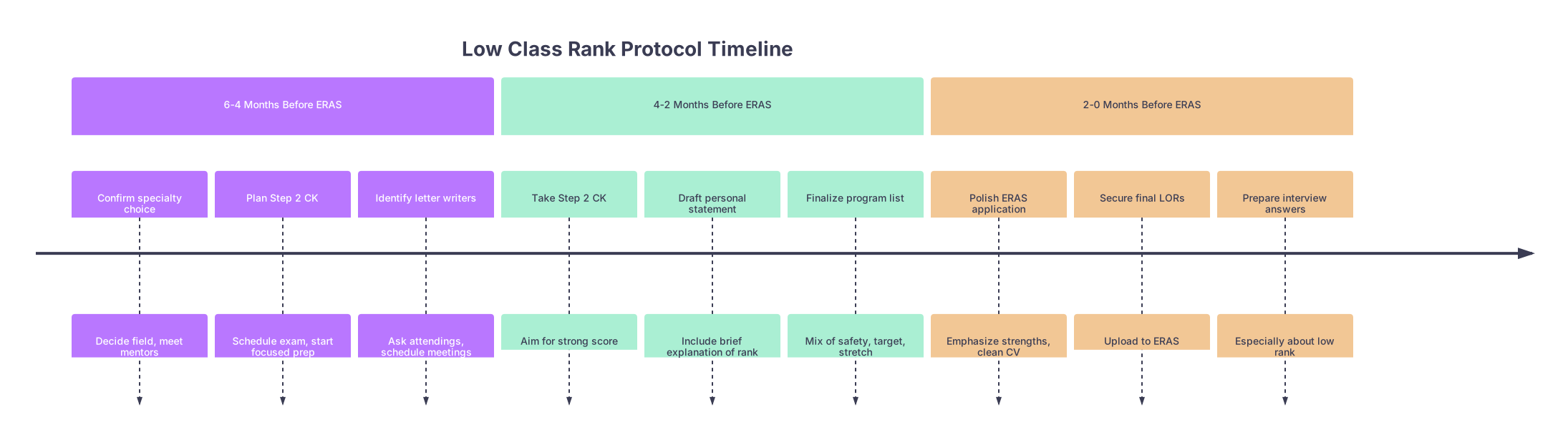
| Period | Event |
|---|---|
| 6-4 Months Before ERAS - Confirm specialty choice | Decide field, meet mentors |
| 6-4 Months Before ERAS - Plan Step 2 CK | Schedule exam, start focused prep |
| 6-4 Months Before ERAS - Identify letter writers | Ask attendings, schedule meetings |
| 4-2 Months Before ERAS - Take Step 2 CK | Aim for strong score |
| 4-2 Months Before ERAS - Draft personal statement | Include brief explanation of rank |
| 4-2 Months Before ERAS - Finalize program list | Mix of safety, target, stretch |
| 2-0 Months Before ERAS - Polish ERAS application | Emphasize strengths, clean CV |
| 2-0 Months Before ERAS - Secure final LORs | Upload to ERAS |
| 2-0 Months Before ERAS - Prepare interview answers | Especially about low rank |
Adapt the details to your calendar, but do not drift. Put tasks on a schedule.
Step 10: Quick Protocol Checklist
You want something you can literally print out or keep next to your laptop. Here it is.
| Area | Action |
|---|---|
| Reality Check | Classify rank level and specialty competitiveness |
| Scores | Take/retake Step 2 with serious prep if still pending |
| Clinical | Max effort on current/future rotations, seek feedback |
| Letters | Secure 2–3 strong, specific LORs in your field |
| Narrative | Write a brief, honest explanation of low rank + growth |
| Programs | Build a wide, realistic list with enough safeties |
| Interviews | Rehearse concise responses about class rank and adversity |
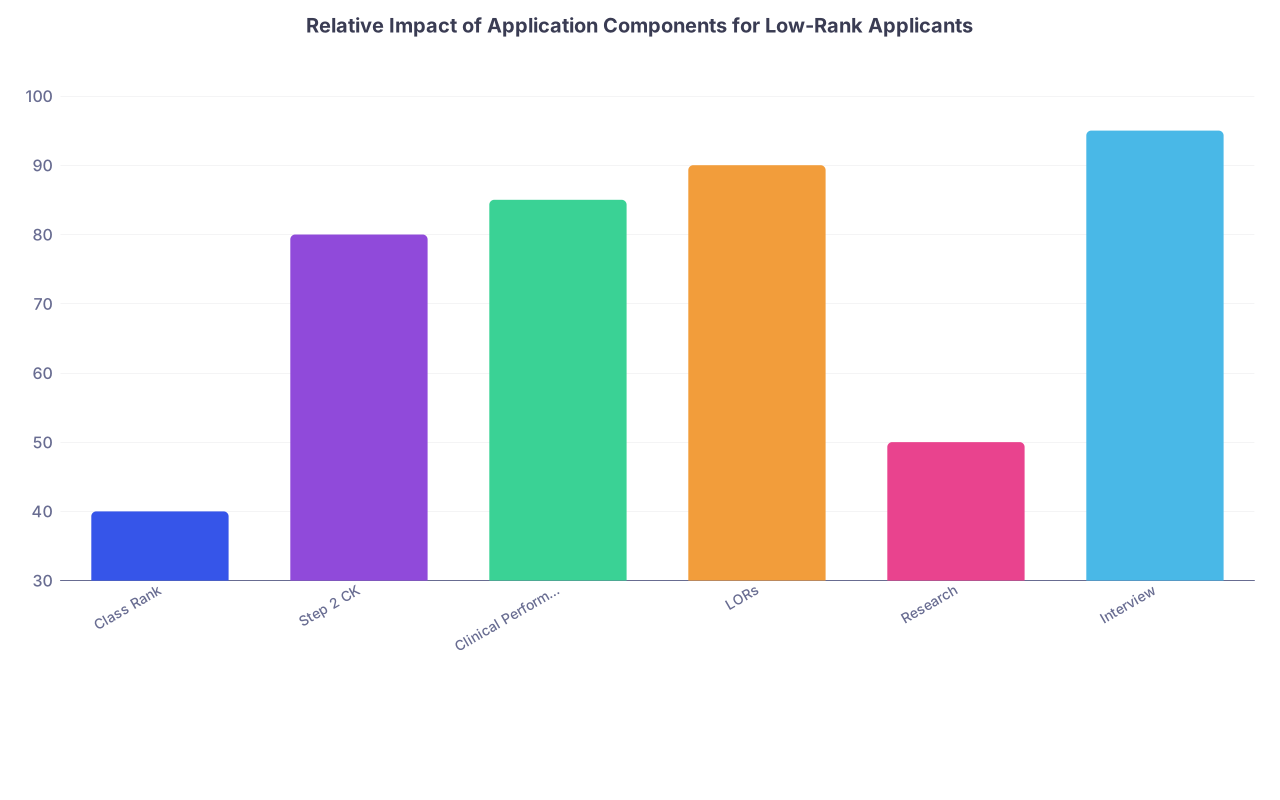
| Category | Value |
|---|---|
| Class Rank | 40 |
| Step 2 CK | 80 |
| Clinical Performance | 85 |
| LORs | 90 |
| Research | 50 |
| Interview | 95 |
(Interpretation: you cannot delete class rank, but everything else can outvote it.)
Two Things to Remember
Low class rank is a data point, not a verdict. If you give programs stronger, more recent data (Step 2, rotations, letters, interview presence), many will care far more about who you are now than where you sat in a preclinical curve three years ago.
You do not fix a red flag by ignoring it. You fix it by:
- Explaining it briefly and honestly
- Showing exactly how you improved
- Stacking every other part of your application so high that taking a chance on you looks smart, not risky.