
It’s 9:12 a.m. You’re in a Zoom breakout room. You just finished your quick “tell me about yourself,” it actually went okay, and then the faculty member leans in and says: “So. I see you took a personal leave of absence in medical school. Can you tell me more about that?”
You answer. You give the line you practiced. You try to sound calm.
But they don’t move on.
They ask: “How long was it exactly?”
Then: “Why couldn’t you stay enrolled?”
Then: “Do you think this will happen again in residency?”
You feel your ears heat up. You’re trying not to ramble, but now you’re sure this is it, this is the moment your entire application dies on camera.
That’s what this is about. That exact panic:
What if they keep pushing about my personal LOA and I feel cornered, exposed, or judged?
Let’s walk through this without sugarcoating it, but also without letting your catastrophic brain run the whole show.
First: Is a Personal LOA Automatically a Giant Red Flag?
Short answer: no.
But… it can become one if it’s handled badly. On paper or in the room.
Programs mostly care about three things:
- Are you reliable?
- Are you safe?
- Are you going to disappear mid-residency and blow up their schedule?
A “personal” leave of absence makes people curious because it’s vague. Curiosity + limited time + high stakes = probing questions.
Here’s the hierarchy in most faculty minds, whether they admit it or not:
| Type of LOA | Initial Reaction Level |
|---|---|
| Medical/health, now stable | Mild concern |
| Family emergency/caregiver | Mild to moderate |
| Personal/unspecified | Moderate concern |
| Academic remediation | Moderate to high |
| Conduct/professionalism | Huge red flag |
So a “personal” LOA for one semester/year sits in that “Hm, I need to understand this” category. It’s not an automatic no. I’ve seen people with:
- 6–12 month personal LOAs
- Multiple repeated rotations
- Even a complete repeat year
…and they still matched solidly as long as they:
- Owned it
- Framed it clearly
- Demonstrated stability afterward
The red flag isn’t the leave itself. The red flag is mystery + evasiveness + ongoing instability.
Why Do Some Interviewers Keep Pushing?
You feel like you already explained. Why are they digging?
A few reasons, none of which are, “We enjoy torturing applicants” (even if it feels like that):
Risk assessment mode
They’re trying to answer: “If I rank this person, am I going to regret it?” They’re thinking about call schedules, coverage gaps, wellness, GME oversight. It’s not personal; you’re a possible future staffing problem in their mind.Your answer triggered more questions
If you give an answer that is:- Very vague
- Overly emotional and unstructured
- Contradictory to what’s in your MSPE/Dean’s letter
…they will push. They’re trying to figure out if you’re hiding something serious like substance use, chronic poor performance, or major professionalism issues.
Some attendings are just blunt
There’s always that one person who interviews like they’re cross‑examining a witness. They think they’re “getting the real story.” They’re often not trained in behavioral interviewing and just ask whatever pops into their head.Something in your file doesn’t match
Example I’ve seen:- ERAS says “personal leave”
- MSPE hints at “significant personal challenges”
- You say, “Oh, it wasn’t a big deal”
Now they’re confused. Confusion = more questions.
Does any of this feel fair? Not necessarily. But understanding why they’re pushing helps you respond strategically instead of spiraling.
How Much Do You Actually Have to Share?
Here’s the line: You need to be honest, consistent, and reassuring, not fully confessional.
There are things you do not have to do:
- You don’t have to give graphic detail about trauma, abuse, or family crises.
- You don’t have to disclose a specific diagnosis if you don’t want to.
- You don’t have to emotionally bleed out on camera to prove you “grew.”
You do have to:
- Give a coherent, believable reason
- Make clear why it required time away
- Show that the issue is addressed and that your performance since then backs that up
Think in terms of a 3-part structure:
What happened in simple terms
“I took a personal leave of absence for X months due to serious family circumstances that required my full attention.”or
“I took a personal leave for health reasons. I needed dedicated time for treatment and recovery.”
What you did with that time / what changed
“During that time, I focused on treatment, established stable follow-up care, and worked with my school to be sure I’d be ready to return to full-time clinical duties.”Evidence that you’re stable now
“Since returning, I completed all required rotations on time, with strong evaluations and no further interruptions.”
That last part is huge. They care a lot more about your trajectory after the leave than the drama of what started it.
What If They Keep Pushing Past Your Comfort Zone?
Here’s the nightmare scenario in your head: you give the clean, rehearsed answer, and they keep drilling:
“But what exactly was going on?”
“Can you tell me specifically what the condition was?”
“Could this come back? How do we know you won’t need another leave?”
You feel trapped. It’s your life, your body, your family, and suddenly it’s being treated like an MMI station.
You need some stock phrases. Literally memorized lines you can lean on when your brain starts to flood.
If they pry for specific diagnosis/details
Example: They say, “What medical condition?” or “What exactly happened in your family?”
You can say:
“I’m not comfortable going into very personal specifics, but I can say this: I needed time away, I got appropriate care/support, and I’ve been stable and fully functional in my training since returning. My subsequent evaluations and performance reflect that.”
That hits all the things they actually need: care happened, it’s not untreated chaos, and there’s proof you’re functioning.
If they keep circling back to “Will this happen again?”
You can say:
“That was a very specific period in my life under unusual circumstances. Since then, I’ve put long-term supports and systems in place, and I’ve been able to meet all my responsibilities without interruption. Based on the last [X] years of stable performance, I’m confident I can handle the demands of residency.”
You are allowed to remind them of your track record. This isn’t vibes-based; you’ve got data.
If they’re borderline inappropriate
Sometimes someone crosses the line. You’ll feel it.
Questions like:
- “Were you hospitalized for psychiatric reasons?”
- “Do you have a diagnosis of [specific condition]?”
- “Are you currently on medication?”
That veers into ADA territory and is not okay. In the moment, you don’t need to be a civil rights lawyer. You can keep it simple:
“I’d prefer not to discuss specific medical details, but I can assure you that I’m currently fully able to meet the demands of residency, and that’s reflected in my recent performance.”
If they keep pressing after that, that tells you more about the program than it does about you. Make a mental note. Rank accordingly.
Making Your Story Less Scary to You (And to Them)
Your LOA feels like a huge, loud, blinking siren in your file. To you, it’s a core memory. To them, it’s one line in a PDF.
You’re scared they’ll see:
“Personal LOA = unstable, unreliable, future problem.”
You need to help them see instead:
“Personal LOA = tough period, handled it, came back stronger, now stable.”
The way you talk about it shifts the frame.
Here’s what helps you:
Neutral, steady tone
If you look like you’re about to cry or get defensive, they subconsciously tag this as “still unresolved.” Practice until you can say your answer without your throat tightening.Clear timeline
“This was from May 2021 to December 2021.”
No fuzzy, “Oh, around third year sometime.” Vague = suspicious.Strong post-LOA performance receipts
Shelf scores, sub-I comments, Step 2 improvement, letters that mention your work ethic. You want your post-LOA period to scream: “I show up. Every day.”No contradictions with your application
If you said “personal” but your MSPE hints at “academic,” you need a clean way to reconcile that:“The leave was classified as personal by my school, but the underlying issue was that I was dealing with [family/health] circumstances that affected my performance. Once those were addressed, my academic performance improved and I didn’t need further remediation.”

How to Practice Without Making Yourself More Anxious
You’ve probably already rehearsed your LOA story in your head 300 times at 2 a.m. That doesn’t count. That’s just rumination.
You need out loud practice with another human being.
Here’s a simple rehearsal plan:
Write a 3–4 sentence answer using that structure:
reason (broad) → what you did → proof you’re okay now.Ask a friend, resident, mentor, or even your school’s career office to “grill” you.
Tell them: “Be pushy. Ask follow-ups that make me uncomfortable.”Practice setting boundaries in real time.
Use the phrases above. Get used to saying, “I’m not comfortable going into more detail, but…” without flinching.Record at least one practice session.
You’ll hate watching it, but you’ll see if you ramble, apologize too much, or overshare.Refine. Tighten your main answer to about 20–30 seconds. Prepare 1–2 follow-up lines. That’s it.
If you don’t do this, here’s what happens: the first time someone pushes you is in a real interview, and that’s when your brain goes blank and you start blurting out raw, unedited stuff you regret later.
What If They Obviously Don’t Like Your Answer?
You’ll recognize the signs:
- They frown, nod slowly, and say, “Hmm.”
- They change the subject abruptly.
- They ask the next question with a different vibe—colder, more distant.
Your anxious brain will translate this as: “I’m dead. I just lost this program. I’m going unmatched. I will be 40 and living with my parents.”
Reality: you do not know what’s happening in their head. I’ve talked to faculty who later said things like:
- “I was just thinking about how poorly our curriculum supports students in crisis.”
- “That reminded me of my own burnout in residency.”
- “I was mentally checking if we had enough wellness resources.”
Your job in that moment is not to mind-read. Your job is to:
- Stay steady
- Finish the interview like a professional
- Give them plenty of chances to see who you are beyond the LOA
One awkward segment doesn’t tank an entire interview day. People remember the overall impression more than one uncomfortable question.
When a Program’s Reaction Is Actually a Useful Data Point
Here’s something people don’t tell you when you’re in full “please just rank me” mode:
How they handle your vulnerability is data.
If a program:
- Is respectful when you say you don’t want to give details
- Focuses on your recovery and current functioning
- Asks reasonable, straightforward questions about support and reliability
…that’s a place more likely to treat you like a human when something goes wrong in residency. Which it will, in some form. Life doesn’t pause.
If a program:
- Presses for diagnosis/medications/graphic detail
- Keeps circling back even after you set a boundary
- Makes a face or comment that feels judgmental or dismissive
You’re allowed to say, “Even if they rank me, I’m not sure this is a healthy place for me.” You are not a beggar in this process, even if it feels like it.
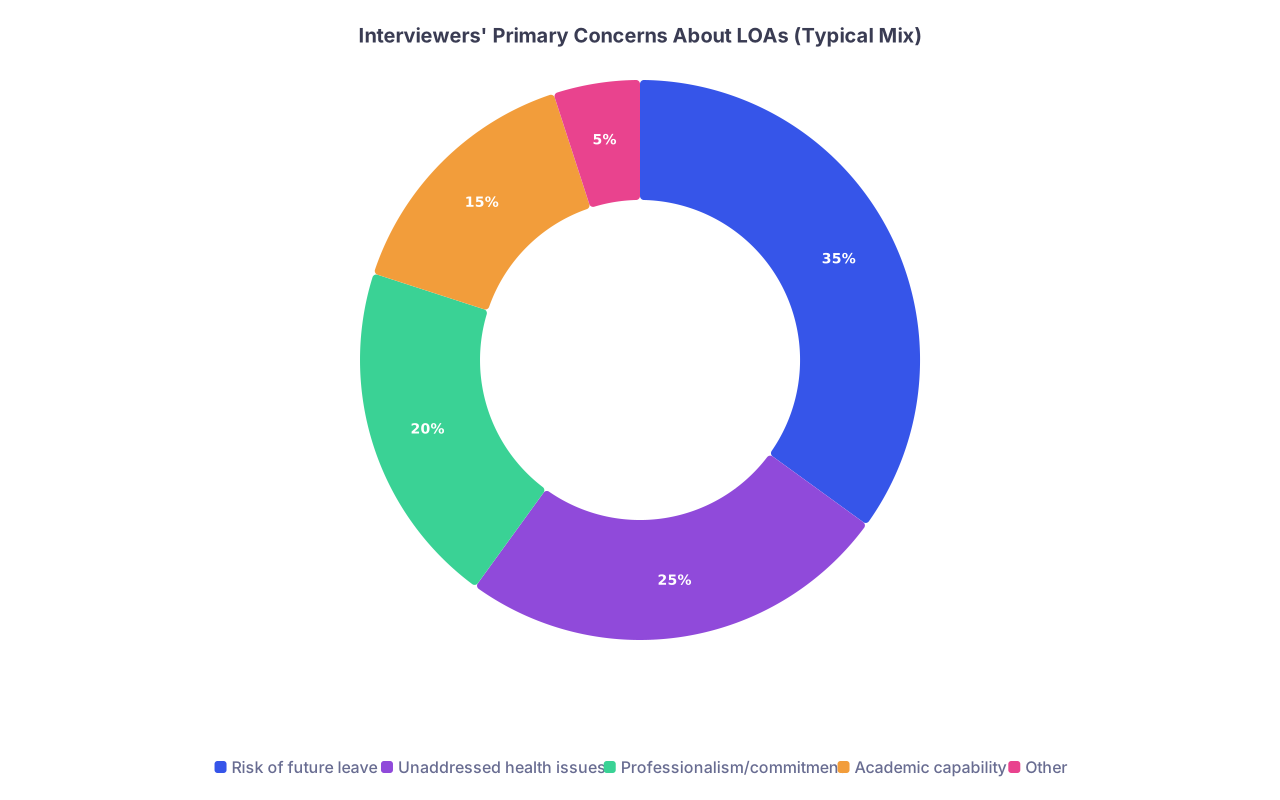
| Category | Value |
|---|---|
| Risk of future leave | 35 |
| Unaddressed health issues | 25 |
| Professionalism/commitment | 20 |
| Academic capability | 15 |
| Other | 5 |
Quick Reality Check Before Your Brain Runs Away
Let me be really blunt:
- Programs have matched people with personal LOAs, health LOAs, mental health LOAs, family crisis LOAs. Every year.
- An LOA handled cleanly, confidently, and concisely is usually a yellow flag at worst, not a red one.
- The biggest interview killers around LOAs are:
- Rambling
- Oversharing in a way that sounds unstable
- Inconsistent stories
- Getting defensive/angry
You can fix those with preparation. You cannot rewrite the past, but you can control how you present it now.
And honestly? The fact that you stopped, dealt with your life, and came back says something about your judgment. Plenty of people crash and burn silently. You didn’t.
FAQ (Exactly 5 Questions)
1. Should I pre-emptively bring up my LOA in my “Tell me about yourself” answer?
Generally no. Don’t lead with your weakest card. Let them bring it up when they review your file. Your opening should highlight who you are now—your interests, strengths, and what you’d bring to their program. The LOA is something you’re ready to discuss, not something you center your whole identity around.
2. What if my LOA was for mental health and I’m terrified they’ll judge me?
They might. Some will. But you don’t have to say “depression,” “anxiety,” or “panic disorder” if you don’t want to. You can say “health reasons” or “a significant health challenge,” focus on the fact that you sought treatment, achieved stability, and have had strong performance since returning. The key message is: you recognized a problem, addressed it appropriately, and have been functioning well for a sustained period.
3. Is it better to say my LOA was for ‘family reasons’ or be more specific?
Use the level of specificity you’re comfortable repeating 20 times without falling apart. “Serious family circumstances that required my full-time support” is usually enough. If they ask follow-ups, you can repeat a slightly expanded version without naming every detail: “I became the primary support person for a close family member with a serious illness, and I needed dedicated time to manage that.” Then pivot quickly to how you returned and your performance since.
4. What if different interviewers ask about my LOA and I don’t say it exactly the same way each time? Will that look suspicious?
You don’t need a verbatim script. You need consistent content. The basic story, timeline, and emphasis should match. Small wording differences are human. What raises eyebrows is when the reason seems to morph—e.g., “family” in one interview, “my health” in another, “burnout” in a third. Write your core story down once, anchor to that, and use it as your reference point.
5. Should I mention that I’m still in therapy or follow-up care?
You don’t have to. If you choose to, frame it as a strength and a stability measure: “I continue to use ongoing support to maintain the balance that’s allowed me to perform consistently.” But you’re not obligated to disclose current treatment. The only thing programs are entitled to know is that you’re able to meet the essential functions of the job. Focus on your track record since returning—completed rotations, solid evaluations, no further interruptions.
Key points to walk away with:
- A personal LOA isn’t an automatic Match death sentence; how you explain it matters far more than the fact that it exists.
- You’re allowed to set boundaries: clear, honest, concise answers plus “I’m not comfortable going into more detail” is completely acceptable.
- Strong, stable performance after your LOA is your best evidence—and your best protection—when interviewers start pushing.