
The scariest thing about residency applications isn’t the Match. It’s realizing the only places that seem interested in you might be the ones everyone whispers are “problem programs.”
And then the thought hits: “What if these are the only places that will rank me high enough to match? Am I about to lock myself into a toxic residency just because I’m desperate not to go unmatched?”
Yeah. That feeling.
I’m going to be blunt: this is one of the most anxiety-inducing realities of the Match that people don’t talk about publicly. On Reddit and at school, everyone pretends they’re only ranking “solid” programs. Meanwhile, a ton of us are quietly staring at interview lists that are… not ideal. Community programs with bad reputations. Places with constant resident turnover. Sketchy vibes on interview day.
And we start doing the mental gymnastics: “A bad program is better than no program… right? Right??”
Let’s talk about that honestly.
The Fear: “What If My Only Realistic Match Options Are Red-Flag Programs?”
Here’s the nightmare scenario that plays on loop in your head:
- You don’t have a “sexy” application: average scores, some bumps on your record, maybe an attempt or remediation, maybe you’re an IMG or non‑traditional.
- You applied broadly and strategically… and your interview list still leans heavily toward:
- New or untested programs
- Places with terrible scut-to-learning ratios
- Programs with rumors of malignant culture or unstable leadership
- You have maybe 1–2 “decent” programs you interviewed at… but honestly you know they’re long shots.
So you start thinking:
“If I rank only the good ones, I might go unmatched. If I rank the questionable ones, I might end up miserable or unsafe for 3–7 years.”
Neither option feels acceptable. That’s the trap.
Here’s the hard truth: some programs really are bad enough that I wouldn’t rank them, even if it meant risking SOAP or taking a different path. But. A lot of programs that feel “sketchy” at first glance are actually just lower-prestige, under-resourced, or in less desirable locations — not actual horror shows.
That distinction matters.
First: Not Every “Non-Top” Program Is A Problem Program
You’re probably lumping too many programs into the “danger zone” bucket.
There’s a massive difference between:
- A community program in a non-glamorous city with average fellowship matches
- A new program still figuring out curriculum and workflow
- A genuinely malignant program with:
- Chronic ACGME citations
- No evidence of improvement
- Residents leaving mid-year or discouraging you from coming
- Systemic safety issues (unattainable workloads, no supervision, retaliation)
Your anxiety brain throws them all into the same category: “less than ideal = dangerous.” That’s not accurate.
Here’s a way to think about it:
| Level | Type of Program | How Worried To Be |
|---|---|---|
| 1 | Low-prestige but stable | Mild |
| 2 | New but seemingly supported | Moderate |
| 3 | Chaotic leadership, mixed reviews | High |
| 4 | Repeated red flags, unsafe | Extreme |
You only absolutely avoid Level 4. Levels 1–2 can be totally fine careers. Level 3 is where you pause, dig deep, and decide if the risk is worth it for you.
Concrete Red Flags vs. “Vibe” Red Flags
Your brain will label a lot of things as “red flags” because you’re scared. Some actually are. Some are just your perfectionism panicking.
Here’s the difference.
Real, structural red flags:
- Multiple residents independently say, “If I had to do it again, I wouldn’t come here.”
- Nobody can clearly tell you who your program director is or leadership has turned over repeatedly.
- Residents look exhausted and on edge, and dodge questions about wellness or support.
- ACGME or NRMP publicly available info shows:
- Recent probation or significant citations
- Sudden drops in number of residents
- Major changes in accreditation status
- Obvious violations:
- Blatant duty hour abuses described as “normal”
- No backup when sick
- No time for basic human needs (food, bathroom) without being shamed
- Residents talk about:
- Fear of retaliation for raising concerns
- Favoritism, bullying, harassment that’s “just how it is here”
Those are “this could damage my health/career/sanity” red flags.
Anxiety-driven or lower-stakes red flags:
- City isn’t somewhere you dreamed of living
- Program doesn’t have big-name fellowships historically
- Facilities are older, call rooms kind of sad
- Less structured teaching, more “learn-by-doing” feel
- They don’t care if you match into ultra-competitive fellowships
Those might matter to you, but they’re not inherently toxic. They’re often just “this isn’t my fantasy program.”
You’re allowed to care about fit and career development. But don’t confuse “not perfect” with “problem program.”
How Much Risk Is Too Much? The Real Trade-Off
Here’s the question that keeps you awake:
Would you rather:
- Match at a program with some serious concerns
- Risk going unmatched and having to SOAP or reapply from scratch
There isn’t a universal right answer. But there are some patterns.
I’ve seen people regret ranking programs when:
- They knew, before Match, residents were telling them the program was unsafe or malignant, and they ignored it out of fear.
- They had actual evidence of ACGME issues and still ranked them high because “something is better than nothing.”
- They felt physically or psychologically unsafe on interview day and rationalized it away.
I’ve also seen people regret not ranking decent but imperfect programs when:
- They were overly prestige-focused and turned down stable, supportive community programs.
- They went unmatched, ended up in SOAP at a place even less ideal, with zero time to assess fit.
- They let fear of “closing doors” (like not getting some elite fellowship) outweigh the reality that most physicians have solid careers from non-name-brand programs.
So where does that leave you?
Honestly: if a program seems moderately flawed but not malignant, I’d rather see you rank it than gamble everything on an idealized version of what residency “should” look like.
But if you see repeated, serious red flags about safety, culture, or basic respect? Those are the ones I’d consider leaving off — even if that means you’re staring down SOAP.
What You Can Still Do Now To Protect Yourself
You’re not powerless here, even if your interview list is locked.
You can still:
Interrogate your list program by program.
For each one, literally write:- Evidence for “stable enough to survive and learn”
- Evidence for “this might seriously harm me”
If your only concerns are prestige, location, or being “average,” that’s different than: “Attending sexually harassed residents and nothing happened.”
Reach out to current or recent grads (not just the ones they put on display).
Ask very direct questions:- “Do you feel safe bringing up concerns?”
- “If you could go back, would you choose this program again?”
- “What made people leave, if anyone has?”
- “How does the program respond when residents struggle?”
Check what’s publicly available.
- Look up ACGME accreditation status.
- Look at resident rosters over several years — are people disappearing between PGY1 and PGY3?
- Google: “[Program name] resident complaint,” “[Hospital name] ACGME,” etc.
Be brutally honest about your own tolerance.
- Are you already hanging by a thread mentally?
- Do you have strong support near a specific region?
One person’s “I can grind this out” is another person’s breaking point.
The SOAP / Reapply Fear: Is Unmatched Actually Worse?
Your brain probably screams: “Anything is better than going unmatched.”
Not always. Here’s the nuance.
Going unmatched (and possibly SOAPing) usually means:
- A short, chaotic timeline
- Limited choices
- Programs that may be just as questionable as the ones you’re currently worried about
- A massive emotional hit — feeling humiliated, lost, behind
But sometimes it also means:
- A clearer-eyed second attempt with:
- More strategic specialty choice
- A research year, prelim year, or stronger letters
- More time to assess programs and build connections
What’s worse: one extremely toxic year at a malignant program, then scrambling to escape… or one horribly painful unmatched year, then landing somewhere safer?
I’d argue: a truly abusive program can do longer-term damage than a delayed match.
Not “less-than-elite,” not “community hospital in Ohio,” not “no fancy fellowships.” I mean programs where residents are crying in the stairwells, hiding mistakes out of fear, considering leaving medicine altogether.
That’s the line.
What If Every Program You Have Feels Like a Compromise?
This is the most uncomfortable place to be: when none of your options match what you imagined for yourself.
A few grounding truths:
- You don’t need a “perfect” program to become a good doctor.
- Most physicians did not train at their dream institution. They’re fine. Many are happy.
- Community programs with high volume and decent supervision can make you very competent — even if no one on SDN is bragging about them.
Your anxiety will tell you:
- “If I don’t match at a strong academic place, I’ll never get a good job.”
- “If I go to this no-name, my career is over.”
Reality:
- Hospitals hire competent people, not just logos.
- Plenty of attendings in desirable cities trained in places you’ve never heard of.
- Fellowship is still possible from mid-tier or community places if you hustle and get good mentorship.
So the question for you isn’t: “Is this my dream?”
It’s: “Is this safe, tolerable, and adequate for me to grow?”
If yes → it’s probably rankable, even if it bruises your ego.
If no → then you’re not overreacting by considering leaving it off.
A Quick Framework To Sort Your List (So You Don’t Spiral)
When you’re drowning in what-ifs, you need structure. Try this.

| Step | Description |
|---|---|
| Step 1 | Program on your list |
| Step 2 | Strongly consider do not rank |
| Step 3 | Move low on list or skip |
| Step 4 | Safe to rank mid-high |
| Step 5 | Rank lower but keep if needed |
| Step 6 | Any serious safety or abuse red flags? |
| Step 7 | Residents regret coming here? |
| Step 8 | Supportive leadership and stable? |
You’re not ranking your fantasies. You’re ranking real-world options, with real-world trade-offs.
What You Can Actually Control Right Now
You can’t change:
- Your Step scores
- Your class rank
- How many interviews you got this year
But you still control:
- How you investigate each program you did interview at
- Where you draw your personal safety/ethics line
- How honest you are with yourself about risk vs reward
And you do still have a future, even if this Match cycle doesn’t go how you wanted. People rematch specialties. They switch programs. They SOAP then thrive. They take research years and come back stronger.
You’re not trapped in this exact moment forever — even though it feels like it.
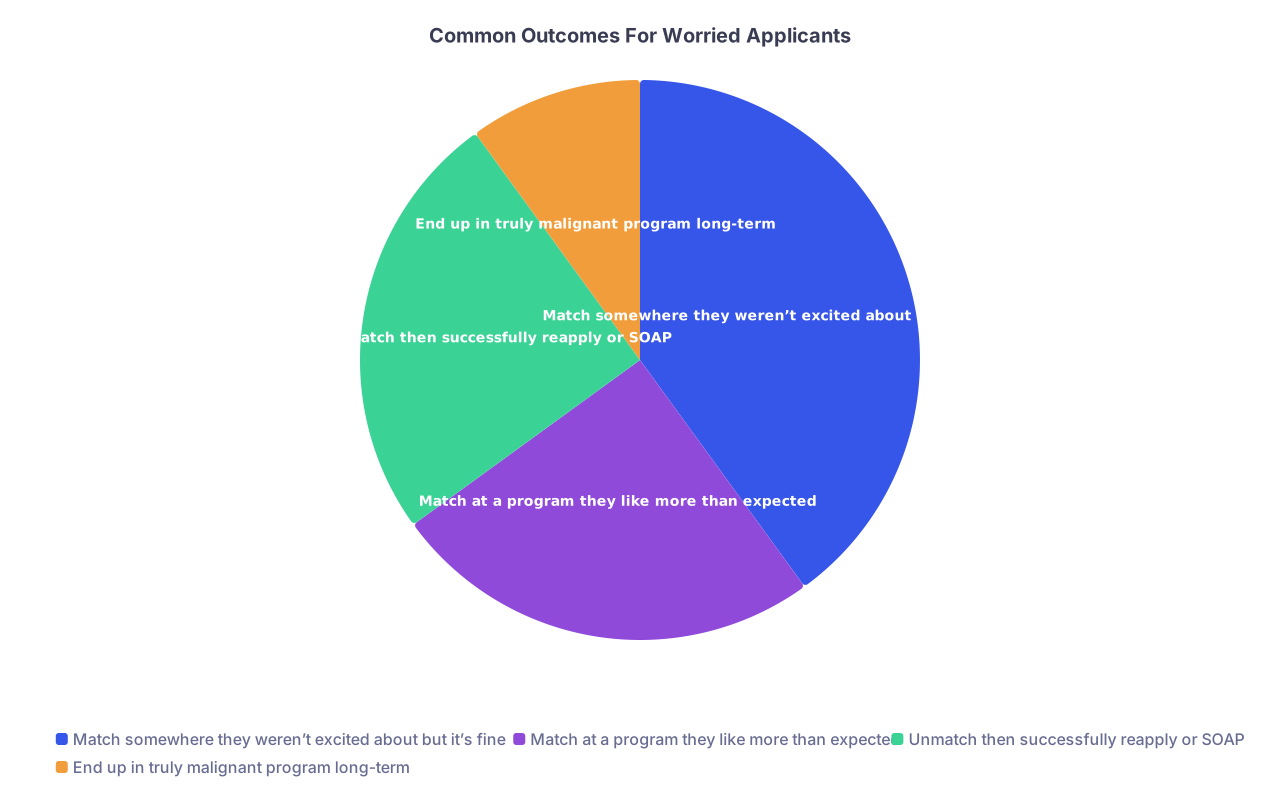
| Category | Value |
|---|---|
| Match somewhere they weren’t excited about but it’s fine | 40 |
| Match at a program they like more than expected | 25 |
| Unmatch then successfully reapply or SOAP | 25 |
| End up in truly malignant program long-term | 10 |
That last slice — people stuck long-term in truly malignant programs — is real, but it’s not the majority. And a lot of those had clear red flags they ignored because they felt they “had no choice.”
You still have some choice.
How To Reality-Check Your Perception (So Your Anxiety Doesn’t Drive the Bus)
Because we’re anxious, we catastrophize. We hear one bad story and decide a program is doomed. We see one mid-tier result and assume “No one gets a good fellowship from there.”
If you can stomach it, force yourself to:
- Look at actual outcomes: board pass rates, where grads go, how many finish.
- Compare to your real goals, not internet flexing. Do you actually want a super-rare ultra-competitive fellowship, or do you want a solid, livable career?
- Talk to someone who knows you, not just anonymous forums: an advisor, mentor, resident who’s seen your file and your resilience.
Sometimes what you think is “my only options are trash” is actually “my only options aren’t prestigious.” Very different problem.

FAQs
1. Should I ever rank a program I actively felt bad about on interview day?
If “felt bad” means you were bored, unimpressed, or underwhelmed? You can still rank it if it’s structurally sound and you need safer options. If “felt bad” means your body was screaming — you felt unsafe, dismissed, or saw clear signs of disrespect or chaos — I’d strongly consider leaving it off. Your gut isn’t perfect, but it’s not useless either.
2. What if my school advisor says, “You should rank everything you interviewed at”?
They’re trying to protect you from going unmatched, which on paper is the biggest “failure” in their metrics. But they don’t live your life. You’re allowed to say, “I’d rather risk SOAP or taking another path than knowingly choose a place that seems unsafe or abusive.” Use their advice as data, not a command.
3. How low is “too low” for a program on my list if I’m worried about matching?
There’s no magical rank number. But generally, if you’d be devastated — like genuinely regretful — to match at a particular program, it shouldn’t be on your list at all. If you’d be disappointed but able to say, “Okay, I can work with this,” then it can live lower on the list as a safety net.
4. What if I match at a problem program — am I stuck forever?
No. It’ll be hard, but not hopeless. People transfer programs. Some move after intern year. Some complete residency, then change institutions for fellowship or attending jobs and never look back. If you end up somewhere worse than you hoped, your entire future is not permanently ruined — it just may take time and support to course-correct.

Today, don’t try to solve your whole life. Just do this one thing:
Open your list of programs and, for each one, write a single sentence: “Why I would be okay here” and “Why I might not be okay here.” No Reddit noise. No prestige talk. Just your actual safety, sanity, and goals. Then step back and see which programs honestly don’t belong on your rank list at all.