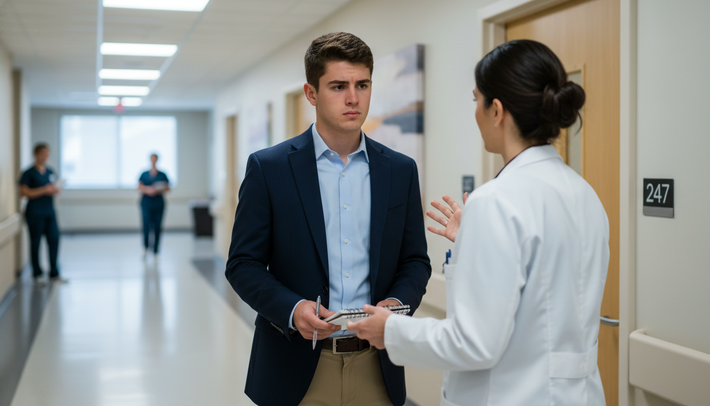
You’re looking at your activity list (or AMCAS draft) and your stomach drops a little.
All of your shadowing is in one specialty.
(See also: Handling a Toxic or Disrespectful Shadowing Environment Professionally for tips on navigating challenging situations.)
Maybe it’s 60 hours with an orthopedic surgeon your aunt knows. Or 45 hours with a pediatrician from your hometown clinic. Or you spent an entire summer with a cardiologist and… that’s it.
Now you’re hearing: “You should have varied shadowing across multiple specialties.”
And you’re thinking: I’m applying in 4 months. How am I supposed to fix this now?
This is exactly the situation we’re handling: your shadowing is heavily skewed to one area, and you need realistic ways to add variety fast—without magically gaining 200 more hours or an uncle who’s a dean.
Let’s walk through what actually matters and what you can still do right now.
1. Reality Check: Is Single-Specialty Shadowing Really a Problem?
First, ground yourself in what admissions committees actually see.
When this is a problem
It can raise a small red flag when:
- All your shadowing is one physician in one specialty (e.g., 80 hours neurosurgery, nothing else)
- You also say in your personal statement that you’re “undecided” or “open to all fields”
- You have no primary care or generalist exposure at all
- Your total hours are low and they’re narrow (e.g., 10–15 hours in one subspecialty only)
In those cases, your application can read as:
- Unbalanced
- Possibly influenced by convenience or family connections
- Not clearly informed about the breadth of medicine
When this is less of a problem
It’s usually fine if:
- You have strong clinical experiences with patients (MA, scribe, EMT, CNA, hospital volunteer)
- You’ve shadowed one specialty extensively, but:
- You can speak clearly about what you learned about the profession as a whole, not just that field
- You show maturity about uncertainty (you’re not “married” to that specialty)
- You add even a small amount of outside exposure (10–20 hours) strategically
Schools care more that you understand:
- What doctors actually do day-to-day
- The realities of patient care, documentation, time pressure, and decision-making
- The range of careers that exist in medicine (not all are high-tech procedures or clinic-only)
So the good news: you don’t need 10 different specialties. But you probably do need to patch the gaps.
2. Triage: How Much Variety Do You Actually Need?
Before you start frantically emailing physicians, figure out your target.
Use this quick triage framework:
Step 1: List what you already have
Write down:
- Specialty (e.g., orthopedic surgery)
- Setting (inpatient vs outpatient; academic vs community)
- Approximate hours
Example:
- Orthopedic surgery – academic center – OR + clinic – 70 hours
- Sports medicine clinic – outpatient – 10 hours
Total: 80 hours, all MSK-focused.
Step 2: Ask: “Do I have any of these?”
- Primary care (FM, IM, peds, med-peds)
- Inpatient adult medicine (internal medicine, hospitalist)
- Outpatient clinic-heavy specialty (derm, rheum, endocrine, etc.)
- Emergency department
- Procedural/surgical vs non-procedural/non-surgical balance
You do not need one of each, but if you have none of them except surgery, or none except outpatient pediatrics, that’s where you target.
Step 3: Set a realistic add-on goal
If you’re 3–6 months from applying:
- Aim to add 1–3 new specialties
- Aim for 10–25 hours each
- 8–12 hours can be a minimum viable dose if time is tight
- 20–30 hours is plenty; you do not need 100 per specialty
Your real goal: be able to say in secondaries and interviews:
“I explored [primary specialty X] in depth, but I also intentionally sought out exposure in [Y and Z] to better understand different models of care, including primary care and inpatient medicine.”
Now that you know what you’re missing, let’s get tactical.
3. Fastest Ways to Add Variety: Concrete Tactics by Situation
You’re not starting from scratch—you just need to diversify quickly. Here’s how, based on where you are.

Situation A: You’re still on campus (college premed)
Use three main channels:
1. Your premed or health professions office
Action steps:
- Email or walk in:
- Ask if they maintain a list of physicians open to student shadowing
- Specifically request: “I’d like to add brief experiences in primary care and one inpatient specialty to complement my existing shadowing.”
- Ask about:
- Alumni physicians who take students
- Formal premed shadowing programs with local hospitals
Be explicit about timeline:
“I’m applying in June and would like to gain 10–20 hours in each of 1–2 new areas over the next 3 months.”
2. Student organizations and peers
Talk to:
- Premed club officers
- AMSA / AED members
- Friends who’ve already shadowed multiple doctors
Ask specifically:
- “Who did you shadow in internal medicine or family medicine?”
- “Would you be comfortable introducing me by email?”
Warm introductions cut through a lot of waiting.
3. Campus or affiliated hospital systems
If your school is near a hospital:
- Check if they have:
- “Observer” or “shadowing” program
- Volunteer roles that include shadowing opportunities
When you call or email:
- Mention that you already have shadowing in [X specialty] and you’re hoping for brief exposure in:
- Primary care, internal medicine, pediatrics, or EM
You want them to picture you as focused and intentional, not just collecting hours.
Situation B: You’ve graduated / are taking a gap year
You’ll lean heavier on:
1. Your hometown clinic or hospital
Pick 2–3 target settings:
- Community hospital
- Large outpatient multispecialty clinic
- FQHC (community health center)
Ask to speak with:
- Physician recruitment
- Medical staff office
- Volunteer coordinator
- Practice manager for primary care
Your script (phone or email):
“I’m a premed applicant with about 60 hours of orthopedic surgery shadowing. Before I apply this cycle, I’d really like to balance that with some primary care or internal medicine shadowing—around 10–20 hours if possible. Is there a physician in your system who might be open to having a premed observe for a few shifts?”
You’re showing you’re organized and not asking for months of access.
2. Your own doctors
Primary care physician? Pediatrician? OB/GYN?
At your next visit (or via portal message):
“I’m applying to medical school this upcoming cycle. I’ve had significant shadowing in [specialty], but I’d love to get a better sense of outpatient primary care as well. Would you ever be open to me shadowing you for a few half-days, or is there a colleague you’d recommend?”
Even if they say no, they may refer you to someone.
3. Employer connections (if you’re working clinical jobs)
If you’re a:
- Scribe
- MA
- CNA
- ED tech
Use that built-in network.
Ask your supervisor or a friendly attending:
“Do you know if any of the hospitalists / family med docs / pediatricians here are open to having a premed shadow? I already have significant exposure in [your specialty] and I’m trying to round that out before I apply.”
You’re not asking the doctor directly in the OR. You’re leveraging relationships.
Situation C: You’re already in the application year and time is short
If your primary app is submitted in 1–2 months, speed matters.
Your goal: Add anything that broadens your profile and then update schools.
Priority targets:
- 1 primary care or generalist (FM, IM, peds, med-peds, hospitalist)
- 1 contrast specialty (if you’re heavy in surgery, find non-surgical; if you’re all outpatient, find inpatient)
Focus on short, intense bursts:
- 2–3 half-days with a family med doc
- 1–2 full shifts with an ED physician
- 2 clinic days with general internal medicine
Even 12–15 hours per new specialty is enough to mention legitimately.
Then:
- Add it to your activity list as ongoing
- When it’s underway, consider sending a brief update to schools that accept them:
- “Since submitting my primary application, I’ve added 18 hours of family medicine and 12 hours of emergency medicine shadowing to broaden my understanding of primary and acute care.”
4. Where to Aim: High-Yield Specialties That Complement What You Have
If you’re heavy in one area, pick add-ons that give clear contrast. Admissions readers like to see that “breadth.”
If all your shadowing is surgical (ortho, neurosurg, ENT, etc.)
Try to add:
Family medicine or internal medicine clinic
To understand continuity care, chronic disease management, and non-procedural medicineHospitalist or inpatient internal medicine
To see multidisciplinary rounds, discharge planning, general adult careEmergency medicine
To contrast elective surgery with acute, undifferentiated presentations
If all your shadowing is pediatrics
Add:
Adult primary care (FM or IM)
Shows you understand the full age spectrumHospitalist or ED
To see higher acuity and adult pathologiesOB/GYN
Nice demographic contrast: women’s health, deliveries, surgery + clinic mix
If all your shadowing is outpatient clinic (no hospital exposure)
Add:
Hospitalist or inpatient internal medicine
To see admissions, overnight issues, discharge workICU (if allowed) – even 1–2 days
For critical illness, family meetings, and rapid decision-makingED
Shows the “front door” of the hospital
If all your shadowing is one hyper-competitive field (derm, plastics, ortho, neurosurg)
This is where adcoms get slightly wary. It can look like you’re chasing prestige or salary.
Balance it with:
- Primary care or general internal medicine
- Geriatrics or palliative care
Shows you value relationship-based care and complexity, not just procedures
Then make sure your personal statement doesn’t sound like a mini residency application in that niche.

5. How to Frame Single-Specialty Heavy Shadowing So It Still Works for You
You can’t erase what you’ve already done—and you shouldn’t. 80+ hours in one field is a strength, as long as you frame it correctly.
In activity descriptions
For your primary specialty shadowing entry, emphasize:
- Breadth within that one specialty:
- “Observed both clinic and OR days”
- “Saw pre-op visits, post-op follow-ups, and acute consults”
- Generalizable lessons:
- Teamwork with nurses, PT/OT, anesthesiologists
- How physicians communicate difficult news
- How they balance efficiency with thoroughness
Example bullet points:
- “Witnessed full spectrum of care for patients with musculoskeletal injuries—from initial ED consults to OR procedures and long-term rehab follow-up.”
- “Observed how the attending explained surgical risks and realistic post-op expectations to patients and families, highlighting the importance of communication and trust.”
For newer, short shadowing experiences
Don’t downplay the hours, but be honest.
If you only get 12–15 hours in internal medicine or family med, you can still say:
- “Shadowed a family medicine physician over 4 clinic sessions, observing management of chronic illness (diabetes, hypertension), preventive care, and the logistical challenges of short visits with complex patients.”
You’re demonstrating you actually noticed and learned something, not just showed up.
In your personal statement
If you mention your heavy specialty:
- Focus on what it taught you about being a physician, not about how cool that specialty is
- Include at least a line or two that nods to exploring other areas:
Example:
“While most of my early exposure occurred in orthopedic surgery, shadowing in family medicine and internal medicine clinics underscored for me that my draw is less to a specific procedure and more to the ongoing problem-solving and relationships that characterize any field of medicine.”
This calms committees who worry you’re inflexible or naïve about the breadth of medicine.
6. Handling the “Why Only One Specialty?” Question in Interviews
If this comes up, you’re not caught off guard.
Use a three-part approach:
- Context – Briefly explain why it ended up that way.
- Action – Describe how you deliberately sought to broaden.
- Insight – Share what you learned from both the specialty and the added variety.
Example answer:
“Initially, my shadowing opportunities came through a mentor in orthopedic surgery. That led to a fairly deep experience in one field, seeing both clinic days and OR time over several months. Once I realized most of my exposure was in one area, I intentionally sought out other perspectives—family medicine and emergency medicine in particular—to understand more of the longitudinal and acute care sides of medicine. That combination helped me see that what draws me to medicine isn’t just the procedures themselves, but the diagnostic reasoning and team-based care that cut across specialties.”
You’re showing insight, initiative, and growth. That’s what they want.
7. If You Absolutely Cannot Add Variety Before You Apply
Sometimes the answer is: you tried and hit walls.
Maybe you’re in a rural area with restrictions. Maybe hospitals are still limiting observers. Maybe you’re working two jobs and caring for family.
Do two things:
1. Maximize what you can do
- Lean into clinical work (scribing, MA, CNA, ED tech, hospice volunteering with patient contact)
- Emphasize variety in populations and conditions, even if the supervising docs are from one specialty
- Read and reflect—show in essays you understand more than what you’ve literally seen
2. Own it honestly if asked
Example:
“Due to hospital restrictions in my area, my formal shadowing was largely limited to one orthopedic surgeon who was willing to host premeds. To round out my understanding of medicine more broadly, I’ve relied heavily on my direct clinical work as a [scribe/MA/CNA] in the emergency department, where I interact with physicians from multiple specialties and see a wide range of presentations, from minor issues to life-threatening emergencies.”
Then, if you’re reapplying later, make varied shadowing a top priority early.
FAQ (Exactly 5 Questions)
1. How many different specialties should I ideally shadow before applying?
You don’t need a huge list. For most applicants, 2–4 specialties is enough if chosen thoughtfully. For example, 40–60 hours in one primary specialty plus 10–25 hours each in 1–2 contrast areas (like primary care and emergency medicine) is solid. Committees care more about depth + evidence of deliberate breadth than about a long checklist.
2. Is it a problem if 80–90% of my shadowing is in one specialty?
It can be fine if you:
- Have at least a small amount of exposure elsewhere (even 10–15 hours)
- Have good patient-facing clinical experience
- Frame your shadowing as helping you understand the profession, not just that one field.
If literally 100% is one niche and you have no other clinical context, you should prioritize adding at least a minimal contrasting experience.
3. Does virtual shadowing help if I cannot find in-person variety?
Virtual shadowing is better than nothing, but it’s not equivalent to in-person observation. It can help you articulate broader understanding of different specialties, especially if you take notes and reflect. Still, if at all possible, aim for some in-person variety—even a few half-days—in high-yield areas like primary care or internal medicine. Treat virtual shadowing as a supplement, not the foundation.
4. Should I avoid talking about a highly competitive specialty I’ve mostly shadowed in (like derm or ortho)?
You do not need to hide it, but you should be careful not to sound locked into that one field. Emphasize what you learned about medicine and patient care in general, and show that you’ve also considered other types of practice through broader experiences. It’s fine to say you’re interested in [specialty], as long as you also clearly express openness and understanding that many fields could satisfy what draws you to medicine.
5. I’m only a sophomore—how should I plan shadowing so I don’t end up in this situation later?
Think in phases:
- Year 1–2: Start with whatever is accessible (often one specialty) and focus on learning basics of clinical environments.
- Year 2–3: Intentionally add at least one primary care or internal medicine experience, and one contrasting area (hospitalist or ED, for example).
- Year 3–4: Fill gaps—if you’ve never seen inpatient medicine or adult care, fix that.
If you plan this way, you won’t be scrambling senior year with all your hours in one niche.
Today, take one concrete step: open your email, identify two realistic contacts (your premed advisor, a local clinic, your own doctor, or a supervisor at work), and send a short, specific request for 10–20 hours of shadowing in a different specialty than you already have.