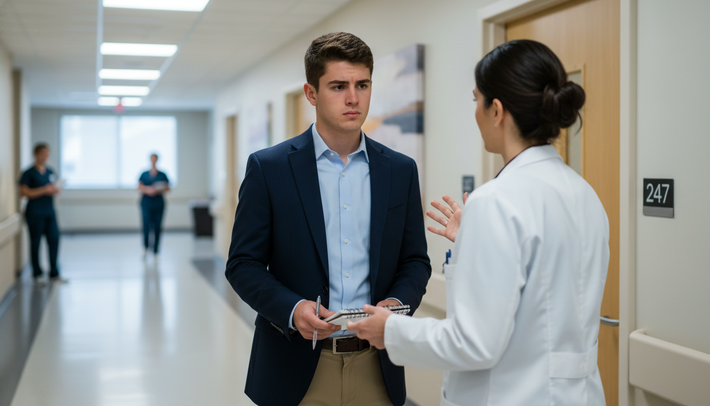
Most students waste half their shadowing day just trying to figure out where to stand. You will not be one of them.
This is your hour‑by‑hour, minute‑by‑minute playbook for the entire day of shadowing—from the moment your alarm goes off to the debrief before bed.
You are not “just observing.” You are training yourself to think, move, and reflect like a future physician. That starts with structure.
The Night Before: Set Yourself Up (T‑12 Hours)
At this point you should stop treating tomorrow like “just another day” and start treating it like a clinical rotation.
Between 7:00–9:00 PM: Logistics Lock‑In
You should:
- Confirm:
- Exact location (clinic vs hospital building, floor, suite)
- Arrival time (before clinic begins—often 15–20 minutes early)
- Where to park and how long it takes to walk in
- Any badge or check‑in instructions
- Lay out your clothes:
- Business casual or as instructed (e.g., slacks + blouse/shirt)
- Closed‑toe, comfortable shoes you can stand in for hours
- White coat only if the physician specifically said it’s OK
- Pack your bag:
- Small notebook + 1 pen (no large binders)
- A printed copy or screenshot of the confirmation email
- A snack that does not smell (granola bar, nuts) and water bottle
- Breath mints (clinics are small spaces)
Set two alarms. Aim for at least 7 hours of sleep. Tomorrow will be longer than you think.
9:30–10:00 PM: Mental Rehearsal
(See also: Gap Year Planning: Building Strategic Shadowing Blocks Month‑by‑Month for more details.)
At this point you should spend 15–20 minutes on:
- Quick review of:
- Physician’s specialty and typical patient population
- Common conditions you might see (e.g., hypertension for IM, otitis media for pediatrics)
- Setting 1–2 personal goals for the day, for example:
- “Notice how the physician builds rapport during the first 60 seconds of each encounter.”
- “Track how they explain lab or imaging results in patient‑friendly language.”
Write your goals in your notebook. You’ll return to them during the debrief.
Lights out on time. A foggy brain cannot absorb clinical nuance.
Early Morning: From Wake‑Up to Arrival (T‑2 Hours to T‑0)
5:30–7:00 AM: Wake‑Up and Pre‑Game
Time will depend on your shadowing start, but at this point you should:
- Aim to arrive 15–20 minutes earlier than the physician asked
- Work backwards to set:
- Wake‑up time
- Commute time (add buffer for parking and getting lost)
Your morning checklist:
- Light breakfast—avoid heavy, greasy foods that might make you sluggish
- Skip strong perfume or cologne
- Check email/text for any last‑minute messages from the physician or coordinator
- Put your phone on:
- Silent
- Vibration off
- Auto‑lock short (you should not be using it except during breaks)
Do a quick 60‑second mindset reset:
“My role today: observe quietly, respect privacy, ask thoughtful questions during appropriate breaks, and adapt to the team’s flow.”
You’re not the star of the show. You’re there to learn.
Arrival Buffer: T‑30 to T‑15 Minutes
Plan to be physically at the building 30 minutes before start time. That gives you a 15‑minute cushion for:
- Parking machine confusion
- Security desk delays
- Finding the correct hallway (it always takes longer than you think)
At this point you should:
- Check in with front desk/security:
- “Hi, my name is [Name]. I’m scheduled to shadow Dr. [Last Name] today. Where should I wait?”
- Put on any visitor badge or temporary ID
- Text or email the physician’s office (if previously instructed) to let them know you’ve arrived:
- “Good morning Dr. [Last Name], this is [Your Name]. I’m here in the waiting area outside [clinic/office].”
You want to be waiting calmly at T‑15, not sprinting down a hallway at T‑2.
First Contact: Meeting the Physician (T‑15 to T+15)

T‑15 to T‑5 Minutes: Initial Greeting
When the physician or staff comes to meet you:
- Stand up, make eye contact, shake hands (if culturally appropriate)
- Introduce yourself in one clean sentence:
- “Hi, I’m [Name], a premed student from [School], here to shadow you today. Thank you for having me.”
- Let them set the tone. Follow their energy and pace.
Expect a very quick orientation. They’re busy. You might hear:
- “You’ll mostly be in the corner here. I’ll introduce you to patients and let you know when you need to step out.”
- “We have a packed schedule, so save questions for between patients.”
At this point you should:
- Clarify any boundaries in 1–2 direct questions, for example:
- “Would you like me to introduce myself to patients, or would you prefer to do that?”
- “Is it OK if I take notes about your workflow as long as I don’t write any patient identifiers?”
If they say no notes, respect it immediately.
T+0 to T+15 Minutes: Orientation to Space
Your first 10–15 minutes usually look like this:
- Quick tour:
- Exam rooms
- Physician’s workstation
- Staff room/bathroom location
- Short HIPAA reminder:
- No patient names in your notes
- No photos
- No social media posts about the day
At this point you should:
- Identify your “default spot” in:
- Exam rooms: usually against the wall nearest the door, out of the way of the sink, computer, and physician’s movement path
- Hallways: stand where you’re not blocking traffic or carts
- Observe how staff interact and communicate:
- Are they using phone, intercom, EHR messaging?
Notice: your real education has already started, even before the first patient.
Mid‑Morning: First Patients and Finding Your Role (T+15 to T+180)
Patient 1: T+15 to T+30 Minutes
At this point you should focus only on three things:
Patient comfort
- Let the physician introduce you
- If the patient looks uncertain, be ready to step out gracefully
- Always accept being asked to leave with zero visible disappointment
Room etiquette
- Stand or sit where the physician indicated
- Keep your arms relaxed (not crossed) and your face neutral but attentive
- Do not touch anything—equipment, charts, computer—unless explicitly invited
Observation lens
- For this first encounter, track:
- How the physician opens the visit
- How they listen without interrupting
- How they translate medical information
- For this first encounter, track:
You’re just calibrating. No need to overanalyze yet.
Patients 2–5: T+30 to T+120 Minutes
By now, the physician’s rhythm will start to feel predictable. At this point you should:
- Start structured observation in your head:
- How long does each visit last?
- How do they switch gears between a new patient and a follow‑up?
- What changes when a patient is visibly anxious or upset?
During brief hallway or computer pauses (but never in front of patients), you can ask concise questions like:
- “I noticed you used simpler language when explaining that diagnosis. How do you decide which terms to use?”
- “What were you looking for specifically during that abdominal exam?”
Keep each question under 20 seconds. If they’re rushing, hold it.
Your nonverbal behavior checklist:
- Phone remains out of sight
- No chewing gum
- Minimal fidgeting
- Attentive posture—lean slightly forward when listening
Late Morning: T+120 to T+180 Minutes
Around late morning, fatigue can hit. At this point you should:
- Use transitions (physician checking notes, walking between rooms) to:
- Drink a quick sip of water
- Mentally reset your focus
- Notice patterns:
- Common chief complaints
- How the physician triages multiple issues in limited time
- How often they document during vs after each visit
If there’s a lull, good questions are:
- “How do you prioritize when a patient comes in with a long list of concerns?”
- “What’s the hardest part of your mornings typically?”
You’re building a realistic picture of the specialty, not the TV version.
Midday: Lunch, Informal Mentoring, and Avoiding Mistakes (T+180 to T+240)

If you’re invited to lunch with the physician or team, accept. If they say “I usually work through lunch,” do not insist—follow their routine.
T+180 to T+210 Minutes: Transition to Lunch
At this point you should:
- Let the physician lead the plan:
- “I’m going to grab a quick lunch; you can come along if you’d like.”
- Offer to give them a few minutes alone if they seem drained:
- “I don’t want to take your whole break—if it’s OK, I’ll just ask one or two quick questions?”
During lunch or a short break, ideal topics:
- Their path:
- “When did you know you wanted to choose [specialty]?”
- “What surprised you most during residency?”
- Specialty reality:
- “What do people misunderstand about your day‑to‑day work?”
- Advice:
- “If you were in my position, what would you focus on during the premed years?”
Things to avoid:
- Detailed questions about your own application stats
- Complaints about other doctors, your school, or healthcare systems
- Making the conversation all about you
Have your notebook ready, but be discreet—take quick notes right after, not during every sentence like a court reporter.
T+210 to T+240 Minutes: Reset and Refocus
After lunch, energy dips for both of you. At this point you should:
- Re‑align with your goals:
- Look briefly at the 1–2 goals you wrote last night
- Add one more based on the morning, such as:
- “Notice how the physician ends each visit and transitions out of the room.”
Then mentally prepare for:
- More complex cases in the afternoon
- Possible delays piling up—and how the physician manages time pressure
Afternoon: Deeper Clinical Exposure and Professionalism Tests (T+240 to T+420)
Early Afternoon: T+240 to T+330 Minutes
This stretch often reveals the “real” job:
- Delayed patients
- Emotional conversations
- Care coordination challenges
At this point you should:
- Pay attention to:
- How the physician delivers bad news or uncertain results
- How they handle a frustrated or non‑adherent patient
- Their body language and tone under stress
In emotionally charged situations:
- Keep your facial expression compassionate but not exaggerated
- Do not interject or react verbally
- Let the physician guide whether you stay or step out
Later, during a private moment, possible reflection questions:
- “How do you decompress after difficult conversations like the one earlier?”
- “Has your approach to those situations changed since residency?”
Late Afternoon: T+330 to T+390 Minutes
By now, you’ll have seen multiple variations on common themes. At this point you should start synthesizing:
- Ask yourself:
- “Could I see myself doing this kind of work for 30+ years?”
- “What parts of this day energized me? What parts drained me?”
- Observe interdisciplinarity:
- How do they collaborate with nurses, MAs, PAs/NPs, pharmacists, or social workers?
- Who actually keeps the clinic/hospital functioning smoothly?
If workflow allows, this is a good window for the “big picture” question:
- “What do you think are the biggest changes coming to this field in the next 5–10 years?”
Take mental notes for your future personal statement and interviews.
Final Patients: T+390 to T+420 Minutes
Approaching the end of your shadowing day, at this point you should:
- Maintain the same professionalism as in the morning—no “checking out” mentally
- Watch how the physician:
- Wraps up their day
- Handles last‑minute add‑ons or urgent calls
- Documents and reviews labs/imaging at the end of clinic
Anticipate the close. You’ll likely have just 5–10 minutes of debrief time with them, so start prioritizing what you most want to ask or say.
End‑of‑Day Wrap‑Up: With the Physician (T+420 to T+450)
Right before you leave, the interaction matters. Many students fumble this part.
At this point you should:
- Signal awareness of time:
- “I know your day’s wrapping up, and I don’t want to keep you long.”
- Offer a concise reflection:
- “Today really helped me see how much communication matters in [specialty].”
- Ask 1–2 high‑yield questions, not ten:
- “For a student early in the process, are there things you wish you’d done before medical school?”
- “Is there anything you recommend I pay attention to in future shadowing experiences?”
If the day went well and felt appropriate, you can gently ask:
- “If it’s alright with you, would you be open to me reaching out with a question or two by email as I move through the process?”
Don’t ask for a letter of recommendation at this point unless you’ve had multiple days of shadowing and substantial interaction.
Before leaving:
- Thank them specifically:
- “Thank you for letting me observe not just the patient visits but also how you coordinate with the team. It gave me a deeper understanding of what this work really involves.”
- Confirm whether you should sign out at the front desk or return a badge
You want them to remember you as thoughtful, professional, and low‑maintenance.
Evening: Solo Reflective Debrief (T+450 to Bedtime)
Your real learning solidifies after you leave.
Within 1–2 Hours of Leaving: Capture the Day
At this point you should sit down with your notebook or laptop and spend 20–30 minutes on a structured debrief.
Use these prompts:
Timeline recap
- What time did the day actually start and end?
- Roughly how many patients did you see?
- How many staff roles did you notice involved in care?
Three moments
- One moment that energized you
- One moment that challenged you emotionally or ethically
- One moment that surprised you about the specialty
Skill observations
- How did the physician:
- Build trust quickly?
- Explain complex information?
- Handle uncertainty?
- How did the physician:
Fit reflection
- Could you imagine yourself in this environment?
- What aspects of this specialty (or medicine in general) felt aligned with your values?
Write in enough detail that “future you” can use this for:
- Personal statement stories
- Secondary essays (“Describe a clinical experience that influenced your decision to pursue medicine.”)
- Interview answers (“Tell me about a time you observed a physician handling a difficult situation.”)
Before Bed: Thank‑You and Next‑Steps
At this point you should:
Draft and send a concise thank‑you email before you go to sleep or by early next morning:
Subject: Thank you for allowing me to shadow today
Body (example):
Dear Dr. [Last Name],
Thank you for allowing me to shadow you in clinic today. I appreciated seeing how you [specific observation—e.g., balanced complex medical decisions with clear explanations for patients with chronic disease].
The experience gave me a much clearer understanding of the realities of [specialty] and reinforced my interest in pursuing medicine.
Thank you again for your time and for welcoming me into your clinical space.
Best regards,
[Your Name]
[School], [Year]
[Contact info]
File your notes somewhere organized:
- Create a “Shadowing Log” document or spreadsheet
- Include:
- Date
- Physician name and specialty
- Setting (clinic, hospital, OR)
- Approx hours
- 3–5 key takeaways
Then close the day by identifying one concrete thing you’d do differently next time (e.g., arrive with 3 prepared questions, watch body language more closely, or take better mental notes during emotional moments).
Frequently Asked Questions
1. What if a patient doesn’t want a student in the room—how should I respond in the moment?
Step out immediately and calmly, without hesitation. A simple, quiet “Of course” while you move toward the door is enough. Do not look offended or disappointed. In the hallway, you can ask the physician later how often that happens and whether certain visit types are more sensitive. Patient comfort and privacy override your learning every single time.
2. Is it ever OK to use my phone during shadowing, even just to check the time?
During active clinical time and when you’re with the physician or in patient areas, no. Keep your phone silenced and out of sight. If you truly need to check something—like your ride home—wait until a natural break and excuse yourself to the restroom or a private area. Rely on wall clocks or your watch for timekeeping. Physicians and staff notice phone behavior immediately and often interpret it as disinterest.
3. How many questions are too many during a shadowing day?
If you’re asking questions after every single patient, it is probably too many. A good rule: save questions for natural breaks, limit yourself to 1–2 per break, and prioritize ones that connect directly to what you just observed. If the physician seems rushed, say, “I have a couple of questions, but I’m happy to save them for the end of the day if that’s better.” Let their pace and energy level guide you.
4. What should I do if the clinic seems chaotic and I feel like I’m in the way?
At that point you should make yourself as low‑impact as possible: stand out of traffic lines, avoid interrupting any conversations, and minimize movement. If you get a brief private moment with the physician or a nurse, you can say quietly, “I know it’s busy—please let me know if there’s anywhere you’d prefer I stand or wait.” Sometimes they’ll park you at the nurse’s station or in a corner of the workroom. Your adaptability under stress is part of the shadowing lesson.
Open your calendar right now and block 30 minutes the evening of your next shadowing day for a structured debrief—label it “Shadowing Reflection” and commit to filling it with specific observations, not just “it was interesting.”