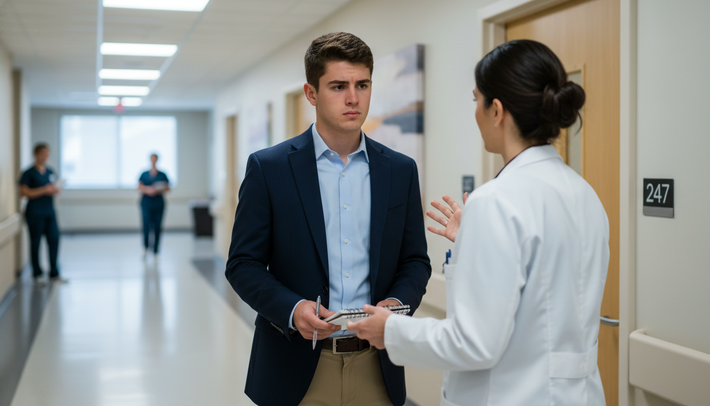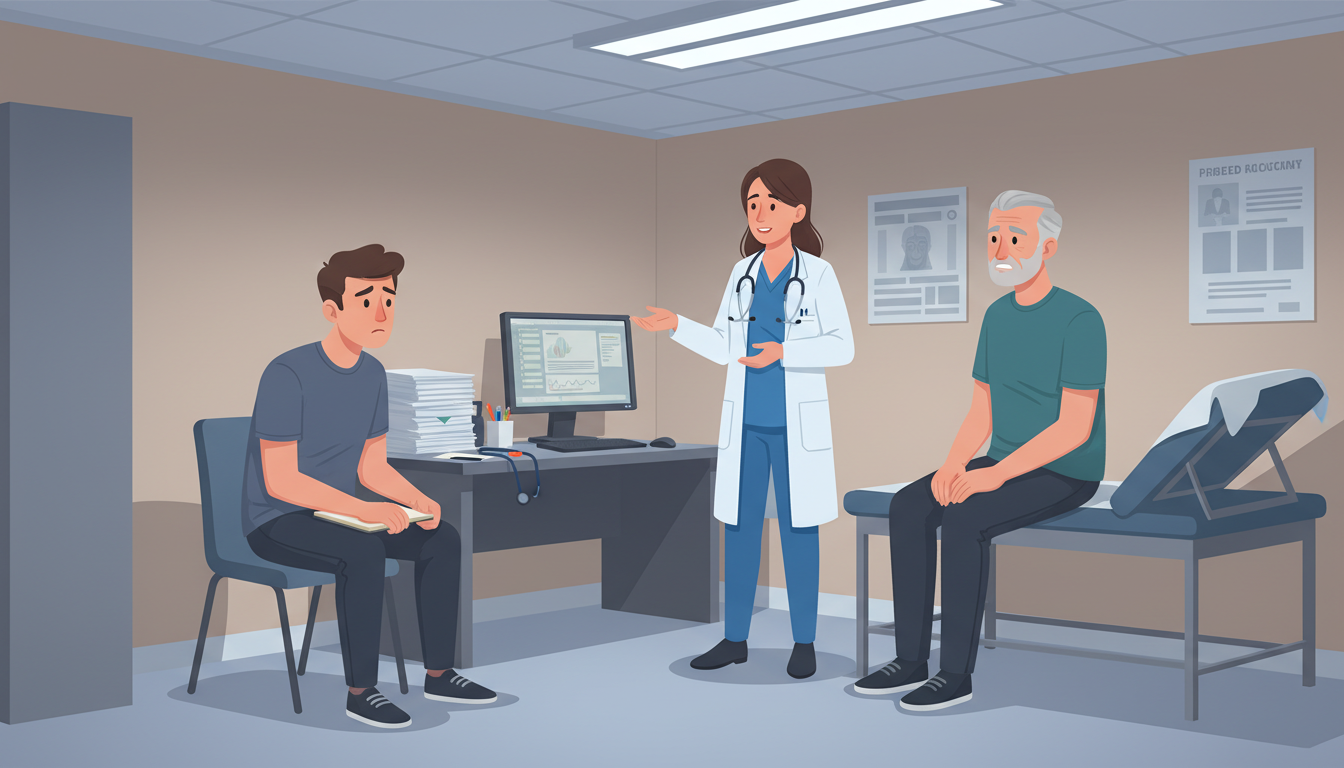
It’s 4:15 pm on a Tuesday. You’re sitting in the corner of a cramped exam room, on a rolling stool that squeaks every time you shift your weight. The physician you’re shadowing is on their eighth follow‑up visit of the afternoon—another discussion about blood pressure meds, refills, “any chest pain? any shortness of breath?” You haven’t touched a stethoscope, you’re not in the EMR, and mostly you’re just… watching.
And now, staring at your med school application, you’re wondering:
“My shadowing was mostly observing boring clinic days—is that enough? Are schools going to look at my app and think I didn’t really see medicine? That I don’t actually know what I’m getting into?”
(See also: What If I Felt Uncomfortable During Shadowing? Will Schools Judge Me? for more details.)
You’re not alone. A lot of us thought shadowing would look like Grey’s Anatomy and instead got… 3-month follow‑ups, prior authorizations, and printer jams.
Let’s unpack what this really means for your application—and your sanity.
What Med Schools Actually Want From Shadowing (Not What You Think)
Here’s the core fear:
“If I didn’t see cool procedures or intense cases, my shadowing doesn’t count.”
That’s not actually how admissions looks at it.
Schools mostly want shadowing to answer three questions:
- Do you understand the day-to-day reality of being a physician?
- Have you had sustained, direct exposure to physicians in clinical settings?
- Can you reflect meaningfully on what you saw?
They don’t have a hidden checklist like:
- “Must witness at least 3 surgeries”
- “Must put in one central line”
- “Must do CPR on someone”
In fact, if your shadowing was mostly:
- Primary care clinic
- Follow-up visits
- Chronic disease management
- EMR documentation
- Calls with pharmacies and insurance
…that’s honestly a lot closer to the real life of many physicians than the dramatic stuff.
The problem is how it feels on your side:
- It feels passive.
- It feels dull.
- It feels like you didn’t “do” anything.
- It feels unimpressive next to people who talk about “shadowing in the OR” or “seeing a code.”
But admissions committees aren’t expecting you to be the star of the show. They’re checking: did you actually see what medicine is like when nobody’s trying to impress you?
That sounds exactly like a “boring clinic day.”
“But I Didn’t DO Anything—Is That a Red Flag?”
Here’s the nasty little voice in your head:
“I just sat in the corner and watched. I barely talked. I didn’t take vitals, didn’t room patients, didn’t do anything hands-on. Won’t that make me look passive or uninterested?”
No. Not if you present it right.
Shadowing by definition is observational. In many clinics:
- You can’t document in the chart.
- You shouldn’t examine patients independently.
- You’re limited by liability/insurance/privacy rules.
Admissions committees know this. Most of them had the exact same “chair in the corner” experience as premeds.
What does matter is:
- Did you show up consistently? (e.g., 3 hours/week for a semester)
- Did you pay attention? (can you talk about what you learned?)
- Did you ask questions when appropriate?
- Did this shadowing help you confirm (or question) your desire to be a physician?
If all you did was:
- Show up
- Sit on your phone
- Leave early when things got slow
- Remember nothing about what you saw
…then yeah, that’s a problem. But if your main “issue” is “I observed routine stuff and it felt boring”—that’s not a red flag. That’s actually honest exposure.
How to Turn “Boring Clinic Days” into Strong Application Material
The anxiety usually spikes when you try to write about this experience.
You sit down to write a description and think:
- “I watched primary care visits.” (sounds boring)
- “I saw management of hypertension and diabetes.” (still boring)
- “Sometimes I sat at the nurse’s station and watched them chart.” (worst of all)
But there’s a big difference between “boring experience” and “boring reflection.”
Step 1: Pull out what was actually meaningful
Ask yourself:
- What patterns did you notice across patients?
- What did you learn about longitudinal care?
- Did you see any tough conversations?
- Did you notice how the physician:
- Balanced time pressure with patient needs?
- Handled frustrated patients?
- Dealt with social determinants (transportation, cost of meds, family dynamics)?
Examples you can reference:
- Watching a family medicine physician in a community clinic manage:
- Patients who couldn’t afford their meds
- Language barriers
- Missed follow-ups and nonadherence
- Seeing the same diabetic patient multiple times and watching:
- A1c improve—or not
- Lifestyle counseling repeated and reframed
- How the doctor stayed patient (or got quietly frustrated)
Those are huge insights into real medicine.
Step 2: Focus on what you understood, not what you did
Instead of writing:
- “I shadowed for 50 hours in an internal medicine clinic.”
Think:
- “Through weekly half‑day sessions in an internal medicine clinic, I saw how chronic conditions like diabetes and heart failure are managed over time. I watched my preceptor adjust medications based not only on lab values but also on what patients could realistically afford and remember to take.”
You’re showing:
- You saw complexity.
- You realized medicine isn’t just “diagnose and fix.”
- You understand the unglamorous but essential follow-up world.
Step 3: Mention the “boring” parts honestly
You can even acknowledge it (briefly):
Example angle:
- “Before shadowing, I imagined medicine as dramatic diagnoses and high‑stakes emergencies. Most of what I saw were routine follow-ups and medication adjustments. At first, it felt uneventful. Over time, I realized how much skill and patience it takes to keep patients stable and out of the hospital.”
Now the “boring” part becomes:
- A sign that you stuck with it long enough to see reality
- Evidence of maturity
- Proof that you’re not just chasing adrenaline
Do I Need Different Types of Shadowing to “Balance It Out”?
This is where a lot of spiraling starts:
- “I only did primary care—do I need surgery too?”
- “What if I never saw inpatient medicine?”
- “I didn’t see any emergencies, is that bad?”
- “My friends have ICU and OR shadowing; I just have clinic in a strip mall…”
Here’s the honest breakdown:
Is single-setting, clinic-heavy shadowing acceptable?
Yes.
If you have:
- ~20–50+ hours with physicians
- Clear, thoughtful reflection
- Understanding of what MDs actually do
…you are not going to get rejected just because you never scrubbed into an OR.
What can help—but isn’t mandatory—is diversity of exposure:
- Primary care + one specialty
- Clinic + hospital
- MD + DO (if you’re applying DO)
But that’s a nice-to-have, not a requirement.
When should you actively try to add variety?
It might be worth adding a bit of breadth if:
- You have very few total hours (like under 15)
- Your only exposure is a single doc for a couple of afternoons
- You genuinely feel you still don’t understand what physicians do in other settings
In that case, you don’t need 200 extra hours. You might aim for:
- 8–10 hours in a different specialty
- A couple of shifts in a hospital or ED if possible
- Even just a single day with a different type of physician (e.g., pediatrician vs internist)
Not to “check a box.”
To make you feel more honest when you say, “I know what I’m signing up for.”
The Ugly Truth: A Lot of Medicine Is “Boring Clinic Days”
Here’s a thought that’s both terrifying and reassuring:
If you hated every second of those clinic days—like, deep, burning hatred—
you might actually have learned something very important about yourself.
Because:
- Primary care physicians
- Many specialists (endocrine, rheum, cards, GI, etc.)
- Even surgeons between OR days
…spend massive chunks of their lives in clinics exactly like the ones you shadowed.
So your reaction matters:
- If you thought, “This is so boring, I could never do this every week,” that’s not a failure. It’s data.
- If you thought, “It’s not thrilling, but I liked getting to know the patients, seeing progress, talking about real life,” that’s also data.
Admissions committees aren’t just asking:
- “Did you see cool things?”
They’re asking:
- “Do you understand the non-cool parts and still want this?”
Your “boring” experience is actually better at answering that than some random OR day where you stood 10 feet from the table and couldn’t see anything.
How to Talk About This in Interviews Without Sounding Weak
Another anxiety grenade:
“What if they ask about my shadowing, and all I can say is I watched them click boxes in the EMR?”
You can prepare for that.
Frame it like this:
Acknowledgment of expectations vs reality
“Going in, I imagined more dramatic cases. What I mostly saw were routine follow-ups and chronic disease management.”What you noticed/learned
“Those ‘routine’ visits showed me how much time physicians spend building long-term relationships, adjusting treatment plans based on patients’ lives, and coordinating care with other providers and insurance issues.”How it affected your motivation
“Seeing that less glamorous side of medicine actually made me more confident in my decision to pursue it. I’m not just drawn to the rare, exciting cases—I’m okay with and even value the steady, day-in-day-out work that keeps patients stable.”
That sounds mature. Grounded. Reflective.
Not: “I want to be a doctor because I saw someone get intubated once.”
If they push with, “Did you see any other settings?” and you didn’t, you can say:
- You tried to get hospital/OR exposure but had limited options.
- You supplemented with clinical volunteering, scribing, or other experiences (if true).
- You still gained a solid understanding of physician life from what you did see.
They don’t expect perfection. They expect honesty.
When “Boring Clinic Shadowing” Might Actually Be a Problem
Just to be real for a second, there are scenarios where your anxiety might be flagging something real:
Very few total hours
Example: 6 hours total, all on one afternoon. That’s not enough time to show real exposure.No other clinical experience
If your only contact with patients or the medical world is a small chunk of shadowing, that’s thin. Not because it was boring, but because it was shallow.You truly hated it
If you’re forcing yourself to apply while every clinic day filled you with dread and boredom, you might need more exploration, not more justification.
If any of those feel uncomfortably familiar:
- You don’t have to blow up your app.
- But it might be worth:
- Adding clinical volunteering (free clinic, hospital volunteer, hospice, etc.)
- Getting more hours before you apply
- Talking to a premed advisor honestly about whether you’re ready
Your anxiety might not be about “boring” shadowing. It might be about “thin” exposure overall.
Quick Reality Check Before You Spiral
If most of the following are true, you’re probably okay:
- You have 20–50+ hours of shadowing total.
- At least some of it was ongoing (e.g., weekly or regular, not all crammed into one day).
- You can name:
- A few specific patients or patterns that stuck with you (de-identified, of course).
- A few hard realities of medicine you saw (time pressure, chronic illness, social barriers).
- Something about physician behavior you admired or questioned.
- Your motivation to do medicine is stronger, not weaker, after the experience.
If that’s you, then the real issue isn’t that your shadowing “doesn’t count.”
It’s that you think everyone else’s experience was more impressive than yours.
They probably weren’t. They just sound that way on Reddit.
FAQ (Exactly 4 Questions)
1. Is mostly primary care clinic shadowing enough for med school?
Yes. Many applicants have predominantly clinic-based shadowing, especially with family medicine or internal medicine physicians. As long as you:
- Spent a reasonable number of hours
- Paid attention and reflected on what you saw
- Can articulate what you learned about the physician’s role
…it’s completely acceptable. You don’t need a surgery or ER-heavy experience to be “legit.”
2. How many hours of “boring clinic” shadowing do I actually need?
There’s no strict cutoff, but a common informal range is:
- Around 20–40 hours minimum to show meaningful exposure
- 40–80+ hours if you have access and it fits naturally into your schedule
If all you have is a single 4‑hour session, that’s thin. But if you’ve done multiple half‑days over weeks or months, even if they felt repetitive, that still counts as real shadowing.
3. Should I mention that I found some of it boring in my essays?
You can gently acknowledge that it wasn’t all dramatic or exciting, but don’t dwell on the word “boring.” Instead, frame it as:
- “At first, the routine nature of follow-up visits surprised me…” Then pivot to what you learned:
- “Over time, I realized how much quiet skill went into long-term management and relationship-building.”
You want to show maturity and insight, not disinterest.
4. Do I need to scramble to add hospital or OR shadowing before I apply?
Only if your overall exposure is very limited. If you already have solid clinic shadowing plus clinical volunteering, you don’t need to panic-add OR time just for optics. If you can get a few hours in another setting, great—it may help you feel more confident. But your application isn’t doomed without it, especially if you can talk thoughtfully about what you’ve already seen.
Key takeaways:
- “Boring” clinic days are actually what real medicine looks like a lot of the time—and schools know that.
- Your value isn’t in how dramatic the cases were, but in how deeply you understood what you saw and how honestly you can reflect on it.
- If you’ve got sustained clinic shadowing and genuine reflection, you’re almost certainly more prepared—and more solid—than you feel right now.