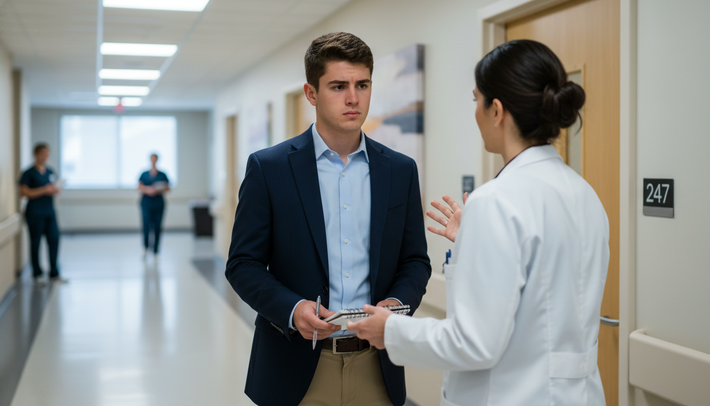
Most students underestimate how much professional preparation must happen before shadowing even begins.
One week out is not “too early.” It is exactly when you should start treating this like your first real step into the profession. From this point forward, physicians and staff are quietly answering one question about you: Would I trust this person around my patients?
Below is a precise, time-based plan for the 7 days before shadowing starts, with professionalism and preparation built into every step.
(See also: Gap Year Planning: Building Strategic Shadowing Blocks Month‑by‑Month for more details.)
7 Days Before: Confirm, Clarify, and Commit
At this point you should lock down every detail that could embarrass you later.
1. Confirm the shadowing arrangement (same day)
Send a concise, professional email to your supervising physician or coordinator:
- Confirm:
- Start date and time
- Exact location (building, floor, clinic, entrance)
- Duration (single day, recurring, hours per day)
- Any onboarding requirements (ID badge, paperwork, training modules)
- Ask explicitly:
- Expected arrival time (“What time would you like me to arrive on my first day?”)
- Dress code specifics (white coat? scrubs? business casual?)
- Where to park / how to access the building
- Whether you need to bring any documents (immunization records, school forms, confidentiality forms)
Your email should read like something you would not be embarrassed to have printed and shown to an admissions committee.
2. Review institutional requirements
At this point you should make sure you are actually allowed to be in patient areas.
Create a checklist:
- Hospital or clinic shadowing policy obtained (website or coordinator email)
- HIPAA or privacy training requirement verified
- Immunizations and tests:
- TB test / Quantiferon Gold
- Hepatitis B vaccine series
- MMR, Varicella, Tdap documentation
- COVID-19 vaccination or exemption if required
- Any required online compliance modules
If the institution uses systems like Epic training or mandatory safety modules, ask now. Scrambling the night before is a rookie mistake that staff remember.
3. Clarify your purpose and limits
Professionalism starts with knowing your role.
Write down, plainly:
- Your primary purpose:
- “Observe clinical practice in [specialty], focusing on communication and workflow.”
- Your limits:
- You do not:
- Provide medical advice
- Make independent decisions
- Touch patients without explicit permission and supervision
- Access records independently without explicit authorization
- You do not:
Set this expectation with yourself right now. Then you will not overstep when you are nervous on day one.
6 Days Before: Build Your Professional Profile
At this point you should align your outward identity with a future healthcare professional.
1. Email, voicemail, and name consistency
Audit how you appear when staff try to reach you:
- Email address:
- Use a format like:
[email protected] - Avoid numbers-heavy or joke usernames
- Use a format like:
- Email signature:
- Name
- Academic status (e.g., “Premedical student, University of X”)
- Phone number
- Optional: Pronouns
- Phone/voicemail:
- Set a professional greeting:
- “Hello, this is [Name]. I am unable to answer right now. Please leave your name, number, and a brief message, and I will return your call as soon as I can.”
- Set a professional greeting:
2. Social media quick scrub
No need to delete your life, but be realistic. Attendings and coordinators sometimes search.
- Make public:
- Neutral/academic content
- LinkedIn profile
- Set private or restrict:
- Party photos, offensive posts, unprofessional jokes
- Content that might conflict with patient privacy or professionalism
3. Basic knowledge refresh
You are not expected to be a walking textbook, but you should not arrive clueless.
Do a focused 1–2 hour review on:
- The specialty you will be shadowing:
- For internal medicine: common conditions (hypertension, diabetes, COPD)
- For surgery: common procedures (cholecystectomy, appendectomy, hernia repair)
- For pediatrics: vaccine schedule basics, common infections
- The setting:
- Outpatient clinic vs inpatient wards vs OR
- Basic workflow: intake → assessment → plan → documentation
Use:
- A short specialty overview (e.g., from a med school website)
- One or two relevant patient-education handouts (from UpToDate patient info, Mayo Clinic, etc.)
Do not try to memorize minutiae. Focus on context.
5 Days Before: Logistics and Appearance Planning
At this point you should make it impossible for small details to derail your first impression.
1. Plan your clothing
Professional appearance is part of patient trust. The exact standard varies by site, but this framework works:
- If not told otherwise:
- Top: Solid color, modest blouse or button-up
- Bottom: Dark slacks or professional skirt (knee-length or longer)
- Shoes: Closed-toe, clean, comfortable (you may stand all day)
- Usually avoid:
- Jeans
- Leggings as pants
- Sandals or open-toe shoes
- Strong perfume/cologne
- Excessive jewelry
If scrubs are allowed or expected:
- Confirm color or brand if the institution has standards
- Check if a white coat is appropriate or if only licensed providers wear them there (this varies)
Try your full outfit on, including shoes, and do a quick “10-hour test” in your head. Could you bend, walk fast, sit on a low stool, and stand for long periods without discomfort or wardrobe issues?
2. Transport and timing
Map out your route as if you already started.
- Look up:
- Exact address and entrance
- Visitor vs employee parking
- Expected security checks
- Practice:
- One dry run at the same time of day to see traffic and parking realities
- Decide:
- What time you must leave to arrive 15–20 minutes early on day one
Write this in your calendar as a fixed departure time. Treat it as non-negotiable.
3. Health and stamina prep
Shadowing can be surprisingly exhausting.
On this day:
- Check:
- Comfortable socks
- A water bottle that fits in a bag
- Easy, non-messy snacks (bar, nuts) if allowed
- Note any personal needs:
- If you have back, knee, or foot issues, consider supportive insoles or compression socks.
You are not a resident, but your body will still be pushed beyond “sitting in lecture” mode.
4 Days Before: Professionalism Mindset and Boundaries
At this point you should consciously align your behavior with clinical expectations.
1. Privacy and confidentiality
Review core professionalism points:
- You never:
- Discuss patient details outside the clinical setting
- Post anything about patients or the hospital on social media
- Take photos in patient care areas
- You always:
- De-identify cases when reflecting or journaling (no names, dates, or uniquely identifying details)
- Step out if a patient looks uncomfortable with your presence
Look up a short, reputable HIPAA summary (your institution may provide this). Read it carefully.
2. Hierarchy awareness
Map out who you may interact with:
- Attending physician
- Residents/fellows (if at teaching hospital)
- Nurses
- Medical assistants
- Unit clerks / front desk staff
- Technicians (lab, radiology, etc.)
Your professional posture:
- Default to:
- Respectful tone with everyone
- “Excuse me, is this a good time to ask a quick question?”
- Never:
- Interrupt active patient care
- Insert yourself into conflicts or complaints among staff
- Complain about the schedule, pace, or content of your day
You are a guest in their workplace. That is the right mindset.
3. Clarify your internal boundaries
Decide now how you will respond to:
- Witnessing something emotionally difficult (death, bad news, distressed patient)
- Feeling faint or overwhelmed
- Being asked to step out of a room
Acceptable professional responses include:
- Quietly stepping out and finding a nurse’s station if you feel faint
- Letting your supervising physician know, briefly and honestly, during a break:
- “Dr. X, I felt a bit lightheaded during that procedure, so I stepped out to avoid disrupting anything. I will work on it and appreciate the opportunity to be in the room.”
Embarrassing moments handled professionally are not dealbreakers. Hiding problems is.
3 Days Before: Educational Structure and Question Planning
At this point you should design how you will learn from the experience without interrupting clinical flow.
1. Create a small, discreet notebook system
Bring:
- 1 small, pocket-sized notebook
- 1–2 pens with black or blue ink
Plan to write:
- Non-identifiable notes:
- Themes you observe (communication styles, workflow, team roles)
- Questions for later (label these with a “?” in the margin)
- Reflections on your reactions
Never write patient names, MRNs, or detailed identifiers. If in doubt, leave it out.
2. Prepare 5–7 thoughtful questions in advance
You will not ask them all at once. They are backups for quiet moments.
Examples tailored to professionalism and career insight:
- “What do you wish premeds understood better about the realities of this specialty?”
- “How do you balance thorough documentation with time pressures in clinic?”
- “What do you look for in future trainees that tells you they will be reliable?”
- “How do you handle situations when patients decline recommended care?”
- “What would make a shadowing student stand out to you in a positive way?”
Keep these in your notebook. Use them only in appropriate breaks, not while the physician is charting urgently or visibly rushed.
3. Align your shadowing goals with applications
Write 3–4 specific goals:
- “Observe how physicians explain complex diagnoses in patient-friendly language.”
- “Understand the daily time breakdown between patient care, documentation, and other tasks.”
- “Notice how the team coordinates during busy clinic sessions or challenging cases.”
These goals will later anchor your personal statement or secondaries rather than vague statements like “I like helping people.”

2 Days Before: Final Communication and Materials Check
At this point you should eliminate any remaining uncertainty.
1. Send a brief confirmation email (if not already done)
A short message to your contact:
- Subject: “Shadowing Confirmation – [Your Name], [Date]”
- Body:
- Thank them for the opportunity
- Confirm:
- Date and start time
- Location where you will meet them or staff
- Offer your phone number in case plans change
Do not spam. One concise confirmation is sufficient.
2. Prepare your physical materials
Lay out:
- Photo ID (driver’s license, student ID, or passport)
- Any required paperwork:
- Immunization documentation
- Confidentiality forms
- Shadowing program forms for signatures
- Notebook and pens
- Simple, clean bag (backpack or tote)
- Optional:
- Breath mints (use before, not in front of patients)
- Small bottle of hand sanitizer (though hospitals usually provide plentiful sanitizer)
Avoid bringing:
- Large textbooks
- Flashy or bulky personal items
- Strongly scented products
3. Health, sleep, and schedule
From this point:
- Aim for consistent bedtime and wake-up close to your shadowing day schedule
- Adjust caffeine intake so you are functional but not jittery
- Clear your schedule:
- No tight commitments immediately before or after your shadowing block on day one
A rushed, exhausted student looks disorganized, no matter how smart they are.
1 Day Before: Dress Rehearsal and Mental Run-Through
At this point you should run a complete simulation of day one.
1. Full outfit and bag check
- Put on:
- Clothes, shoes, ID lanyard (if you have one already), watch if you wear one
- Check:
- Pockets (for notebook and pen)
- No transparency or fit issues
- No uncomfortable tags or seams
Pack your bag:
- ID, paperwork, notebook, pens, water bottle, snack (if allowed), small wallet
- Phone charged, with:
- Lock screen set to something neutral (not offensive or distracting)
- Volume on vibrate, plan to keep it silent and put away
2. Review core professionalism behaviors
Quick mental checklist:
- Arrive 15–20 minutes early
- Introduce yourself clearly:
- “Good morning, I am [Name], a premedical student shadowing Dr. [Name] today.”
- Greet staff with respect and eye contact
- During patient encounters:
- Let the physician introduce you
- Stand where you are told
- Maintain neutral, calm expression
- Do not interrupt or speak unless invited
- During downtime:
- Observe nearby workflows
- Jot quick notes if appropriate
- Ask questions only when the physician or staff have space to answer
3. Prepare for common awkward scenarios
Plan your responses:
- If someone asks you a clinical question you cannot answer:
- “I am still early in my training, so I do not know the answer yet.”
- If a patient asks you about their care:
- “That is a great question for Dr. [Name]; I am just observing today.”
- If you make a minor misstep:
- Brief, sincere apology:
- “I apologize, I did not mean to interrupt,” and do not over-explain
- Brief, sincere apology:
Run through these out loud once. It feels awkward at home. That is the point.
4. Sleep, seriously
Commit to a real bedtime. Groggy, unfocused behavior on day one is noticed.
Morning Of: Professional Launch Checklist
At this point you should move through a clear, calm routine.
2–3 hours before:
- Wake up on time; avoid snoozing repeatedly
- Eat a non-greasy, sustaining breakfast (protein + complex carbs)
- Do a quick hygiene check:
- Clean nails, subtle or no makeup, hair secured if long
- Brush teeth, use deodorant
60–90 minutes before:
- Dress intentionally; final mirror check from head to toe
- Put your phone on silent and place it in your bag
- Review:
- The name of your supervising physician
- The clinic or unit name
- Any access instructions
Arrival window:
- Aim to reach the building 20–25 minutes before your scheduled start
- This buffer covers parking, security, elevators, and getting lost
- Check in as instructed:
- Security desk, front desk, or nurse’s station
- When you meet your physician:
- Firm but not crushing handshake (if culturally appropriate)
- Clear introduction:
- “Good morning, Dr. [Name]. I am [Name], the premedical student scheduled to shadow you today. Thank you for having me.”
After that, your job is simple: observe, respect, and learn.