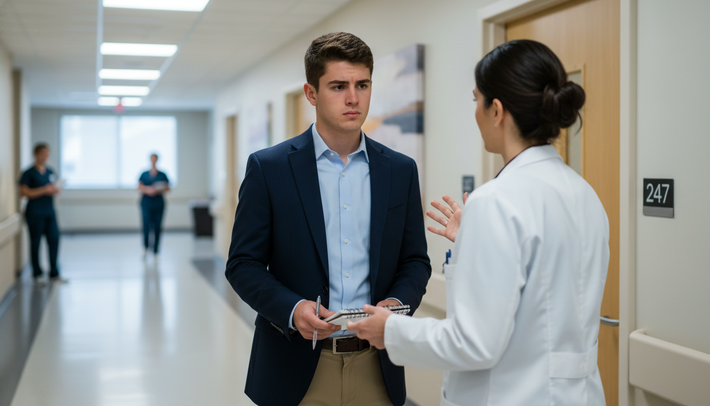
Your shadowing got canceled at the worst possible time. You can either panic—or turn it into a strategic advantage.
Most premeds treat a canceled shadowing day as a disaster. Strong applicants use it as proof they can adapt like a real clinician: calmly, quickly, and with a clear plan.
This guide is the playbook you follow when an attending emails, “Sorry, I have to cancel tomorrow.”
Step 1: Triage The Situation Like A Clinician
First move: stop thinking like a premed. Think like a doctor triaging a patient.
You have three questions to answer in the first 15–20 minutes:
- What is actually at risk?
- What is still salvageable?
- Who needs to know right now?
1. Clarify the stakes
Write down, very concretely, what depended on that shadowing:
- Were you counting hours for:
- A specific school’s “X hours of clinical exposure” guideline?
- A requirement for an enrichment program (like a summer pipeline, honors thesis, or committee letter)?
- An upcoming application cycle with a firm submission date?
Rank the impact:
- Critical – Without these hours, a requirement is not met.
- Important – Fewer hours than ideal, but not technically disqualifying.
- Low-impact – This was extra padding, exploration, or “nice to have.”
Knowing the category controls your response speed and intensity.
2. Timeline reality check
On paper or in a note app, map your timeline:
- MCAT date (if scheduled)
- Primary application target submission date
- Secondary deadlines (estimated or known)
- Committee letter deadlines
- Program or scholarship application deadlines
Then add:
- Current shadowing/clinical hours completed
- Projected hours before deadlines (minus this canceled block)
You need to see: “Do I have a numbers problem, or just a narrative problem?”
- Numbers problem → You truly might come up short on hours.
- Narrative problem → Hours are adequate, but you lost a unique specialty or story.
Both are solvable, but the strategy differs.
3. Immediate communication
Within 24 hours (ideally the same day), decide who you must update:
- Research mentor or premed advisor if:
- This shadowing was arranged through a program or office.
- Your advisor has been tracking your clinical exposure.
- Program coordinator if:
- Shadowing was part of a formal pipeline program or scholarship.
- Your school’s premed committee if:
- You are very close to a minimum-hours threshold.
Keep the message concise and professional:
Dear [Name],
I wanted to update you that my planned shadowing with Dr. [Last Name] on [date(s)] was unexpectedly canceled due to [brief reason if given]. I am actively arranging alternative clinical experiences and would appreciate any suggestions or connections you may have.
I will send an updated experiences list once new plans are confirmed.
Best,
[Your Name]
You do not complain. You inform, then immediately pivot to solutions.
Step 2: Salvage The Relationship With The Physician
A canceled shadowing experience is not always a dead end. Many premeds lose the future opportunity because they respond emotionally or passively.
Your objective: preserve the relationship and create openings for rescheduling or alternative involvement.
Send a professional, low-friction reply
Within hours of receiving the cancellation email:
- Acknowledge.
- Express understanding.
- Leave the door open without pressure.
Example:
Dr. [Last Name],
Thank you for letting me know. I completely understand that clinical schedules can change unexpectedly.
If your schedule permits at any point in the future, I would still be very grateful for the opportunity to observe or assist with any appropriate non-clinical tasks. In the meantime, I appreciate the initial offer and your time.
Best regards,
[Your Name]
Notice what you are doing here:
- Demonstrating maturity about uncertainty in clinical work.
- Showing sustained interest.
- Making it easy for them to say “Yes” later, even if not to full shadowing.
Offer structured rescheduling options
If the attending seemed genuinely interested in teaching, send a follow-up 1–2 weeks later with specific options:
I know your schedule is very dynamic, but if it is helpful, I am fully available on [X dates/times] over the next month. If any of those align with your clinic or OR schedule, I would be happy to adjust.
Physicians are more likely to respond “That Thursday morning works” than to build a plan from scratch.
Extract other opportunities
Sometimes the physician cannot host you but can still help. Ask one of the following, depending on context:
- “Is there a colleague in your department who occasionally hosts premedical students?”
- “Would your clinic or department have any non-clinical projects (patient education materials, quality improvement data entry, chart audit support) that a student could assist with under supervision?”
You are no longer just chasing shadowing. You are building professional capital.
Step 3: Turn The Same-Day Cancellation Into A Productive Day
If the cancellation happens the night before or the morning of, you have a surprise gift: several uninterrupted hours.
Wasting this time is the real red flag, not the canceled shadowing.
Option A: Rapid clinical exposure replacement (same day)
You will not find a new formal shadowing opportunity same-day. You can, however, increase clinical exposure in meaningful ways.
Some realistic same-day moves:
Call or visit local clinics you already have connections with
If you have volunteered or worked somewhere clinically:- Ask if you can pick up an extra shift.
- Ask if a provider might allow brief observational time after your volunteer tasks, if policy allows.
Health-related community organizations
Examples:- Free clinics
- Mobile vaccination or screening units
- Community health centers
- Campus health education outreach events
If you have previously volunteered, send a short message:
My hospital shadowing was canceled today, so I am unexpectedly free. Is there any way I can be useful for a few hours today with [clinic/task]? I understand if scheduling is not flexible, but thought I would check.
You may not succeed every time, but even sending those messages shows initiative and often creates future opportunities.
Option B: Application-strengthening work block
If no clinical replacement is feasible today, convert those hours into visible progress on your application. Choose from:
Draft or refine activity descriptions
Focus on:- Clinical roles
- Non-clinical community service
- Leadership experiences
Use CAR structure (Challenge–Action–Result) for each entry.
Work on your personal statement or most meaningful experiences
Incorporate:- Times you adapted when plans fell through.
- Situations where you persisted despite lack of structure.
MCAT precision work
Three to four focused hours on:- Question bank practice (UWorld, Kaplan, Altius, Blueprint)
- Reviewing missed question patterns
- One targeted content review (e.g., acid-base, cardiac physiology)
Your goal: at the end of the day, you should be able to point to something concrete:
- “Today I completed 80 MCAT questions and revised two activities.”
- “Today I finalized the first draft of my personal statement.”
That is impressive. The admissions committee will never know why you made that progress on that particular day, but you will.
Step 4: Build A Structured Backup System For Future Cancellations
One canceled day is bad luck. Multiple canceled days with no backup plan is poor planning.
You fix this like you would fix any fragile process: build redundancy.
1. Diversify exposure types
You need a portfolio that does not collapse if one piece fails. Aim for a mix across:
Shadowing
- 2–4 different specialties if possible
- Mix of inpatient and outpatient
Clinical employment
- Scribe, medical assistant, EMT, CNA, patient care tech, phlebotomist
Clinical volunteering
- Hospital volunteer roles with direct patient contact
- Free clinic or mobile health units
Non-traditional clinical exposure
- Hospice volunteering
- Crisis hotline (with medical/mental health focus)
- Rehab centers, dialysis centers, infusion clinics
If your only clinical contact is shadowing, you are vulnerable. Adding even one part-time clinical job or consistent volunteer role dramatically lowers the risk of disruption.
2. Maintain a “standby list” of opportunities
Create a simple document with:
Facilities where:
- You have already been accepted as a volunteer.
- You have relationships with staff.
- You are cleared (HIPAA, immunizations, etc.).
Contacts:
- Names and emails of coordinators, charge nurses, volunteer office staff.
- Availability expectations (e.g., “usually can add extra shifts on weekends”).
When a cancellation hits, you do not start from zero. You review your list and send targeted messages.
3. Time-block your “clinical flex” windows
Reserve consistent windows each week that are:
- Primarily intended for clinical activities.
- Secondarily used for application prep if clinical is not possible.
Example schedule:
- Tuesday 1–5 pm: Clinical block
- Saturday 8–12 pm: Clinical block
During these windows, you either:
- Shadow
- Volunteer / work clinically
- Or, if all else fails, use them for:
- Application essays
- MCAT prep
- Reaching out to new clinical opportunities
You protect these windows on your calendar. That routine sends a clear message to yourself and your recommenders: “I show up for clinical work like it is a job.”
Step 5: Create New Opportunities On Short Notice (1–4 Weeks)
Sometimes the loss is not just one day. A physician cancels an entire planned shadowing month, or a clinic stops taking students. You need fresh options within weeks.
Here is a tactical approach.
1. Use existing institutional infrastructure
Do not reinvent the wheel. Start with:
Your university’s pre-health advising office
Ask specifically:- “Which hospitals or clinics close to campus have previously accepted our students for shadowing or clinical volunteering?”
- “Is there a contact person there, or should I use a general application portal?”
Health professions pipeline programs
Examples:- AHEC (Area Health Education Centers)
- Summer enrichment programs at academic medical centers
- Local hospital student observer programs
These often have structured processes and are used to handling cancellations and reassignment.
2. Targeted cold outreach that actually works
Random mass emails like “Can I shadow you?” fail. You need focused, professional, short messages.
Template:
Subject: Undergraduate Student Requesting Brief Clinical Observation Opportunity
Dear Dr. [Last Name],
My name is [Name], and I am a premedical student at [University] with a strong interest in [specialty or patient population]. I recently had a scheduled shadowing opportunity fall through and am hoping to arrange a brief clinical observation experience in the next [time frame] if feasible.
I have completed [HIPAA training, immunizations, hospital volunteering, etc.], and can provide any documentation required by your institution. My availability is [list 2–3 specific windows], but I will gladly adjust to your schedule if an opportunity is possible.
Thank you very much for considering this request.
Sincerely,
[Name]
[Major, Year]
[University]
[Phone]
[Email]
Key details:
- You mention the cancellation briefly, but you do not sound desperate.
- You highlight readiness (training, paperwork).
- You give concrete availability while showing flexibility.
Aim for:
- 5–10 targeted emails per week.
- Mix of:
- Academic doctors tied to your university
- Community physicians in specialties you truly want to explore
3. Leverage non-physician clinicians
Many premeds ignore excellent clinical exposure options:
- Physician assistants (PAs)
- Nurse practitioners (NPs)
- Certified nurse midwives (CNMs)
- Clinical pharmacists
- Physical and occupational therapists
While some schools emphasize physician shadowing, many will value any sustained clinical exposure where you:
- See patient encounters.
- Learn about healthcare teams.
- Reflect on differences in training and scope.
Confirm with your premed advisor, but do not underestimate the value of observing non-MD/DO providers, especially if physician opportunities are temporarily blocked.
Step 6: Repair Your Application Narrative
Canceled shadowing primarily hurts you in two places:
- Total hours and breadth of exposure.
- The strength and coherence of your story.
You can address both directly.
1. Adjust your activities strategically
If you lose 20–40 shadowing hours in a specific specialty:
- Do not fabricate or exaggerate.
- Expand and highlight:
- Clinical employment hours.
- Longitudinal volunteering.
- Other shadowing you already have.
In your activities section:
- Emphasize depth and reflection over raw numbers.
- Use “Most Meaningful” entries to show:
- How you learned to handle uncertainty and cancellations.
- Times you created value for a clinic or team, not just observed.
2. Address disruptions in secondaries where appropriate
Some secondaries or update letters provide natural spaces to explain disrupted plans. Use these only when:
- Shadowing loss was substantial.
- It affected a required program component or forced a gap.
Example passage for a “challenges” prompt:
During my junior year, I arranged a month-long shadowing experience in [specialty], which was canceled one week before it was scheduled to begin due to unexpected staffing changes. Rather than accept a prolonged gap in clinical exposure, I contacted [X] local clinics and used existing volunteer relationships to add shifts at [site]. I also began working as a [clinical job], which ultimately provided more longitudinal patient contact than the initial shadowing would have. The sudden loss of that opportunity reinforced that clinical work requires flexibility, and that I can still contribute meaningfully when plans change abruptly.
You are not making excuses. You are demonstrating resilience and proactivity.
3. Build a clear “clinical exposure summary” for yourself
Create a single-page document (for you and your advisor) that lists:
- Role / setting (e.g., “Emergency Department volunteer,” “Family Medicine shadowing,” “Hospice volunteer”)
- Dates
- Approximate hours
- Key responsibilities or types of patient interaction
This makes it obvious whether:
- You are missing primary care.
- You need more continuity (long-term, weekly work).
- You are overreliant on passive shadowing.
Then plan the next 3–6 months accordingly.

Step 7: What Actually Impresses Admissions Committees
You might think admissions committees are secretly tracking whether someone had a shadowing day canceled.
They are not.
They care about patterns:
- Do you seek clinical exposure actively or passively?
- Do you maintain commitments even when they are inconvenient?
- Do you adapt to setbacks rationally or dramatically?
Here is what can genuinely impress them after a cancellation:
Sustained, longitudinal clinical involvement
- 6–18 months in a consistent role outweighs a handful of disconnected shadowing days in many cases.
Evidence you added value, not just observed
- Training new volunteers
- Developing patient education resources
- Helping with quality improvement data projects
- Supporting workflow in a clinic reliably
Thoughtful reflection on the realities of medicine
- Mentioning that you have learned:
- Schedules change.
- Staffing shortages disrupt patient care.
- Clinics and hospitals have to constantly triage priorities.
When you link your shadowing disruptions to understanding those realities, you look like someone who understands the profession’s texture, not just its highlight reel.
- Mentioning that you have learned:
Professional communication and boundaries
- You did not send guilt-tripping emails to physicians.
- You handled cancellations with gratitude and maturity.
- You respected institutional policies.
Those behavioral signals matter as much as your total hours.
Concrete 7-Day Recovery Plan After A Major Cancellation
If you just lost a big shadowing block, use this exact sequence for the next week.
Day 1–2
- Map your clinical hours and deadlines.
- Email your premed advisor with:
- Your updated hours.
- What was canceled.
- What you are planning to do about it.
- Send a respectful reply to the canceling physician.
- Convert the original shadowing time into:
- MCAT block or
- Essay drafting.
Day 3–4
- Send 5–10 targeted outreach emails to new physicians / clinics.
- Contact:
- Campus pre-health office
- Hospital volunteer office
- Any existing clinical supervisors
- Identify:
- One additional clinical role you could realistically start in 4–8 weeks (e.g., scribe, MA, hospice volunteer).
Day 5–7
- Finalize applications for:
- Hospital volunteer roles
- Free clinics
- Scribe or other clinical jobs (if schedule permits)
- Establish:
- 2 weekly “clinical flex” blocks on your calendar.
- Document all of this:
- Spreadsheet of hours
- List of applications sent
- Notes on potential opportunities
At the end of these seven days, your application should be more robustly planned than it was before the cancellation ever happened.

Quick Summary: What You Should Take From This
- A canceled shadowing day is not the problem. Failing to respond with structure and initiative is.
- You impress admissions committees by demonstrating resilience: diversifying clinical exposure, communicating professionally, and converting setbacks into concrete progress.
- Redundancy wins. Build a portfolio of clinical roles so that when one opportunity falls apart, your overall trajectory does not.