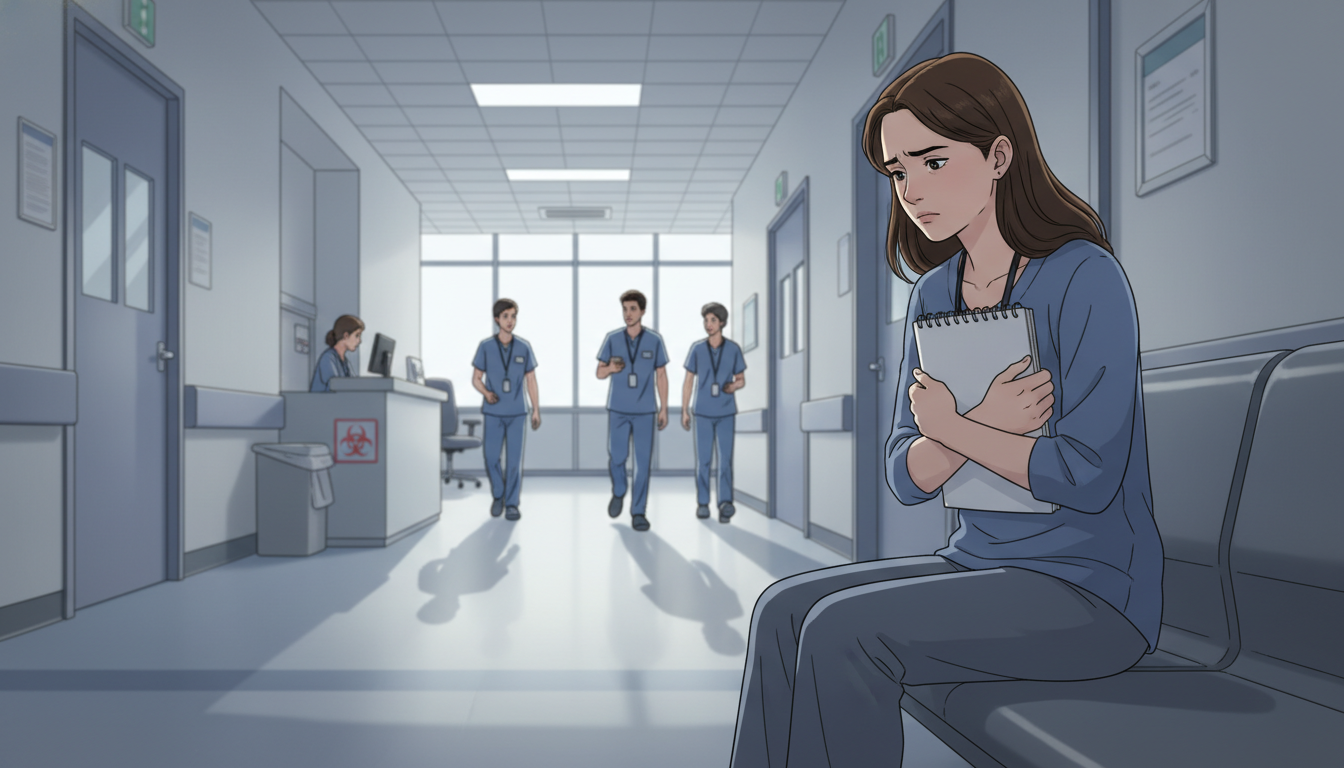
Your biggest fear right now isn’t overreacting — it’s being ignored when something serious might have actually happened.
You’re stuck in that mental loop: “Did I just violate patient confidentiality? Did I break HIPAA? Are they going to kick me out of shadowing? Will this ruin my med school chances?”
And the worst part? You can’t tell if you’re being irrationally anxious… or if this is one of those “your entire future is on the line” moments.
(See also: What If I Felt Uncomfortable During Shadowing? Will Schools Judge Me? for more details.)
Let’s walk through this like two people sitting in a quiet study room, doors closed, no judgment. I’m going to say the things I wish someone had said to me when I spiraled over this stuff.
First: Did You Actually Violate Confidentiality, Or Are You Catastrophizing?
Here’s the ugly truth: premeds almost never get clear teaching about what’s actually a confidentiality breach vs what just feels terrifying.
So your brain fills in the gaps with worst-case scenarios:
- “I said something about a patient to my roommate.”
- “I mentioned a diagnosis in a group chat.”
- “I posted a story on Instagram from the hospital.”
- “I repeated a really interesting case to a friend.”
And then you start thinking: I’m basically done. They’re going to flag my name forever. AAMC will know. Every med school will know. This goes on some permanent secret list, right?
Let’s slow down.
Confidentiality is about identifiable patient information. It’s not just that you talked about a patient; it’s whether what you said could reasonably let someone figure out who that patient is.
Stuff that leans more into “probably not a real violation” territory:
- You said “we saw a patient with appendicitis today” without any name, age, location, or uniquely identifying details.
- You mentioned “a woman in her 50s with breast cancer” but didn’t say where, when, or anything personally identifiable.
- You talked about a surgery type you saw without connecting it to any specific patient.
Stuff that gets closer to “possible or likely violation”:
- You used names or initials in a non-clinical context.
- You shared very specific details: age, rare condition, exact date, small hospital, and something unique (“the teacher from X high school who had Y surgery today”).
- You posted ANYTHING on social media that:
- shows a patient
- shows a name on a board or chart
- shows dates / medical record numbers
- is specific enough that someone local could recognize the person
Here’s the painful, annoying thing: even if what you did is technically minor, your anxiety doesn’t care. It just tells you: “You messed up. Big. Forever.”
But medicine doesn’t usually work like that. It’s less “one mistake and you’re done,” and more “what did you do when you realized there might be a problem?”
Which brings us to the part your brain is probably dreading most.
The Terrifying Step: Telling Someone (And Why You Probably Need To)
You’re probably asking: “If I say something, do I make it worse? But if I don’t say anything, what if they find out later and it’s worse? Am I supposed to just confess everything? Or nothing?”
Here’s the uncomfortable answer:
If you truly think what you did might have involved identifiable patient information — you should tell someone.
Not Twitter. Not your group chat. Not a random Reddit thread.
Someone connected to your shadowing site or program.
Who that might be:
- The physician you’re shadowing
- The clinic coordinator
- The volunteer director
- Your premed advisor (for help planning how to disclose)
What you can say (without spiraling all over them):
“I’m worried I might have accidentally shared more about a patient than I should have. I didn’t intend to, but I’m concerned it could be a confidentiality issue. Can I explain what happened and get your guidance?”
Notice a few key things there:
- You’re not saying “I maliciously violated HIPAA.”
- You’re not minimizing it.
- You’re asking for guidance — which is what a professional-in-training is supposed to do.
You’re terrified they’ll react like this:
“Wow. That’s serious. We have to report you. You can’t come back. Also, enjoy never going to med school.”
What actually usually happens:
- They clarify what you said/did.
- They assess if it’s an actual breach or just a learning moment.
- If needed, they may:
- Ask you to delete something (social media post, message, etc.).
- Document it internally.
- Give you a talk about confidentiality.
- In many cases, it ends with “Okay, thanks for telling me. Let’s be more careful. Here’s what to do next time.”
Does that feel good? No.
Does it feel like the end of the world in the moment? Yes.
Is it usually the end of your future? No.
What absolutely does look worse long-term is:
- Hiding it.
- Lying if someone asks directly.
- Panicking and destroying evidence if there actually is an official inquiry.
Your honesty under stress is part of your professional identity. People are paying attention to that.
What If I Already Did The Bad Thing (Like Posting On Social Media)?
Let’s say you did the thing you’re not supposed to do: you posted a story or photo from the hospital.
Maybe you:
- Snapped a selfie in a hallway and accidentally caught patient info on a monitor in the background.
- Posted a “crazy case we saw today” story with too many specific details.
- Shared a TikTok about a unique patient encounter.
You can’t undo the moment, but you can respond in a way that signals maturity.
Here’s what to do, step-by-step:
Remove the content immediately.
Delete the post, the story, the video — everything. Even if you’re not 100% sure it was a violation, take it down.Don’t edit the story to make it “less bad” and keep it up.
Just take it down. Half-measures look like you understood it was wrong but didn’t fully commit to fixing it.Document what happened for yourself.
Write down:- What you posted/said (as accurately as you can remember)
- Where/when you posted it
- Who could see it (private vs public account)
- When you deleted it
Not for your Instagram. For you. In case someone asks later, you’ll have details instead of foggy panic.
Decide who to tell.
If this happened as part of:- A formal hospital shadowing program → contact the site coordinator or supervising physician.
- A small private clinic → contact the physician you shadowed.
- A volunteer role → contact the volunteer supervisor.
You’re not sending a dramatic confession email. You’re saying something like:
“I realized I posted something online that may have included more information about the clinical environment than was appropriate. I’ve since deleted it, but I’m worried it might have been a confidentiality issue. Can I discuss this with you to understand if any further steps are necessary?”
Prepare yourself emotionally for discomfort — not doom.
You might get:- A warning.
- Required training.
- Restrictions on future shadowing at that site.
But medical education is built around people making mistakes and learning from them. If this is your first time and you’re taking it seriously, that matters.
Will This Ruin My Med School Chances?
Here’s the anxiety script in your head:
“I violated confidentiality → the hospital reports me → it goes into some record with my name → AMCAS or TMDSAS sees it → every school rejects me → I’m permanently labeled unsafe.”
Reality is more layered and less catastrophic.
A few key points:
There is no national “shadowing violation” database for premeds.
You don’t have an official medical license. You’re not in residency. You’re not in a regulated professional role. There’s no centralized federal list tracking “premed who said too much about a patient once.”Most minor issues stay internal.
If your “violation” is small and you’re honest, it’s often handled at the site level:- A talk with your supervisor.
- Maybe removal from that program.
- Maybe a note in their internal records.
Not a nice outcome, but not a career death sentence.
What med schools care about most is patterns + integrity.
One incident handled maturely is very different from:- Repeated careless sharing of patient information.
- Blatant social media posting with no remorse.
- Lying about it later.
You usually won’t be asked to self-report this on applications unless it led to formal disciplinary or legal action.
Did:- The hospital officially sanction you?
- Your university put it on your record as disciplinary action?
- You get involved in a legal process?
If none of that happened, this typically doesn’t show up in those “institutional action” questions.
Worst-case scenario — if it does become a formal issue — it’s not always fatal.
If, in the truly extreme version, you ended up with something on your record and had to report it, adcoms will look at:- Your age when it happened.
- Your insight and reflection.
- What you’ve done since.
- How honest and specific you are in explaining it.
Is that fun to deal with? Absolutely not.
But there are med students sitting in lecture halls right now who have had to explain much more serious things than “I mishandled a confidentiality situation in my early premed days.”
How To Actually Learn From This (Instead of Just Beating Yourself Up Forever)
Your brain probably wants you to either:
- Obsess about this for months and spiral every time someone says “HIPAA,” or
- Try to shove it into a mental closet and pretend it never happened
Neither helps.
Here’s what actually does help you long-term:
Get very clear on what you did and why it might have been wrong.
Not in the “I’m a horrible person” way. In the “if I had to teach a younger premed about this, what would I say?” way.For example:
- “I repeated a unique patient story with enough details that local people might identify them.”
- “I took photos inside a clinical area where patient info was visible in the background.”
Decide what your personal rules will be from now on.
Things like:- “I will not discuss patient cases outside clinical settings unless fully de-identified and for education only.”
- “I won’t take my phone out in clinical areas except for necessary communication.”
- “I will ask, when in doubt, whether something counts as PHI or is okay to talk about.”
Treat this as practice for the future physician you want to be.
Doctors mess up. Residents mess up. Med students mess up.
The professional difference is:- Do they disclose?
- Do they take responsibility?
- Do they change their behavior?
You’re rehearsing that now, whether you like it or not.
Give yourself a limit on how long you’re allowed to ruminate.
After you:- Delete/fix what you can
- Tell the appropriate person
- Reflect and set new rules
You’re allowed to let it rest. You can still feel anxious about it (because that’s how brains work), but you don’t need to constantly restart the “what if my entire career is doomed?” movie in your head.
What You Should Do Today (Not Someday)
Here’s your concrete, not-overwhelming checklist for today:
Ask yourself honestly:
“Did I share anything that could reasonably let someone identify a specific patient?”
If yes or “I’m not sure,” continue.If there’s any post / story / text / DM that you control and are worried about, delete it now.
Write down exactly what happened — as if you had to explain it calmly to someone else.
Decide who the right person is to tell (physician, coordinator, volunteer director, or advisor).
Send a short, calm message asking to speak about a possible confidentiality concern.
That’s it for today. Not redoing your entire life plan. Not deciding you’re unfit for medicine.
Just those steps.
FAQ (Exactly 5 Questions)
1. Do I have to report this to medical schools if I think I violated confidentiality while shadowing?
Usually, you only have to report something on your application if it led to official institutional action (like a documented disciplinary record at your university or hospital, or legal consequences). If your situation was handled informally (a warning, a conversation, removal from a single shadowing site without formal documentation), it typically doesn’t need to be reported as an institutional action. If you’re unsure, talk to a premed advisor or the institution where the issue occurred and ask if anything was formally recorded.
2. What if I already talked about a patient case to friends or family without names — is that automatically a violation?
Not necessarily. Healthcare workers and trainees discuss cases all the time for learning, as long as they’re de-identified. Problems arise when details are so specific that someone could reasonably figure out who the patient is (unique condition, small community, clear timeline, recognizable context). If what you shared was vague and educational (“we saw a case of heart failure”), it’s unlikely to be a true confidentiality breach. If you gave several specific details, it’s worth reflecting and possibly asking a supervisor if you’re worried.
3. Could a single confidentiality mistake really stop me from ever becoming a doctor?
One minor mistake, handled honestly and responsibly, almost never becomes a permanent barrier. What raises red flags is a pattern of behavior or dishonesty about what happened. If this is your first issue, you addressed it, and you actually learned from it, most physicians and (if it ever even came up) admissions committees will see it as part of your growth story, not a final judgment of your character.
4. Should I mention this in interviews as a “learning moment” even if no one ever found out?
In general, no. You don’t need to volunteer every fear or misstep you’ve ever had, especially if it didn’t result in any formal consequences and you’ve already corrected your behavior. If you’re asked about a time you made a mistake, you can choose something you addressed constructively that doesn’t create confusion about professionalism or patient safety. If this incident did lead to formal action, then yes, you’ll need to be honest if asked — but you should frame it with insight, responsibility, and what changed afterward.
5. What if my anxiety is telling me I violated confidentiality, but logically I’m not sure anything identifiable was shared?
This is really common, especially for anxious premeds who care a lot about doing the right thing. If you genuinely can’t identify anything specific and traceable you shared (no names, no unique details, no photos with info, no clear clues about identity), it may be more of an anxiety spiral than an actual violation. You’re still allowed to bring it to a mentor or advisor and say, “I’m worried I might be overthinking this — can I run it by you?” Sometimes having a calm, knowledgeable person say, “This wasn’t a breach, but it’s good you’re thinking about it,” is enough to let your brain unclench a bit.
Open your messages or email right now and draft one short note to the appropriate person asking to talk about a possible confidentiality concern — then save it as a draft. Don’t send it yet. Just write it. See how it feels to put the fear into actual words you can work with, instead of just letting it keep spinning in your head.