

The magic “right number” of job offers before deciding is a myth.
Most physicians don’t need more offers. They need better comparison and clearer priorities.
Here’s the real answer:
You generally want 2–4 serious offers on the table before committing — but the right target for you depends on your risk tolerance, specialty, and how clear you are on what you want.
Let me break that down properly.
The Short Answer: A Practical Range
If you want a single guideline you can actually use, here it is:
- Most people: Aim for 2–3 solid offers before signing.
- Highly competitive specialties or big career moves (academics to PP, PP to leadership, cross-state move): Aim for 3–4 offers.
- If you have strong constraints (geography locked to one city, spouse job fixed, kids in school, visa issues): You might realistically get 1–2 offers — and that can still be enough if you compare them ruthlessly and negotiate well.
The important part isn’t the count.
It’s whether you’ve seen enough variation to understand your market value and your options.
Step 1: Decide Your Strategy – Safety, Comparison, or Optimization?
Most post-residency job searches fall into one of three mindsets:
Safety-first:
“I need something stable, in X city, near family. I’m tired and I just want a reasonable job.”Comparison-first:
“I want to understand what’s out there and not get lowballed.”Optimization-first:
“I’m willing to wait for the right combination of money, schedule, setting, and growth.”
Your target number of offers should match which camp you’re in.
| Strategy | Typical Target | Realistic Minimum |
|---|---|---|
| Safety-first | 1–2 offers | 1 |
| Comparison-first | 2–3 offers | 2 |
| Optimization-first | 3–4 offers | 2 |
If you’re optimization-first but only applying locally to two hospital systems, your expectations are just wrong. That’s not a “get 4 offers” strategy; that’s a “pick from what exists” strategy.
Step 2: Understand Why More Offers Actually Matter
You’re not collecting offers for fun. There are three concrete reasons to push for more than one:
You need a reference point for compensation.
First offer: you have no idea if 320k base, 20 RVU, or 65% collections is generous or trash.
Second offer: patterns start to appear.
Third offer: now you can say, “Everyone else is at 350–375k plus 20–30k sign-on. Can we move closer to that?”You need leverage to negotiate.
Programs take you more seriously when you can truthfully say:
“I’m excited about your offer, but I do have another offer at X base and Y vacation weeks. Is there any room to improve your package to be more competitive?”You need diversity of models.
Seeing:- a pure RVU job
- a hospital-employed salary + RVU model
- and a private practice partnership track
…teaches you more than reading 50 online threads.
Good offers don’t just repeat numbers.
They expose different practice styles, schedules, and cultures. That’s where the real learning happens.
Step 3: Know When One Offer Is Enough
Sometimes, chasing a second or third offer is just procrastination dressed up as “being thorough.”
One offer can be enough when:
- You’re constrained geographically to one small market and there just aren’t many options.
- The offer meets or exceeds your must-haves:
- Location works for you and your family.
- Schedule is sustainable (for your reality, not your fantasy self).
- Compensation is in a reasonable band for your specialty/region.
- Call, support staff, and resources are acceptable.
- You’ve done serious due diligence:
- Talked to current and recently departed physicians.
- Got clear answers on partnership track, bonus structure, and non-compete.
- Reviewed the contract with a lawyer or experienced mentor.
If your one offer checks those boxes, and dragging out your search means 3 more months of locums you hate or living apart from your partner? Take the job. That’s not “settling”; that’s prioritizing.
Step 4: Red Flags That You Need More Offers
If any of these are true, one offer is absolutely not enough:
You’re unsure about the practice model.
Example: First outpatient psych job, heavy RVU, vague bonus formula. You’ve never seen another contract to compare. Get more offers.The comp feels “fine” but you can’t tell if it’s average or bottom 20%.
That uneasy feeling? Usually means you need at least one more data point.You feel rushed.
“We need a decision in 5 days.” Classic tactic when they know the offer is mediocre. Speed is a red flag. Time pressure is a red flag. That’s when a second offer becomes protective.You haven’t seen different practice setups.
Only academic jobs. Only big hospital systems. Only private practice. You’re choosing a path for years. You should at least see what the other side looks like.
If more than two of those are you, I’d say aim for at least 2 additional offers, even if it means more interviews and a later start.
Step 5: How Many Applications It Takes To Get Those Offers
This is where people under-estimate badly.
You don’t apply to 3 jobs and get 3 offers. That’s fantasy.
Typical funnel post-residency (very approximate, varies by specialty):
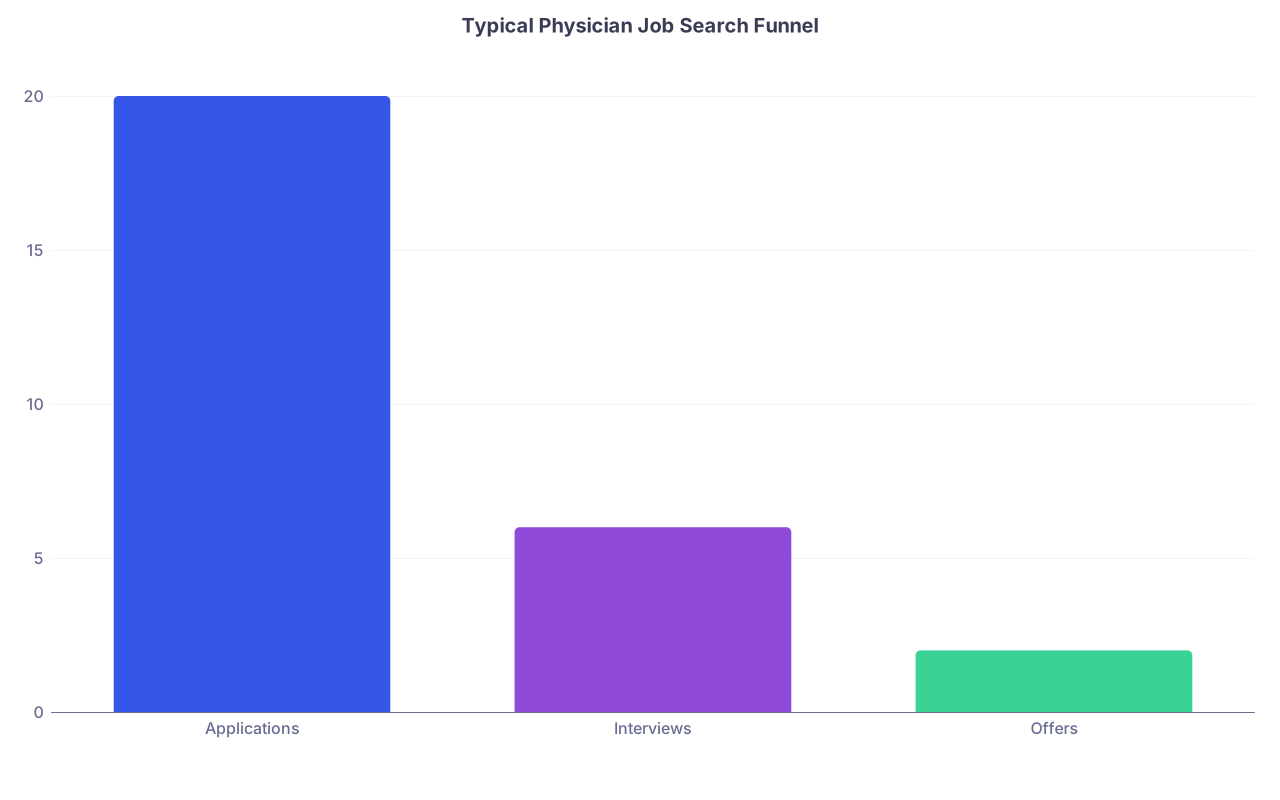
| Category | Value |
|---|---|
| Applications | 20 |
| Interviews | 6 |
| Offers | 2 |
Real-world ballpark for a decent but not hyper-competitive specialty:
- Applications sent: 15–30
- Interviews offered: 5–10
- Serious offers: 2–4
If you want 3 solid offers, you should be thinking in terms of 20+ applications in most fields, unless your specialty is in very high demand in your target geography.
So the question isn’t just “How many offers?” but also “Am I applying widely enough to make that realistic?”
Step 6: Use a Clear Decision Framework (So You Don’t Need 10 Offers)
People chase “just one more offer” when they don’t have a real decision process.
Here’s a simple, ruthless framework that keeps you from endlessly collecting options.
Define your non-negotiables (must-haves):
- Max commute time or specific city/region
- Minimum base pay or total comp band
- Maximum clinic days or call burden
- Deal-breakers like heavy inpatient, weekends, or certain EMR systems
Any offer that fails on ≥1 true non-negotiable? Out. No matter how shiny the rest is.
Rank your top 4–5 “nice-to-haves”: Examples:
- Strong mentorship or academic title
- Real partnership track (with numbers, not vibes)
- Flexibility for telehealth or part-time eventually
- Robust ancillary support (NPs, scribes, MA ratio)
- Pathway to leadership
These are tiebreakers, not survival criteria.
Score each offer quickly:
- Must-haves: Pass/Fail
- Nice-to-haves: 1–5 scale each, add them up
Once you’ve got 2–3 “pass” offers and one of them is clearly ahead in your scoring? You’re done. More offers won’t change the outcome; they’ll just waste time.
Step 7: How Multiple Offers Strengthen Negotiation
You don’t need to play games. Just be factual and calm.
Examples of how to use multiple offers:
Compensation: “I appreciate the 320k base. My other written offer is 350k with a 25k sign-on. I prefer your group for the teaching opportunities. Is there any way to bring your base or sign-on closer so I can justify choosing you?”
Schedule / Call: “Another hospital offered 1:7 call with post-call day off. You’re at 1:4 with no post-call. That’s a big lifestyle difference. Is there flexibility to adjust call frequency or add comp time?”
Non-compete: “Other local offers don’t include a non-compete, or they’re limited to one clinic location. A 30-mile entire county restriction is tough for me. Can we narrow this?”
You don’t have to mention every detail. Just enough so they understand:
You’re desirable, informed, and have real alternatives.
When More Offers Are a Waste of Time
Past a point, more offers do nothing for you. They just feed your anxiety.
You’re probably in “avoidance mode” if:
- You’ve got 3 decent offers that all:
- Meet your must-haves
- Live in the same compensation ballpark
- Differ mostly on secondary perks
- You keep saying things like:
- “What if something perfect is still out there?”
- “I just need to see a few more before I’m sure.”
- Your mentor/attending looks at your options and says, “These are all fine. Pick one.”
At that point, your problem isn’t too few offers. It’s fear of committing.
And no number of offers fixes that.
Special Situations
Academics vs Private Practice
If you’re torn between academic and private practice:
- Try to get at least one offer in each world.
- Don’t judge academics on pay alone. Look at:
- Protected time
- Title
- Promotion track
- Research/teaching support
- Don’t judge PP only on partnership fairy tales. Demand:
- Specific buy-in numbers
- Recent partner compensation ranges
- Timeline and criteria in writing
One offer in each domain is often more valuable than 4 offers all in the same lane.
H1B/J1 or Visa-Dependent Physicians
Your realism has to be higher.
- You might only get 1–2 compliant options in your geography.
- Quality still matters, but visa sponsorship is a hard constraint.
- Your energy might go more into:
- Contract review
- Future mobility
- Non-compete limits
…rather than chasing a fourth shiny offer you can’t legally take.
Visual: Timing Your Decision
Here’s a simple timeline that works for most people.
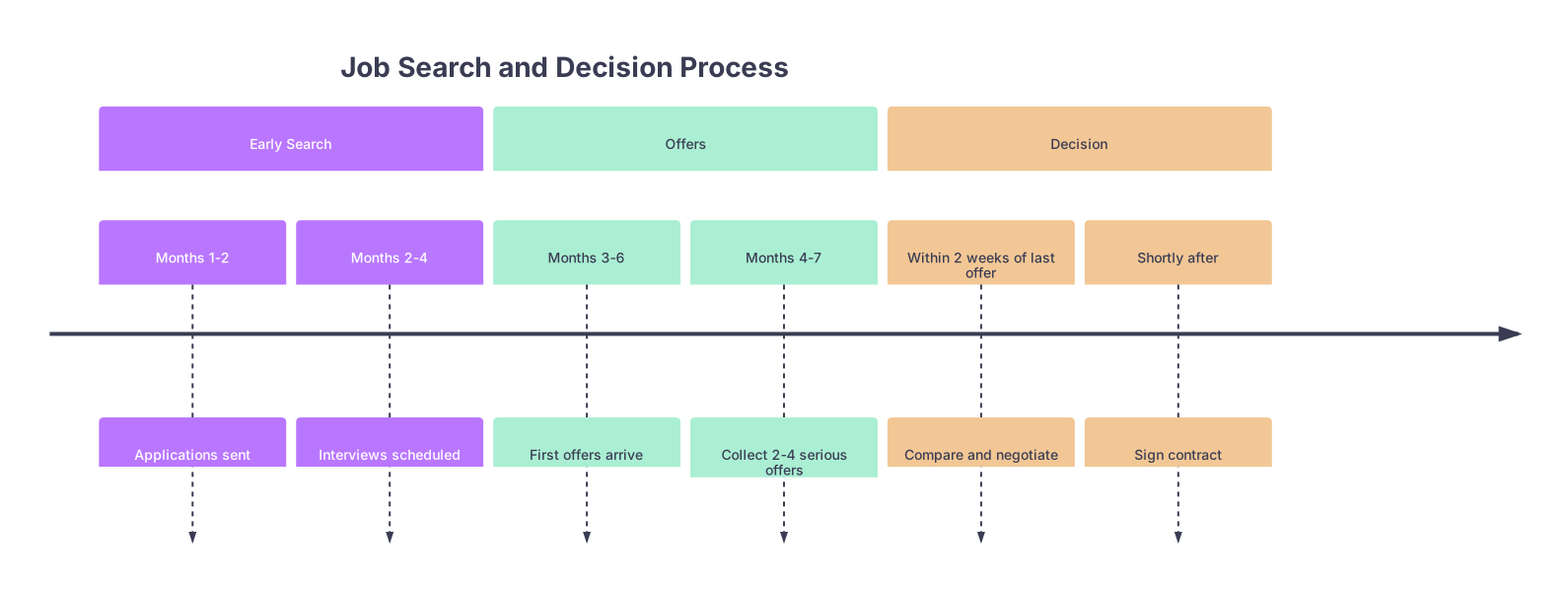
| Period | Event |
|---|---|
| Early Search - Months 1-2 | Applications sent |
| Early Search - Months 2-4 | Interviews scheduled |
| Offers - Months 3-6 | First offers arrive |
| Offers - Months 4-7 | Collect 2-4 serious offers |
| Decision - Within 2 weeks of last offer | Compare and negotiate |
| Decision - Shortly after | Sign contract |
You don’t need to wait until every possible offer is in.
Once you’ve hit your target range (say 2–3 serious offers) and done your homework, decide.
FAQs: Job Offers After Residency
1. Is it risky to accept the first offer I get?
It’s only risky if:
- You haven’t seen any other contracts for comparison,
- You’re fuzzy on your own priorities, or
- You’ve ignored red flags (high turnover, vague bonus, weird non-compete).
If the first offer is solid, you’ve compared it to at least one other real option (or multiple interviews without offers yet), and you’ve done due diligence? Accepting the first one isn’t inherently dumb.
2. How long can I reasonably ask to think about an offer?
Typical range: 1–2 weeks.
You can say: “I’m very interested. I’d like about 10 days to review the contract, discuss with my family, and speak with a lawyer. Is that acceptable?”
If they push for 48 hours, that’s a yellow flag. Good groups understand you’re making a career-level decision.
3. What if I accept one offer and a better one shows up?
Once you’ve signed, you’re in contract territory. Backing out:
- Burns bridges,
- Can affect your reputation, and
- In rare cases, can have legal consequences.
If you haven’t signed yet, you can absolutely pivot. Just don’t be shady. Tell them promptly and clearly that you’ve decided on another opportunity.
4. How do I know if my compensation is fair without 5 offers?
Use:
- MGMA or specialty society data (often via mentors or leadership),
- Colleagues 1–3 years out (what did they get in similar markets?),
- One or two other actual offers for comparison.
You don’t need five offers. You need one or two plus external data and honest conversations with people in your specialty.
5. Is it okay to tell an employer I’m waiting on other offers?
Yes, and you should. Something like:
“I’m very interested in your position. I do have other interviews and one pending offer, so I want to be transparent that I’m comparing options over the next couple of weeks.”
This doesn’t offend anyone serious. It signals you’re in demand.
6. How many interviews should I aim for to get 2–3 offers?
Rough ballpark: 5–8 interviews for most non-ultra-competitive specialties.
That usually translates into 2–4 offers, assuming you interview decently and you’re not trying to lock into one tiny, saturated city.
7. What’s the biggest mistake people make with number of offers?
Two extremes:
- Jumping on the first “okay” offer because they’re exhausted, without seeing any alternatives.
- Endlessly chasing more offers because they’re scared to choose, even when they already have multiple good options.
Aim for the middle:
Apply widely, get 2–4 real offers, compare them against clear priorities, negotiate, then commit and move on with your life.
Key takeaways:
You don’t need a magical number of offers. You need:
- At least 2–3 serious offers in most cases, or 1–2 if you’re tightly constrained.
- A clear framework for must-haves and nice-to-haves so you stop when you have enough data.
- The guts to decide once your offers meet your criteria, instead of hiding in “maybe there’s something better” forever.


