
It’s January. You’re staring at your interview spreadsheet and your loan balance side by side. One tab says “$280k outstanding.” The other says “NYC, Boston, SF, LA” in bold next to programs you actually liked. Your brain is doing that horrible math loop: “Resident salary ≈ $65k. Rent ≈ everything I own. I’m going to end up bankrupt. Or moving back in with my parents. Or both.”
You’re supposed to be thinking about “fit,” “mentorship,” and “case volume,” but all you can see is post‑tax income vs. rent prices and wondering if matching to your dream program is basically financial self-harm.
You’re not crazy for thinking this. The “don’t worry, it’ll all work out” crowd is either rich, delusional, or hasn’t actually run a budget in the last decade.
So let’s do the thing nobody does honestly: actually assess residency affordability. Not vibes. Not “it’ll be tight but manageable.” Real numbers.
Step 1: Admit Money Is a Real Constraint (You’re Not Weak for Caring)
Let me just say the thing out loud: you can’t “just suck it up for 3–7 years” if sucking it up means:
- taking on more high-interest debt just to live
- living with constant financial panic
- never having any buffer for emergencies
That’s not grit. That’s recklessness.
Residency is already exhausting. Add chronic financial stress and you get burnout, resentment, and that quiet dread when your card gets declined at the grocery store because timing + autopayments + chaos.
People love to say, “You’ll be an attending one day, you’ll be fine.” Yeah, cool, but:
- You still have to survive the next few years.
- Compound interest is not your friend.
- Financial anxiety will bleed into everything: your mood, your focus, your mental health.
So no, you’re not shallow or selfish for putting money in the decision. You’re doing what half your classmates are secretly doing but are too embarrassed to admit.
Step 2: Get Real About Your Numbers (Not Vague Guesses)
You can’t assess “affordability” on vibes. You need a rough but real snapshot. Not perfect. Just honest.
Here’s what you need:
- Total educational debt
- Interest rate(s)
- Minimum payments in residency (if you’re planning PAYE/REPAYE/SAVE or forbearance)
- Expected take-home pay by program region
- Realistic cost of living (not what some website says; what actual residents are paying)
Let’s compare typical resident salaries and rough high‑level costs, just so your brain has some grounding.
| Region | Typical PGY-1 Salary | After-Tax (Monthly, Rough) | Typical Rent (Room in Shared Housing) |
|---|---|---|---|
| NYC / SF / Coastal Big City | $70,000 | ~$4,200 | $1,400–$2,000+ |
| Large Metro (Chicago, Boston, Seattle) | $68,000 | ~$4,050 | $1,200–$1,700 |
| Mid-Sized City (St. Louis, Cincinnati, Raleigh) | $62,000 | ~$3,700 | $800–$1,300 |
| Smaller City / College Town | $58,000 | ~$3,450 | $600–$1,100 |
| Low-Cost Rural / South / Midwest | $55,000 | ~$3,250 | $500–$900 |
Are these numbers perfect? No. Are they directionally right? Yes. Enough to start panicking more productively.
Step 3: Build a Brutally Honest “Residency Budget Skeleton”
Not a polished spreadsheet. Just a skeleton so you can sanity-check each program/city.
Take your monthly after-tax number (rough guess is fine). Then subtract:
- Rent (with roommates, not fantasy solo apartment)
- Utilities + Wi-Fi
- Groceries + basic household stuff
- Transportation (gas + parking + insurance, or transit pass + occasional Uber when post-call)
- Health + disability insurance (if not fully covered)
- Phone
- Minimum loan payment (even if it’s IDR)
Then see what’s left.
Let’s do a not-fancy example.
Say you’re in a large metro, salary $68k, after-tax ~ $4,050/month.
Rough skeleton:
- Rent (room with roommates): $1,300
- Utilities/Wi-Fi: $120
- Groceries/house: $400
- Transportation: $200 (public transit + some Uber)
- Phone: $70
- Loan payment (IDR, depending on debt): let’s say $350–$600
- Misc required (licensing fees spread monthly, USMLE/boards fees over time, etc.): maybe $100
That’s $2,540–$2,790 fixed-ish.
Leftover: ~$1,260–$1,510.
Now remember, out of this leftover has to come:
- Clothes, scrubs, shoes that aren’t falling apart
- Occasional flights (weddings, family, holidays)
- Eating out, takeout when you’re post-call and dead
- Emergency stuff (car repair, broken phone, replacing a laptop)
- Any savings at all (even $100/month)
If that “leftover” number is under ~$500? You’re in the danger zone. That’s when people start throwing stuff on credit cards “just for this month.”
You need to run this kind of skeleton by city/program type, not in the abstract.
Step 4: Compare Cities and Programs Like a Slightly Paranoid Accountant
Your brain probably tells you: “Big-name program in big expensive city = better career.” Sometimes true. Sometimes completely wrong.
You want to ask:
- What’s the actual PGY-1 salary?
- How much does it increase each year?
- Do they offer meal stipends? Parking? Transit passes? Housing subsidy?
- Are there union contracts (lots of California, NYC, some other places) that bump pay and benefits?
- Are you realistically living alone or with roommates? (Very different cost.)
A lot of people don’t realize how much benefits vary. Two programs with the same base salary can feel totally different in real life.
| Benefit Type | Low-Help Program Example | High-Help Program Example |
|---|---|---|
| Meal Support | None, pay cafeteria out of pocket | $10–$15/day meal card on duty days |
| Parking | $150/month | Free or heavily discounted |
| Housing | No help | On-campus housing below market |
| Union/Contract | No union, small raises | Union with negotiated raises/bonuses |
| Education Stipend | $500/year | $1,500–$2,000/year |
This stuff adds up. A $10/day meal card on 20 workdays is ~$200/month. Free parking vs $150/month is massive over a year. That’s your emergency fund right there.
Step 5: Actually Talk to Residents About Money (Not Just “How’s the Program?”)
This is where you have to push past the polite small talk. When you’re on interview day or sending follow-up emails, ask questions like:
- “How many roommates do most interns have?”
- “What’s a realistic rent range for a PGY-1?”
- “Do most people feel like they can pay their loans + live decently, or is everyone stressed about money?”
- “Any hidden costs nobody tells applicants about?”
- “Do people here moonlight? When does that start? How much does it actually help?”
If they say, “Yeah, a lot of us are really tight financially, especially with loans,” believe them. People sugarcoat programs all the time. They rarely exaggerate the financial stress.
Also watch for the red flags:
- “Most interns live 45–60 minutes away to afford rent.”
- “Parking is expensive but you kind of have to drive.”
- “A lot of us defer loans for residency.” (Translation: many people are financially backed into a corner.)
Step 6: Run a “Worst-Case Scenario” Test for Each Program
This is your specialty. You’re already catastrophizing. Let’s use that in a structured way.
Pick a program. Ask yourself:
- If my loan payment is on the high end of what IDR could be, can I still pay rent, eat, and not use credit cards for basics?
- If my car dies and I have to throw $1,000 on a card, how long would it take me to pay that off here?
- If I get sick or need therapy/psych meds and my out-of-pocket is $100–$200/month, does this budget explode?
- If I don’t moonlight at all (because I’m exhausted or it’s not allowed until PGY-3), can I still function financially?
If the honest answer is: “No, this collapses unless literally everything goes right,” then that program/city might be financially unsafe for you. Not “ideal but tough.” Just unsafe.
You don’t need zero stress. You need survivable stress.
Step 7: Weigh Career Benefits vs. Financial Cost… Like an Adult, Not a Fantasy Version of You
Here’s where people lie to themselves.
They say: “This big-name program will 100% guarantee me a dream fellowship and high-paying attending job, so I can justify any amount of residency misery for 3–7 years.”
Reality:
- Plenty of people match competitive fellowships from lower cost-of-living, mid-tier programs.
- Being completely burned out from financial stress can actually hurt your performance, letters, research productivity.
- Not every “prestige” program will translate into a better job if you end up changing specialties, locations, or priorities.
So you want to ask:
- Does this expensive program genuinely open doors I can’t get elsewhere?
- Would a solid but less-famous program in a cheaper city still get me where I want to go with less financial destruction?
- Am I willing to trade some name recognition for stability, sleep, and the ability to occasionally have a life?
Sometimes the answer is: “Yes, this expensive option is worth it for my goals.” Then fine—but you go in with eyes open, and you plan like hell. Sometimes the answer is: “I don’t actually need Manhattan rent and $20 cocktails to be a great internist.”
Step 8: Use Your Rank List Strategically, Not Emotionally
You don’t have to choose “dream program or financial ruin.” You can build a rank list that protects you.
Think about tiers:
- Top tier: programs that are both excellent and financially reasonable
- Middle tier: programs that are a bit of a stretch financially but still survivable with roommates + a tight budget + maybe some moonlighting later
- “Nuclear stress” tier: dream city/programs that would be maximum strain
You don’t need to banish the nuclear tier, but they shouldn’t dominate your top 5 if your numbers are already tight. The match algorithm does favor the applicant, but it can’t fix your budget.
Sometimes the bravest thing isn’t ranking the flashy name #1. It’s ranking the place where you can be a functioning human.
Step 9: Micro-Adjustments That Actually Help (And What’s Just Coping Fantasy)
Real things that help:
- Taking roommates even if you hate the idea. This is probably your biggest lever.
- Living close enough to walk/bike/transit to save on car/parking.
- Saying no to lifestyle creep even if co-residents are living like they’re not broke.
- Starting IDR paperwork early so you don’t mess up and end up in forbearance with interest ballooning.
- Asking about institutional loan repayment assistance (some academic centers offer this quietly).
Things that sound good but are mostly fantasy:
- “I’ll just moonlight a ton and fix everything.” (You might be in a specialty or program where this is not allowed or realistically possible.)
- “I’ll do tons of locums right after residency and crush loans.” (Maybe. But also maybe you’re exhausted and want a life.)
- “I’ll live exactly like a student for 7 more years.” (You won’t. You’re going to need at least some comfort just to stay sane.)
You want realistic constraints, not self-punishing fantasies.
Step 10: When It’s Actually Okay to Say “No, That Program Is Not Affordable For Me”
Here’s the scary part. Sometimes you have to say it out loud:
“This would be an amazing program, but with my debt and their pay and this city’s rent, I would be underwater for 3+ years.”
That doesn’t make you lazy or uncommitted. It makes you someone who doesn’t want to end up:
- Calling your parents at 29 asking for grocery money
- Swiping a credit card for every emergency
- Lying awake at 3am doing payment math instead of sleeping before a 28‑hour call
You’re allowed to protect your future self from that.
Your classmates will make different choices. Some of them have less debt. Some have family help. Some just… don’t do the math.
You are not them.
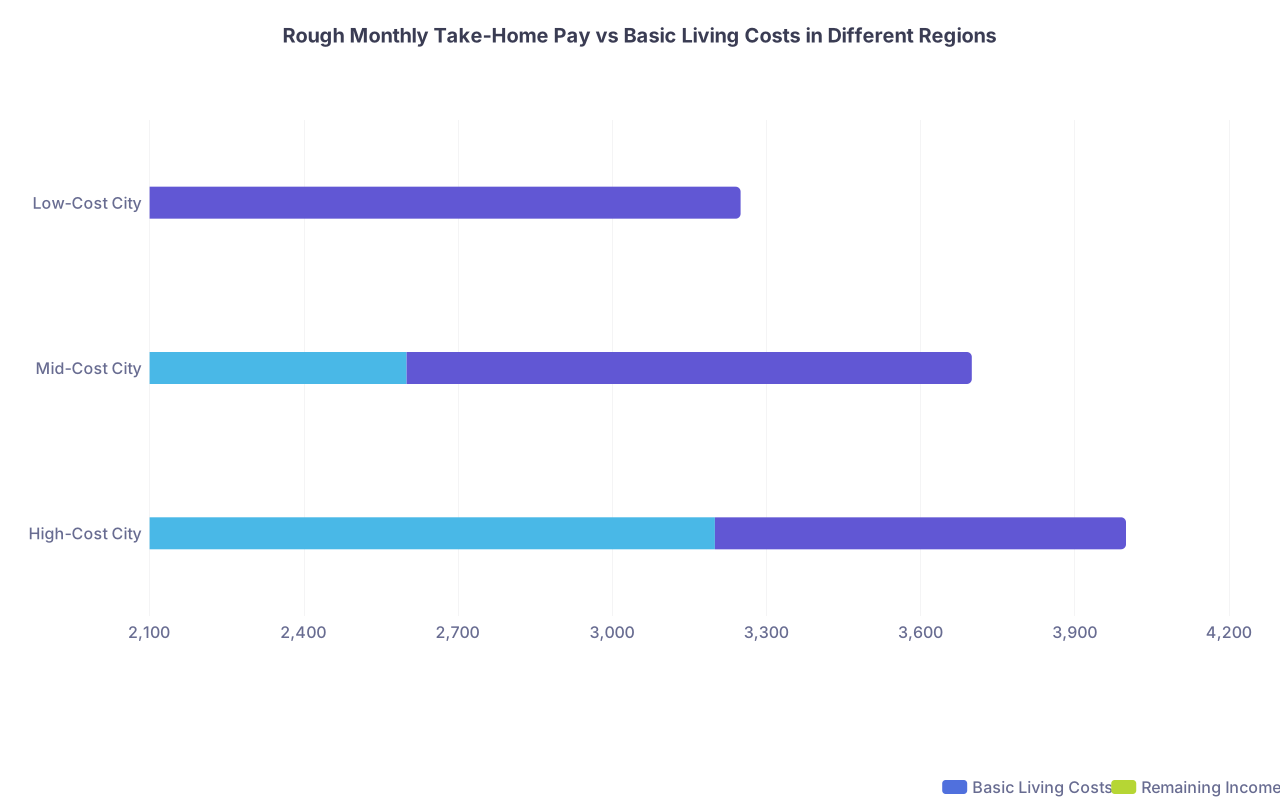
| Category | Basic Living Costs | Remaining Income |
|---|---|---|
| High-Cost City | 3200 | 800 |
| Mid-Cost City | 2600 | 1100 |
| Low-Cost City | 2100 | 1150 |

| Step | Description |
|---|---|
| Step 1 | Choose Program |
| Step 2 | Estimate Take Home Pay |
| Step 3 | Estimate Rent and Living Costs |
| Step 4 | High Financial Risk |
| Step 5 | Moderate Stress |
| Step 6 | More Comfortable |
| Step 7 | Rank Lower |
| Step 8 | Keep But Plan Carefully |
| Step 9 | Consider Roommates and Savings |
| Step 10 | Financially Safer Choice |
| Step 11 | Money Left After Essentials |
| Step 12 | Program Benefits Huge? |
FAQ (6 Questions)
1. How much “leftover” money per month should I aim for as a resident?
Personally, I start to get nervous if, after rent, utilities, basic food, transportation, minimum loan payment, and required fees, you’ve got less than $500/month. That’s where a single car repair or flight home blows everything up. Around $800–$1,200 leftover gives you some breathing room to handle life plus small savings. More is obviously better, but under $500 is “red alert” territory.
2. Is it dumb to rank a dream program lower just because of cost of living?
No. It’s actually rational. If the dream program doesn’t give you a truly unique career advantage, and it would put you in constant financial distress, ranking a more affordable but still solid program higher is a smart move. Prestige doesn’t pay your rent or your therapy bills when you’re burned out and broke.
3. Should I seriously consider forbearance to “just get through residency”?
Forbearance is almost always a bad idea long term because interest keeps growing and capitalizes. If you literally can’t make IDR payments, you’re not in a safe financial zone. I’d treat forbearance as an emergency-only, worst-case backup, not your default plan. If your whole financial survival plan in a city requires forbearance for 3+ years, that’s a huge red flag.
4. How many roommates is “normal” for residents in expensive cities?
In NYC, SF, Boston, etc., 2–3 roommates is common. Plenty of interns are in 3–4 bedroom shared apartments just to make it work. If most residents say they live 45+ minutes away with multiple roommates, that tells you how stretched everyone is. You don’t have to love that, but you should factor it in honestly.
5. What if my family is saying “go to the biggest name, money will sort itself out”?
They don’t have to live your life day-to-day. They’re not the ones checking their bank account at midnight. You can appreciate their support and still ignore their financial advice. It’s easy to say “just go for it” when you’re not the one facing a $3,000 rent and $250k in loans on a $65k salary.
6. How do I stop obsessing over money to the point it paralyzes my rank list decisions?
You won’t totally stop—that’s just how your brain works. But you can box it in. Run the numbers for each city/program once. Write down your “safe,” “stretch,” and “danger” categories. Then make your rank list using that as a guide and accept some imperfection. At some point, you have to say, “I did the math, I’m not ignoring reality, and now I’m making the least-bad choice I can.” That’s usually as good as it gets.
Key takeaways:
- Stop pretending money is a side issue; it can make or break your sanity in residency.
- Run real numbers—after-tax pay vs. realistic costs—by city and program, not just in your head.
- It’s not weak or cowardly to choose a financially safer program; it’s self-preservation, and your future self will thank you.